第4章イスラーム世界The Islamic World
4.2 The Ottoman Empire4.2 オスマン帝国
Learning Objectives学習の目標
By the end of this section, you will be able to:
この節を学ぶと、次のことができるようになる。
Analyze the significance of the reign of Suleiman the Magnificent, including the rise of the Sultanate of Women
「女人の統治」の台頭を含め、壮麗者スレイマンの治世の意義を分析する。
Describe the relationship between the Ottoman Empire and the nations of Europe in the sixteenth and seventeenth centuries
16〜17世紀のオスマン帝国とヨーロッパ諸国の関係を説明する。
Identify scientific and technological innovations of the Ottoman Empire
オスマン帝国の科学・技術上の革新を挙げる。
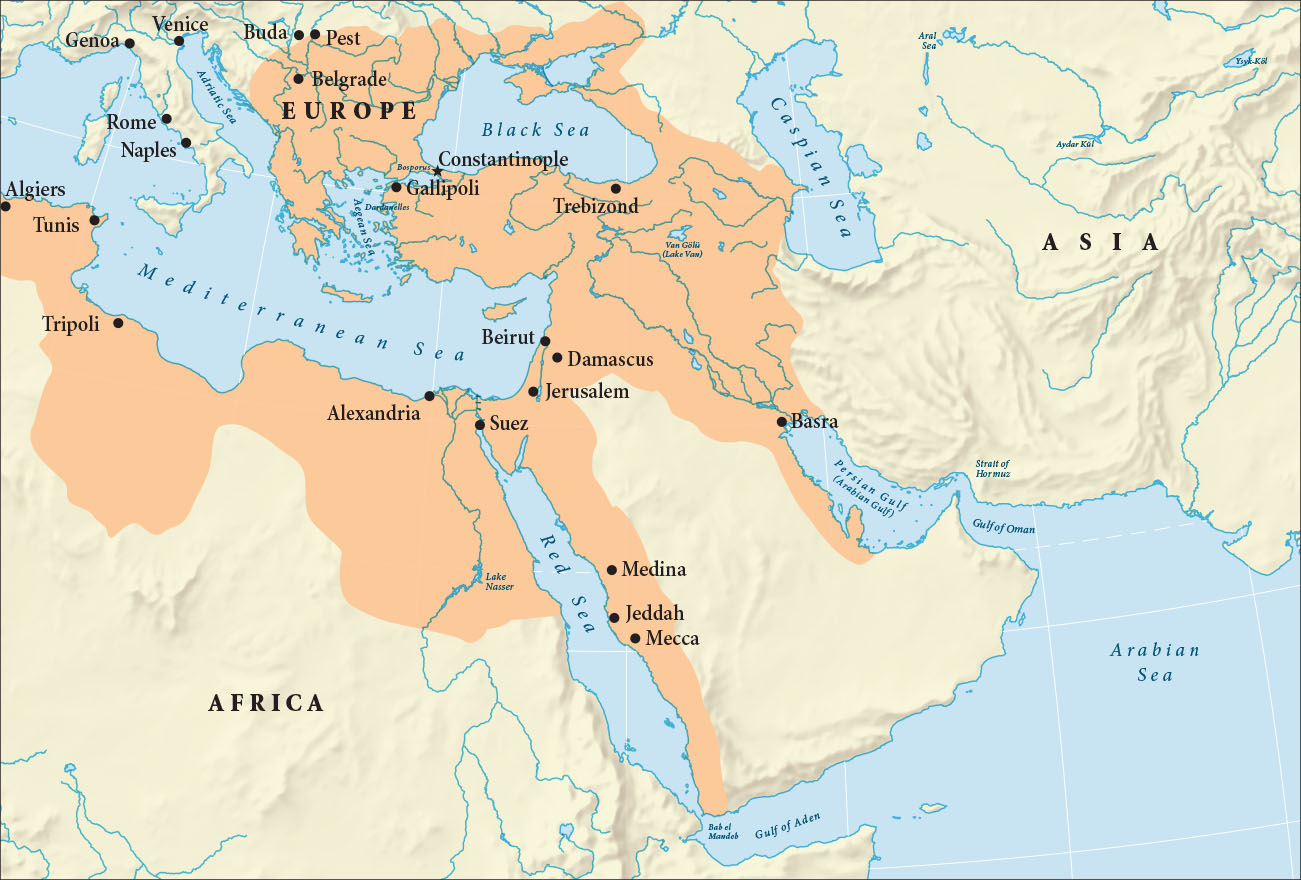
The Ottoman Empire was the foremost and longest-lived of the Islamic empires of the early modern world. It was formed by a small group of Turkic-speaking warriors assisted by Anatolian and Balkan Christian warlords and their followers at the end of the thirteenth century. For nearly seven hundred years, the Ottoman state lay at the crossroads of Europe, Asia, and Africa, ruling over a population diverse in ethnicity, language, and religion. In 1453, the Ottomans conquered Constantinople. A century later, the city, then called Istanbul, was one of the largest in the world, occupying a prize position on the Bosporus, the sea passage between the Black Sea and the Mediterranean, and facilitating trade between the Silk Roads and Europe. At its height under Sultan Suleiman I in the sixteenth century, the Ottoman military was the most technologically advanced in the Mediterranean world, threatening the gates of Vienna to the west, reaching the Persian Gulf to the east, and conquering Yemen and the Islamic holy cities of Mecca and Medina to the south (Figure 4.11). In the seventeenth century, as its enemies grew stronger, the empire became more inward-looking, focusing less on external expansion and more on resolving domestic affairs, professionalizing its bureaucracy, and conducting internal reforms.
英語のヒント
オスマン帝国は、近世世界のイスラーム帝国の中で最も重要で、最も長く存続した帝国だった。13世紀末、テュルク系言語を話す小規模な戦士集団が、アナトリアやバルカン半島のキリスト教徒の軍閥とその従者の助力を得て形成した。ほぼ700年にわたり、オスマン国家はヨーロッパ、アジア、アフリカの交差点に位置し、民族、言語、宗教の多様な住民を統治した。1453年、オスマン軍はコンスタンティノープルを征服した。その1世紀後、当時イスタンブルと呼ばれていたこの都市は、世界最大級の都市となっていた。黒海と地中海を結ぶ海上通路であるボスポラス海峡の好位置を占め、シルクロードとヨーロッパの間の交易を促進していたのである。16世紀、スルタン・スレイマン1世の下で最盛期を迎えたオスマン軍は、地中海世界で最も先進的な技術を備えていた。西ではウィーンの門を脅かし、東ではペルシア湾に達し、南ではイエメンとイスラームの聖地メッカ、メディナを征服した(図4.11)。17世紀、敵の力が増すにつれて、帝国は内向きになった。対外拡張よりも、内政問題の解決、官僚機構の専門化、国内改革に重点を置くようになった。
Area of Ottoman Control.オスマン帝国の支配地域。
(attribution: Copyright Rice University, OpenStax, under CC BY 4.0 license) · CC BY 4.0
Figure 4.11 At its height, the Ottoman Empire (orange) stretched from the Balkans to the Caspian Sea. It also laid claim to the coast of North Africa, Egypt, and portions of the Arabian Peninsula. (attribution: Copyright Rice University, OpenStax, under CC BY 4.0 license)
図4.11 最盛期のオスマン帝国(オレンジ)は、バルカン半島からカスピ海まで広がっていた。また北アフリカの海岸、エジプト、アラビア半島の一部にも領有を主張した。(出典表示:著作権ライス大学、OpenStax、CC BY 4.0ライセンス)
Culture and Society文化と社会
The Ottoman state originated in the fertile plains of Anatolia (also known as Asia Minor, roughly modern-day Turkey), which lies between the Aegean Sea to its west, the Black Sea to its north, the Mediterranean Sea to its south, and the Zagros Mountains to its east. The lands of Anatolia were attractive to the nomadic Turkic peoples who lived in the semifertile Eurasian steppe, a band of grassland that runs from east to west between western China and Hungary. As the Turkic peoples extended their control over northern Iran in the tenth and eleventh centuries, a group of Turkic warriors established their own state, ruled by the Seljuk dynasty.
英語のヒント
オスマン国家は、アナトリアの肥沃な平原で生まれた。アナトリアは小アジアとも呼ばれ、おおむね現在のトルコに当たり、西のエーゲ海、北の黒海、南の地中海、東のザグロス山脈の間に位置する。アナトリアの土地は、肥沃度のやや低いユーラシアのステップに暮らす遊牧民のテュルク系諸民族にとって魅力的だった。このステップは、中国西部とハンガリーの間を東西に走る帯状の草原である。10〜11世紀にテュルク系諸民族がイラン北部への支配を広げると、テュルク系戦士の一団が、セルジューク朝の統治する独自の国家を樹立した。
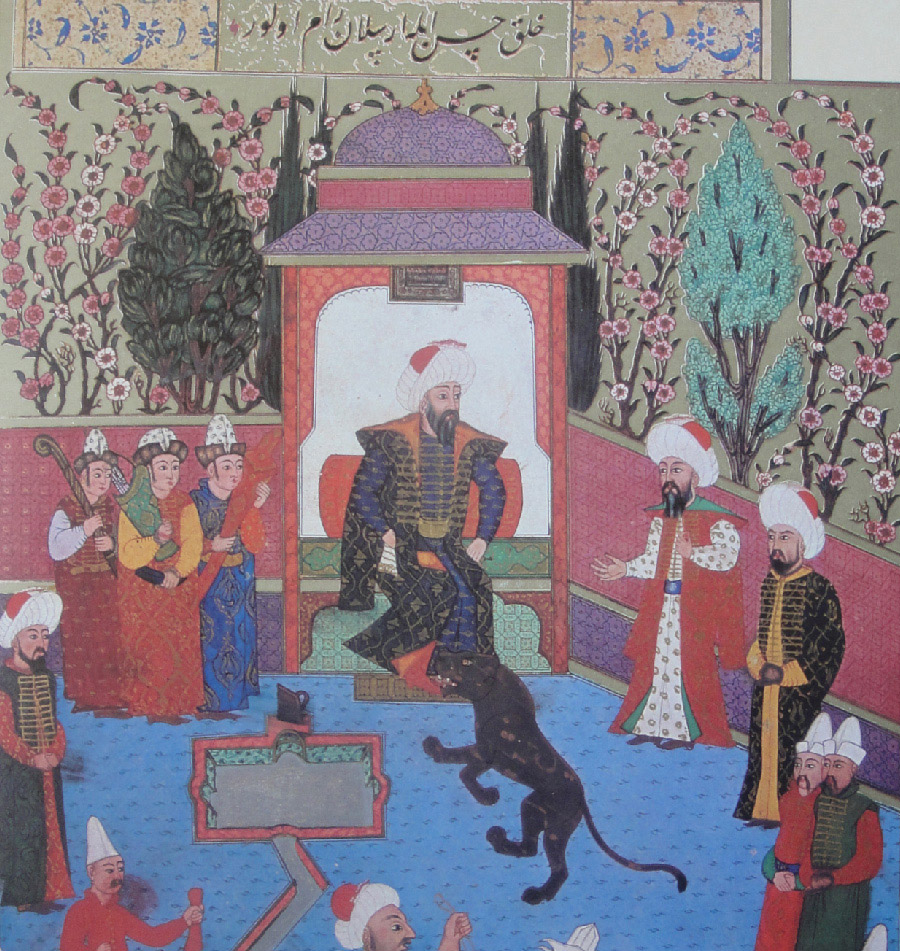
Over the next century and a half, this Seljuk state grew to control much of central and southern Anatolia. The Mongol invasions of the thirteenth century transformed the political landscape in Anatolia, however, and a number of small Turkic principalities emerged in the region in the wake of these disruptive invasions. The Turkic principality in the northeastern corner of Anatolia rose to prominence around 1300, under the leadership of Osman I (Figure 4.12). Osman raised an army and began to take territory from the neighboring Byzantines.
英語のヒント
続く1世紀半の間に、このセルジューク朝国家は成長し、アナトリア中部・南部の大部分を支配するようになった。しかし、13世紀のモンゴル軍の侵入はアナトリアの政治状況を一変させ、この破壊的な侵入の後に、いくつものテュルク系小侯国が地域に現れた。アナトリア北東隅のテュルク系侯国は、1300年ごろ、オスマン1世の指導下で有力になった(図4.12)。オスマンは軍隊を組織し、隣接するビザンツ帝国から領土を奪い始めた。
Osman I.オスマン1世。
(credit: modification of work “Osman Gazi (I)” by Seyid Lockman/Wikimedia Commons, Public Domain) · Public Domain
Figure 4.12 This detail of a miniature painted in 1584 shows Osman I seated (at center) amid courtiers and attendants. (credit: modification of work “Osman Gazi (I)” by Seyid Lockman/Wikimedia Commons, Public Domain)
図4.12 1584年に描かれた細密画のこの部分には、廷臣や従者に囲まれて中央に座るオスマン1世が描かれている。(クレジット:セイイド・ロクマン/Wikimedia Commons「オスマン・ガーズィ1世」を改変、パブリックドメイン)
Osman’s son Orhan continued the campaign upon his father’s death, expanding the territory under his control to encompass much of northwestern Anatolia. The state Orhan established became the Ottoman Empire, named for his father Osman. By the fourteenth century, the Ottoman Empire had expanded into southeastern Europe, effectively surrounding the Byzantine city of Constantinople. In 1453, Ottoman armies marched into the city and made it the capital of their expanding realm. Over the next century, successive rulers expanded the empire deeper into Europe, down through Syria and Palestine, and across North Africa.
英語のヒント
オスマンの息子オルハンは、父の死後も軍事行動を続け、アナトリア北西部の大部分を含むまで支配領域を広げた。オルハンが築いた国家は、父オスマンにちなみ、オスマン帝国となった。14世紀までにオスマン帝国はヨーロッパ南東部へ進出し、ビザンツ帝国の都市コンスタンティノープルを事実上取り囲んでいた。1453年、オスマン軍は市内に進軍し、そこを拡大し続ける国家の首都とした。続く1世紀に、歴代の支配者は帝国をさらにヨーロッパの奥へ、シリアとパレスチナを経て南へ、そして北アフリカ全体へと拡大した。
At the height of the Ottoman Empire in the sixteenth century, the Muslim-controlled state exerted dominance over a vast expanse of territory that included not only Muslims but also many dhimmis: Christians, Jewish people, and others. For example, the Ottoman-controlled areas of the Balkans in southeastern Europe were not only much more densely populated than Anatolia but were also overwhelmingly Christian. The Christian populations in southeastern Europe were some of the oldest in the Christian world and unlikely to convert to Islam in any large numbers. This reality led the Ottomans to implement a system under which dhimmis were able to govern their own affairs according to their own religious laws. This became known as the millet system, a term that comes from the Arabic word millah, meaning nation.
英語のヒント
16世紀の最盛期、ムスリムが統治するオスマン帝国は広大な領土を支配し、そこにはムスリムだけでなく、キリスト教徒、ユダヤ人など、多くのズィンミーも暮らしていた。例えば、ヨーロッパ南東部のバルカン半島でオスマン帝国が支配した地域は、アナトリアよりはるかに人口密度が高いだけでなく、圧倒的多数がキリスト教徒だった。ヨーロッパ南東部のキリスト教徒の共同体は、キリスト教世界で最も古いものの一部であり、大人数がイスラーム教に改宗する可能性は低かった。この現実から、オスマン帝国は、ズィンミーが自分たちの宗教法に従って自らの事柄を管理できる制度を実施した。これはミッレト制度として知られるようになった。ミッレトは「民族・国民」を意味するアラビア語のミッラに由来する。
Millets were organized around religious identity: Orthodox Christians comprised one millet under the Orthodox patriarch in Istanbul, Armenian Christians were a second, and Jewish people a third. Other groups, such as the Syriac-speaking Christians and the Coptic Christians of Egypt, were later given their own millets. Millets had their own courts to settle their affairs; a dhimmi would appear in a sharia court only if dealing with a Muslim in a legal or business matter, or with the state itself. The millet system was intended to give non-Muslims a degree of autonomy and the ability to conduct their affairs according to their own customs and norms.
英語のヒント
ミッレトは宗教的な帰属を中心に組織された。正教徒はイスタンブルの正教会総主教の下に一つのミッレトを形成し、アルメニア人キリスト教徒が二つ目、ユダヤ人が三つ目となった。シリア語を話すキリスト教徒や、エジプトのコプト教徒など、他の集団にも後に独自のミッレトが与えられた。ミッレトは内部の問題を解決する独自の裁判所を持っていた。ズィンミーがシャリーアの裁判所に出向くのは、法的・商業的な事柄でムスリムを相手にする場合、または国家そのものを相手にする場合だけだった。ミッレト制度は、非ムスリムに一定の自治権と、独自の慣習や規範に従って自分たちの事柄を処理する能力を与えることを目的としていた。
Among the most striking measures imposed on Christian communities in the Balkans and Caucasus was the devshirme (“gathering”), the enslavement of youth for state and military service. Conceived as a form of taxation on the Christian territories of Ottoman-controlled Europe, this system gathered boys between eight and ten years of age from specified villages, converted them to Islam, and gave them an education designed to create an elite military force in the service of the sultan. They were selected for both their physical attributes and their intelligence. The training was harsh and emphasized discipline, endurance, and loyalty to the sultan. Most became part of an elite corps of soldiers known as the Janissaries (from the Turkish words yeni cheri, meaning “new soldier”). Janissaries were expected to serve as bodyguards to the sultan, to whom they were fiercely loyal and who paid them directly.
英語のヒント
バルカン半島とコーカサスのキリスト教徒共同体に課された措置の中で、特に際立っていたのがデヴシルメ(「徴集」)であった。これは、国家や軍への奉仕のために若者を奴隷化する制度である。オスマン帝国が支配するヨーロッパのキリスト教地域に対する一種の徴税として考案され、指定された村から8〜10歳の少年を集め、イスラーム教に改宗させ、スルタンに奉仕する精鋭軍を育成するための教育を施した。少年は身体的な資質と知性の両方によって選ばれた。訓練は厳しく、規律、忍耐力、スルタンへの忠誠を重視した。大多数はイェニチェリとして知られる精鋭兵団に入った。この名は「新しい兵士」を意味するトルコ語のイェニ・チェリに由来する。イェニチェリはスルタンの親衛隊として仕えることを期待された。彼らはスルタンに強い忠誠を持ち、スルタンから直接俸給を受けた。
A small number of young men who demonstrated exceptional intellect were sent to the palace school to receive language and other training in preparation for becoming the empire’s trusted administrative elite. The idea was to create a self-perpetuating system of administrators and military leaders who had been raised by the Ottoman state, and whose loyalty was not to their families, whom (in theory) they never saw again, but to the sultan and the system of which they were a part. In this way, political infighting within the government could be avoided because personal identity, ethnicity, and religion were suppressed and nepotism eliminated. The devshirme system lasted until the late 1600s.
英語のヒント
並外れた知性を示した少数の若者は宮廷学校に送られ、帝国の信頼できる行政エリートになる準備として、語学などの訓練を受けた。狙いは、オスマン国家に育てられた行政官と軍事指導者を継続的に生み出す仕組みを作ることだった。彼らの忠誠は、理論上は二度と会わない家族ではなく、スルタンと自分たちが属する制度に向けられるはずだった。こうして個人の帰属意識、民族性、宗教が抑えられ、縁故主義が排除されるため、政府内部の政治的な内紛を避けられるとされた。デヴシルメ制度は1600年代後半まで続いた。
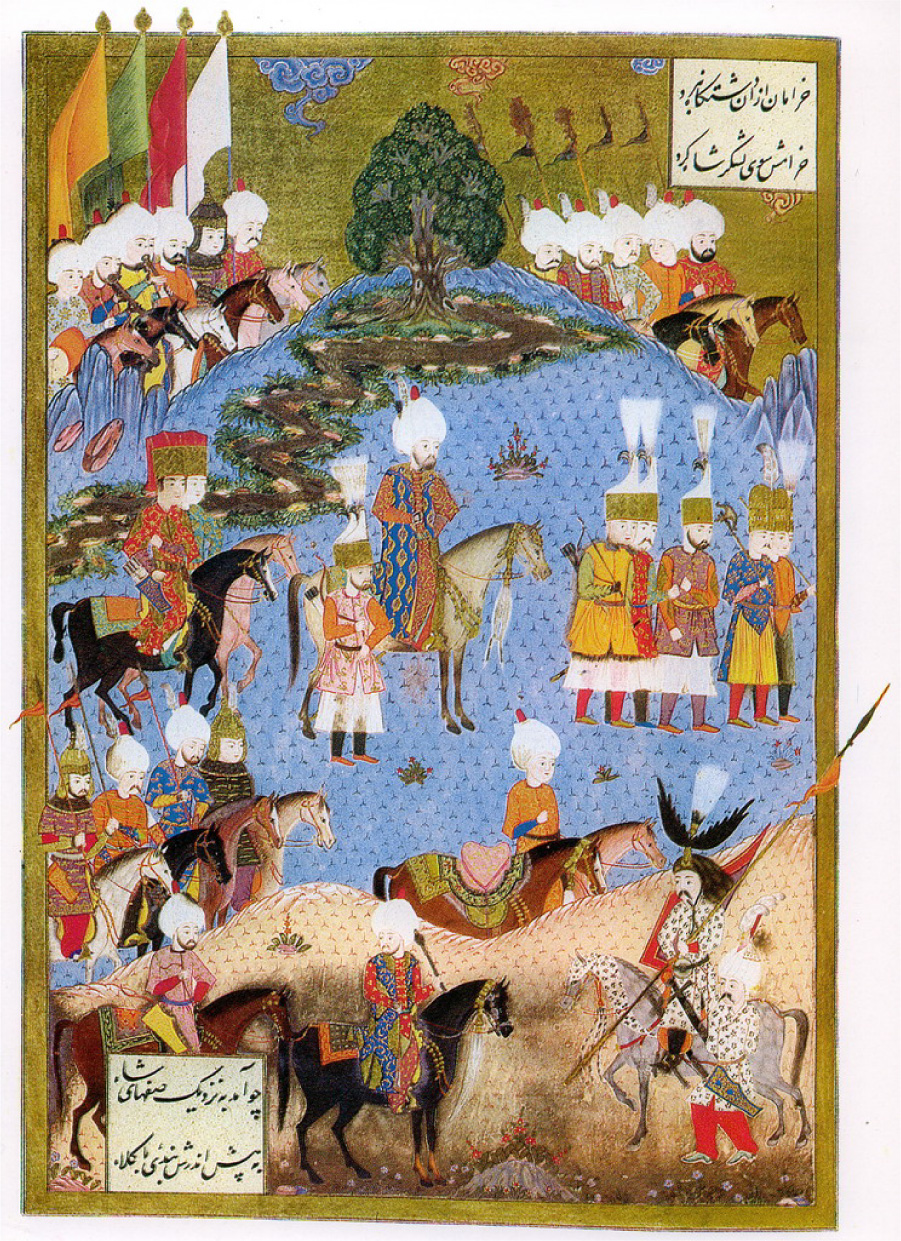
The Ottomans brought knowledge of horses, military organization, and statecraft to their early empire. They followed their Seljuk predecessors in holding Persian culture and style in high esteem. While Arabic was considered the language of learning and religion, Persian was often the language of poetry and literature, even in the otherwise Arabic-speaking court of the Abbasid caliphs. The Ottoman Empire is often described as Persianate, meaning its culture, including visual art and architecture, was heavily influenced by that of Persia, but it was not Persian itself (Figure 4.13). Turkish was the language of administration and education; it was written in an adapted version of the Perso-Arabic script, and it incorporated numerous loan words from both Persian and Arabic. A parallel tradition of high poetry in Turkish called divan poetry also developed, which used the rhyme schemes and poetic meters of Persian poetry. In the seventeenth century, during the long conflict between the Ottomans and the Safavids in Iran, Turkish replaced Persian as a literary language, to emphasize the Turkish nature of the Ottoman state and distinguish its culture from that of its rival.
英語のヒント
オスマン人は初期の帝国に、馬、軍の組織、統治術に関する知識をもたらした。彼らは先行するセルジューク朝にならい、ペルシアの文化と様式を高く評価した。アラビア語が学問と宗教の言語と考えられた一方、ペルシア語はしばしば詩と文学の言語であった。これは、それ以外ではアラビア語を話していたアッバース朝カリフの宮廷でも同様だった。オスマン帝国はしばしば「ペルシア文化圏に属する」と形容される。美術や建築を含むその文化が、ペルシア文化の強い影響を受けていたという意味であり、帝国そのものがペルシアだったわけではない(図4.13)。行政と教育の言語はトルコ語であった。トルコ語はペルシア・アラビア文字を改変した文字で書かれ、ペルシア語とアラビア語の双方から多数の借用語を取り込んだ。これと並行して、ディーヴァーン詩と呼ばれるトルコ語の高度な詩の伝統も発達し、ペルシア詩の押韻形式と韻律を用いた。17世紀、オスマン帝国とイランのサファヴィー朝の長い対立の中で、トルコ語が文学言語としてペルシア語に取って代わった。オスマン国家のトルコ的性格を強調し、自国の文化を競争相手の文化と区別するためであった。
The Suleymanname.『スレイマンの書』。
(credit: “Sueleymanname nahcevan” by Unknown/Wikimedia Commons, Public Domain) · Public Domain
Figure 4.13 Persian literary and artistic styles greatly influenced the Ottoman Empire in the sixteenth century. This illustration, made in the style of a Persian miniature, is part of the Suleymanname (The Book of Suleiman), created at the court of Suleiman the Magnificent in 1561. It includes verses written in Persian by the poet Fethullah Çelebi. (credit: “Sueleymanname nahcevan” by Unknown/Wikimedia Commons, Public Domain)
図4.13 ペルシアの文学と美術の様式は、16世紀のオスマン帝国に大きな影響を与えた。ペルシア細密画の様式で描かれたこの挿絵は、1561年に壮麗者スレイマンの宮廷で制作された『スレイマンナーメ』(『スレイマンの書』)の一部である。詩人フェトフッラー・チェレビがペルシア語で書いた詩句も含まれている。(クレジット:作者不明/Wikimedia Commons「スレイマンナーメ、ナヒチェヴァン」、パブリックドメイン)
Most people in the Ottoman Empire could not read or write. As in most of the early modern world, primary education was considered the domain of religious institutions, not the state, although schools were often endowed by members of the sultan’s family. Basic schools called mekteps taught young Muslims to recite the Quran, and each millet was allowed to coordinate education for its own children. Schools tended to provide education in the preferred local language, since Turkish was required only of those who interacted directly with the state. This is one of the main reasons that Turkish did not eventually replace local languages like Arabic, Bulgarian, Greek, and Serbo-Croatian-Bosnian, although in some places people who were not ethnically Turkish did speak only Turkish. Local languages like Bosnian also incorporated many loan words from Ottoman Turkish. Multilingualism was valued for trade and commerce and let European traders communicate easily with local agents and business partners. It also allowed new immigrant groups to retain their languages. For example, after Jewish people were expelled from Spain in 1492, many resettled in the Ottoman Empire, particularly in Izmir, Salonica, and Istanbul, where they continued to speak Judeo-Spanish (often called Ladino).
英語のヒント
オスマン帝国の人々の大多数は読み書きができなかった。近世世界の大半と同じく、初等教育は国家ではなく宗教施設の領域と考えられていたが、学校はスルタンの一族から寄進を受けることも多かった。メクテプと呼ばれる基礎学校は、ムスリムの子どもにクルアーンの朗誦を教え、各ミッレトには自分たちの子どもの教育を組織することが認められた。トルコ語が必要なのは国家と直接やりとりする人々だけだったため、学校は現地で好まれる言語で教える傾向にあった。これが、アラビア語、ブルガリア語、ギリシア語、セルビア・クロアチア・ボスニア語などの現地語が、最終的にもトルコ語に置き換わらなかったおもな理由の一つである。ただし、民族的にはトルコ人でない人々が、トルコ語だけを話す地域もあった。ボスニア語などの現地語は、オスマン・トルコ語から多くの借用語も取り込んだ。多言語能力は交易・商業で重視され、ヨーロッパの商人は現地の代理人や取引相手と容易に意思疎通できた。また、新たに移住してきた集団も自分たちの言語を維持できた。例えば、1492年にスペインから追放されたユダヤ人の多くは、オスマン帝国、特にイズミル、サロニカ、イスタンブルに移り住み、ユダヤ・スペイン語(しばしばラディーノ語と呼ばれる)を話し続けた。
Education past the basic primary level was generally accessible mainly to the wealthy. Some boys from average and poor families managed to attend local schools, but most people needed their children to help with agricultural work or assist in their father’s business. Boys from elite families went to private schools, and girls from similar families were educated at home by a private tutor. This was also the case among the millets. Millets provided schools for members of their community; a private school for Greek Christians opened in Istanbul in 1454, for example. The further education of exceptionally bright children from the lower classes might be sponsored by a wealthy local patron or landowner, often with the condition that the children go to work for the patron’s business after finishing school.
英語のヒント
基礎的な初等教育より先の教育を受けられるのは、一般におもに富裕層であった。中程度の暮らしや貧しい家庭の少年の中にも、何とか地元の学校に通う者がいたが、大半の人々は、子どもが農作業や父親の商売を手伝うことを必要とした。エリート家庭の少年は私立学校へ通い、同じような家庭の少女は家庭教師から自宅で教育を受けた。ミッレトでも同様であった。ミッレトは共同体の成員に学校を提供し、例えば1454年には、イスタンブルでギリシア人キリスト教徒のための私立学校が開校した。下層の特に優秀な子どもの進学を、地元の裕福な支援者や地主が援助する場合もあった。多くの場合、それには学校を終えた後、その支援者の事業で働くという条件が付いた。
Following the construction of a lavish palace complex in Istanbul in the early 1460s, important changes took place in the royal court and the Ottoman style of government. Over the next century, successive Ottoman sultans ruled less frequently from constantly moving military encampments—as had been their practice—and took up longer periods of residence at the new palace, later given the name Topkapi. One result of this change to a more stable home was the reentry of women into the public and political life of the Ottoman court, which had once been more usual in the Seljuk state.
英語のヒント
1460年代初めにイスタンブルで豪華な宮殿群が建設されると、宮廷とオスマン帝国の統治様式に重要な変化が起こった。続く1世紀に、歴代のスルタンは、従来の慣行であった、常に移動する軍の野営地からの統治を減らしていった。そして、後にトプカプと名付けられる新宮殿に、より長く滞在するようになった。住まいがより安定したことによる一つの結果は、女性がオスマン宮廷の公的・政治的生活に再び加わるようになったことである。セルジューク朝の国家では、かつてそれはより普通のことだった。
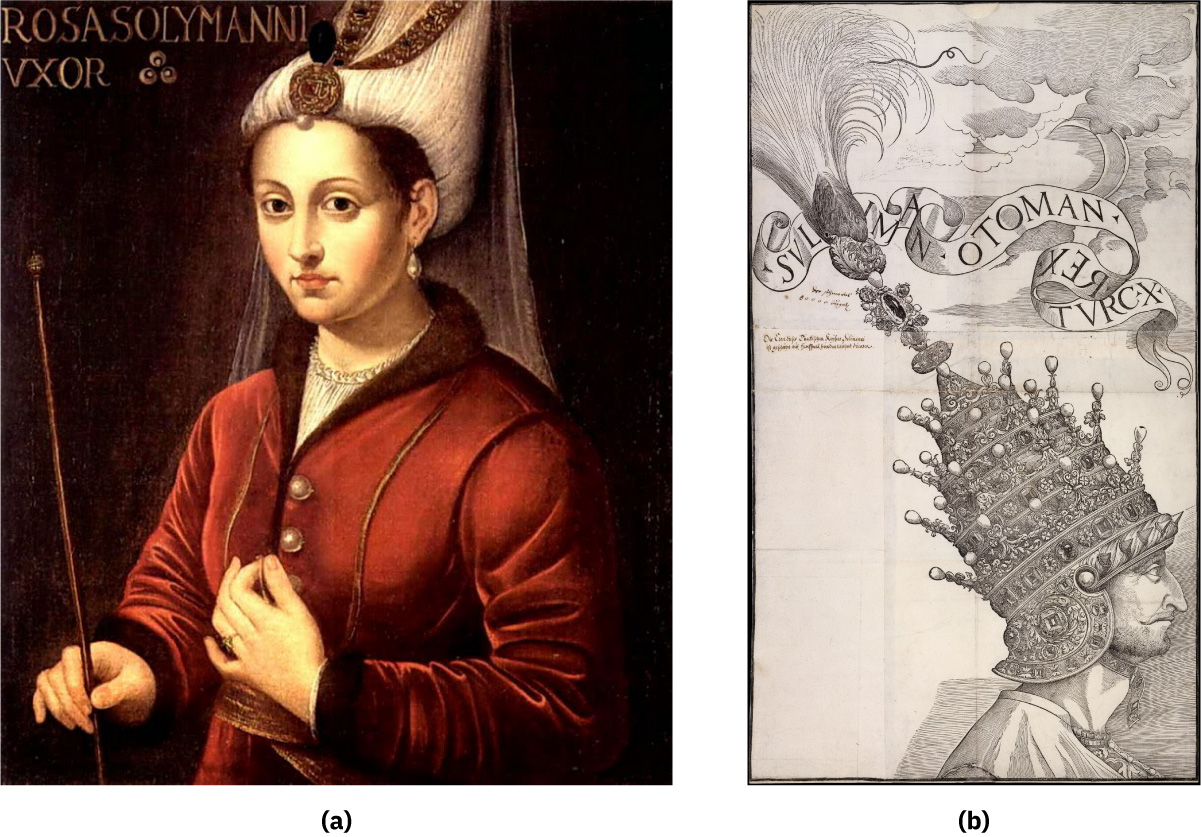
After Sultan Bayezid I’s wife had been captured and held hostage by the Mongol conqueror Timur in the 1400s, it became the practice for sultans not to marry but to simply take concubines, women who did not have the same legal status as an official wife and whose chief purpose was to bear children for the sultan. Suleiman I defied this tradition to marry Hurrem, a young woman from Ruthenia (now western Ukraine) who had been captured and enslaved by Crimean Tatars. While a captive, Hurrem was eventually taken to Istanbul and purchased by Suleiman’s mother as a gift for her son. As Hurrem Sultan, she became one of the most important and influential women in Ottoman history, setting a precedent for the powerful wives and chief concubines who followed her in what became known as the Sultanate of Women (Figure 4.14).
英語のヒント
1400年代にスルタン・バヤジト1世の妻がモンゴルの征服者ティムールに捕らえられ、人質とされた後、スルタンは結婚せず、側室だけを置くことが慣行となった。側室は正式な妻と同じ法的地位を持たず、おもな役割はスルタンの子を産むことであった。スレイマン1世はこの伝統に背き、ヒュッレムと結婚した。彼女はルテニア、現在のウクライナ西部の出身で、クリミア・タタール人に捕らえられ奴隷化された若い女性だった。捕囚の身のヒュッレムはやがてイスタンブルへ連れてこられ、スレイマンの母が息子への贈り物として購入した。ヒュッレム・スルタンとなった彼女は、オスマン史上最も重要で影響力のある女性の一人になり、「女人の統治」と呼ばれる時代に彼女の後に続いた、有力な正妻や首席側室たちの先例を作った(図4.14)。
Hurrem Sultan.ヒュッレム・スルタン。
(credit a: modification of work “Portrait of Roxelana, Khourrem” by Jak Amran Collection, Istanbul/Wikimedia Commons, Public Domain; credit b: modification of work “Sultan Suleyman the Magnificent Wearing the Jewel-Studded Helmet” by Harris Brisbane Dick Fund, 1942/The Metropolitan Museum of Art, Public Domain) · Public Domain
Figure 4.14 This sixteenth-century oil painting of Hurrem Sultan (a), who was known as Roxelana in Europe, identifies her with the Latin words for “Suleiman’s wife.” In this mid-sixteenth-century woodcut (b), Sultan Suleiman wears a four-tiered helmet encrusted with diamonds and pearls. The design was modeled on the three-tiered tiara of the pope. (credit a: modification of work “Portrait of Roxelana, Khourrem” by Jak Amran Collection, Istanbul/Wikimedia Commons, Public Domain; credit b: modification of work “Sultan Suleyman the Magnificent Wearing the Jewel-Studded Helmet” by Harris Brisbane Dick Fund, 1942/The Metropolitan Museum of Art, Public Domain)
図4.14 ヨーロッパではロクセラーナと呼ばれたヒュッレム・スルタンの16世紀の油彩肖像画(a)には、ラテン語で「スレイマンの妻」と記されている。16世紀半ばの木版画(b)では、スルタン・スレイマンがダイヤモンドと真珠をちりばめた四段の兜を着けている。その意匠は、教皇の三重冠を手本にした。(a:イスタンブルのジャック・アムラン・コレクション/Wikimedia Commons「ロクセラーナ、ヒュッレムの肖像」を改変、パブリックドメイン。b:ハリス・ブリスベン・ディック基金、1942年/メトロポリタン美術館「宝石をちりばめた兜をかぶる壮麗者スルタン・スレイマン」を改変、パブリックドメイン)
The wife or mother of the reigning sultan had unequaled power over the imperial family and frequently gained popularity by funding public monuments and buildings for use by the public, including soup kitchens, bath houses, fountains, and schools. Many of these were vaqfs, charitable endowments intended to help the poor or to serve religious purposes. Wealthy women (and men as well) often donated land or buildings along with funds to assist the public.
英語のヒント
在位中のスルタンの妻や母は、皇族に対して並ぶもののない権力を持っていた。また、炊き出し所、浴場、噴水、学校など、一般の人々のための公共記念施設や建物に資金を提供することで、しばしば人気を得た。これらの多くは、貧しい人々を援助したり、宗教的な目的に奉仕したりするための慈善寄進財産、ワクフであった。裕福な女性たち、そして男性たちも、人々を助けるため、資金とともに土地や建物を寄付することが多かった。
Outsiders who sought favor often wrote letters to or sent female relatives to plead their case with the sultan’s wife or mother. She in turn might transform her popular influence into political power by conspiring with palace administrators like the palace’s chief eunuch, becoming one of the most powerful people in the empire. The chief wife and the sultan’s mother were often rivals for political prominence; clashes could occur between them and also with the sultan’s chief (male) advisers at court. The Sultanate of Women lasted more than a century, ending in the late seventeenth century when a number of sultans died unexpectedly in a short period. The result was instability in the palace and a weakening of the interpersonal relationships between the imperial family and outside advisers upon whom the Sultanate of Women had relied.
英語のヒント
恩恵を求める宮廷外の人々は、スルタンの妻や母に書簡を送ったり、女性の親族を送り込んで事情を訴えさせたりすることが多かった。妻や母はその民衆への影響力を、宦官長のような宮廷の管理者と結託することで政治権力へ変え、帝国で最も強力な人物の一人になることもあった。正妻とスルタンの母は、政治的な優位をめぐって競争相手になることが多かった。両者の間だけでなく、スルタンに仕える宮廷の男性首席顧問たちとの間にも衝突が起こりえた。「女人の統治」は1世紀以上続き、短期間に複数のスルタンが予期せず死去した17世紀末に終わった。その結果、宮廷は不安定になり、皇族と、「女人の統治」が頼っていた外部の顧問たちとの人的な関係が弱まった。