第4章イスラーム世界The Islamic World
Other than the sultan’s mother or wife, women in the Ottoman Empire played no role in politics. They were active in other areas of life, however. Unlike European women before the nineteenth century, married and unmarried Ottoman women could buy, inherit, and own property and bequeath their wealth to others upon their death. They could borrow and lend money and sue to protect their rights in court. Marriages were usually arranged by parents, but at least in theory, women had to consent to the match and could later obtain a divorce. Elite and middle-class women’s time was occupied in raising their children and supervising their households. If they lived in towns or cities, they socialized with other women, often meeting them at bathhouses. On their rare ventures out in public, they wore veils as a sign of their status.
英語のヒント
スルタンの母や妻を除き、オスマン帝国の女性は政治的な役割を担わなかった。しかし、生活の他の領域では活動していた。19世紀以前のヨーロッパの女性と異なり、オスマン帝国の女性は、既婚・未婚を問わず、財産を購入、相続、所有し、死後に他者へ遺贈することができた。金銭の借り入れや貸し付けもでき、法廷で権利を守るために訴えることもできた。結婚はたいてい親が取り決めたが、少なくとも理論上は、女性本人がその縁組に同意する必要があり、後に離婚することもできた。エリート層と中間層の女性は、子育てや家の管理に時間を費やした。町や都市に住んでいる場合には、他の女性と交流し、しばしば浴場で会った。まれに公の場へ出かけるときには、身分のしるしとしてヴェールを着用した。
Women from the working class might manufacture goods in their homes and peddle them in the streets. Although they could invest in businesses, they were largely excluded from the official guild system, which admitted only male artisans. There were a number of female-dominated trades, however, such as nursing and dancing, and women often made a living doing laundry. They also belonged to the various Sufi orders. Of course, the lives of both Muslim and non-Muslim women differed depending on where in the Ottoman Empire they lived. The lives of peasant women were different from those of city dwellers, and besides caring for the home and children, they might assist their male relatives with chores on the farm.
英語のヒント
労働者層の女性は、自宅で品物を製造し、街頭で売り歩くことがあった。事業への投資はできたが、男性職人しか加入を認めない公認のギルド制度からは、おおむね排除されていた。しかし看護や舞踊など、女性が中心を占める職業もいくつかあり、洗濯で生計を立てる女性も多かった。女性はさまざまなスーフィー教団にも属していた。当然ながら、ムスリム・非ムスリムのどちらの女性も、オスマン帝国のどこに暮らすかによって生活が異なった。農民の女性の暮らしは都市住民とは異なり、家と子どもの世話に加え、農場の雑事で男性親族を助けることもあった。
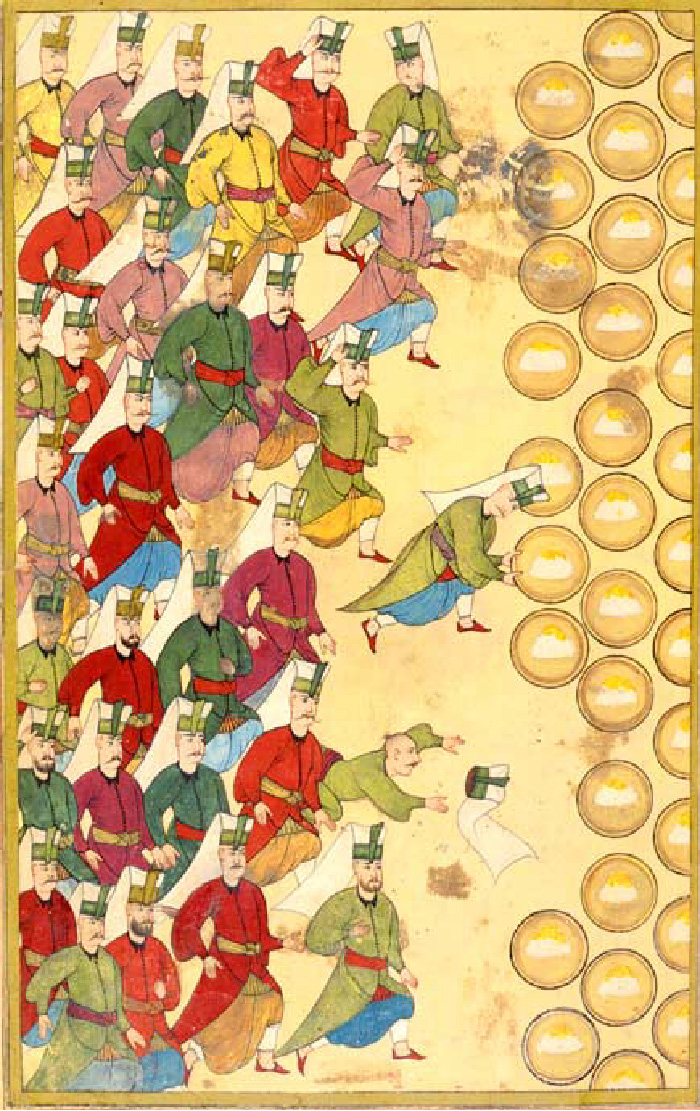
The synthesis of the Ottoman Empire’s diverse cultural base is perhaps most evident in its cuisine, which incorporated cooking styles and ingredients from places all over the world including Greece, Iran, the Balkans, the Arabian Peninsula, and central Asia. Following the discovery of the Americas, Ottoman cooks were among the first to incorporate ingredients from there, such as maize, peppers, tomatoes, and pumpkins, into their dishes. The Ottomans also likely introduced foods from elsewhere in Asia, like sesame, into the kitchens of the Middle East. Many dishes, such as rice pilafs from Egypt, Iran, and central Asia and Indian tandoori casseroles, were elegantly re-created for the imperial court in the kitchens of Topkapi Palace and then adopted in less extravagant versions by people throughout the empire. Food was an important symbol of power and generosity, and Topkapi could host up to four thousand people for a banquet. Each year, the sultan provided a lavish feast for the Janissary corps, the Ottoman Empire’s most elite troops. At one point in the eighteenth century, ten thousand troops were fed at once (Figure 4.15).
英語のヒント
オスマン帝国の多様な文化的基盤の融合が、おそらく最も明瞭に見えるのは料理である。ギリシア、イラン、バルカン半島、アラビア半島、中央アジアを含む世界各地の調理法と食材を取り込んでいた。アメリカ大陸の発見後、オスマンの料理人は、トウモロコシ、トウガラシ、トマト、カボチャといった新大陸の食材を料理に取り入れた最初期の人々の一部であった。また、ゴマなどアジアの他地域の食材を中東の台所に伝えたのも、オスマン人だった可能性が高い。エジプト、イラン、中央アジアの米のピラフや、インドのタンドールの鍋料理など、多くの料理が、トプカプ宮殿の厨房で宮廷向けに洗練された形で作り直された。その後、帝国各地の人々が、より控えめな形でそれを取り入れた。食は権力と寛大さを示す重要な象徴であり、トプカプでは最大4000人の宴を開くことができた。スルタンは毎年、帝国で最も精鋭の部隊であるイェニチェリ軍団に豪華な宴を提供した。18世紀には一度に1万人の兵士に食事を出したこともある(図4.15)。
The Janissaries’ Banquet.イェニチェリの宴。
(credit: “Banquet (Safranpilav) for the Janissaries, given by the Sultan” by Badisches Landesmuseum/Wikimedia Commons, Public Domain) · Public Domain
Figure 4.15 A miniature painting from 1720 by the artist Abdulcelil Levni contained in Surname-i Vehbi (The Book of Festival) depicts the Janissaries rushing toward their plates at a banquet given by the sultan. (credit: “Banquet (Safranpilav) for the Janissaries, given by the Sultan” by Badisches Landesmuseum/Wikimedia Commons, Public Domain)
図4.15 アブデュルジェリル・レヴニーが1720年に描き、『スールナーメ・イ・ヴェフビー』(『祝祭の書』)に収められた細密画。スルタンが催した宴で、イェニチェリが皿に向かって駆け寄る様子を描く。(クレジット:バーデン州立博物館/Wikimedia Commons「スルタンがイェニチェリに振る舞う宴〔サフラン・ピラフ〕」、パブリックドメイン)
The birth of an heir, a royal wedding, and the funeral of the sultan (or his wife or mother) were all occasions upon which the palace was expected to hold public banquets. Soup kitchens fed thousands of people each day in major cities throughout the empire, as did the caravansaries. At the same time, public refusal to partake of the sultan’s food also conveyed a powerful message. When upset with imperial policies, the Janissaries symbolically turned their metal soup bowls upside down and beat them like drums. The sound reverberated around the capital, signaling their displeasure for all to hear.
英語のヒント
後継者の誕生、王族の婚礼、スルタンやその妻・母の葬儀は、いずれも宮殿が公の宴を開くことを期待される機会だった。帝国各地の主要都市では、炊き出し所が毎日何千人にも食事を与え、隊商宿も同様の役割を果たした。同時に、スルタンの食事を公然と拒むことも、強い意思表示となった。帝国の政策に不満を抱いたイェニチェリは、象徴的な行為として金属製のスープ椀を逆さにし、太鼓のようにたたいた。その音は首都じゅうに響き渡り、誰の耳にも届くように彼らの不満を伝えた。
Coffee drinking occupied a position in Ottoman life that was on par with—indeed, perhaps more important than—feasting, and the Ottomans first introduced it to Europe. The practice began in Arabia and spread to other places in the Islamic world. The first coffeehouses were established in the Ottoman Empire in the sixteenth century during the reign of Suleiman the Magnificent, where they provided spaces for men to socialize, do business, and exchange news. Men of all social classes frequented coffeehouses, and men of little education could listen to literate men reading aloud from books, hear poets recite their newest works, and watch scholars engage in debates. Political discussions were common, and the Ottoman government often sent spies to listen for signs of dissent or potential rebellion. Talk of politics was especially frequent at coffeehouses favored by Janissaries. While many Muslim clerics had no objection to coffee because it was not forbidden by sharia, some clerics disapproved of it because of its stimulating qualities, and unsuccessful attempts to ban it were made in the sixteenth century. In the seventeenth century, Sultan Murad IV, fearful that rebellion might be plotted in coffeehouses, banned them, and citizens who persisted in drinking coffee risked being sentenced to death.
英語のヒント
コーヒーを飲む習慣は、オスマン社会で宴と同等、実際にはそれ以上に重要だったかもしれない地位を占め、ヨーロッパへ最初にそれを伝えたのもオスマン人であった。この習慣はアラビアで始まり、イスラーム世界の他の地域へ広まった。オスマン帝国では、壮麗者スレイマンの治世の16世紀に最初のコーヒーハウスが開かれ、男性が交流し、商売をし、ニュースを交換する場となった。あらゆる社会階層の男性が通い、十分な教育を受けていない男性も、読み書きのできる人が本を朗読するのを聞き、詩人が新作を朗誦するのを聞き、学者の討論を見ることができた。政治談議も盛んで、オスマン政府はしばしば密偵を送り、異議や反乱の兆候を探らせた。イェニチェリが好む店では、特に政治の話が多かった。シャリーアで禁じられていないことから、多くのムスリムの宗教家はコーヒーに異議を唱えなかったが、刺激作用を理由に認めない宗教家もいた。16世紀には禁止の試みがなされたが、成功しなかった。17世紀にはスルタン・ムラト4世が、コーヒーハウスで反乱が計画されることを恐れて営業を禁じた。それでもコーヒーを飲み続ける市民は、死刑を宣告される危険を冒した。
Many Muslim clerics and scholars also objected to the smoking of tobacco, which had been introduced from the Americas in the sixteenth century and become popular in the Ottoman Empire by the seventeenth century. They saw tobacco as an intoxicant that affected people in the way wine or coffee did, and also as bad for health. Some denounced it as a foreign practice introduced by European Christians for the purpose of harming Muslims. Tobacco was also damned by its association with the coffeehouse, where much smoking took place, and when Murad IV closed the coffeehouses, he also outlawed tobacco smoking with the death penalty for violators.
英語のヒント
多くのムスリムの宗教家や学者は、タバコの喫煙にも反対した。タバコは16世紀にアメリカ大陸から伝わり、17世紀までにオスマン帝国で人気を得ていた。彼らはタバコを、ワインやコーヒーと同じように人に作用する酩酊物質であり、健康にも悪いものと考えた。ヨーロッパのキリスト教徒がムスリムを害するために持ち込んだ外国の習慣だと非難する者もいた。また、喫煙が盛んなコーヒーハウスと結びついていたことでも、タバコは糾弾された。ムラト4世はコーヒーハウスを閉鎖した際、喫煙も違法とし、違反者には死刑を科した。