第4章イスラーム世界The Islamic World
Science and Technology科学と技術
As the Ottoman state grew in prestige and size, its sultans deliberately set out to become patrons of science and learning, following the examples set by the Umayyad and Abbasid caliphs and other prominent Muslim leaders. The core of all education was religious; there was no separation between what today would be considered religious philosophy or doctrinal study and the “hard sciences” such as astronomy, chemistry, mathematics, and physics. On the contrary, scientific investigation was considered an act of devotion because of its exploration and discovery of the intricacies of the divinely created universe.
英語のヒント
オスマン国家の威信と規模が増すにつれ、スルタンたちは、ウマイヤ朝やアッバース朝のカリフ、その他の有力なムスリム指導者を手本に、意識的に科学と学問の保護者となることを目指した。すべての教育の中核は宗教的だった。今日なら宗教哲学や教義研究と考えられるものと、天文学、化学、数学、物理学などの「厳密科学」の間に区別はなかった。それどころか、科学的探究は、神が創造した宇宙の精妙な仕組みを調べ、発見するものであるため、信仰の実践と考えられていた。
From the very beginning of the state, institutions of higher learning—madrasas—were established in major cities. Patronage of science, art, and culture reached a new level under Sultan Mehmed II. Mehmed founded the first institution of higher learning in the new capital, the Fatih complex, which included a hospital, public kitchens, a library, and schools. The Fatih hospital remained operational into the nineteenth century.
英語のヒント
国家の最初期から、主要都市にはマドラサという高等教育機関が設立された。科学、美術、文化への支援は、スルタン・メフメト2世の下で新たな水準に達した。メフメトは新首都で最初の高等教育施設であるファティフ複合施設を創設した。そこには病院、公共の炊き出し所、図書館、学校が含まれていた。ファティフの病院は、19世紀まで機能し続けた。
As Istanbul developed as the imperial capital, many other such institutions came to be established there. Another complex of charitable institutions, the first one designed and built in Istanbul by Mimar Sinan, the master architect and engineer of Armenian origin, was a teaching hospital endowed by Hurrem Sultan, the wife of Sultan Suleiman. It was also common for wealthy Jewish and Christian patrons to establish their own vaqfs to fund projects that benefited their communities, because these trusts were exempt from inheritance taxes. Teaching hospitals were considered important recipients of vaqf funds given that hospital care was provided free of charge.
英語のヒント
帝都としてイスタンブルが発展するにつれ、このような施設が他にも数多く設けられた。アルメニア系の名建築家・技術者ミマール・スィナンがイスタンブルで初めて設計・建設した慈善施設群もその一つで、スルタン・スレイマンの妻ヒュッレム・スルタンの寄進による教育病院であった。裕福なユダヤ人やキリスト教徒の支援者も、それぞれの共同体に役立つ事業の資金を賄うために、独自のワクフを設立することが一般的だった。こうした信託財産は相続税を免除されたからである。病院の診療は無料で提供されたため、教育病院はワクフ資金の重要な受領先と考えられた。
The geographic diversity of the empire was an advantage to the development of medical science because it was now possible to compare the results of medical treatments and experiments in several different geographic and climate zones. For this reason, many important medical treatises of the day were written in the Ottoman Empire. The tradition of medical writing built upon the foundation established by such famous Muslim scholars and physicians as Ibn Sina, who composed The Canon of Medicine in the tenth century. The works produced by physicians who made their home in the Ottoman Empire included one of the first treatises dedicated to dentistry, written by the Spanish Jewish scholar Musa bin Hamun, who made his home in the Ottoman Empire after the Jewish people were expelled from Spain.
英語のヒント
帝国の地理的多様性は医学の発展に有利だった。複数の異なる地理・気候帯で、治療や実験の結果を比較できたからである。そのため、この時代の多くの重要な医学論書が、オスマン帝国で書かれた。医学著述の伝統は、10世紀に『医学典範』を著したイブン・スィーナーなど、著名なムスリムの学者・医師が築いた基盤の上に成り立っていた。オスマン帝国に定住した医師が著した作品には、歯科に特化した最初期の論書の一つも含まれる。著者は、ユダヤ人がスペインから追放された後に帝国に居を定めた、スペインのユダヤ人学者ムーサー・ビン・ハームーンであった。
Among the great scientists of the Ottoman Empire was Taqi al-Din, who was invited by Sultan Murad III to build an observatory in Istanbul (Figure 4.18). Taqi al-Din’s method of calculating the coordinates of stars is said to have been better than those of Tycho Brahe and Nicolas Copernicus, noted astronomers working in northern Europe around the same time. Taqi al-Din also developed steam turbines and mechanical clocks and conducted research into the optical refraction of light. His work illustrates the way scientific discoveries transcended religious and national divisions; he himself had set out to improve on astronomical techniques devised by Ulugh Beg at Samarkand (in today’s Uzbekistan), and in turn his own research was consulted by Tycho Brahe in Denmark when Brahe was developing his ideas about astronomy. Taqi al-Din’s works were also collected by the Dutch mathematician Jacob Golius, who brought them to the library of Leiden University in the Netherlands in the seventeenth century.
英語のヒント
オスマン帝国の偉大な科学者の一人がタキー・アッディーンで、スルタン・ムラト3世に招かれ、イスタンブルに天文台を建設した(図4.18)。星の座標を計算する彼の方法は、ほぼ同時期に北ヨーロッパで活動した著名な天文学者ティコ・ブラーエやニコラウス・コペルニクスの方法よりも優れていたといわれる。タキー・アッディーンは蒸気タービンや機械式時計も開発し、光の屈折を研究した。その業績は、科学的発見が宗教や国家の境界を越えるあり方を示している。彼自身、サマルカンド、現在のウズベキスタンでウルグ・ベクが考案した天文学の技法を改良しようと取り組んだ。そして今度は、デンマークのティコ・ブラーエが天文学上の考えを発展させる際、彼の研究を参照した。タキー・アッディーンの著作は、オランダの数学者ヤコブス・ゴリウスによっても収集され、17世紀にオランダのライデン大学図書館へ運ばれた。
The Scientific Work of Taqi al-Din.タキー・アッディーンの科学研究。
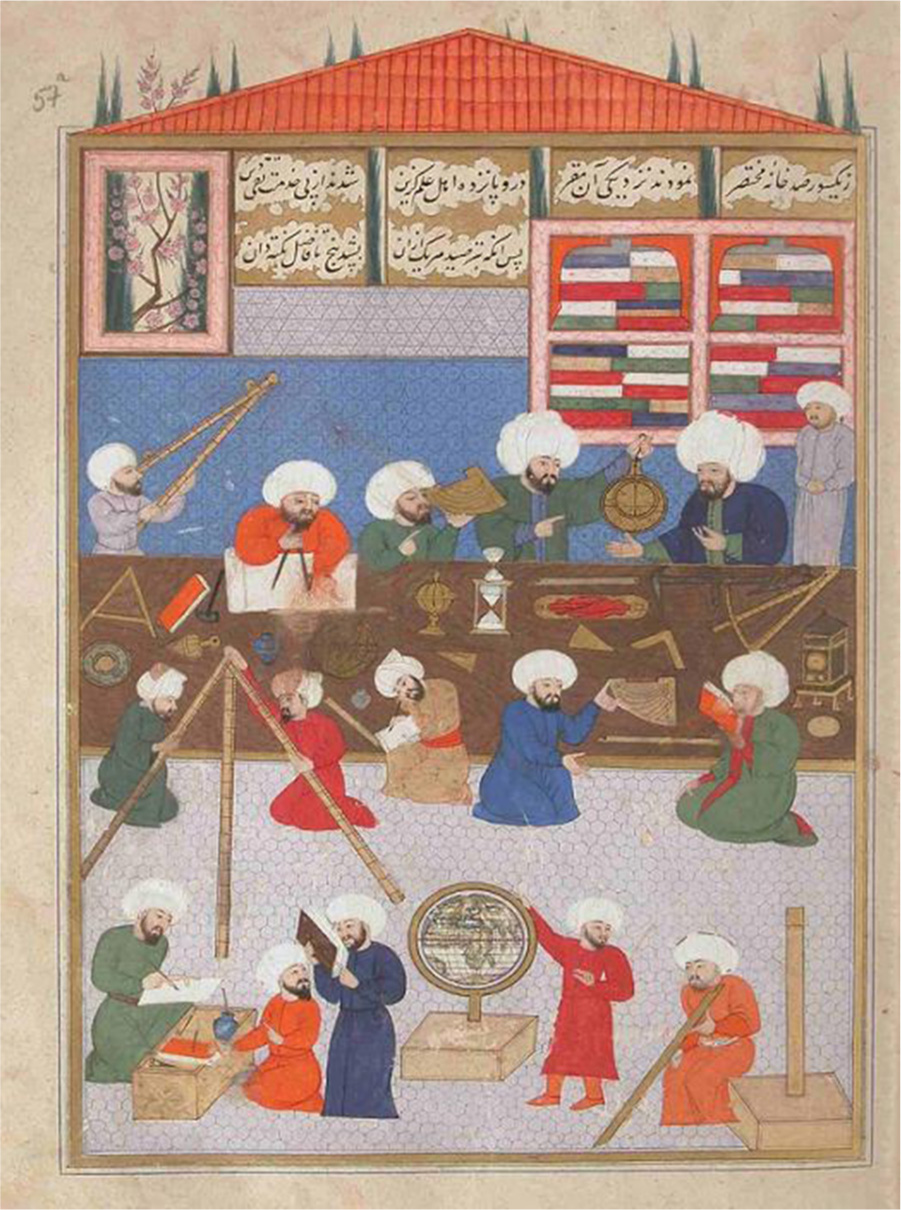
(credit: “Ottoman astronomers at work around Taqī al-Dīn at the Istanbul Observatory” by Shahinshahnāme Istanbul University Library /Muslim Heritage, Public Domain) · Public Domain
Figure 4.18 Scientists and their astronomical instruments are depicted in Taqi al-Din’s Istanbul observatory in this 1581 miniature by an unknown painter. (credit: “Ottoman astronomers at work around Taqī al-Dīn at the Istanbul Observatory” by Shahinshahnāme Istanbul University Library /Muslim Heritage, Public Domain)
図4.18 作者不明の1581年の細密画に、タキー・アッディーンのイスタンブル天文台の科学者と天文器具が描かれている。(クレジット:『シャーハンシャーナーメ』、イスタンブル大学図書館/Muslim Heritage「イスタンブル天文台でタキー・アッディーンを囲んで働くオスマンの天文学者たち」、パブリックドメイン)
Section Summary節のまとめ
The Ottoman Empire was one of the most diverse political entities of its time. Sultans such as Suleiman I encouraged people of all ethnicities to settle there, and under the millet system, each religious community had its own leader, regulated its own affairs, and educated its own children. This diversity is reflected in the languages spoken in the empire. Turkish was for interacting with the government, Arabic for scholarship and in religious settings, and Persian for literature.
英語のヒント
オスマン帝国は、当時最も多様な政治体の一つだった。スレイマン1世などのスルタンは、あらゆる民族の人々に定住を奨励した。またミッレト制度の下で、各宗教共同体は独自の指導者を持ち、内部の事柄を管理し、自分たちの子どもを教育した。この多様性は、帝国内で話される言語にも表れている。トルコ語は政府とのやりとりに、アラビア語は学問や宗教的な場面に、ペルシア語は文学に用いられた。
The empire reached its greatest heights under Suleiman I, known in the West as “the Magnificent” and among Ottomans as “the lawgiver” for his creation of a legal code that applied throughout the realm. Under Suleiman and his successors, science flourished, and important advances were made in fields such as astronomy and medicine. The Ottoman Empire began to decline in power following the defeat of its forces by European navies at the Battle of Lepanto in 1571. In the seventeenth century, the Ottomans found their power being eclipsed by that of Russia in the Black Sea region.
英語のヒント
帝国はスレイマン1世の下で最盛期を迎えた。彼は西洋では「壮麗者」、オスマン帝国内では、全領域に適用される法典を作ったため「立法者」と呼ばれた。スレイマンとその後継者たちの下で科学は栄え、天文学や医学などの分野で重要な進歩があった。1571年のレパントの海戦でヨーロッパの海軍に敗れた後、オスマン帝国の力は衰え始めた。17世紀には、黒海地域におけるオスマンの力は、ロシアの力の陰に隠れるようになった。