第4章イスラーム世界The Islamic World
Expansion, Revolutions, and Reform拡大、革命、改革
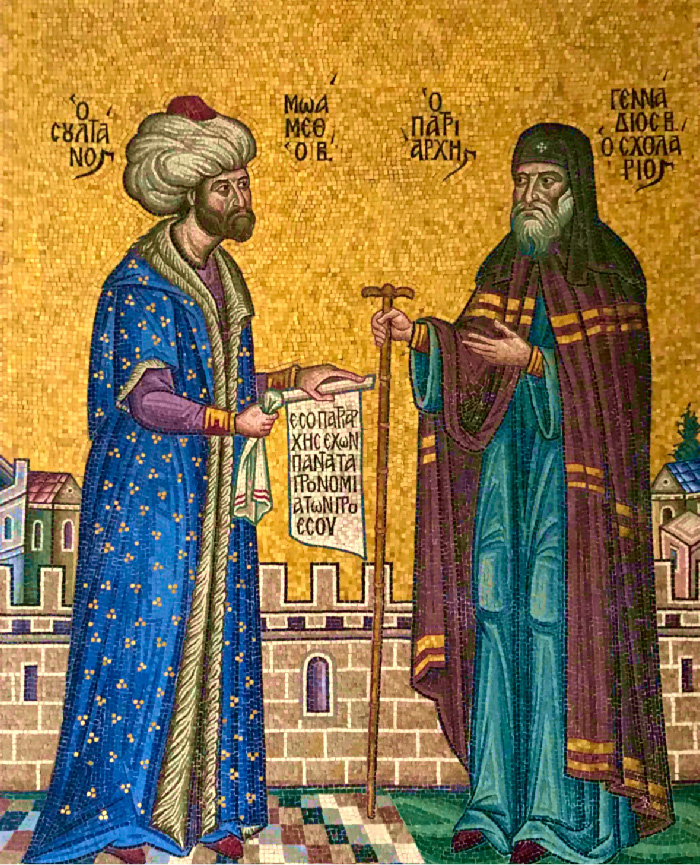
The Ottoman state’s geographic position was an important advantage from its beginning well into the height of its power in the seventeenth century. The early empire was born on the dividing line between Europe and Asia and balanced between them for nearly its entire existence. The collapse of the Byzantine Empire allowed the Ottoman sultan to rule from a capital city situated between the two continents. After establishing his new capital in Istanbul, Mehmed II issued a call for citizens of the empire to come and settle there to restore its economic vitality (Figure 4.16). This was necessary because the city had experienced steady demographic decline over the previous few centuries. At first, Mehmed offered free housing to anyone who moved there voluntarily; later, he ordered thousands of Serbs, Armenians, Greeks, Jewish people, and Turks to settle in the city. Although he would not live to see it, within a century Istanbul was by far the largest city in Europe, with nearly a half million residents, and it dominated the land and sea trade between Europe and Asia.
英語のヒント
オスマン国家の地理的位置は、建国当初から17世紀の全盛期に至るまで、重要な利点だった。初期の帝国はヨーロッパとアジアの境界上に生まれ、その存続期間のほぼ全体にわたり、両者の間で均衡を保った。ビザンツ帝国の崩壊により、オスマンのスルタンは二つの大陸の間にある首都から統治できるようになった。メフメト2世はイスタンブルを新首都とした後、その経済的活力を回復させるため、帝国の住民に移住・定住を呼びかけた(図4.16)。過去数世紀にわたって都市の人口が減少し続けていたため、それが必要だったのである。最初、メフメトは自発的に移住する者に無料の住居を提供した。その後は、何千人ものセルビア人、アルメニア人、ギリシア人、ユダヤ人、トルコ人に、都市への定住を命じた。彼はそれを見るまで生きることはなかったが、1世紀以内にイスタンブルは人口約50万人を擁する、他を大きく引き離したヨーロッパ最大の都市となり、ヨーロッパとアジアの間の陸海の交易を支配した。
Mehmed II and Gennadios II.メフメト2世とゲンナディオス2世。
(credit: modification of work “Gennadios II and Mehmed II” by Ecumenical Patriarchate/Wikimedia Commons, Public Domain) · Public Domain
Figure 4.16 This eighteenth-century mosaic shows Mehmed II (left) handing Gennadios II a document officially recognizing Gennadios’s position as the Greek Orthodox patriarch of the new capital of Istanbul. (credit: modification of work “Gennadios II and Mehmed II” by Ecumenical Patriarchate/Wikimedia Commons, Public Domain)
図4.16 この18世紀のモザイクは、メフメト2世(左)がゲンナディオス2世に、新首都イスタンブルのギリシア正教会総主教としての地位を正式に認める文書を渡す場面を描いている。(クレジット:全地総主教庁/Wikimedia Commons「ゲンナディオス2世とメフメト2世」を改変、パブリックドメイン)
Over the next century, the Ottoman Empire extended its influence into Syria, Palestine, Egypt, and North Africa. Under Ottoman control, the Egyptian Red Sea fleet battled the Portuguese for dominance in the Indian Ocean, sending troops and armaments to aid allied rulers in India and ships to the straits of Malacca. The Ottoman Empire is generally considered to have reached its pinnacle by the rise of Sultan Suleiman I in 1520. During his reign, Ottoman armies continued their Balkan expansion by conquering Serbia and Hungary, and in 1529 they laid siege to Vienna, then the seat of the Habsburg Empire.
英語のヒント
続く1世紀、オスマン帝国はシリア、パレスチナ、エジプト、北アフリカへ影響力を広げた。オスマン帝国の支配下で、エジプトの紅海艦隊はインド洋での優位をめぐってポルトガルと戦い、インドの同盟支配者を援助するために兵士と武器を送り、マラッカ海峡にも艦船を派遣した。オスマン帝国は、1520年のスルタン・スレイマン1世の即位までに頂点に達したと一般に考えられている。その治世に、オスマン軍はセルビアとハンガリーを征服してバルカン半島での拡大を続け、1529年には当時ハプスブルク帝国の中心だったウィーンを包囲した。
Although Vienna was never conquered, the threat of military conquest by the Ottomans was a constant worry for the Habsburgs. Queen Elizabeth I of England, also a rival of the Habsburgs, sent an embassy and military advisers to Istanbul to propose an anti-Habsburg alliance. Despite the Ottoman alliance with England, the Ottoman’s war with the Habsburgs quickly reached a stalemate, where it remained for several decades. Ottoman territorial expansion in North Africa found its farthest limit to the west in modern Algeria; to the east, it reached the shores of the Persian Gulf and established official borders with Safavid Iran. In Europe, Suleiman’s strength and military dominance of the Mediterranean world, along with the splendor of his capital city and the riches flowing through the empire, earned him the title “the Magnificent.”
英語のヒント
ウィーンは結局征服されなかったが、オスマン軍による軍事征服の脅威は、ハプスブルク家にとって絶え間ない懸念であった。同じくハプスブルク家の競争相手だったイングランド女王エリザベス1世は、反ハプスブルク同盟を提案するため、使節と軍事顧問をイスタンブルへ派遣した。イングランドとの同盟にもかかわらず、オスマン帝国とハプスブルク家の戦争はすぐに膠着状態に陥り、そのまま数十年続いた。北アフリカでのオスマン帝国の領土拡大は、西では現在のアルジェリアを限界とした。東ではペルシア湾岸に達し、サファヴィー朝イランとの正式な国境を定めた。ヨーロッパでは、スレイマンの力と地中海世界での軍事的優位に加え、首都の壮麗さと帝国を流れる富によって、彼は「壮麗者」という称号を得た。
To most Ottomans, however, Suleiman was known as “the lawgiver.” Most Ottoman subjects were unaware of their legal rights until Suleiman’s rule. Although Ottoman law was based on sharia, a certain amount of interpretation was required in matters such as criminal law, management of lands, and tax law. These laws were thus usually established by decree. Over the course of two and a half centuries, different parts of the empire were subject to decrees issued by many sultans, often substantially different from one another and sometimes contradictory. Suleiman reviewed the laws, ensured their compliance with Islamic principles, and issued a single unified law code for the empire that remained in force for three centuries. He also ordered the new law code to be publicized widely, so every Ottoman subject knew they had the right to have disputes heard in a court of law and judged fairly. These reforms won Suleiman wide acclaim and popularity as a ruler who cared about his people. Suleiman died in 1566 while commanding an expedition into Hungary. His death was kept secret for two months so as not to demoralize the troops; it was not until they returned to Istanbul that his death was made public in time for the coronation of his son as Selim II.
英語のヒント
しかしオスマン帝国の大半の人々には、スレイマンは「立法者」として知られていた。帝国の臣民の大多数は、彼の統治まで自らの法的権利を知らなかった。オスマン法はシャリーアに基づいていたが、刑法、土地の管理、税法などでは、一定の解釈が必要だった。そのため、これらの法律は通常、勅令によって定められた。2世紀半の間に、帝国の各地域には多数のスルタンが発した勅令が適用されていた。それらは互いに大きく異なることが多く、ときには矛盾していた。スレイマンは法を検討し、イスラームの原則への適合を確かめ、帝国全体に一つの統一法典を発布した。この法典は3世紀にわたって効力を保った。彼は新法典を広く知らせることも命じたため、すべての臣民が、紛争を法廷で審理してもらい、公正な判決を受ける権利を持つことを知った。こうした改革は、民を気にかける支配者として、スレイマンに広い称賛と人気をもたらした。1566年、彼はハンガリー遠征を指揮中に死去した。兵士の士気をくじかないよう、その死は2か月間秘密にされた。軍がイスタンブルへ戻って初めて、息子のセリム2世としての戴冠に間に合うように、死が公表された。
The period of Ottoman history after Suleiman’s rule has often been described by historians as a time of slow decline, leading to the empire’s disintegration beginning in the nineteenth century. This largely European interpretation attributes the ebbing of Ottoman power to two factors: the rise of European military might and Ottoman territorial overextension. In this view, the winds of change began to blow in 1571 when the Ottoman navy was destroyed in a naval battle at Lepanto in Greece by the Holy League—a confederation of the Spanish Empire, the Papal States, Venice, and Genoa, among others. The battle effectively ended Ottoman naval supremacy in the eastern Mediterranean, as well as Ottoman enthusiasm for continuing its naval rivalry with Portugal, the Netherlands, and France in the Indian Ocean.
英語のヒント
スレイマンの治世後のオスマン史は、歴史家によって、19世紀に始まる帝国の解体へと至る緩やかな衰退の時代と描かれることが多かった。この、おもにヨーロッパで生まれた解釈は、オスマンの力の衰えを二つの要因に帰する。ヨーロッパの軍事力の増大と、オスマンの領土の過度な拡張である。この見方では、変化の風が吹き始めたのは1571年であった。ギリシアのレパントでの海戦で、オスマン海軍が、スペイン帝国、教皇領、ヴェネツィア、ジェノヴァなどの連合である神聖同盟に壊滅させられたのである。この戦いは、東地中海におけるオスマンの海上優位を事実上終わらせ、同時にインド洋でポルトガル、オランダ、フランスとの海上の競争を続ける意欲も失わせた。
With this loss, the curtain was drawn back on the legend of Ottoman invincibility. European military technology caught up to and then surpassed Ottoman capabilities over the seventeenth and eighteenth centuries. Ottoman territory was then gradually lost to European kingdoms, particularly in the western part of North Africa and in the Balkans. While the empire’s land wars against the Habsburgs in Europe continued for another century, culminating in yet another failed siege of Vienna in 1683, it was also recognized at court that foreign wars were becoming more expensive but leading to far less economic and territorial gain.
英語のヒント
この敗北によって、オスマン無敵の伝説の実像が露わになった。17〜18世紀にかけて、ヨーロッパの軍事技術はオスマンの能力に追いつき、やがて追い越した。その後、特に北アフリカ西部とバルカン半島で、オスマン領は徐々にヨーロッパ諸王国へ奪われていった。ヨーロッパのハプスブルク家との陸戦はさらに1世紀続き、1683年のまたしても失敗したウィーン包囲に至った。それでも宮廷では、対外戦争の費用が増大する一方、得られる経済的・領土的利益ははるかに小さくなっていることも認識されていた。
From the north, the growing power of Russia became another threat. Beginning in the seventeenth century, Russian forces pushed south across the steppes toward Ottoman territory. Under Tsar Peter the Great, Russian armies temporarily captured the Ottoman-held territory of Azov in the Crimea along the Black Sea in 1696. In the late eighteenth century, Russia’s expansion ramped up again, eventually leading it deep into Ottoman territory with control over the northern coast of the Black Sea. Often aided by Austria, Russia steadily undermined Ottoman control over the Balkans, and over the nineteenth century, its influence came to replace Ottoman sway in the region.
英語のヒント
北からは、成長するロシアの力が新たな脅威となった。17世紀からロシア軍は、草原を南下してオスマン領へ進出した。ツァーリ・ピョートル大帝の下で、ロシア軍は1696年、黒海沿いのクリミアにあるオスマン支配地域アゾフを一時占領した。18世紀後半にはロシアの拡張が再び加速し、やがて黒海北岸を支配して、オスマン領の奥深くへ進んだ。ロシアはしばしばオーストリアの援助を受けて、バルカン半島におけるオスマンの支配を着実に弱め、19世紀の間に、この地域での影響力はオスマンに取って代わった。
More recently, historians have refined this older interpretation of Ottoman decline. According to the newer view, the threats from Europe in the west and the Safavids in the east convinced the Ottoman rulers to try making their control over their core territory more efficient. They sent delegations to several countries in Europe and to Mughal India to observe local systems and make recommendations for improvements at home. Several European military advisers were brought to Istanbul to train soldiers, and Ottoman scientists and engineers were sent to European universities to learn more about engineering, history, and military modernization and the ways in which they could be applied at home. Although the Ottoman Empire had become weaker by the nineteenth century, these reforms nevertheless helped it to survive into the twentieth century.
英語のヒント
近年、歴史家はオスマン衰退についてのこの古い解釈を、より精密なものにしてきた。新しい見方によると、西のヨーロッパと東のサファヴィー朝からの脅威が、オスマンの支配者に、中核領土の支配をいっそう効率的にしようと決意させた。彼らはヨーロッパの数か国とムガル朝インドに使節団を送り、現地の制度を観察して国内改善の提言をさせた。ヨーロッパの軍事顧問が何人も兵士の訓練のためにイスタンブルへ招かれ、オスマンの科学者や技術者は、工学、歴史、軍の近代化、そしてそれらを国内に応用する方法を学ぶため、ヨーロッパの大学へ派遣された。19世紀までにオスマン帝国は弱まっていたが、それでも、これらの改革は帝国が20世紀まで生き残る助けとなった。