第15章サハラ以南のアフリカの国家と社会States and Societies in Sub-Saharan Africa
15.3 The People of the Sahel15.3 サヘルの人々
Learning Objectives学習の目標
By the end of this section, you will be able to:
この節を学ぶと、次のことができるようになる。
Discuss the development of the Gao and early Songhai states
ガオ国家と初期ソンガイ国家の発展を論じる。
Explain why the people of the Sahel were able to take advantage of long-distance trade routes
サヘルの人々が、なぜ遠距離交易路を利用できたかを説明する。
Explain why some nomadic African tribes settled at the edges of the Sahara
アフリカの遊牧集団の一部が、なぜサハラの縁に定住したかを説明する。
Among the peoples of the Maghreb and Sahel in West and North Africa, a group known as the Berbers (Amazigh) played an outsized role in the region’s history. This assortment of nomads, settled agriculturalists, and merchants and traders who in ancient times inhabited modern-day Morocco, Algeria, Mauritania, Tunisia, Mali, and northern Niger, included many ethnic tribes—such as the Sanhaja, Masmuda, Zenata, Kutama, and Tuareg, among others—who called various pockets of the Maghreb, Sahel, and Sahara home. Each had a distinct culture, and often unique language and social structures. These Amazigh groups were crucial to the creation and longevity of the trans-Saharan trade, the control of which led to the rise and ultimately the fall of multiple medieval African kingdoms and empires. Eventually these peoples Islamized and became great empire builders themselves.
英語のヒント
西アフリカと北アフリカのマグリブ・サヘルの人々の中で、ベルベル人、すなわちアマジグと呼ばれる集団は、地域の歴史でとりわけ大きな役割を果たした。遊牧民、定住農民、商人などから成り、古代には、現在のモロッコ、アルジェリア、モーリタニア、チュニジア、マリ、ニジェール北部に住んでいた。サンハージャ、マスムーダ、ザナータ、クターマ、トゥアレグなど、多数の集団が含まれ、それぞれマグリブ、サヘル、サハラの各地を故郷としていた。独自の文化を持ち、言語や社会の仕組みも異なることが多かった。これらのアマジグ集団は、サハラ縦断交易の成立と長期の存続に不可欠だった。その交易の支配は、中世アフリカの多くの王国・帝国の台頭と、最終的な衰退につながった。やがて彼ら自身もイスラーム化し、大帝国を築くようになった。
The Gao Dynasty and Early Songhaiガオの王朝と初期のソンガイ
In the seventh century CE, the region of the Middle Niger was home to a number of different peoples including the Gabibi, Gow, and Sorko, all of whom had migrated to the area to live off its abundant resources. Each group exploited the region for different reasons: the Gabibi were settled agriculturalists who farmed the fertile banks along the Niger; the Gow hunted the river’s animals, including crocodile; the Sorko were warrior fishers and hunters of hippopotamus. The different purposes for which these peoples used the river and its resources ensured a relative balance between themselves and their environment.
英語のヒント
紀元7世紀、ニジェール川中流域には、ガビビ、ゴウ、ソルコなど、さまざまな人々が住んでいた。皆、豊かな資源で暮らしを立てるために、この地域へ移ってきた。利用のしかたは集団ごとに異なった。ガビビは、ニジェール川沿いの肥沃な土地を耕す定住農民で、ゴウは、ワニなど川にすむ動物を狩り、ソルコは、戦士でもある漁民で、カバの狩人だった。川と資源を異なる目的で使うことで、人々の間、そして人々と環境の間に、ある程度の均衡が保たれた。
Of these groups, the Sorko were best positioned to exercise control over the area. The canoes from which they hunted and fished gave them mastery of the river, which they used as a trading route to exchange food along this section of the Niger. They soon extended their territory upstream toward the Niger bend, establishing villages along the banks to help facilitate trade. From these trading post villages, the Sorko dominated the nearby communities of Gabibi farmers, raiding their granaries and pillaging their settlements. The dynamic in the region changed sometime in the ninth century, with the arrival of a nomadic horse-riding people who spoke Songhai, a dialect of the Nilo-Saharan language family. Gradually, the Sorko, Gabibi, and Gow peoples adopted the language of their conquerors, and collectively their cultures formed the basis of Songhai identity and the state of Songhai, with its capital at Kukiya. As the emerging Songhai state coalesced, its people were in steady contact with Muslim traders at Gao in the north.
英語のヒント
これらの集団のうち、地域を支配するのに最も有利だったのは、ソルコだった。狩猟や漁に使うカヌーが、川の主導権を与えた。川を交易路として、この区間のニジェール川沿いで、食料を交換した。まもなく上流の湾曲部へ領域を広げ、交易を進めるため、河岸に村々を築いた。その交易拠点の村々から、近くのガビビの農民共同体を支配し、穀倉を襲い、集落を略奪した。9世紀のある時期、ソンガイ語を話す、馬に乗る遊牧民が現れ、地域の力関係が変わった。ソンガイ語は、ナイル・サハラ語族の一つの方言である。ソルコ、ガビビ、ゴウの人々は、次第に征服者の言語を受け入れた。彼らの文化が合わさって、ソンガイとしての意識と、クキヤを都とするソンガイ国家の基礎を形作った。国家がまとまっていく間、人々は、北のガオのムスリム商人と、継続的に接触していた。
At the eastern edge of the Niger bend, an area of historical significance to both the Ghana and Mali Empires, the trading city of Gao was founded in the seventh century by African and Egyptian merchants attracted by the Bambuk gold trade in Ghana. It soon became an important link in the trans-Saharan trade of gold, copper, enslaved captives, and salt in the eastern and central regions of the Sahara. The earliest mention of Gao dates from the ninth century; by the 870s, it had already grown into a regional power.
英語のヒント
ニジェール川の湾曲部の東端は、ガーナ帝国とマリ帝国の両方にとって、歴史的に重要な地域だった。そこに7世紀、ガーナのバンブクの金交易に引かれた、アフリカとエジプトの商人が、交易都市ガオを築いた。まもなくガオは、サハラ東部・中部で、金、銅、奴隷にされた人々、塩を運ぶサハラ縦断交易の、重要な接点となった。ガオに言及する最古の記録は9世紀で、870年代までには、すでに地域の有力国へ成長していた。
By the tenth century, Arab travelers had noted Gao’s strategic location as a hub in the trans-Saharan trade route between Egypt and ancient Ghana. As Gao grew, so too did its needs. Songhai farmers and fishers provided the city’s merchants with food in exchange for salt, cloth, and other products from North Africa. As a result of their contacts with Muslim traders, the rulers of Songhai were exposed to Islam and converted in the eleventh century, making theirs one of the first West African states to do so. This conversion marks the beginning of the Gao imperial period.
英語のヒント
10世紀までには、アラブの旅行者が、エジプトと古代ガーナを結ぶサハラ縦断交易路の中心として、ガオの戦略的な立地に注目していた。ガオが成長すると、必要とする物資も増えた。ソンガイの農民や漁民は、北アフリカの塩、布、そのほかの品と交換に、都市の商人へ食料を供給した。ムスリム商人との接触を通して、ソンガイの支配者はイスラームに触れ、11世紀に改宗した。その結果、ソンガイは、西アフリカで最初期にイスラームへ改宗した国家の一つになった。この改宗が、ガオ帝国期の始まりを示す。
The earliest dynasty of kings of the Songhai state was the Za dynasty, which tradition and later historical record suggest ruled the kingdom during the eleventh and twelfth centuries. The Za are an obscure dynasty; what evidence exists comes to us in the form of myths and legends, the seventeenth-century History of the Sudan, the oral tradition of the Songhai written down by Abd al-Sadi, and some tombstone inscriptions dating to the fourteenth and fifteenth centuries. According to al-Sadi’s history, the mythical founder of the dynasty was Za Alayaman, who settled in Kukiya sometime before the eleventh century. Za Alayaman and his immediate successors bore the title malik or “king.” Evidence suggests that later rulers, possibly a second dynasty, bore the title zuwa, hence the name Zuwa dynasty.
英語のヒント
ソンガイ国家の最初の王朝はザ朝で、伝承と後世の史書によれば、11〜12世紀に王国を支配したと考えられる。よく分からない王朝で、残る証拠は、神話や伝説、アブド・アル=サーディーがソンガイの口承を書き留めた17世紀の『スーダーン史』、14〜15世紀の墓碑銘などである。サーディーの歴史書によれば、伝説上の創始者はザ・アラヤマンで、11世紀以前のある時期に、クキヤへ定住した。彼と直後の後継者は、マリク、すなわち「王」という称号を持った。証拠からは、後の支配者、もしかすると第2の王朝が、「ズワ」という称号を持ったことが示される。そこからズワ朝という名が生まれた。
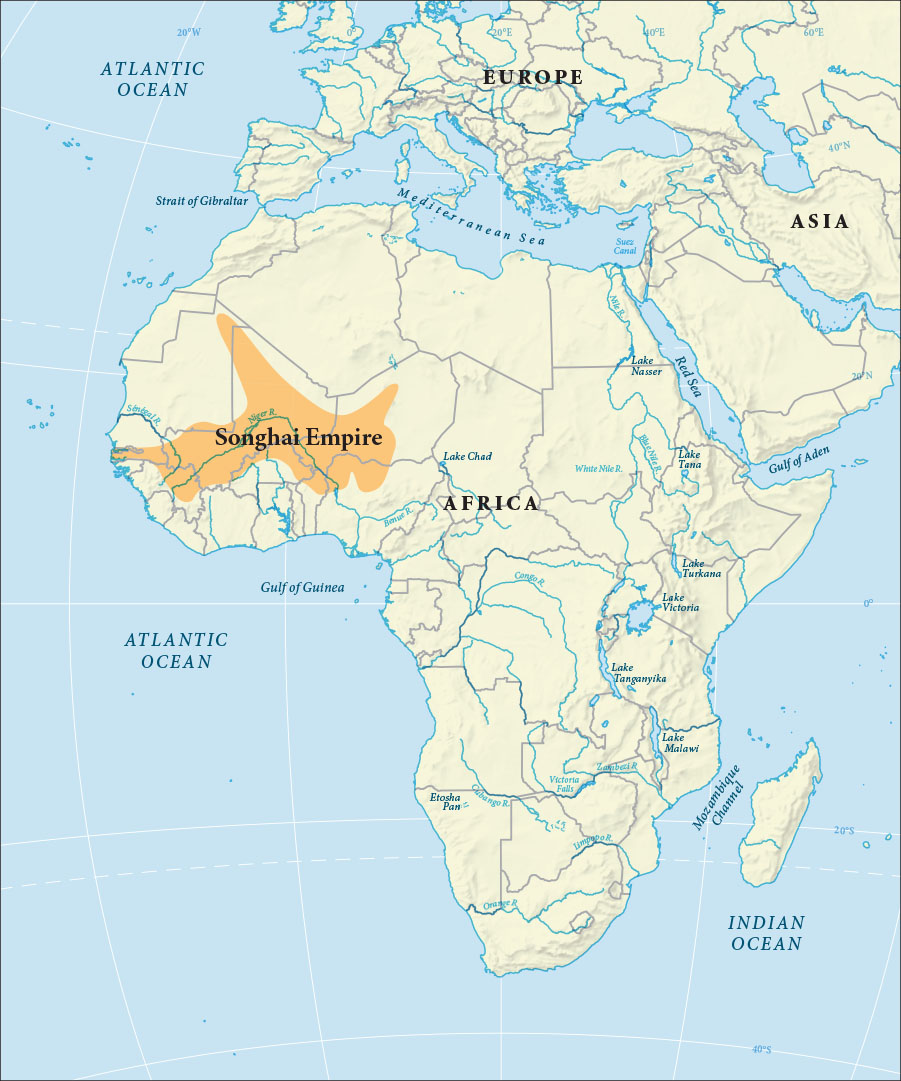
Tradition holds that the first fourteen rulers of the Songhai state, which was initially centered on Kukiya, were jahiliyyah (literally “in ignorance [of Islam]”). Sometime in the 1000s, the dynasty Islamized, possibly under Za Kusay, whom the History of the Sudan remembers as the first Muslim ruler of Songhai. This timeline is contested, however. Modern scholars believe the Islamization of the Songhai rulers occurred toward the end of the eleventh century with the arrival of the Sanhaja Almoravids from Morocco. In any event, it was sometime during this period that the political focus of the kingdom shifted from Kukiya to Gao. Due in large part to its position as a terminus in the caravan route connecting the northern Sahara, Gao became the center of a significant Islamized kingdom (Figure 15.17).
英語のヒント
伝承では、当初クキヤを中心としたソンガイ国家の、最初の14人の支配者は、「ジャーヒリーヤ」、直訳すると「イスラームを知らない状態」にあったという。1000年代のある時期に、王朝はイスラーム化した。『スーダーン史』がソンガイ最初のムスリム支配者として記憶する、ザ・クサイのもとで、起きたのかもしれない。ただし、この年代順には異論がある。現代の研究者は、支配者のイスラーム化を、モロッコからサンハージャ系のムラービト勢力が到来した、11世紀末頃と考えている。いずれにせよ、この時期のどこかで、王国の政治の中心が、クキヤからガオへ移った。サハラ北部と結ぶ隊商路の終点という位置が、大きな理由となり、ガオは、有力なイスラーム化した王国の中心になった(図15.17)。
The Songhai Empire.ソンガイ帝国
(attribution: Copyright Rice University, OpenStax, under CC BY 4.0 license) · CC BY 4.0
As goods such as kola nuts, dates, enslaved captives, ivory, salt, leather, and of course gold passed through the capital on their way to and from the kingdom of Ghana, traders and merchants, including the Songhai themselves, prospered. Gao’s prosperity also drew the attention of the new and expansionist West African kingdom of Mali, which annexed Gao around 1325. This was the golden age of imperial Mali, and for the next century, its rulers profited from Gao’s trade and collected taxes from its kings. When the explorer Ibn Battuta arrived at Gao from Timbuktu in 1353, he described it as a “[Quotation omitted for rights reasons.]”
英語のヒント
コーラの実、ナツメヤシの実、奴隷にされた人々、象牙、塩、革、そしてもちろん金などが、ガーナ王国への往復の途中に、都を通った。ソンガイの人々自身を含む商人たちは、繁栄した。ガオの繁栄は、拡大を目指す西アフリカの新興王国マリの注意も引いた。マリは1325年頃、ガオを併合した。マリ帝国の黄金時代で、その後約1世紀、支配者はガオの交易から利益を得て、その王たちから税を集めた。1353年、探検家イブン・バットゥータがトンブクトゥからガオへ着くと、次のように述べた。〔権利の関係で割愛〕
The annexation of Gao greatly expanded the Mali Empire, but only temporarily. Periodic rebellions by the peoples of Timbuktu, Takedda, and Gao, coupled with civil war, a struggling economy, and incursions by Almoravids from the north, caused Gao’s Malian rulers to withdraw in the 1430s. The leader of the Songhai rebels, Sunni Ali, became the first king of the Songhai Empire. Under him, Songhai became one of the greatest empires of medieval Africa. From his capital at Gao in the heart of the kingdom, Sunni Ali engaged in a war of conquest against his Muslim neighbors. Marshaling his massive cavalry and fleet of war canoes, the king extended his empire deep into the desert in the north and as far as Djenné in the southwest. His near-constant harassment and pursuit of the Tuareg nomads resulted in his capture of Mali’s great religious and scholarly center in Timbuktu, the trading town of Djenné, and almost the whole of the Middle Niger floodplain and the Bandiagara uplands.
英語のヒント
ガオの併合は、マリ帝国を大きく広げたが、一時的なものだった。トンブクトゥ、タケッダ、ガオの人々が繰り返した反乱に、内戦、経済不振、北からのムラービト勢力の侵入が重なり、ガオのマリ人支配者は、1430年代に撤退した。ソンガイの反乱勢力の指導者スンニ・アリは、ソンガイ帝国の最初の王となった。そのもとで、ソンガイは、中世アフリカ最大級の帝国となった。王国の中心にある都ガオを拠点に、近隣のムスリム勢力に対し、征服戦争を行った。大規模な騎兵と戦闘用カヌーの船団を動員し、帝国を、北は砂漠の奥、南西はジェンネまで広げた。トゥアレグの遊牧民を、ほぼ絶えず攻撃・追撃した結果、マリの宗教・学術の大中心トンブクトゥ、交易都市ジェンネ、ニジェール川中流の氾濫原のほぼ全域、バンディアガラの高地を手に入れた。
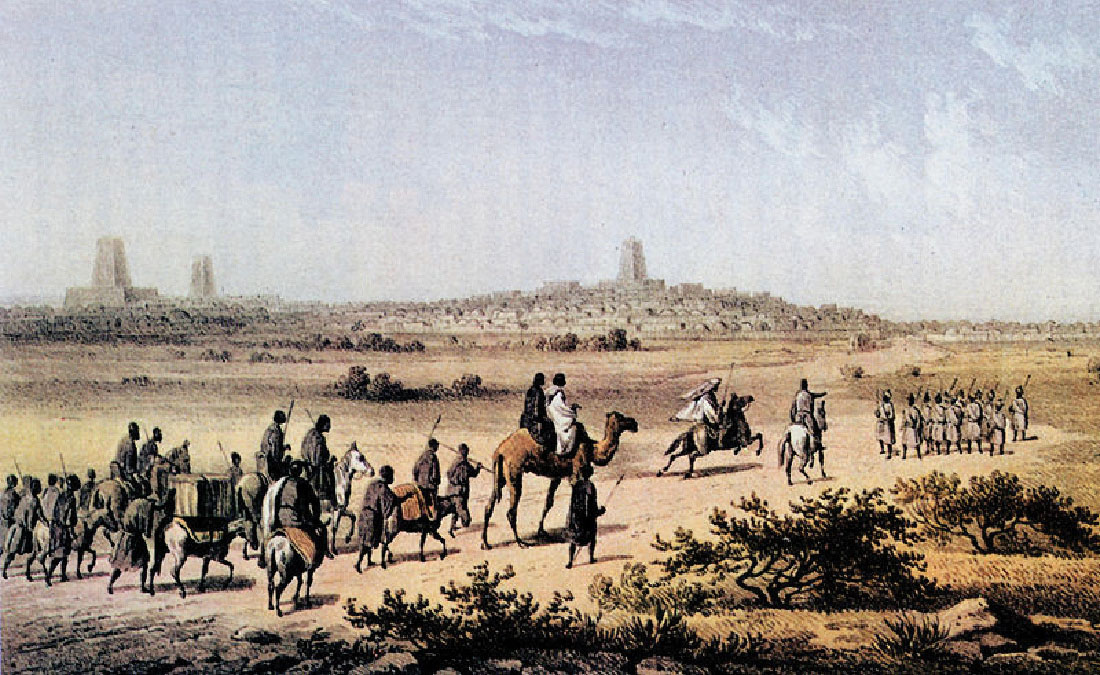
Despite being Muslim himself, Sunni Ali campaigned against Muslim forces. This and his general lack of respect for Islam led to his being highly criticized by Arabic historians. In the History of the Sudan, al-Sadi characterized Sunni Ali as “[Quotation omitted for rights reasons.]” and reported that he “[Quotation omitted for rights reasons.]” As a result, many of the scholars in Timbuktu fled to Oualata, leading to a significant diminishment in Islamic scholarship in the city (Figure 15.18). Nevertheless, in Songhai oral tradition, Sunni Ali is remembered as a great general and conquering hero, as well as the founder of the Songhai Empire. Through his domination of important trade routes and urban areas, he enriched his kingdom and enabled it to become even wealthier than Mali.
英語のヒント
スンニ・アリは、自身がムスリムだったにもかかわらず、ムスリム勢力を攻撃した。この行為と、イスラームを全般に尊重しない姿勢から、アラビア語で書く歴史家に、厳しく批判された。サーディーは『スーダーン史』で、アリの人物像を〔権利の関係で割愛〕と描き、さらに、その行為を〔権利の関係で割愛〕と伝えた。その結果、トンブクトゥの学者の多くはワラタへ逃れ、同市のイスラーム学問は、大きく衰えた(図15.18)。それでもソンガイの口承では、アリは偉大な将軍、征服の英雄、ソンガイ帝国の創始者として記憶されている。重要な交易路と都市を支配し、王国を富ませ、マリを上回る富を持てるようにした。
Timbuktu.トンブクトゥ
(credit: “Timbuktu seen from a distance by Heinrich Barth’s party, September 7, 1853” by Heinrich Barth, Reisen und Entdeckungen. Gotha 1858, vol. 4./Wikimedia Commons, Public Domain) · Public Domain
Figure 15.18 This artist’s rendering shows the German scholar and explorer Heinrich Barth approaching Timbuktu in 1853, one of the first Europeans to do so. Note the city’s baked-mud mosques and centers of learning in the background. The image was published in Barth’s famous five-volume travel journal of Africa. (credit: “Timbuktu seen from a distance by Heinrich Barth’s party, September 7, 1853” by Heinrich Barth, Reisen und Entdeckungen. Gotha 1858, vol. 4./Wikimedia Commons, Public Domain)
図15.18 1853年、ドイツの学者・探検家ハインリヒ・バルトが、トンブクトゥへ近づく様子を描いた絵。バルトは、同市を訪れた最初期のヨーロッパ人の一人だった。背景の、泥を固めて造ったモスクや学問の施設に注目しよう。この絵は、バルトの有名な全5巻のアフリカ旅行記に掲載された。(出典:Heinrich Barth『Reisen und Entdeckungen』、Gotha、1858年、第4巻/Wikimedia Commons「Timbuktu seen from a distance by Heinrich Barth’s party, September 7, 1853」、パブリックドメイン)