第15章サハラ以南のアフリカの国家と社会States and Societies in Sub-Saharan Africa
The Mali Empireマリ帝国
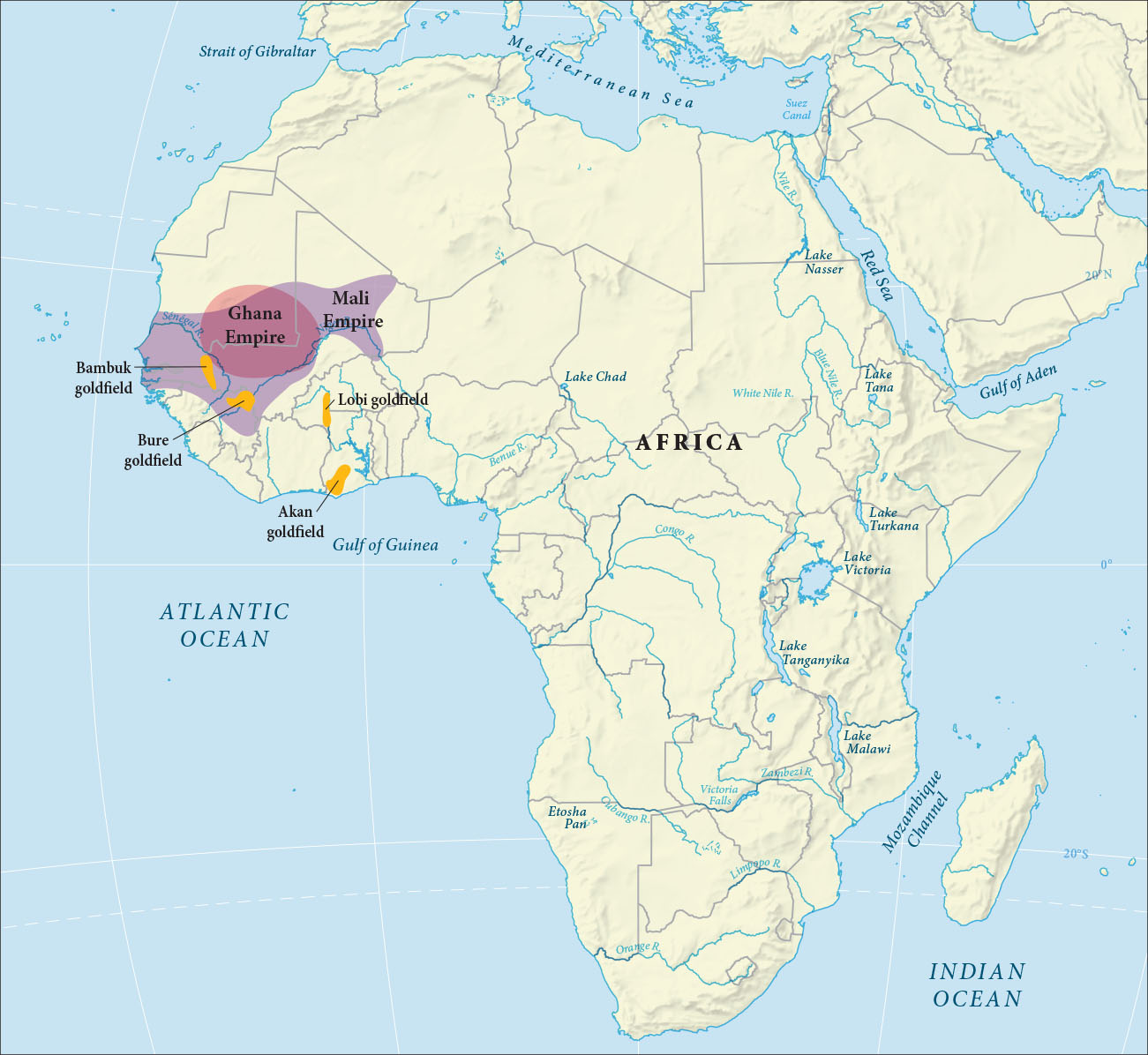
The kingdom of Sosso benefited the most from the dissolution of the Ghana Empire, a process furthered by the collapse of the Islamic Almoravid state in present-day Morocco in the mid-twelfth century. Yet the Sosso Kingdom was short-lived; it was defeated by Sundiata Keita in 1235. Five years later, Prince Sundiata (also spelled Sunjata) captured Koumbi Saleh, laying the foundation for the great Mali Empire, the largest and richest that medieval Africa had yet seen (Figure 15.12).
英語のヒント
ガーナ帝国の解体で、最も利益を得たのはソソ王国だった。解体は、12世紀半ば、現在のモロッコで、イスラーム国家ムラービト朝が崩壊したことで、さらに進んだ。しかしソソ王国は短命で、1235年、スンジャタ・ケイタに敗れた。5年後、スンジャタ王子はクンビ・サレーを奪い、大マリ帝国の基礎を築いた。それは、中世アフリカがそれまでに見た、最大で最も豊かな帝国だった(図15.12)。
The Ghana and Mali Empires.ガーナ帝国とマリ帝国
(attribution: Copyright Rice University, OpenStax, under CC BY 4.0 license) · CC BY 4.0
Figure 15.12 This map shows the extent of the two great medieval West African empires: Ghana and Mali. At its height, Mali extended farther west and south than Ghana. (attribution: Copyright Rice University, OpenStax, under CC BY 4.0 license)
図15.12 中世西アフリカの二大帝国、ガーナとマリの範囲を示す地図。最盛期のマリは、ガーナよりも西方と南方へ広がっていた。(出典:Rice University/OpenStax、CC BY 4.0)
In the twelfth century, the main source of gold in West Africa had shifted from Bambuk to Bure, located to the southeast in the savanna country. This shift not only ended Ghanaian control over trans-Saharan trade, it also brought new groups into the great Sudanese trading network of West Africa, notably the southern Soninke and Malinke-speakers of the savanna. The Sosso, a branch of the southern Soninke, were the first to take full advantage of these changed circumstances. Sometime around 1200, they broke away from Ghana and established a successor state under Soumaoro, their sorcerer-king. During its brief existence, their Sosso Kingdom earned a grim reputation for violence by raiding and conquering neighboring kingdoms, killing their rulers, and seizing tribute. During the 1220s, the Sosso army made raids on the Malinke-speaking Mande people to the south and then attacked the northern Soninke of Ghana, sacking their capital in about 1224.
英語のヒント
12世紀、西アフリカの金の主要産地は、バンブクから、その南東のサバンナにあるブレへ移った。この変化は、ガーナによるサハラ縦断交易の支配を終わらせただけでなく、西アフリカのスーダーン地域の大交易網に、新しい集団を加えた。特に、サバンナの南部ソニンケと、マリンケ語を話す人々だった。変化した状況を、最初に十分利用したのは、南部ソニンケの一派であるソソだった。1200年頃、ガーナから離れ、呪術師王スマオロのもとに、後継国家を建てた。短い存続期間に、ソソ王国は、隣国を襲撃・征服し、支配者を殺し、貢納を奪い取る暴力で、恐ろしい評判を得た。1220年代には、南方の、マリンケ語を話すマンデの人々を襲い、次いでガーナの北部ソニンケを攻撃し、1224年頃に、その都を略奪した。
In response to the incursions against the Mande, Prince Sundiata of the Keita clan, a survivor of one of Soumaoro’s raids, rallied several of the region’s small Mande kingdoms and united them against the invaders. The exploits of Sundiata Keita, a near-mythical figure in the Mande oral tradition, have been passed down by generations of bards. Beginning around 1235, Sundiata set about consolidating his control over the heartland of the Mande people, a region centered on the upper reaches of the Senegal and Niger Rivers. He then moved to expand the kingdom of Mali by taking control of all the Soninke peoples recently conquered by the Sosso. Their territory comprised much of the former kingdom of Ghana and its nominally independent vassal states, including Mema and Wagadu. These newly conquered territories were often administered indirectly, leaving friendly puppet regimes in place to do the bidding of the Malian monarch (a political strategy that bred resentment among certain of the Malian vassal states, including Takrur and Songhai).
英語のヒント
マンデへの侵攻に対抗したのは、スマオロの襲撃を生き延びた、ケイタ氏族のスンジャタ王子だった。地域の小さなマンデ諸王国を結集させ、侵略者に対抗するために統合した。マンデの口承で、神話に近い存在となったスンジャタ・ケイタの功績は、代々の語り手が伝えてきた。1235年頃から、スンジャタは、マンデの人々の中核地域の支配を固め始めた。セネガル川とニジェール川の上流域を中心とする地域である。次いで、直前にソソに征服されたソニンケの人々を、すべて支配下に置き、マリ王国を広げようとした。その領域には、旧ガーナ王国の大部分と、メマやワガドゥなど、名目上は独立した従属国が含まれた。新たな征服地は、しばしば間接的に統治された。マリ王の命令に従う、友好的な傀儡政権を、そのまま置いたのである。この政治的手法は、タクルールやソンガイを含む、一部のマリの従属国に、不満を生んだ。
When forming alliances against the Sosso, Sundiata convinced the other Malinke kings to surrender their title, mansa, to him. He thus became the sole mansa, the religious and secular leader of all the Malinke people. In a few short years, he had built up a vast realm. Its imperial capital was advantageously situated at Niani, in the southern savanna country of the upper Niger valley near the goldfields of Bure. Within Sundiata’s lifetime, the Mali Empire extended from the forested margins of the southwest through the grassland savanna country of the Malinke and southern Soninke to the Sahel of former Ghana.
英語のヒント
ソソに対抗する同盟を作る際、スンジャタは、ほかのマリンケの王たちを説得し、「マンサ」という称号を、自分に譲らせた。こうして唯一のマンサとなり、マリンケのすべての人々にとって、宗教と世俗の指導者となった。わずか数年で、広大な領域を築いた。帝国の都ニアニは、南部サバンナ、ニジェール川上流の谷にあり、ブレの金産地にも近い、有利な場所だった。スンジャタの生存中に、帝国は、南西の森林地帯の縁から、マリンケと南部ソニンケのサバンナ草原を通り、旧ガーナのサヘルにまで広がった。
Awdaghost, the one-time trade center at the western extreme of trans-Saharan trade, remained in the hands of nomads, and its role was taken by the more easterly commercial center of Oualata, now the main southern desert port for trade traversing the Sahara. The kings of Mali were less interested in conquering the various small kingdoms and chiefdoms of the grasslands than in taking the Sahelian trading towns that linked the regional economy to the vast trans-Saharan trade. These towns were key prizes and included Oualata, Gao, Timbuktu, and Djenné.
英語のヒント
かつて、サハラ縦断交易の西端の交易中心だったアウダゴストは、遊牧民の手に残った。その役割を引き継いだのは、さらに東の商業中心ワラタで、サハラを横断する交易の、南の主要な「砂漠の港」となった。マリの王たちは、草原の小王国や首長国を征服することより、地域経済を広大なサハラ縦断交易へ結ぶ、サヘルの交易都市の獲得に関心を持った。ワラタ、ガオ、トンブクトゥ、ジェンネなどが、重要な獲得対象だった。
Control of the towns and the trade routes they connected was one of several components in Mali’s diverse economy, which included access to the Bure goldfields and the agriculturally rich rural areas, particularly those around Niani in the south of the country. Unlike in Ghana, rainfall in Mali, located in the southern savanna, was more abundant, and the farmers of Mali had no difficulty growing enough food to sustain the population. Different areas of the empire specialized in different crops. For example, sorghum and millet grew on the savannah, and rice flourished in the Gambia valley and around the upper Niger floodplain. Meanwhile, the more northerly and drier Sahelian grasslands specialized in the grazing of camels, sheep, and goats.
英語のヒント
都市と、それらが結ぶ交易路の支配は、マリの多様な経済を構成する、複数の要素の一つだった。ほかには、ブレの金産地を利用できることや、農業の豊かな農村地域、特に国の南部、ニアニ周辺の存在があった。ガーナと異なり、南部サバンナに位置するマリでは、降雨がより多く、農民は、人口を養うのに十分な食料を、容易に育てられた。帝国内の地域ごとに、異なる作物が専門となった。たとえばサバンナではソルガムや雑穀が育ち、ガンビア川流域やニジェール川上流の氾濫原では、稲がよく育った。より北方の乾いたサヘルの草地では、ラクダ、羊、ヤギの放牧が中心だった。
Control over the gold-producing towns could present challenges for Mali’s rulers. When a king conquered a region and attempted to spread Islam, the gold producers who refused to convert ceased mining operations, thereby threatening the Malian gold supply. This posed a serious risk to the imperial economy, so Malian rulers allowed gold areas to remain quasi-independent vassal states. Mali’s gold trade was bolstered by events taking place elsewhere in the world. European kingdoms were again producing gold coins as the medieval economy improved. To meet the new demand, merchants from southern Europe sought to buy gold from their counterparts in North Africa. At the same time, new southerly trade routes were opened into the goldfields of the Akan forest (in present-day Ghana), from which sellers brought gold to the settlements of the Middle Niger. These developments to the north and south of Mali allowed the trans-Saharan gold trade to attain its greatest heights in the fourteenth century.
英語のヒント
金を産出する町の支配は、マリの支配者に、難題をもたらすこともあった。王がある地域を征服し、イスラームを広めようとすると、改宗を拒む金の生産者は、採掘を停止した。それはマリへの金の供給を脅かした。帝国経済に深刻な危険を及ぼすため、支配者は、金の産地が、半ば独立した従属国であり続けることを認めた。マリの金交易は、世界のほかの場所の出来事によっても支えられた。中世の経済が好転すると、ヨーロッパ諸王国は、再び金貨を造るようになった。新たな需要に応えるため、南ヨーロッパの商人は、北アフリカの商人から金を買おうとした。同じ頃、現在のガーナにある、アカンの森林の金産地へ、さらに南の交易路が開かれた。商人は、そこからニジェール川中流の集落へ金を運んだ。マリの南北で起きたこれらの変化によって、サハラ縦断の金交易は、14世紀に最大の繁栄を迎えた。
The pilgrimage of Mansa Musa to Egypt and Mecca in 1324–1325 represents the golden age of the Mali Empire. Mansa Musa, the most famous of the Malian kings and reputed to be fabulously wealthy, arrived in Cairo at the head of a huge caravan that accounts tell us included sixty thousand soldiers, five hundred captives, and a hundred camel-loads of gold. Received with great respect by the sultan of Egypt as a fellow Muslim, Mansa Musa spent lavishly, giving away so many gifts that the value of gold in Cairo fell and did not recover for twelve years.
英語のヒント
1324〜1325年のマンサ・ムーサのエジプト・メッカ巡礼は、マリ帝国の黄金時代を象徴する。マリの王のうち最も有名で、途方もなく豊かだったとされるムーサは、大隊商を率いてカイロに着いた。記録によれば、隊商には、6万人の兵士、500人の捕虜・被虜者、ラクダ100頭分の金が含まれていたという。同じムスリムとして、エジプトのスルタンから大いに敬意をもって迎えられたムーサは、惜しげもなく金を使った。贈り物を大量に配ったため、カイロの金の価値は下落し、12年間、回復しなかった。
Mansa Musa’s journey captured the attention of people from Spain to Syria, including the Muslim geographer Ibn Battuta, who, after years traveling throughout Asia, visited Mali during the reign of Mansa Musa’s brother Mansa Suleyman. Ibn Battuta’s account has become a major source of our knowledge about fourteenth-century Mali.
英語のヒント
マンサ・ムーサの旅は、スペインからシリアまで、人々の注目を集めた。その一人が、ムスリムの地理学者イブン・バットゥータだった。アジア各地を何年も旅した後、ムーサの弟マンサ・スライマーンの治世に、マリを訪れた。その記録は、14世紀のマリを知る、主要な史料となっている。
As a marker of Mali’s enduring fame in the fourteenth century, the Majorcan mapmaker Abraham Cresques featured it in The Catalan Atlas in 1375. One of the maps, which in part depicts the trade routes of North Africa, shows Mansa Musa enthroned (Figure 15.1). His royal status is proclaimed by his gold crown and scepter. In one hand he holds an immense piece of gold, proof of his kingdom’s wealth. The caption reads, “[Quotation omitted for rights reasons.]”
英語のヒント
14世紀にもマリの名声が続いていたことを示す例として、マジョルカ島の地図製作者アブラハム・クレスケスは、1375年の『カタルーニャ図』にマリを取り上げた。地図の一枚は、北アフリカの交易路も描いており、玉座に座るマンサ・ムーサを示す(図15.1)。金の冠と王笏が、王としての身分を明らかにする。片手に持つ巨大な金の塊は、王国の富の証しである。添え書きには、こうある。〔権利の関係で割愛〕。
The strength and success of the Mali Empire depended on its ruler. During the late fourteenth century, a series of weak rulers, brief reigns, and dynastic civil wars opened the empire to conquest. With their power weakened, the mansas of Mali were unable to maintain unchallenged control of the trade routes on which they depended. Opposition from the Mossi people in the country south of the Niger, coupled with attacks from the Tuareg to the north of the Niger bend and regular uprisings by the Songhai people who controlled the city of Gao (on the edge of the empire), led Mali to abandon both Gao and Timbuktu in 1438. At the same time, Mema, one of the kingdoms that had formed an alliance with Sundiata, broke away and became independent once more. Although weakened, Mali retained control of the Mande heartland and the nearby southern grasslands. However, the emerging Songhai Empire centered on Gao was beginning to take control of the lucrative trade across the Sahara.
英語のヒント
マリ帝国の力と成功は、その支配者にかかっていた。14世紀後半、弱い支配者や短い治世が続き、王朝内部の内戦も起こって、帝国は征服を受けやすくなった。力を弱めたマンサたちは、依存していた交易路を、他者に脅かされずに支配し続けることができなくなった。ニジェール川南方のモシの人々の抵抗に、同川の湾曲部より北からのトゥアレグの攻撃が加わった。帝国の周縁のガオを支配するソンガイの人々も、繰り返し反乱を起こした。こうして1438年、マリは、ガオとトンブクトゥの両方を放棄した。同じ頃、スンジャタと同盟した王国の一つ、メマも離反し、再び独立した。マリは弱体化しながらも、マンデの中核地域と、近くの南の草原地帯の支配を保った。しかしガオを中心として興りつつあったソンガイ帝国が、利益の大きいサハラ縦断交易を、支配し始めていた。