第15章サハラ以南のアフリカの国家と社会States and Societies in Sub-Saharan Africa
The Expansion of Christianity in Africaアフリカでのキリスト教の拡大
Throughout its history, North Africa’s fate and fortunes have been connected to the Mediterranean Sea and the peoples who share its borders. Whether economic, political, or spiritual, changes and innovations occurring in this region have had lasting and important consequences for Africa. These changes often went hand in hand; as the Roman Empire grew and expanded, for instance, so did Christianity.
英語のヒント
北アフリカの歩みと盛衰は、その歴史を通じて、地中海と、その沿岸に住む人々に結び付いてきた。この地域で起こる変化や革新は、経済、政治、精神・宗教のいずれのものであれ、アフリカに重要で持続的な影響を及ぼした。こうした変化は、しばしば一緒に進んだ。たとえばローマ帝国が成長・拡大すると、キリスト教も広がった。
Christianity emerged as a distinct religion in the second half of the first century and soon spread into communities around the Roman-controlled Mediterranean world. Being part of the Roman Empire, North Africa became home to some of the world’s earliest Christian communities. According to Christian tradition, Saint Mark traveled to the Egyptian city of Alexandria and founded the first Christian community in Africa there around the middle of the first century. Regardless of whether we accept this tradition as factual or not, it is indisputable that by the third century Alexandria was a major center of Christianity. By that time, the influential School of Alexandria was an important center for theological research, and the bishop of the Church of Alexandria was held by Christians to be as important as the pope (the bishop of Rome). It was from Alexandria that Christianity spread south along the Nile, penetrating the reaches of Upper Egypt.
英語のヒント
キリスト教は1世紀後半に、独自の宗教として現れ、ほどなく、ローマが支配する地中海世界の共同体へ広がった。ローマ帝国の一部だった北アフリカにも、世界で最も早い時期のキリスト教共同体が生まれた。キリスト教の伝承によれば、聖マルコはエジプトのアレクサンドリアへ旅し、1世紀半ばごろ、アフリカ最初のキリスト教共同体を築いた。この伝承を史実として認めるかどうかにかかわらず、3世紀までに、アレクサンドリアがキリスト教の大きな中心となっていたことは確かである。その頃には、影響力のあるアレクサンドリア学派が、神学研究の重要な中心をなしていた。アレクサンドリア教会の司教も、教皇、すなわちローマ司教に劣らず重要な人物と、キリスト教徒にみなされていた。キリスト教がナイル川沿いに南へ広がり、上エジプトへ浸透した、その起点はアレクサンドリアだった。
The growth of the church in Africa mirrored its expansion across the Mediterranean and drew the attention of Roman officials. In general, the Roman Empire was not interested in persecuting the followers of the many religions practiced around the empire, even members of new religions like Christianity. However, some actions of early Christian communities were seen by Roman officials as disruptive to peace and stability in the empire. For example, Christians refused to participate in the state cults that honored the Roman gods and protected Roman society. Such refusal was interpreted as treason and occasionally punished accordingly, such as under Emperor Nero, who ruled from 54 to 68. But during the reign of Emperor Decius in 250, official empire-wide persecution noticeably increased, reaching its height under Emperor Diocletian in 303. During this time, Rome undertook a series of official persecutions meant to restore the primacy of ancient pagan religious worship and practice throughout the empire.
英語のヒント
アフリカの教会の成長は、地中海全域での拡大を映し、ローマの官吏の注意を引いた。一般に、ローマ帝国は、帝国内の多くの宗教の信徒を迫害することには関心が薄く、キリスト教のような新しい宗教の人々も、その例外ではなかった。しかし、初期キリスト教共同体のある種の行動は、帝国の平和と安定を乱すものだと、官吏たちにみなされた。たとえばキリスト教徒は、ローマの神々をあがめ、ローマ社会を守るとされた、国家の祭祀への参加を拒んだ。それは反逆と解釈され、ときには、在位54〜68年のネロ帝のもとでのように、処罰された。250年、デキウス帝の治世には、帝国全域での公的な迫害が目立って増え、303年のディオクレティアヌス帝のもとで頂点に達した。この時期、ローマは、古来の異教の礼拝と慣行が帝国全体で最優先される状態を取り戻すため、公的な迫害を繰り返した。
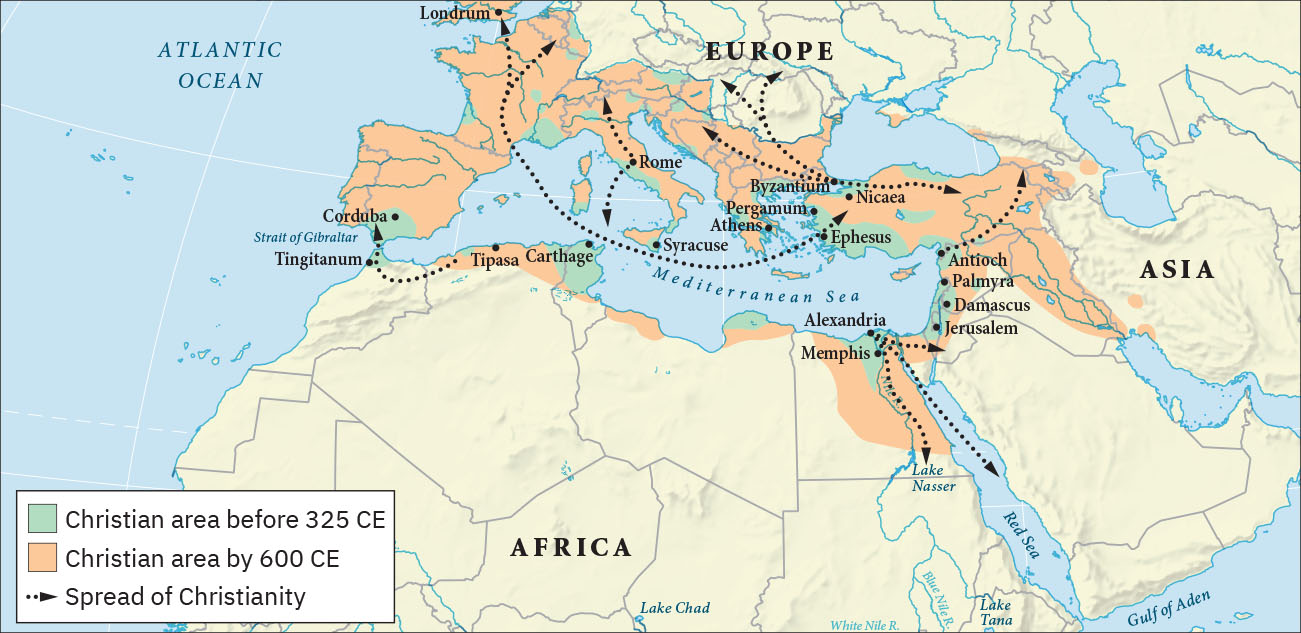
In Africa, these persecutions prompted many orthodox Christians to flee the relative security of the Nile and seek refuge in the western desert. There, some chose to dwell in solitude as hermits while others chose to build monasteries and live as part of communities of the faithful. One of the latter was Antony of the Desert, who, around the year 300, chose to end his life of isolation and welcomed the company of those who wished to live with him and follow his teachings. Soon, numerous religious settlements cropped up throughout the desert (Figure 15.7).
英語のヒント
アフリカでは、こうした迫害により、多くの正統派のキリスト教徒が、比較的安全だったナイル川沿いを離れ、西の砂漠へ避難した。そこで、一人きりで暮らす隠修士になる者もいれば、修道院を建て、信仰者の共同体で暮らす者もいた。後者の一人が、砂漠のアントニオスだった。300年ごろ、それまでの孤独な暮らしを終え、自分と共に暮らし、教えに従おうとする人々を迎えた。まもなく砂漠の各地に、多くの宗教的な集落が現れた(図15.7)。
The Early Spread of Christianity.初期のキリスト教の広がり
(attribution: Copyright Rice University, OpenStax, under CC BY 4.0 license) · CC BY 4.0
Figure 15.7 The Christian faith spread widely throughout the Mediterranean world, including in northern Africa, from the first through the sixth centuries. (attribution: Copyright Rice University, OpenStax, under CC BY 4.0 license)
図15.7 1〜6世紀に、キリスト教は、北アフリカを含む地中海世界へ、広く伝わった。(権利表記:Copyright Rice University, OpenStax、CC BY 4.0)
Within a hundred years, three distinctive forms of monasticism had emerged in northeast Africa. Many isolated hermits continued to dwell in northern Egypt. In southern and northwestern Egypt, however, religiously devout men and women preferred to live a communal existence. Monks in southern Egypt gathered together as bands of “brothers” who lived together and shared their daily work. Another type of monasticism emerged in northwestern Egypt. West of the Nile delta monasteries were more hierarchical in structure. At the head of the monastery was a man known as the abbot (“father”). Around him he gathered other men willing to live according to his directions and his teachings. Religious women also chose to engage in the monastic lifestyle. Like men, some chose to live in communities of the faithful, where they sometimes assumed leadership roles. Others, like Amma (Mother) Sarah, preferred a more solitary existence. According to legend, for sixty years Amma Sarah lived a severely ascetic existence in a small dwelling beside a river, probably the Nile, at which she never looked because she was so focused on the state of her soul that little else held interest for her. The way of life pioneered by the devout men and women of North Africa would be imitated by Christians in Europe and elsewhere.
英語のヒント
100年もたたないうちに、アフリカ北東部には、三つの異なる修道生活の形が現れた。エジプト北部では、多くの隠修士が一人で暮らし続けた。南部と北西部では、敬虔な男女は、共同生活を好んだ。南部の修道士は、「兄弟」の集団として集まり、暮らしも日々の仕事も共にした。北西部には、別の形が現れた。ナイル・デルタの西の修道院は、より階層的な構造を持った。頂点には、「父」を意味するアボット、すなわち修道院長がいた。院長は、自分の指示と教えに従って暮らす男性たちを、周囲に集めた。女性も修道生活を選んだ。男性と同じく、信仰者の共同体で暮らし、ときに指導者となる者もいた。アンマ、すなわち「母」と呼ばれたサラのように、孤独な生活を好む者もいた。伝説によれば、サラは60年間、おそらくナイル川と思われる川のほとりの小屋で、厳しい禁欲生活を送った。自分の魂のあり方に集中し、ほかのことにほとんど関心がなかったため、川には一度も目を向けなかったという。北アフリカの敬虔な男女が切り開いた生活は、ヨーロッパなどのキリスト教徒にも、模倣されることになった。
Christianity quickly spread beyond Egypt southward to Ethiopia. The eventual rise of the Christian Kingdom of Aksum was due in large part to the efforts of the missionary Frumentius. Shipwrecked on the Eritrean coast, Frumentius was brought to the royal court and in the role of tutor converted King Ezana, then a devout polytheist. Following his baptism, Ezana sent Frumentius to Alexandria to ask that the head of the Christian Church in Egypt name a bishop for Ethiopia. The bishop of Alexandria, Athanasius, duly appointed Frumentius, who assumed the name “Selama.” It was likely Bishop Selama who founded Ethiopia’s first Christian monastery.
英語のヒント
キリスト教は、エジプトを越え、南のエチオピアへも急速に広まった。のちにアクスムがキリスト教王国となったのは、宣教師フルメンティウスの努力によるところが大きい。エリトリア沿岸で難船した彼は、王宮へ連れて行かれ、教育係として、それまで熱心な多神教徒だったエザナ王を改宗させた。洗礼の後、エザナはフルメンティウスをアレクサンドリアへ送り、エジプトのキリスト教会の長に、エチオピアの司教を任命してもらうよう求めた。アレクサンドリア司教アタナシオスは、その求めに応じてフルメンティウスを任命し、彼はセラマという名を取った。エチオピア最初のキリスト教修道院を建てたのも、おそらくセラマ司教だった。
It was also from Egypt that Christianity spread westward in the second and third centuries along the North African coast to the Maghreb, the region of northwest Africa lying between modern-day Morocco and Libya and encompassing a vast tract of the Sahara. One of the places in this region where Christianity appears to have flourished was Carthage. Like Christians in Egypt, the community in Carthage was also subject to Roman persecution during the third century. Most of the evidence we have of this community comes to us in the form of martyr stories. One such story, passed down through a diary, tells of the life of Perpetua, a young Christian mother imprisoned along with her infant and her pregnant servant Felicitas, who gave birth while in prison. Perpetua and Felicitas were executed with other Christians in the arena at Carthage.
英語のヒント
2〜3世紀に、北アフリカ沿岸を西へ進み、マグリブへ広がったキリスト教も、エジプトから伝わった。マグリブは、現在のモロッコからリビアまで、広大なサハラの一部も含む、アフリカ北西部の地域である。その中で、キリスト教が栄えたとみられる場所の一つが、カルタゴだった。エジプトと同じく、カルタゴの共同体も、3世紀にローマの迫害を受けた。この共同体について残る証拠の多くは、殉教者の物語という形で伝わる。その一つは日記を通じて残り、若い母親ペルペトゥアの生涯を述べる。彼女は、乳児と、妊娠中の召使いフェリキタスと共に投獄された。フェリキタスは獄中で出産し、二人は、ほかのキリスト教徒と共に、カルタゴの闘技場で処刑された。
To avoid a similar fate, many Christians in North Africa chose to renounce their faith openly while still practicing it in safety. Often the Roman authorities would be satisfied if church leaders simply handed over their scriptures. While this practice seemed preferable to execution for some Christians, others found the refusal to accept martyrdom for their faith an inexcusable offense. Once the persecutions ceased in 313 with the Edict of Milan, which granted religious toleration to Christianity throughout the Roman Empire, many in North Africa refused to recognize those who had renounced their faith as leaders. They further held that any sacramental acts performed by these leaders after they had renounced the faith were invalid, including baptisms, weddings, and even the consecration of clergy. This caused a huge rift in the North African Christian community that became known as the Donatist controversy, named after a Carthaginian bishop named Donatus who led the movement. The problem grew to such proportions that Emperor Constantine had to intervene. Yet even after Donatus was exiled to Gaul (modern France) in 347, the controversy in North Africa continued.
英語のヒント
同じ運命を避けるため、北アフリカの多くのキリスト教徒は、公には信仰を捨てたと表明しながら、安全な場所で信仰を続けることを選んだ。ローマ当局は、教会の指導者が聖典を引き渡すだけで、満足することも多かった。一部のキリスト教徒にとっては、処刑されるよりましな選択だったが、ほかの人々は、信仰のための殉教を拒むことを、許しがたい罪とみなした。313年のミラノ勅令で、ローマ帝国全体にキリスト教への寛容が認められ、迫害が止むと、北アフリカの多くの人々は、信仰を捨てた者を指導者として認めなかった。さらに、そうした指導者が棄教後に行った洗礼、結婚、聖職者の叙階などの秘跡も、無効だと考えた。このため、北アフリカのキリスト教共同体には大きな亀裂が生じ、運動を率いたカルタゴ司教ドナトゥスの名から、ドナトゥス派論争と呼ばれた。問題は、コンスタンティヌス帝が介入せざるをえないほど、大きくなった。ドナトゥスが347年に、現在のフランスに当たるガリアへ追放された後も、北アフリカの論争は続いた。
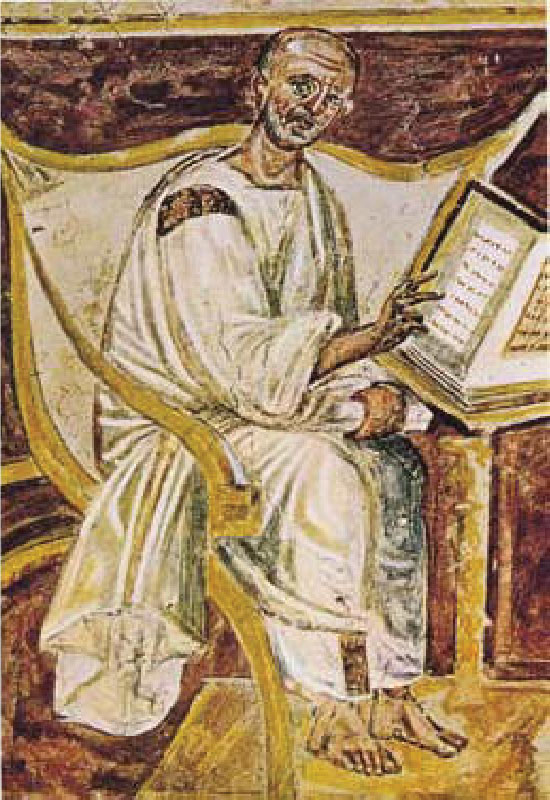
The man who ultimately brought an end to the Donatist rift was one of Christianity’s most influential thinkers, Augustine of Hippo. Augustine was born to a Roman colonist father and indigenous African mother in Tagaste, Roman Numidia (present-day Souk Ahras, Algeria). At the age of seventeen, he took up his studies in Carthage and then went on to become a teacher of rhetoric at the imperial court in Milan. During his time in Italy, Augustine read an account of the life of Antony of the Desert, the famous Egyptian hermit, and was inspired to convert to Christianity (Figure 15.8).
英語のヒント
ドナトゥス派との分裂を、最終的に終わらせた人物は、キリスト教で最も影響力のある思想家の一人、ヒッポのアウグスティヌスだった。ローマ領ヌミディアのタガステ、現在のアルジェリアのスーク・アフラースで、ローマ人入植者の父と、アフリカ先住民の母の間に生まれた。17歳でカルタゴでの勉学を始め、やがてミラノの宮廷で修辞学を教えるようになった。イタリア滞在中に、エジプトの有名な隠修士、砂漠のアントニオスの伝記を読み、その影響でキリスト教へ改宗した(図15.8)。
St. Augustine.聖アウグスティヌス
(credit: “Augustine Lateran” by Unknown/Wikimedia Commons, Public Domain) · Public Domain
Figure 15.8 An influential Christian philosopher and theologian who was later made a saint, Augustine was born in Roman Numidia in the fourth century. This image from a sixth-century fresco, the earliest known of him, shows him as darker skinned, an acknowledgment of his origins as a Romanized African. (credit: “Augustine Lateran” by Unknown/Wikimedia Commons, Public Domain)
図15.8 のちに聖人とされた、影響力のあるキリスト教哲学者・神学者アウグスティヌスは、4世紀にローマ領ヌミディアで生まれた。この6世紀のフレスコ画は、知られる中で最も古い肖像である。ローマ化したアフリカ人という出自を示すものとして、肌を濃い色で描いている。(出典:作者不詳/Wikimedia Commons「Augustine Lateran」、パブリックドメイン)
Augustine returned to North Africa and was appointed bishop of Hippo (present-day Annaba, Algeria) in 395. By this time, the Donatist controversy had been roiling North Africa for approximately a century. A fierce critic of the Donatist view, Augustine was determined to wipe it out. He was the chief opponent of the Donatists at the 411 Council of Carthage, assembled by the emperor to finally resolve the thorny issue. As a result of Augustine’s efforts, the council ordered the Donatists expelled from the church. Despite this fatal blow, elements of the Donatist sect persisted in North Africa until the seventh century.
英語のヒント
北アフリカに帰ったアウグスティヌスは、395年、現在のアルジェリアのアンナバに当たるヒッポの司教に任命された。その頃までに、ドナトゥス派論争は、約1世紀にわたり北アフリカを揺るがしていた。ドナトゥス派の考えを激しく批判した彼は、それを一掃しようと決意した。皇帝が難問に決着を付けようと招集した、411年のカルタゴの会議では、ドナトゥス派に対抗する中心人物だった。彼の働きの結果、会議はドナトゥス派を教会から追放するよう命じた。この決定的な打撃にもかかわらず、同派の一部は、7世紀まで北アフリカに残った。
In addition to his success in combating the Donatists, Augustine left an indelible mark on the early church by writing hundreds of works about Christian doctrine. Perhaps the most influential of these was The City of God, which he wrote in response to the Visigoths’ sack of Rome in 410. In this work, Augustine argued that any kingdom created by humans—including Rome—could fall, but the Kingdom of God, composed of the people who embraced the Christian faith, would persist forever. In effect, Augustine was reassuring the Christians who had witnessed the near-destruction of Rome that it was not the end of the world. The Christian society that had been created over the centuries—the Kingdom of God—would carry on.
英語のヒント
ドナトゥス派との戦いに加え、アウグスティヌスは、キリスト教の教義について何百もの著作を書き、初期の教会に消えない影響を残した。特に影響力が大きかったのは、410年の西ゴートによるローマ略奪に応えて書いた、『神の国』だろう。この著作で彼は、ローマを含め、人間が作った王国は滅びうるが、キリスト教の信仰を受け入れた人々からなる神の国は、永遠に続くと論じた。実質的には、ローマが滅亡しかねない事態を見たキリスト教徒に対し、それが世界の終わりではないと、安心させようとしていたのである。何世紀もかけて作られたキリスト教社会、すなわち神の国は、存続するとした。
Augustine was a major force in helping Christianity assume a more uniform character across the empire. Also, as the Roman Empire became more Christian, religious persecution by Christians against pagans became more common throughout the empire. One of the most violent acts of Christian persecution occurred in Alexandria. In 415, a mob of Christians set upon Hypatia, a pagan philosopher, as she traveled the streets of the provincial capital in her chariot. Pulled from the cart, she was dragged to a nearby temple where she was tortured, flayed alive with shards of roof tiles, and then dismembered. Her body parts were carried to a nearby site and burned. Hypatia’s murder in Roman North Africa was a signal event in the assertion of Christian dominance in the empire, which had witnessed a dramatically violent shift in the tide of persecution throughout the Mediterranean world. So recently pagan, the Christian Roman state now embarked on pogroms and persecutions of pagans and unbelievers meant to eradicate every semblance of the ancient Roman belief systems. An essential feature of this program was the fact that violence against pagans was both actively and passively tolerated by the central administration and provincial governors, leading to the abuse and murder of pagans and the destruction of their temples, altars, and sanctuaries by Christians across the Roman world.
英語のヒント
アウグスティヌスは、キリスト教が帝国全体で、より共通した性格を持つようにする、大きな力となった。また、ローマ帝国がキリスト教化するにつれ、キリスト教徒が異教徒を迫害することも、帝国各地で増えた。その中でも、特に激しい出来事の一つが、アレクサンドリアで起きた。415年、異教徒の哲学者ヒュパティアが、属州の中心都市の街路を馬車で通っていると、キリスト教徒の群衆が襲いかかった。車から引きずり出され、近くの神殿へ連行された彼女は、拷問を受け、生きたまま屋根瓦の破片で皮をはがされ、その後、体を切り分けられた。遺体の一部ずつは、近くの場所へ運ばれ、焼かれた。ローマ領北アフリカでのヒュパティア殺害は、帝国内でキリスト教の優位を押し出す、象徴的な事件だった。地中海世界では、迫害する側とされる側が、激しい暴力とともに転換していた。つい最近まで異教を信じていたローマ国家は、今やキリスト教の国家として、古いローマの信仰の仕組みの名残を一掃するため、異教徒や不信仰者に対する集団的暴力と迫害に乗り出した。この動きの重要な特徴は、中央の行政機構と属州総督が、異教徒に対する暴力を、積極的にも、黙認という形でも許したことである。それが、ローマ世界の各地で、キリスト教徒による異教徒の虐待・殺害、神殿・祭壇・聖所の破壊につながった。
The persecution of pagans in the empire coincided with efforts by the church leadership to reel in aspects of the faith that some considered unorthodox. This process culminated with the Council of Chalcedon in 451 and its decision concerning the nature of Christ. Since the early years of the church, the faithful had been of two minds about the precise nature of Jesus. Some believed he was both fully divine and fully human—the Dyophysite position—while others believed Jesus’s humanity was inseparable from his divinity—the Monophysite position. The Monophysite position dominated in Egypt, but the council decreed it heretical, triggering a schism that brought the ejection of monks and church members throughout Egypt. From that point, the Christian Church in Egypt followed a more independent path and gradually became more isolated from the wider Christian world. It became known as the Coptic Church, reflecting the acceptance of Coptic as both the major literary language and the language of public worship in Egypt at the time.
英語のヒント
帝国内で異教徒への迫害が進むのと並行して、教会指導者は、一部の人々が正統でないと考える信仰のあり方を、統制しようとした。この過程の大きな節目が、451年のカルケドン公会議と、キリストの本性についての決定だった。教会の初期から、イエスの厳密な本性をめぐって、信徒の見解は分かれていた。イエスは完全な神であると同時に、完全な人間でもあるとする立場が、両性論だった。これに対して、イエスの人間性は神性から切り離せないとする立場が、単性論だった。エジプトでは単性論が優勢だったが、公会議はこれを異端と定めた。その結果、分裂が起こり、エジプト各地で、修道士や信徒が教会から排除された。その後、エジプトのキリスト教会は、より独立した道を歩み、キリスト教世界のほかの地域から、次第に隔たるようになった。当時のエジプトで、コプト語が、主要な文語と公の礼拝の言語として受け入れられたことを反映し、この教会は、コプト教会と呼ばれるようになった。
By the eighth century, following the direction of the patriarch of Alexandria, the Coptic Church had uniformly adopted Monophysite Christianity and was flourishing in the upper reaches of the Nile valley. The Christian Kingdom of Aksum thrived until its final destruction by the Zagwe queen Gudit in the tenth century. Queen Gudit and her descendants established the Zagwe Kingdom with its capital at Roha. Later, under King Lalibela, who ruled from 1181 to 1221, Roha became a major pilgrimage center for Christians, styled “the new Jerusalem.” Lalibela renamed the stream flowing through his capital the River Jordan and built new churches by having them carved out of solid rock. By the thirteenth century, Monophysite Christianity was well-established in northeastern Africa.
英語のヒント
8世紀までに、アレクサンドリア総主教に従うコプト教会は、単性論のキリスト教を一様に採用し、ナイル上流で栄えていた。キリスト教王国アクスムも繁栄したが、10世紀に、ザグウェの女王グディトによって、最終的に滅ぼされた。グディトとその子孫は、ロハを都とするザグウェ王国を建てた。のちに、在位1181〜1221年のラリベラ王のもと、ロハは「新しいエルサレム」と称される、大きなキリスト教巡礼地になった。王は、都を流れる小川をヨルダン川と名付け、岩をくり抜かせて、新しい教会を造った。13世紀までには、単性論のキリスト教が、アフリカ北東部に深く根付いていた。