第15章サハラ以南のアフリカの国家と社会States and Societies in Sub-Saharan Africa
15.2 Medieval Sub-Saharan Africa15.2 中世のサハラ以南アフリカ
Learning Objectives学習の目標
By the end of this section, you will be able to:
この節を学ぶと、次のことができるようになる。
Discuss the uniqueness of West African civilization in the premodern world
近代以前の世界で、西アフリカ文明が持っていた独自性を論じる。
Explain the source of wealth and power held by Ghana and Mali
ガーナとマリの富と権力が、何に由来したかを説明する。
Describe how Mapungubwe and Great Zimbabwe developed as a result of the Bantu migrations
バントゥー系の人々の移動を受けて、マプングブエとグレート・ジンバブエがどのように発展したかを述べる。
For nearly seven hundred years, medieval empires and kingdoms dominated the economies and politics of West Africa and southern Africa. The wealth of these states and thus their power came from their control of trade in commodities such as gold, ivory, salt, silk, horses, and enslaved people. In West Africa, the empires of Ghana and Mali moved these goods along a sprawling network of trade that stretched across North Africa, eastward into Ethiopia, and southward as far as the grassland savanna, connecting West Africa to the Mediterranean world, Europe, the Near East, southwest Asia, and beyond. In southern Africa, Mapungubwe and then Great Zimbabwe consolidated their control over local and regional trade and connected their economies with the coastal civilization of the Swahili peoples through a network of waterways that included the Limpopo and Zambezi Rivers. In so doing, they linked the southern African interior with the distant and overlapping nodes of oceanic commerce that connected East Africa with Asia and Arabia.
英語のヒント
中世の帝国や王国は、約700年にわたり、西アフリカとアフリカ南部の経済と政治を支配した。これらの国々の富、そして富がもたらす力は、金、象牙、塩、絹、馬、奴隷にされた人々などの交易を、掌握することから生まれた。西アフリカのガーナ帝国とマリ帝国は、広大な交易網に沿って、これらを運んだ。網は北アフリカ全体に広がり、東はエチオピア、南はサバンナの草原にまで延びていた。それは西アフリカを、地中海世界、ヨーロッパ、近東、南西アジア、さらに遠くの地域と結んだ。アフリカ南部では、マプングブエ、次いでグレート・ジンバブエが、地域内と地域間の交易に対する支配を固めた。リンポポ川やザンベジ川を含む水路網を通じて、その経済は、沿岸のスワヒリの人々の文明と結び付いた。こうして南部アフリカの内陸は、東アフリカとアジア・アラビアをつなぐ海上交易の、遠くで重なり合う拠点とも結ばれた。
The Ghana Empireガーナ帝国
By the turn of the ninth century, Arab rulers in Morocco were minting gold coins called dinars on behalf of the Islamic Caliphate. The official currency of the Muslim world since the end of the seventh century, the dinar was an important link connecting the sprawling Arab empire then centered on Baghdad. The gold used to mint those coins in Morocco came from a kingdom south of the Sahara known as Ghana, a realm the Arab governor of Morocco attempted and failed to conquer (and not to be confused with the modern nation-state of Ghana).
英語のヒント
9世紀への変わり目までには、モロッコのアラブ人支配者は、イスラームのカリフ国に代わり、ディーナールと呼ぶ金貨を鋳造していた。ディーナールは7世紀末以来、ムスリム世界の公式通貨であり、その頃バグダードを中心としていた広大なアラブ帝国を結ぶ、重要なつながりだった。モロッコでその金貨を造るための金は、サハラの南にある、ガーナと呼ばれた王国から来た。モロッコのアラブ人総督が征服を試み、失敗した国である。現在の国民国家ガーナとは、別の国である。
The Ghana Empire dominated the region between western Mali and southeastern Mauritania from the sixth to the thirteenth centuries. Although ancient trade-based societies had existed in the region for some time by enriching themselves on the area’s lucrative salt and gold, the introduction of the Arabian camel by the Romans between the third and fifth centuries CE, and the consequent regularization of trade between Morocco and the Niger River, allowed larger political entities to emerge. Until then, the development of farming and ironworking technology had supported West African clan-based societies in small, simple villages. Sometime around the fifth century, however, a group of chiefdoms in the Sahel grassland south of the Sahara formed a loosely knit empire—that is, the empire or kingdom of Ghana (Figure 15.11).
英語のヒント
ガーナ帝国は6〜13世紀に、現在のマリ西部からモーリタニア南東部までの地域を支配した。この地域には以前から、利益の大きい塩と金によって富を築く、交易を基盤とした社会があった。そこへ紀元3〜5世紀、ローマ人がヒトコブラクダを持ち込み、その結果、モロッコとニジェール川流域の交易が定期的に行われるようになると、より大きな政治組織が生まれた。それまでは、農業と製鉄技術の発達が、西アフリカの氏族を基盤とする社会を、小規模で簡素な村落の中で支えていた。しかし5世紀頃、サハラの南、サヘルの草原にある複数の首長国が、緩く結び付いた帝国を形作った。それがガーナ帝国、あるいはガーナ王国である(図15.11)。
Ghana and the Trans-Saharan Trade.ガーナとサハラ縦断交易
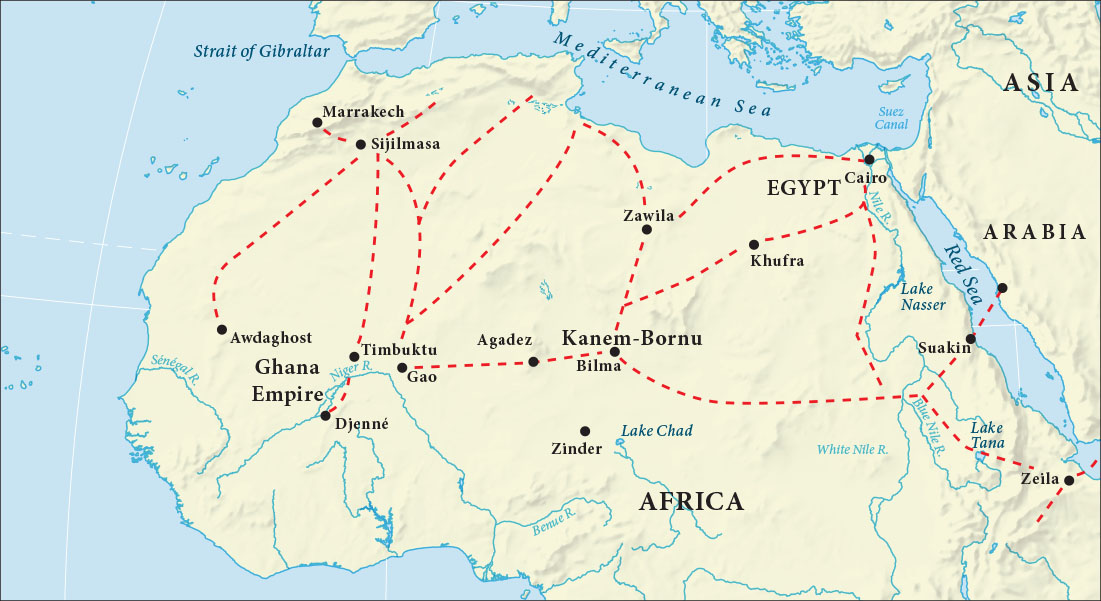
(attribution: Copyright Rice University, OpenStax, under CC BY 4.0 license) · CC BY 4.0
Figure 15.11 The growth and development of Ghana, the first of the great medieval West African empires, were tied to its trade in goods and commodities across North Africa. (attribution: Copyright Rice University, OpenStax, under CC BY 4.0 license)
図15.11 中世西アフリカの大帝国のうち、最初に興ったガーナの成長と発展は、北アフリカを横断する商品・物資の交易と結び付いていた。(出典:Rice University/OpenStax、CC BY 4.0)
Although the origins of the Ghana Empire are shrouded in mystery, one theory holds that it was founded by Soninke speakers from Senegal who referred to their kingdom as Wagadu (Ghana, the name by which it was known to outsiders, was one of the titles of its king). Soninke oral tradition tells us that the kingdom was founded by Diabe Cisse, a powerful figure whose father Dinga, a nomadic mystic, was said to have conquered a female water genie. Dinga subsequently wed the genie’s daughters. Sons resulted from the union of these women and Dinga, and their descendants established important Soninke families. Cisse’s arrival as a son of Dinga, an outsider, marked a turning point in the history of the region, then subject to the destabilizing effects of nomadic raids.
英語のヒント
ガーナ帝国の起源は、謎に包まれている。一説では、セネガルから来たソニンケ語を話す人々が建国し、自国をワガドゥと呼んだという。外部の人々が用いた「ガーナ」は、王の称号の一つだった。ソニンケの口承によると、王国の創始者は、有力者ディアベ・シセだった。父ディンガは、遊牧する神秘家で、女性の水の精霊を征服したと伝えられる。その後、ディンガは精霊の娘たちと結婚した。彼女たちとの間に生まれた息子の子孫が、ソニンケの有力家系を築いた。外来者ディンガの息子シセの登場は、この地域の歴史の転機となった。当時、この地域は、遊牧民の襲撃によって不安定になっていた。
With the drying out of the Sahara, the Sanhaja people of southern Morocco pressed deeper into the Sahel in their search for water and seasonal grazing land. During drought years, their migrations took the form of violent raids on settled agricultural communities, including those of the Soninke. In response, Soninke cavalry commanders turned to Cisse; tradition holds that Cisse unified the Soninke in a loose federation to combat the raiders and to expand the kingdom.
英語のヒント
サハラの乾燥化に伴い、モロッコ南部のサンハージャの人々は、水と季節ごとの放牧地を求めて、サヘルの奥へ進んだ。干ばつの年には、その移動は、ソニンケなどの定住農耕共同体に対する、激しい襲撃という形を取った。対抗するため、ソニンケの騎兵指揮官たちはシセを頼った。伝承によれば、シセはソニンケの人々を緩やかな連合へまとめ、襲撃者と戦い、王国を拡大したという。
The early growth of Ghana was a slow process of conquering independent chiefdoms and kingdoms and then absorbing them into the empire. At the empire’s core were four central provinces established by Diabe Cisse when he first unified the Soninke. Conquered vassal chiefdoms and kingdoms occupied the periphery of the kingdom. Some of these vassal states operated fairly independently of the central administration and paid only a small amount of tribute; other states were controlled to some extent by the capital. As the kingdom expanded, so too did its military. When Ghana reached the apex of its power in the early eleventh century CE, its king had some 200,000 soldiers at his command.
英語のヒント
ガーナ初期の成長は、独立した首長国や王国を征服し、帝国へ取り込む、ゆっくりした過程だった。中心部には、ディアベ・シセが最初にソニンケを統一したときに置いた、四つの中核的な州があった。周辺には、征服され、従属した首長国や王国が並んだ。従属国のうち、中央政府からかなり独立して行動し、少額の貢納しか行わない国もあった。ある程度、都の統制を受ける国もあった。王国が広がるにつれ、軍も拡大した。紀元11世紀初め、ガーナが勢力の頂点に達した頃、王は約20万人の兵を指揮下に置いていた。
The Soninke response to nomadic raiders was only one factor that may have stimulated unification during the early period of Ghanaian history. Historians believe Ghana’s position with regard to trade was another. Ghana grew powerful, and its kings became wealthy on the strength of the trans-Saharan trade, which the Soninke were ideally placed to exploit. Situated in the western Sahel, they stood halfway between the desert—the principal source of salt—and the territory of Bambuk—where goldfields were located along the upper reaches of the Senegal River. Initially, the Soninke had exchanged their gold surplus for salt harvested by the Taghaza people of the Sahara, but soon cross-desert traffic by camel allowed North Africans access to West African gold. As the trans-Saharan demand for gold increased, the Soninke were able to act as intermediaries, passing Saharan salt to the gold producers of the savanna woodland to their south.
英語のヒント
遊牧民の襲撃への対処は、ガーナ史の初期に、統合を促したと考えられる要因の一つにすぎなかった。歴史家は、交易上の位置も、もう一つの要因だったと考えている。ガーナはサハラ縦断交易によって強国となり、王たちは富んだ。ソニンケの人々は、その交易を利用するうえで、理想的な位置にいた。サヘル西部にいた彼らは、塩の主要産地である砂漠と、セネガル川上流沿いに金の産地を持つバンブクとの、中間に位置した。当初、ソニンケの人々は、余剰の金を、サハラのタガザの人々が採取した塩と交換した。やがて、ラクダによる砂漠横断交通が、北アフリカの人々にも、西アフリカの金への道を開いた。サハラの向こう側で金の需要が増すと、ソニンケの人々は仲介者となり、南のサバンナ疎林に住む金の生産者へ、サハラの塩を渡すことができた。
Despite stories that celebrate Ghana as a “land of gold,” its kings’ control over the Bambuk goldfields was tenuous. Located far to the south, the goldfields were beyond Ghiyaru, the kingdom’s southernmost trading post. The chief of the nearest village had local authority over the mining area, and while Ghanaian rulers were able to enforce a strict monopoly on gold nuggets above an ounce in weight, the difficulties of digging mine shafts up to sixty feet deep and transporting the gold to the capital at Koumbi Saleh (southern Mauritania today), which could take upward of eighteen days, made Ghanaian dominance precarious. Yet the empire’s wealth was legendary, and its reputation spread throughout North Africa and into Europe and reached Muslim scholars as far away as Baghdad.
英語のヒント
ガーナを「黄金の国」とたたえる話はあるが、王たちによるバンブクの金産地の支配は、不安定だった。産地ははるか南、王国最南端の交易拠点ギヤルの、さらに先にあった。採掘地の現地の権限は、最寄りの村の首長が持っていた。ガーナの支配者は、1オンスを超える金塊については、厳格な独占を実施できた。それでも、深さ60フィート、約18メートルに及ぶ坑道を掘り、金を都クンビ・サレー、現在のモーリタニア南部まで運ぶのは困難だった。輸送に18日以上かかることもあり、それがガーナの支配を不確かなものにした。それでも帝国の富は伝説的で、その評判は北アフリカ全土からヨーロッパへ広まり、はるかバグダードのムスリム学者にまで届いた。
Ghanaian wealth derived from other commodities as well, including copper (on which the king levied a hefty custom duty) and captives. Many captives were often prisoners of war. Others had been seized in enslavement raids. In the twelfth century, the Moroccan geographer al-Idrisi, recounted a Ghanaian slave raid on a region named Lamlam: “[Quotation omitted for rights reasons.]” Al-Idrisi’s observations were confirmed by his contemporary, al-Zuhri. Scholars have estimated that during the height of the Ghana Empire, some five thousand captives were transported across the Sahara to slave markets in North Africa every year.
英語のヒント
ガーナの富は、ほかの商品からも生まれた。たとえば銅には、王が高い関税を課した。捕虜や連れ去られた人々も、富の源だった。その多くは戦争の捕虜であり、ほかには、人々を奴隷にするための襲撃で捕らえられた者もいた。12世紀のモロッコの地理学者イドリースィーは、ガーナの人々が、ラムラムという地域で行った奴隷狩りを伝えた。〔権利の関係で割愛〕。同時代のズフリーも、イドリースィーの記述を裏付けた。研究者の推計では、ガーナ帝国の最盛期に、毎年約5,000人の捕虜・被虜者が、サハラを越え、北アフリカの奴隷市場へ運ばれたという。
During the eleventh century, the Ghanaians’ tolerance was sorely tested, however. The people welcomed Muslim traders, but radical reformist Islamic sects in Morocco threatened their peace and prosperity. Early in the century, the kingdom had expanded to take over the Islamic town of Awdaghost, an oasis north of the capital. At about the same time, a militant Islamic Almoravid movement emerged among the Sanhaja people of the southern Sahara, who soon established an empire centered on Morocco. In 1055, they captured Awdaghost, and in the ensuing religious strife and sectarian warfare, the Soninke Ghanaians converted to Islam. The wider destruction caused by violence had so weakened Ghana’s trading links that by the end of the twelfth century, it had lost its dominant position over the region’s trade. Having been thoroughly Islamized, Ghana began to produce Muslim scholars, lawyers, and Quran readers of some repute, many traveling to Islamic Spain to study or going on pilgrimage to Mecca.
英語のヒント
しかし11世紀には、ガーナの人々の寛容さが、厳しく試された。ムスリム商人を歓迎していたが、モロッコの急進的なイスラーム改革派が、平和と繁栄を脅かした。世紀の初めに、王国は領域を広げ、都の北のオアシスにある、イスラームの町アウダゴストを手に入れていた。ほぼ同じ頃、サハラ南部のサンハージャの人々の間で、戦闘的なイスラーム運動であるムラービト運動が興った。彼らはまもなく、モロッコを中心とする帝国を築いた。1055年にアウダゴストを占領し、続く宗教的対立と宗派間の戦争の中で、ガーナのソニンケの人々はイスラームへ改宗した。暴力がもたらす広範な破壊は、ガーナの交易上のつながりを著しく弱め、12世紀末までに、地域の交易を支配する地位は失われた。徹底したイスラーム化を経たガーナからは、名のあるムスリムの学者、法律家、クルアーンの読誦者が現れた。多くはイスラーム統治下のスペインへ学びに行き、あるいはメッカへ巡礼した。
The eleventh and twelfth centuries were a transitional time in the history of the kingdoms of West Africa. As Ghana expanded and was in turn conquered, new goldfields were opened at Bure in the woodland savanna south of Bambuk, well beyond Ghana’s commercial reach. Itinerant Soninke traders transported the gold from Bure to the Middle Niger region on new trans-Saharan trade routes east of Awdaghost that bypassed the Ghanaian capital and shifted the caravans of North Africa to Oualata (Walata). These changes provided the southern Soninke and Malinke chiefdoms the chance to assert their independence. In the early 1200s, the southern Soninke chiefdom of Sosso took over most of former Ghana as well as the Malinke people. This set the stage for a struggle for Malinke independence against the Sosso, which ultimately led to the creation of the Sudanese kingdom of Mali.
英語のヒント
11〜12世紀は、西アフリカ諸王国の歴史の転換期だった。ガーナが拡大し、その後、逆に征服される間に、バンブク南方のサバンナ疎林のブレで、新たな金の産地が開かれた。そこは、ガーナの商業上の勢力圏を大きく外れていた。行商するソニンケ商人は、ブレの金をニジェール川中流へ運んだ。アウダゴストの東に開かれた、新しいサハラ縦断交易路を通ってである。路線はガーナの都を迂回し、北アフリカの隊商の行き先を、ワラタへ移した。こうした変化は、南部ソニンケとマリンケの首長国に、独立を主張する機会を与えた。1200年代初め、南部ソニンケの首長国ソソは、旧ガーナの大半と、マリンケの人々を支配下に置いた。それが、ソソに対するマリンケの独立闘争の舞台となり、最終的に、スーダーン地域のマリ王国の成立へつながった。