第15章サハラ以南のアフリカの国家と社会States and Societies in Sub-Saharan Africa
The Expansion of Islam in Africaアフリカでのイスラームの拡大
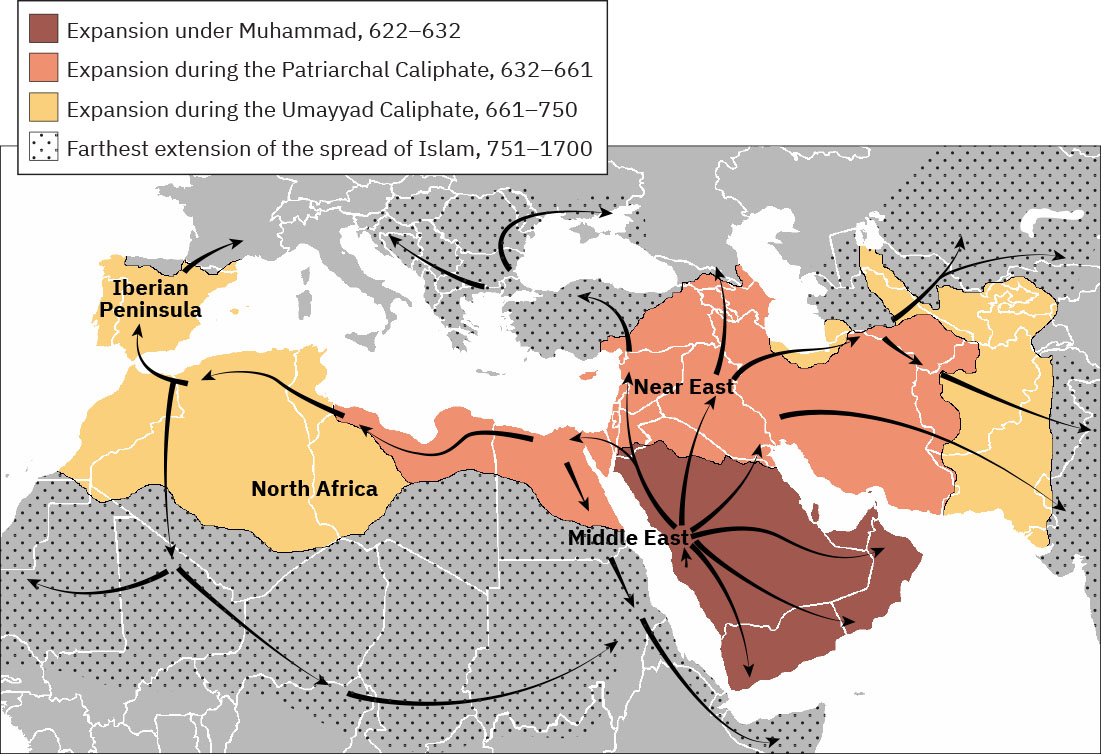
By the start of the seventh century, Christianity seemed firmly entrenched across Egypt and the Maghreb. But by the end of that century, the situation had changed dramatically as the religion of Islam swept across the region. Founded in the early seventh century, within a few decades, Islam had gathered armies that consolidated control of the Arabian Peninsula and the region of the Levant and established a bridgehead in Byzantine Egypt from which to launch the conquest of North Africa. As Muslim conquerors advanced across the region, they established settlements that eventually developed into the towns and cities that would house the officials of the Islamic Caliphate, the area ruled over by the leader of the Islamic state, the caliph (Figure 15.9).
英語のヒント
7世紀の初めには、エジプトとマグリブに、キリスト教が確固として根付いているように見えた。ところが世紀末までに、イスラームが地域一帯へ広がり、状況は劇的に変わった。7世紀初めに成立したイスラームは、数十年の間に軍勢を集め、アラビア半島とレヴァントを掌握し、ビザンツ領エジプトに、北アフリカ征服の足掛かりを得た。ムスリムの征服者は、地域を進むにつれ、集落を築いた。それらはやがて、イスラームのカリフ国の官吏が住む、町や都市へ発展した。カリフ国とは、イスラーム国家の指導者であるカリフが統治する領域である(図15.9)。
The Spread of Islam.イスラームの広がり
(credit: modification of work “Age of the Caliphs (version with more surrounding space)” by Brian Szymanski/Wikimedia Commons, Public Domain) · Public Domain
Figure 15.9 This map shows the spread of Islam over time and across North Africa, the Iberian Peninsula, and the Near and Middle East. (credit: modification of work “Age of the Caliphs (version with more surrounding space)” by Brian Szymanski/Wikimedia Commons, Public Domain)
図15.9 時代とともに、イスラームが北アフリカ、イベリア半島、近東・中東へ広がったことを示す地図。(出典:Brian Szymanski/Wikimedia Commons「Age of the Caliphs (version with more surrounding space)」を加工、パブリックドメイン)
In 661, the Umayya family of Mecca assumed control of the caliphate and combined the previous conquests into a functioning state with a capital at Damascus in Syria. Under their rule, the position of caliph changed from being a family member or close associate of the prophet Muhammad into a dynastic, heritable position passed from father to son. The Umayyad dynasty extended the reach of the caliphate through military conquest until it encompassed all of North Africa's Mediterranean coast. With Egypt as its launching pad, the Muslim conquest of Byzantine-controlled territories in the Maghreb region of North Africa proceeded in three stages between 642 and 709.
英語のヒント
661年、メッカのウマイヤ家がカリフの権力を握り、それまでの征服地を、シリアのダマスカスを首都とする、機能する国家へまとめた。その支配下で、カリフの地位は、預言者ムハンマドの親族や近い仲間が担うものから、父から子へ受け継がれる、王朝の世襲の地位へ変わった。ウマイヤ朝は、軍事征服でカリフ国を広げ、北アフリカの地中海沿岸全体を含むまでになった。エジプトを出発拠点にした、北アフリカのマグリブのビザンツ領征服は、642〜709年の間に、三つの段階を経て進んだ。
The earliest Arab accounts of the conquest date from some two hundred years later and are not very detailed, although they serve as the basis of our understanding of these events. After Egypt was conquered, the Islamic advance across North Africa stalled because of the thousand-plus miles of desert between the Nile delta and the Byzantine province of Africa centered on Carthage. But by 647, tens of thousands of Muslim soldiers had begun their march to the Maghreb. That same year, they engaged with and defeated the forces of the Byzantine governor at Tripolitania (in modern-day Libya).
英語のヒント
征服を伝える最も古いアラブ側の記録も、出来事から約200年後のもので、詳しい内容は乏しい。それでも、これらが、私たちの理解の基礎となっている。エジプト征服の後、ナイル・デルタと、カルタゴを中心とするビザンツのアフリカ属州の間に、1,000マイル以上、約1,600キロメートル以上の砂漠があったため、イスラーム勢力の進撃は足踏みした。しかし647年までには、数万人のムスリム兵がマグリブへの行軍を始めた。同年、現在のリビアのトリポリタニアで、ビザンツ総督の軍と戦い、これを破った。
By 665, a second invasion of North Africa was underway. Once again, an army of tens of thousands of Arab soldiers marched from Egypt, this time determined to take Carthage. Reinforced later by forty thousand soldiers from Damascus, the Islamic advance established a beachhead at Kairouan in modern-day Tunisia. Kairouan, which became the capital of the Islamic province of Ifriqiya, was the center of Islamic operations that plunged Arab armies into the heart of North Africa, including Libya, Tunisia, and Algeria. After prolonged campaigns against indigenous tribes and the forces of the Byzantine provincial government, Carthage finally fell to a third Arab invasion in 698.
英語のヒント
665年までには、北アフリカへの第2の侵攻が始まった。再び数万人のアラブ兵がエジプトを出発し、今度はカルタゴの攻略を目指した。のちにダマスカスから4万人の増援を受け、イスラーム軍は、現在のチュニジアのカイラワーンに足場を築いた。カイラワーンは、イスラームのイフリーキヤ州の都となり、アラブ軍がリビア、チュニジア、アルジェリアなど、北アフリカの内奥へ進む作戦の中心だった。先住民の諸集団やビザンツの属州政府軍との長い戦いの後、698年、第3のアラブ侵攻で、ついにカルタゴが陥落した。
After taking Carthage, Arab armies continued their sweep across North Africa. Along the way, their numbers were swelled by African soldiers. Many were forced to join the Arabs while others volunteered, hoping to share in the spoils that would result from a planned invasion of Spain, which took place in 711. That year, armies of the Umayyad Caliphate sailed across the Strait of Gibraltar and invaded the Iberian Peninsula. A few years later, Islamic forces had occupied all the major towns in the peninsula and advanced as far north as Narbonne, France. In less than a century, Islam went from being a novel religious movement centered on the Arabian Peninsula to an empire that stretched from Iraq in the east to the Atlantic coast of North Africa in the west. Despite its spectacular success, however, the Umayyad dynasty was unable to hold onto power and fell to revolution in 750. That year, the Abbasid family from Mecca seized control of the Islamic Caliphate and relocated its capital from Damascus to Baghdad, where it would remain for five centuries.
英語のヒント
カルタゴ攻略後も、アラブ軍は北アフリカを進んだ。その間にアフリカの兵士が加わり、兵力は増した。強制されて加わる者も多かったが、予定されていたスペイン侵攻の戦利品を分け合おうと、志願する者もいた。侵攻は711年に実行され、ウマイヤ朝の軍はジブラルタル海峡を渡り、イベリア半島へ攻め込んだ。数年後には、半島の主要都市をすべて占領し、北はフランスのナルボンヌまで進んだ。1世紀もたたないうちに、イスラームは、アラビア半島を中心とする新しい宗教運動から、東はイラク、西は北アフリカの大西洋岸に至る帝国へ変わった。しかし、この目覚ましい成功にもかかわらず、ウマイヤ朝は権力を維持できず、750年の革命で倒れた。メッカ出身のアッバース家がカリフ国を掌握し、首都をダマスカスからバグダードへ移した。首都はその後、5世紀にわたり、そこに置かれることになった。
The Islamic military conquest of North Africa might have ended in the eighth century, but the spread of Islam did not. Islam was diffused throughout West, East, and sub-Saharan Africa primarily by merchants, traders, scholars, and missionaries. Muslim Berbers (Amazigh) carried the ideas of Islam from North Africa along the many trans-Saharan trade routes they used. In this way, the ideas of the religion penetrated the arid desert and reached West African trading towns like Gao and Koumbi Saleh, the capital of the Ghana Empire. Over time and through increased exposure, some ruling sub-Saharan African elites began to adopt it, and in some cases, they blended it with their traditional beliefs. Although the Ghanaian kings themselves did not convert, they recognized the importance of the Muslim-led trans-Saharan trade to their economy and so tolerated Islam. In acknowledgment of this fact, they allocated a second town of their capital to Muslim merchants and traders. This district took on a distinct Islamic character, a fact borne out by the presence of mosques within it.
英語のヒント
北アフリカの軍事征服は、8世紀には終わったかもしれない。しかし、イスラームの広がりは終わらなかった。西アフリカ、東アフリカ、サハラ以南のアフリカへは、主に商人、交易者、学者、伝道者が、イスラームを伝えた。ムスリムのベルベル人、すなわちアマジグは、利用する多くのサハラ縦断交易路に沿い、北アフリカから教えを運んだ。こうしてイスラームは、乾いた砂漠を越え、ガオや、ガーナ帝国の都クンビ・サレーなど、西アフリカの交易都市に届いた。触れる機会が増えるにつれ、サハラ以南の支配層の一部は、イスラームを受け入れ始めた。伝統的な信仰と混ぜ合わせる場合もあった。ガーナ王たち自身は改宗しなかったが、ムスリムが主導するサハラ交易が自国の経済に重要だと認め、イスラームを許容した。その重要性を認め、都を構成するもう一つの町を、ムスリム商人や交易者のために割り当てた。その地区には、モスクの存在にも示されるように、はっきりしたイスラーム的性格が生まれた。
By the eleventh century, the broader Islamic world extended across North Africa and the western Sahara into Ghana in the western Sudan. However, even by this late date, Islam had made only a limited impact in West Africa, and many Amazigh groups tended to mingle both Islamic traditions and native African religious practices. Some more orthodox Muslims in the region found this less than satisfactory and sought to rectify the problem. What emerged were reformist Islamic kingdoms in West Africa. The earliest was the Almoravid state, which arose in the eleventh century. Centered in Morocco and led by a radical Islamic scholar, the Almoravid state grew rapidly through Islamic fervor and military conquests. By the 1070s, the Almoravids controlled a vast portion of West Africa from the Mediterranean coast of Morocco to the edges of the Ghana Empire. In the process, many groups in these areas were more thoroughly Islamized. In this period, Islam truly began to expand among the people of Ghana.
英語のヒント
11世紀までに、広いイスラーム世界は、北アフリカとサハラ西部を越え、スーダーン西部のガーナにまで延びた。しかし、その頃でも西アフリカへの影響は限られ、多くのアマジグの集団は、イスラームの伝統と、アフリカ固有の宗教慣行を混ぜ合わせていた。より厳格なムスリムの一部は、その状況に満足せず、正そうとした。こうして現れたのが、西アフリカの、イスラーム改革を掲げる王国だった。最も早いものが、11世紀に興ったムラービト朝である。モロッコを中心とし、急進的なイスラーム学者に導かれた国家は、宗教的熱意と軍事征服で、急速に成長した。1070年代までには、モロッコの地中海岸からガーナ帝国の辺縁まで、西アフリカの広い範囲を支配した。この過程で、多くの集団が、より徹底してイスラーム化した。ガーナの人々の間で、イスラームが本格的に広がり始めたのも、この時期だった。
By the middle of the twelfth century, the religious enthusiasm of the early Almoravid conquests had largely died down. The descendants of the early founders preferred the peace and luxuries of settled life in Morocco to jihad (war on behalf of Islam). This situation was unsettling to some of the Amazigh, who then launched a successful war of religious reform against the Almoravids and established their own reformist West African kingdom, the Almohad Kingdom. The empire forged by the Almohad Caliphate was short-lived, however, and by the thirteenth century, it had been fatally weakened by internal rebellions.
英語のヒント
12世紀半ばまでに、ムラービト朝初期の征服を支えた宗教的熱狂は、ほぼ衰えていた。建国者たちの子孫は、イスラームのための戦争であるジハードより、モロッコでの定住生活の平和とぜいたくを好んだ。この状況を憂えたアマジグの一部は、ムラービト朝に宗教改革の戦争を挑み、勝利した。彼らは、自らの改革を掲げる西アフリカの国家、ムワッヒド朝を建てた。しかし、ムワッヒド朝カリフ国の築いた帝国は短命で、13世紀までには、内部の反乱により、致命的に弱体化していた。
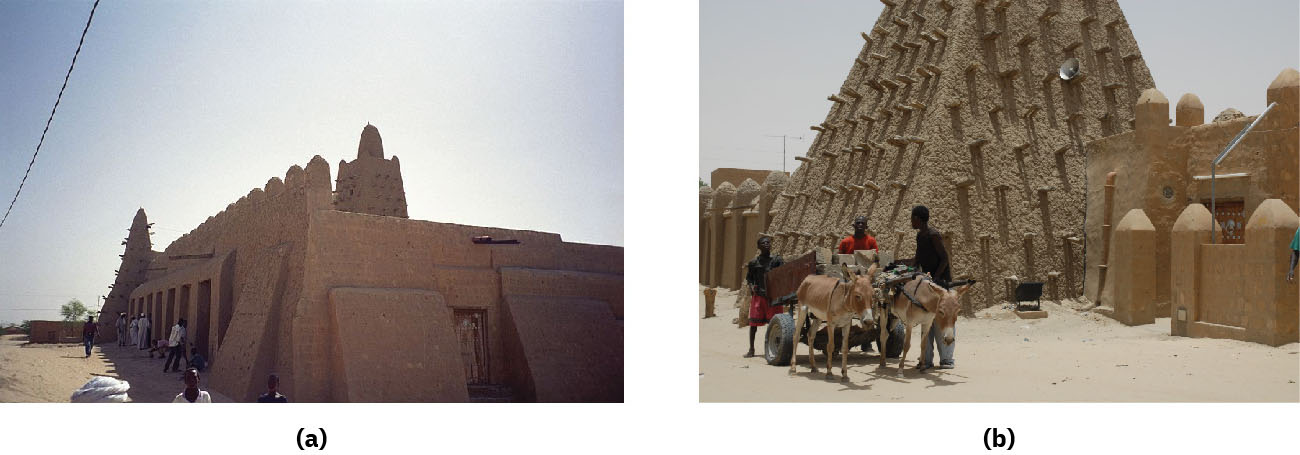
As the geopolitical configuration of the West African kingdoms changed, the center of the regional economy shifted away from Ghana. By the thirteenth century, the kingdom of Mali had become the dominant political and economic force in the region. Unlike the rulers of Ghana, the Malian elite—including the mansa or king—converted to Islam. Mansa Musa, perhaps the most famous ruler of Mali, drew the attention of observers from Arabia to Spain when he went on pilgrimage to Mecca in 1324–1325. Renowned for the wealth of his kingdom, Mansa Musa distributed so much gold during a stopover in Cairo that the Egyptian economy suffered high inflation for more than a decade according to some reports. On his return to Mali, Mansa Musa brought with him Muslim scholars, architects, and books, all of which helped deepen the Islamic character of Mali. At Timbuktu, for example, the Djinguereber Mosque was built, and schools and universities specializing in the study of the Quran were established, cementing that city’s growing international status as a place of Islamic scholarship and learning (Figure 15.10).
英語のヒント
西アフリカの王国の勢力配置が変わるにつれ、地域経済の中心はガーナから移った。13世紀までには、マリが、地域の政治と経済を主導する王国になった。ガーナの支配者と異なり、マンサ、すなわち王を含むマリの支配層は、イスラームへ改宗した。おそらく最も有名なマリの支配者マンサ・ムーサは、1324〜1325年にメッカへ巡礼し、アラビアからスペインまで、人々の注目を集めた。王国の富で名高いムーサは、途中のカイロで大量の金を配った。そのため、ある記録によれば、エジプト経済は10年以上にわたり、高いインフレーションに見舞われたという。マリへ帰る際には、ムスリムの学者、建築家、書物を持ち帰った。それらは皆、マリのイスラーム的性格を深める助けとなった。たとえばトンブクトゥには、ジンガリベル・モスクが建てられ、クルアーンの研究を専門とする学校や学術の場が設けられた。こうして、イスラームの学問と教育の都市として高まりつつあった、国際的な地位が固まった(図15.10)。
Mosques of Timbuktu.トンブクトゥのモスク。
(credit a: modification of work “Djinguereber Mosque, Timbuktu” by “upyernoz”/Flickr, CC BY 2.0; credit b: modification of work “Timbuktu Mud Mosque, Mali, W. Africa” by Emilio Labrador/Flickr, CC BY 2.0) · CC BY 2.0
Figure 15.10 (a) The Djinguereber Mosque in Timbuktu, traditionally dated to 1327. (b) The Sankore Mosque in the same city. Timbuktu was an important center of Islamic learning. (credit a: modification of work “Djinguereber Mosque, Timbuktu” by “upyernoz”/Flickr, CC BY 2.0; credit b: modification of work “Timbuktu Mud Mosque, Mali, W. Africa” by Emilio Labrador/Flickr, CC BY 2.0)
図15.10 (a)トンブクトゥのジンガリベル・モスク。創建は伝統的に1327年とされる。(b)同じ町のサンコーレ・モスク。トンブクトゥはイスラーム学問の重要な中心地だった。(aの出典:“upyernoz”/Flickr「Djinguereber Mosque, Timbuktu」を加工、CC BY 2.0。bの出典:Emilio Labrador/Flickr「Timbuktu Mud Mosque, Mali, W. Africa」を加工、CC BY 2.0)
By the end of the fourteenth century, West African rulers from Mali to Hausaland (present-day Nigeria) had adopted Islam and completed the Islamic encirclement of sub-Saharan Africa. Islam also spread throughout East Africa, although its progress there was checked by entrenched Christianity among the kingdoms of Nubia and the Ethiopian Kingdom of Aksum. By the 1200s, however, such resistance had been severely weakened, and many Christian kingdoms had become Muslim. An important exception was the Kingdom of Abyssinia, the Christian successor state of Aksum and Zagwe. Farther east, in the African Horn, the Muslim sultanates of Ajuran and eventually Adal rose.
英語のヒント
14世紀末までに、マリから、現在のナイジェリアに当たるハウサ地方まで、西アフリカの支配者はイスラームを受け入れ、サハラ以南のアフリカを取り巻くイスラームの広がりが完成した。東アフリカにもイスラームは広がったが、ヌビア諸王国やエチオピアのアクスム王国に深く根付くキリスト教が、進展を阻んだ。しかし1200年代までには、こうした抵抗は大きく弱まり、多くのキリスト教王国がムスリムの国へ変わった。重要な例外は、アクスムとザグウェを継いだ、キリスト教のアビシニア王国だった。さらに東の「アフリカの角」では、ムスリムのアジュラーン・スルタン国が、のちにはアダル・スルタン国が興った。
Islam faced less competition farther south. In the eighth century, Muslim traders from Arabia and Egypt began to settle in towns and trading centers along the Swahili coast, the part of eastern Africa that stretches along the Indian Ocean. By this time, it was home to countless settled Bantu communities, many of which prospered thanks to their role in connecting regional and burgeoning international trade. The Arab incomers intermingled and mixed with the Bantu peoples, creating a unique blended language and culture in an urban, trade-based society.
英語のヒント
さらに南では、イスラームが競合する宗教は少なかった。8世紀、アラビアやエジプトから来たムスリム商人が、インド洋に面する東アフリカのスワヒリ海岸の町や交易拠点に、住み始めた。その頃すでに、無数のバントゥー系定住共同体があり、多くは、地域内の交易と、成長する国際交易を結ぶ役割によって繁栄していた。移住してきたアラブ人は、バントゥー系の人々と交わり、交易を基盤とする都市社会の中に、独自の、混ざり合った言語と文化を生んだ。
By the tenth century, the Swahili coast was acknowledged as an important commercial center. Writing in 915, the Arab traveler al-Masudi described the area’s vigorous trade, which included exports of everything from ambergris and ivory to gold and leopard skins and such imports as stone bowls, Islamic pottery, and glass vessels. By the 1200s, a distinct Swahili civilization had emerged, speaking a distinct Arabic-Bantu dialect, oriented toward the sea rather than the African interior, dominated by independent city-states that specialized in trade, and Islamic in faith. This Swahili language and culture had a powerful influence in the towns of the east African coast. Yet despite Islam’s success along the coast during the medieval period, it made virtually no impact on the peoples of the East African interior until many centuries later.
英語のヒント
10世紀までには、スワヒリ海岸は、重要な商業の中心として知られていた。アラブの旅行家マスウーディーは、915年に書いた記録で、活発な交易を述べた。輸出品は、龍涎香や象牙から、金やヒョウの皮まで広がり、石の鉢、イスラームの陶器、ガラス容器などを輸入していた。1200年代までに、独自のスワヒリ文明が現れた。独特のアラビア語・バントゥー語系の方言を話し、アフリカ内陸より海に目を向け、交易を専門とする独立都市国家が中心となり、イスラームを信じる文明だった。この言語と文化は、東アフリカ沿岸の町に強い影響を及ぼした。しかし中世の沿岸部での成功にもかかわらず、イスラームが東アフリカ内陸の人々に及ぼした影響は、その後何世紀もたつまで、ほとんどなかった。
The spread of monotheistic belief systems like Christianity and Islam throughout Africa proceeded along many fronts, including military conquest, commercial exchange, and cultural diffusion. At no time was the process straightforward and uncomplicated, and conquerors and merchants alike confronted unique challenges. While people adopted these religions for different reasons, whether a firm belief in a better afterlife or the tangible commercial benefits that accompanied conversion, the medieval period of African history nevertheless witnessed a revolution in the nature of belief. This is not to say that ancient African belief systems were eradicated. Indeed, while Christian missionaries and Muslim teachers had little respect for traditional religious practice in Africa, the adoption of Christianity or Islam was often the product of adaptation to the traditional practices and rituals of African peoples.
英語のヒント
キリスト教やイスラームのような一神教は、軍事征服、商業上の交流、文化の伝播など、多くの経路で、アフリカへ広まった。その過程が、単純で込み入っていないことは一度もなく、征服者も商人も、固有の難題に直面した。人々が新しい宗教を受け入れた理由は、よりよい来世への確信であれ、改宗に伴う具体的な商業上の利益であれ、さまざまだった。それでも中世のアフリカでは、信仰のあり方に革命的な変化が起きた。これは、古くからのアフリカの信仰が、根絶されたという意味ではない。実際、キリスト教の宣教師やムスリムの教師は、アフリカの伝統的な宗教慣行をあまり尊重しなかったが、キリスト教やイスラームの受容は、アフリカの人々の伝統的な慣行や儀礼に、適応した結果であることが多かった。
The Africanization of these faiths was largely circumstantial, of course. For example, whereas Christianity emphasized monogamy, Islam allowed a man to take several wives. Thus, Islam would find a more receptive audience among African societies that already practiced polygamous marriages, which were otherwise forbidden in the Christian tradition. The cross-pollination of religious tradition helped to perpetuate ancient African belief systems in both rural and urban communities. Indeed, the Africanization of Islam among the peoples of the Swahili coast produced a distinctive form of the faith, one that included ancestor worship and the appeasing of spirits, as well as the development of unique grave-marking habits and the placement of traditional offerings in mosques.
英語のヒント
こうした信仰のアフリカ化は、もちろん、それぞれの事情に左右された。たとえばキリスト教が一夫一婦制を重視するのに対し、イスラームは、男性が複数の妻を持つことを認めた。そのため、すでに複婚を行っていたアフリカ社会では、イスラームの方が受け入れられやすかった。そうした婚姻は、キリスト教の伝統では禁じられていた。宗教の伝統が交わることで、農村でも都市でも、古くからのアフリカの信仰が、存続しやすくなった。実際、スワヒリ海岸の人々の間では、イスラームのアフリカ化により、独特な信仰の形が生まれた。祖先崇拝や精霊をなだめる行為に加え、独自の墓標の習慣や、モスクに伝統的な供物を置くことも、取り入れられた。