第9章規範倫理学の理論Normative Moral Theory
Ritual and Ren礼と仁
Important to both early and late Confucian ethics is the concept of li (ritual and practice). Li plays an important role in the transformation of character. These rituals are a guide or become a means by which we develop and start to understand our moral responsibilities. Sacrificial offerings to parents and other ancestors after their death, for example, cultivate filial piety. By carrying out rituals, we transform our character and become more sensitive to the complexities of human interaction and social life.
英語のヒント
初期・後期のどちらの儒家倫理でも重要なのは、礼、すなわち儀礼と実践という概念である。礼は、人格の変容に重要な役割を果たす。これらの儀礼は、道徳的責任を育て、理解し始めるための指針、あるいは手段となる。たとえば、亡くなった両親やほかの祖先に供物を捧げることは、孝を育てる。儀礼を行うことで、人格が変わり、人間同士の相互作用や社会生活の複雑さに、いっそう敏感になる。
In later Confucian thought, the concept of li takes on a broader role and denotes the customs and practices that are a blueprint for many kinds of respectful behavior (Wong 2021). In this way, it relates to ren, a concept that refers to someone with complete virtue or specific virtues needed to achieve moral excellence. Confucians maintain that it is possible to perfect human nature through personal development and transformation. They believe society will improve if people abide by moral and social norms and focus on perfecting themselves. The aim is to live according to the dao. The word dao means “way” in the sense of a road or path of virtue.
英語のヒント
後代の儒家思想では、礼はより広い役割をもち、さまざまな敬意ある行動の設計図となる習慣や実践を指す(Wong 2021)。このように、礼は仁と関係する。仁は、完全な徳をもつ人、あるいは道徳的卓越を実現するために必要な特定の徳を指す概念である。儒家は、個人の成長と変容を通じて、人間の本性を完成できると主張する。人々が道徳的・社会的規範に従い、自分自身の完成に努めれば、社会はよくなると考える。目標は道に従って生きることである。道という語は、徳に至る道路や道筋という意味での「道」を意味する。
Junzi and Self-Perfection君子と自己完成
Confucius used the term junzi to refer to an exemplary figure who lives according to the dao. This figure is an ethical ideal that reminds us that self-perfection can be achieved through practice, self-transformation, and a deep understanding of social relationships and norms. A junzi knows what is right and chooses it, taking into account social roles and norms, while serving as a role model. Whenever we act, our actions are observed by others. If we act morally and strive to embody the ethical ideal, we can become an example for others to follow, someone they can look to and emulate.
英語のヒント
孔子は、道に従って生きる模範的な人物を指すために、君子という語を用いた。この人物像は、実践、自己変容、そして社会的関係や規範の深い理解を通じて、自己完成を実現できると教える倫理的理想である。君子は何が正しいかを知り、社会的役割や規範を考慮しながらそれを選び、模範としても働く。私たちが行為するときはいつでも、他者がその行為を見ている。道徳的に行動し、その倫理的理想を体現しようと努めれば、他者が従うべき手本、見習い倣える人になることができる。
The Ethical Ruler倫理的な支配者
Any person of any status can become a junzi. Yet, it was particularly important that rulers strive toward this ideal because their subjects would then follow this ideal. When the ruler Chi K’ang consulted with Confucius about what to do about the number of thieves in his domain, Confucius responded, “If you, sir, were not covetous, although you should reward them to do it, they would not steal” (Analects, 7:18).
英語のヒント
どのような地位にある人も、君子になることができる。しかし、支配者がこの理想に向けて努めることは、特に重要だった。そうすれば、その臣民もこの理想に従うからである。支配者の季康子が、領内の盗賊の多さをどうすればよいか孔子に相談したとき、孔子はこう答えた。「あなたご自身がむさぼらなければ、たとえ褒美を出して盗ませようとしても、人々は盗まないでしょう」(『論語』7:18)。
Confucius thought social problems were rooted in the elite’s behavior and, in particular, in their pursuit of their own benefit to the detriment of the people. Hence, government officials must model personal integrity, understand the needs of the communities over which they exercised authority, and place the welfare of the people over and above their own (Koller 2007, 204).
英語のヒント
孔子は、社会問題の根はエリートの振る舞いにあり、とりわけ民を犠牲にして自分の利益を追求することにあると考えた。したがって官吏は、誠実さを自ら示し、自分が権限を行使する共同体の必要を理解し、民の福祉を自分の福祉より上に置かなければならない(Koller 2007, 204)。
In adherence to the ethical code, a ruler’s subjects must show obedience to honorable people and emulate those higher up in the social hierarchy. Chi K’ang, responding to Confucius’s suggestion regarding thievery, asked Confucius, “What do you say to killing the unprincipled for the good of the principled?” Confucius replied that there was no need to kill at all. “Let your evinced desires be for what is good, and the people will be good.” Confucius believed that the relationship between rulers and their subjects is and should be like that between the wind and the grass. “The grass must bend, when the wind blows across it” (Analects, 7:19).
英語のヒント
倫理的な規範に従い、支配者の臣民は、尊敬に値する人々に従順であり、社会的階層で上にいる者を見習わなければならない。盗みについての孔子の提案を受け、季康子は「道を守る者のために、道を守らない者を殺すことについて、どう考えますか」と尋ねた。孔子は、殺す必要はまったくないと答えた。「あなたが表す欲求を善へ向けなさい。そうすれば、民も善くなるでしょう」。孔子は、支配者と臣民の関係は、風と草の関係のようなものであり、そうあるべきだと考えた。「風が吹き渡れば、草は必ずなびく」(『論語』7:19)。
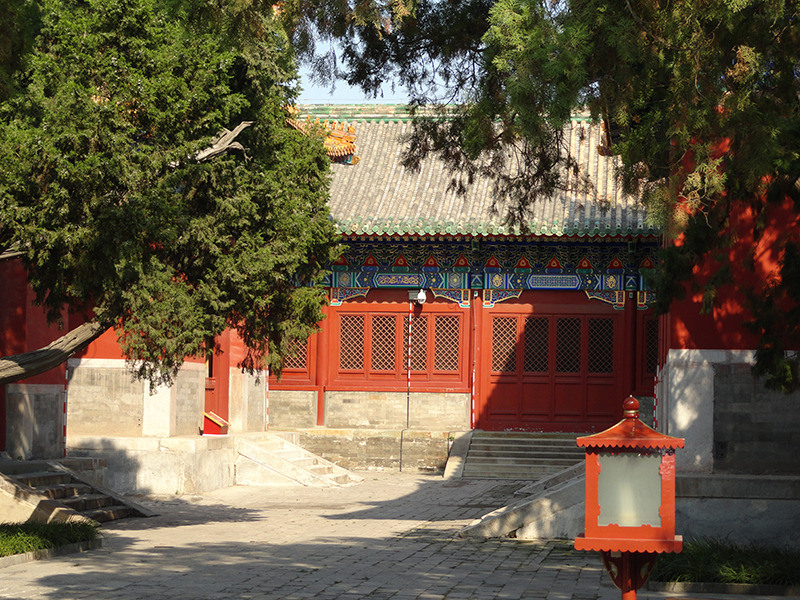
Figure 9.8 The elaborate Temple of Confucius in Beijing, China was initially built in 1302, with additions added in the centuries that followed. (credit: “Temple of Confucius, Beijing, China” by Fabio Achilli/Flickr, CC BY 2.0)
図9.8 中国・北京の精巧な孔子廟は、最初に1302年に建てられ、その後の数世紀に増築された。(クレジット:“Temple of Confucius, Beijing, China” by Fabio Achilli/Flickr, CC BY 2.0)
Japanese Confucianism日本の儒家思想
Although Confucianism was initially developed in China, it spread to Japan in the mid-sixth century, via Korea, and developed its own unique attributes. Confucianism is one of the dominant philosophical teachings in Japan. As in China, Japanese Confucianism focuses on teaching individual perfection and moral development, fostering harmonious and healthy familial relations, and promoting a functioning and prosperous society. In Japan, Confucianism has been changed and transformed in response to local social and cultural factors. For example, Confucianism and Buddhism were introduced around the same time in Japan. It is therefore not uncommon to find variations of Japanese Confucianism that integrate ideas and beliefs from Buddhism. Some neo-Confucian philosophers like Zhu Xi, for example, developed “Confucian thinking after earlier study and practice of Chan Buddhism” (Tucker 2018).
英語のヒント
儒家思想は最初に中国で発展したが、6世紀半ばに朝鮮を経由して日本へ伝わり、日本独自の特徴を発展させた。儒家思想は、日本で有力な哲学的教えの一つである。中国と同じく、日本の儒家思想も、個人の完成と道徳的発達を教え、調和のとれた健全な家族関係を育て、よく機能し繁栄する社会を促すことに焦点を当てる。日本では、儒家思想は土地の社会的・文化的要因に応じて変更され、変容してきた。たとえば、日本には儒家思想と仏教がほぼ同時期に伝わった。そのため、仏教の考えや信念を取り入れた日本の儒家思想の変種が見られることは珍しくない。たとえば、朱熹のような新儒家の哲学者には、「先に禅仏教を学び実践した後で、儒家の思想」を発展させた者もいる(Tucker 2018)。
Aristotelianismアリストテレス主義
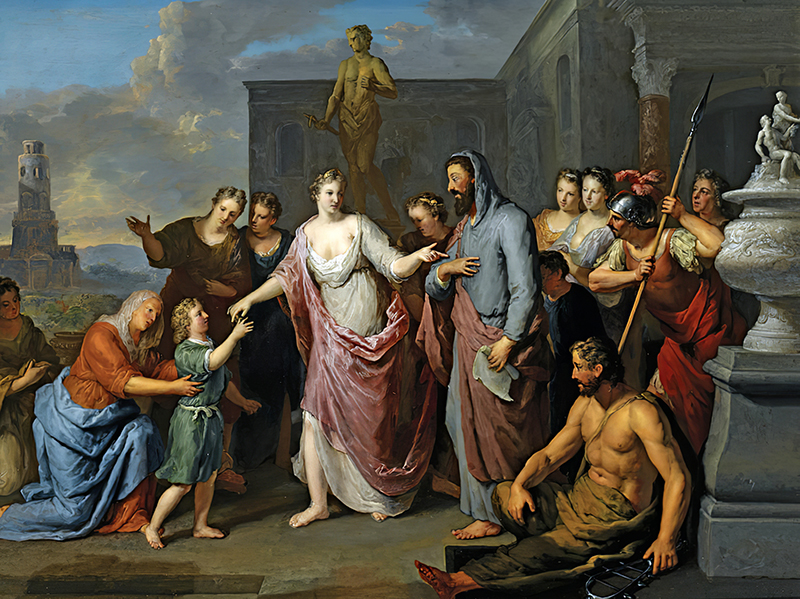
Figure 9.9 This painting by Gerard Hoet depicts Olympias presenting the young Alexander the Great to Aristotle. Aristotle traveled to Macedonian in 343 BCE to tutor the 13-year-old boy, Alexander, who would later become Alexander the Great. (credit: “Olympias presenting the young Alexander the Great to Aristotle” by Gerard Hoet/Wikimedia Commons, Public Domain)
図9.9 ヘラルト・フートのこの絵は、オリュンピアスが幼いアレクサンドロス大王をアリストテレスに引き合わせる場面を描いている。アリストテレスは紀元前343年にマケドニアへ赴き、後にアレクサンドロス大王となる13歳の少年を教えた。(クレジット:“Olympias presenting the young Alexander the Great to Aristotle” by Gerard Hoet/Wikimedia Commons, パブリックドメイン)
Aristotle (384–322 BCE) was a preeminent ancient Greek philosopher. He studied with Plato (ca. 429–347 BCE) at the Academy, a fraternal organization where participants pursued knowledge and self-development. After Plato’s death, Aristotle traveled, tutored the boy who would later become Alexander the Great, and among other things, established his own place of learning, dedicated to the god Apollo (Shields 2020).
英語のヒント
アリストテレス(紀元前384~322年)は、古代ギリシアの卓越した哲学者だった。参加者が知識と自己成長を追求する友愛的な組織、アカデメイアで、プラトン(紀元前429~347年ごろ)に学んだ。プラトンの死後、各地を旅し、後にアレクサンドロス大王となる少年を教え、さらにアポロン神に捧げた自らの学びの場を設立するなどした(Shields 2020)。
Aristotle spent his life in the pursuit of knowledge and wisdom. His extant works today represent only a portion of his total life’s work, much of which was lost to history. During his life, Aristotle was, for example, principal to the creation of logic, created the first system of classification for animals, and wrote on diverse topics of philosophical interest. Along with his teacher, Plato, Aristotle is considered one of the pillars of Western philosophy.
英語のヒント
アリストテレスは、知識と知恵を追求して生涯を送った。今日残っている著作は、生涯の仕事全体の一部にすぎず、その多くは歴史の中で失われた。たとえば、論理学の創設で中心的な役割を果たし、最初の動物分類体系を作り、哲学的関心に関わる多様な主題について書いた。師プラトンとともに、アリストテレスは西洋哲学の柱の一人とされる。