第9章規範倫理学の理論Normative Moral Theory
Utilitarianism功利主義
The term utility means “useful” or “a useful thing.” Utilitarians argue that what is right is whatever produces the most utility, the most usefulness. The question, then, is how do we define usefulness? The utilitarian’s answer is that something is useful when it promotes happiness (or pleasure). According to utilitarians, we have a moral obligation or responsibility to choose the action that produces the most happiness.
英語のヒント
utility という語は、「役に立つ」、あるいは「役に立つもの」を意味する。功利主義者は、正しいものとは、最大の効用、すなわち最大の有用性を生み出すものだと論じる。では、有用性をどう定義するのだろう。功利主義者の答えは、幸福、あるいは快楽を促すとき、あるものは有用であるというものだ。功利主義者によれば、私たちには、最大の幸福を生み出す行為を選ぶ道徳的義務、あるいは責任がある。
Jeremy Bentham and John Stuart Millジェレミー・ベンサムとジョン・スチュアート・ミル
Jeremy Bentham (1748–1832) was the first philosopher to articulate the principle of utility. James Mill (1773–1836), an economist, political philosopher, and historian, was Bentham’s friend and a follower of utilitarianism. James Mill naturally raised his son to be a utilitarian as well. John Stuart Mill (1806–1873) received a rigorous homeschooling under his father’s tutelage. Scholars in the fields of philosophy, political science, and economics continue to apply the insights of Bentham and Mill to this day.
英語のヒント
ジェレミー・ベンサム(1748~1832年)は、功利の原理を明確に述べた最初の哲学者である。経済学者、政治哲学者、歴史家だったジェイムズ・ミル(1773~1836年)は、ベンサムの友人であり、功利主義の信奉者だった。ジェイムズ・ミルは当然、自分の息子も功利主義者になるよう育てた。ジョン・スチュアート・ミル(1806~1873年)は、父の指導のもとで厳格な家庭教育を受けた。哲学、政治学、経済学の研究者たちは、今日に至るまでベンサムとミルの洞察を応用している。
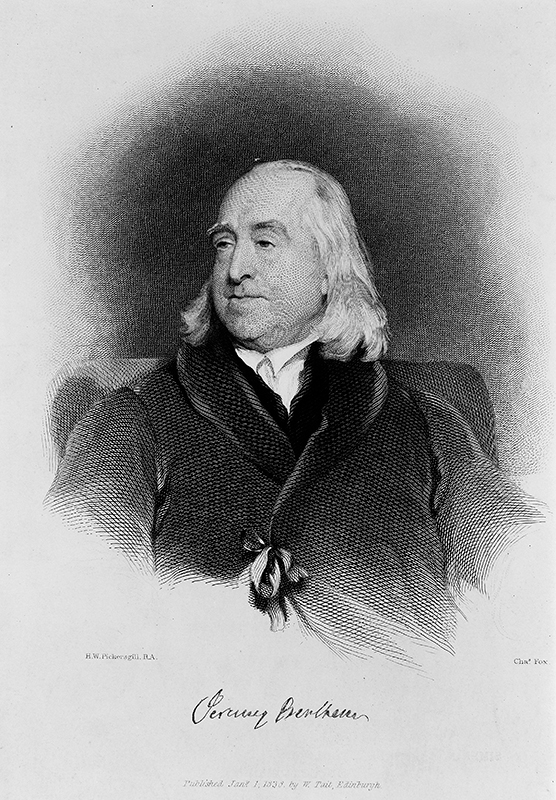
Figure 9.3 Portrait of Jeremy Bentham (1748–1832) by Henry William Pickersgill, 1838. (credit: "Jeremy Bentham. Line engraving by C. Fox, 1838, after H. W. Pickersgill." by C. Fox/Wellcome Collection)
図9.3 ヘンリー・ウィリアム・ピッカースギルによるジェレミー・ベンサム(1748~1832年)の肖像、1838年。(クレジット:“Jeremy Bentham. Line engraving by C. Fox, 1838, after H. W. Pickersgill.” by C. Fox/Wellcome Collection)
The Principle of Utility功利の原理
The principle of utility states that “actions are right in proportion as they tend to promote happiness; wrong as they tend to produce the reverse of happiness” (Mill [1861] 2001, 7). Utilitarians argue that moral conduct is conduct that maximizes the good (or produces the most value). In economics, for example, utility is defined as the amount of enjoyment a consumer receives from a good or a service. You might, for example, choose between buying an oatmeal raisin cookie and a chocolate chip cookie. If you like them both equally, the right action would be to compare the prices and buy the cheaper one. Utility, however, is not always so easy to determine, particularly in more complex situations.
英語のヒント
功利の原理は、「行為は、幸福を促進する傾向に比例して正しく、幸福の反対を生み出す傾向に比例して誤っている」と述べる(Mill [1861] 2001, 7)。功利主義者は、道徳的行為とは善を最大化する、あるいは最大の価値を生み出す行為だと論じる。たとえば経済学では、効用は、消費者が財やサービスから得る楽しみの量と定義される。オートミール・レーズンクッキーとチョコチップクッキーのどちらを買うか選ぶ場合を考えよう。両方が同じくらい好きなら、正しい行為は、値段を比べて安いほうを買うことになる。しかし効用は、特にもっと複雑な状況では、つねにそれほど簡単に決められるわけではない。
The Trolley Problemトロッコ問題
Trolley problems are classic thought experiments first invented by Philippa Foot and widely employed by ethicists to explore moral reasoning (Foot 2002). Consider one such trolley problem, referred to as the bystander case. Imagine you are standing by trolley tracks observing the trolley cars in action. To your horror, you realize that one of the trolley cars is out of control. If nothing is done, the trolley will continue down the track, killing five workers who are performing track maintenance. You happen to be standing near a lever you can pull that will divert the trolley. If you divert the trolley, you will change its path so that it takes a different track where only one worker is performing maintenance. Is it morally permissible to pull the lever?
英語のヒント
トロッコ問題は、フィリッパ・フットが最初に考案し、倫理学者が道徳的推論を探究するために広く用いている、古典的な思考実験である(Foot 2002)。その一つである、傍観者のケースを考えてみよう。あなたはトロッコの線路のそばに立ち、車両が走る様子を見ている。恐ろしいことに、一台のトロッコが制御不能になっていると気づく。何もしなければ、そのまま線路を進み、保守作業をしている五人の作業員を殺してしまう。たまたまあなたは、引くとトロッコの進路を変えられるレバーのそばに立っている。進路を変えると、トロッコは別の線路へ入り、そこでは一人だけが保守作業をしている。レバーを引くことは、道徳的に許されるだろうか。
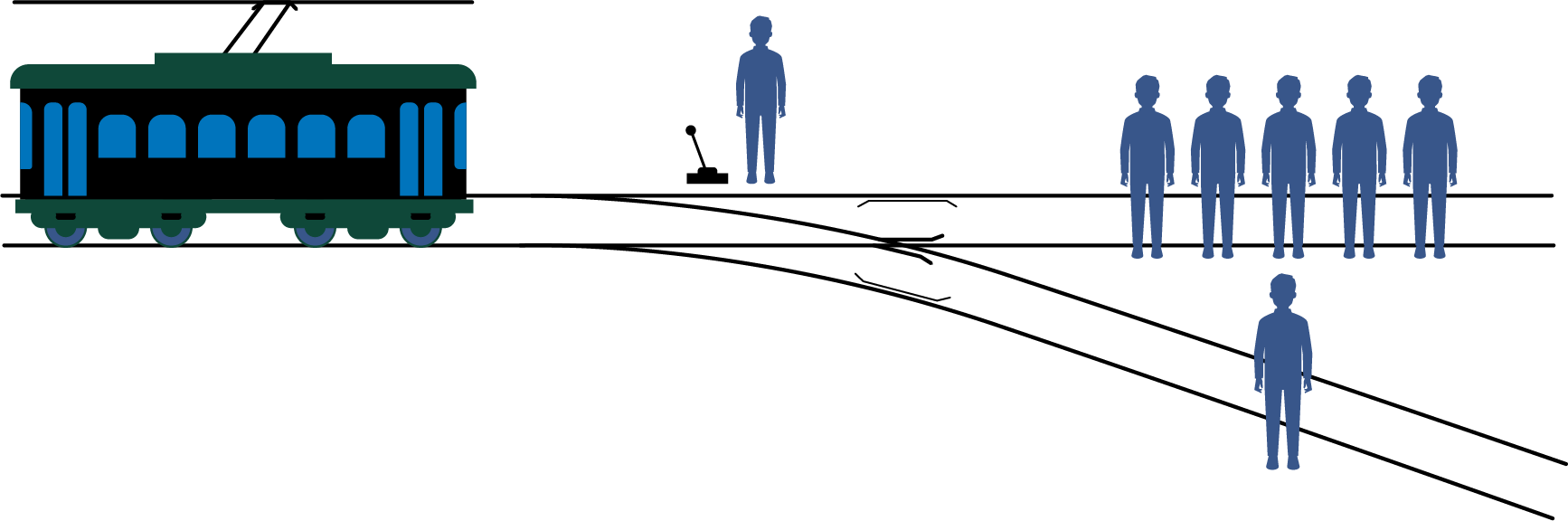
Figure 9.4 Trolley problems are thought experiments that use a difficult ethical dilemma to explore moral reasoning and deliberation. (attribution: Copyright Rice University, OpenStax, under CC BY 4.0 license)
図9.4 トロッコ問題は、難しい倫理的ジレンマを用いて道徳的推論と熟慮を探る思考実験である。(帰属:Copyright Rice University, OpenStax, CC BY 4.0)
The simplest utilitarian response would be “yes.” You would save the lives of four workers. The right decision involves making a simple quantitative calculation: five workers minus one worker is four workers. So the right, moral decision is to divert the trolley. Yet, John Stuart Mill recognized that not all questions of utility can be answered quantitatively.
英語のヒント
功利主義の最も単純な答えは、「はい」となるだろう。四人の作業員の命を救うことになるからである。正しい決定には、単純な量的計算が含まれる。五人の作業員から一人を引くと四人である。したがって、正しい道徳的決定はトロッコの進路を変えることだ。しかしジョン・スチュアート・ミルは、効用に関するすべての問いに、量的に答えられるわけではないと認めていた。
Higher and Lower Pleasures高次の快楽と低次の快楽
Raised to continue in the footsteps of Bentham and his father, John Stuart Mill had a nervous breakdown as a young man. Mill emerged from the crisis with new ideas about utilitarianism, including the realization that Bentham’s characterization of pleasure could be improved upon (Durham 1963). He realized that pleasures differ both quantitatively and qualitatively. Mill identified what he calls higher and lower pleasures to distinguish between different qualities of pleasure. With his revised and more nuanced account of pleasure, Mill set out to develop Bentham’s earlier formulation of utilitarianism. He refined the calculus and assigned a greater significance or preference to higher-quality pleasures (e.g., mental pleasures).
英語のヒント
ベンサムと父の跡を継ぐように育てられたジョン・スチュアート・ミルは、若い頃に神経衰弱に陥った。ミルはその危機から、功利主義についての新しい考えを得て立ち直った。そこには、ベンサムの快楽の捉え方は改善できるという認識も含まれていた(Durham 1963)。ミルは、快楽には量だけでなく質の違いもあると理解した。異なる快楽の質を区別するために、高次の快楽と低次の快楽と呼ぶものを見定めた。快楽についての説明を改め、よりきめ細かくすることで、ベンサムによる先行の功利主義の定式化を発展させようとしたのである。計算を精緻化し、より質の高い快楽、たとえば精神的快楽に、より大きな重要性や優先性を与えた。
Mill distinguished between different (higher and lower) qualities of pleasure in his formulation of utilitarianism. What he called higher pleasures are those pleasures associated with the exercise of our higher faculties. For example, higher pleasures are often associated with the use of our higher cognitive faculties and/or participation in social/cultural life. Lower pleasures, in contrast, are those pleasures associated with the exercise of our lower faculties. For example, lower pleasures are (basic) sensory pleasures like those experienced when we satisfy our hunger or relax after difficult physical activity. As Mill saw it, we have higher cognitive faculties (e.g., reason, imagination, moral sense) that distinguish us from other living things. Our higher cognitive faculties give us access to higher pleasures, and these pleasures are a defining feature of human life.
英語のヒント
ミルは功利主義を定式化する際に、快楽の異なる質、高次と低次を区別した。高次の快楽と呼んだのは、私たちの高次の能力の行使と結びつく快楽である。たとえば、高次の快楽は、高次の認知能力を用いることや、社会的・文化的生活への参加と結びつくことが多い。対して低次の快楽は、低次の能力の行使と結びつく快楽である。たとえば、空腹を満たしたり、きつい身体活動の後でくつろいだりするときの、基本的な感覚的快楽がそれに当たる。ミルの見方では、私たちには理性、想像力、道徳感覚など、ほかの生き物から私たちを区別する高次の認知能力がある。それらの能力は高次の快楽への道を開き、その快楽は人間の生を特徴づけるものとなっている。
It is better to be a human being dissatisfied than a pig satisfied; better to be Socrates dissatisfied than a fool satisfied. And if the fool, or the pig, are of a different opinion, it is because they only know their own side of the question. (Mill [1861] 2001, 10)
英語のヒント
満足した豚であるより、不満足な人間であるほうがよい。満足した愚か者であるより、不満足なソクラテスであるほうがよい。そして、もし愚か者や豚が違う意見をもつなら、それは問題の自分たちの側しか知らないからである。(Mill [1861] 2001, 10)
Mill’s claim that “it is better to be a human being dissatisfied than a pig satisfied” suggests that it is better to be dissatisfied and aware that you are capable of experiencing different qualities of pleasure than to forfeit the higher pleasures merely for the sake of basic satisfaction.
英語のヒント
「満足した豚であるより、不満足な人間であるほうがよい」というミルの主張は、基本的な満足だけのために高次の快楽を放棄するよりも、不満をもちながら、質の異なる快楽を経験できると自覚しているほうがよい、ということを示唆する。
Some Mill scholars have even suggested that our dissatisfaction is a potential source of higher pleasures. In Mill and Edward on Higher Pleasures, Susan Feagin (1983) points out that dissatisfaction stems from a recognition that our situation could be improved. Feagin argues that our ability to formulate plans to improve our situation is a source of higher pleasure. Dissatisfaction motivates us to improve things and pursue a better world and life.
英語のヒント
ミルの研究者の中には、不満は高次の快楽の潜在的な源だとまで論じる人もいる。スーザン・フィーギン(1983)は「ミルとエドワードにおける高次の快楽」で、不満は自分の状況を改善できるという認識から生じると指摘する。フィーギンは、状況を改善する計画を立てる能力こそ、高次の快楽の源だと論じる。不満は、物事を改善し、よりよい世界と生を追求するよう私たちを動機づける。