第5章積分
Fundamental Theorem of Calculus Part 1: Integrals and Antiderivatives微積分の基本定理・第1部:積分と原始関数
As mentioned earlier, the Fundamental Theorem of Calculus is an extremely powerful theorem that establishes the relationship between differentiation and integration, and gives us a way to evaluate definite integrals without using Riemann sums or calculating areas. The theorem is comprised of two parts, the first of which, the Fundamental Theorem of Calculus, Part 1, is stated here. Part 1 establishes the relationship between differentiation and integration.
英語のヒント
微積分の基本定理は、微分と積分の関係を明らかにする強力な定理である。リーマン和や面積計算を使わずに定積分を求める方法も与えてくれる。この定理は二つの部分からなる。まず第1部を示そう。第1部は、微分と積分の関係を確立する。
Before we delve into the proof, a couple of subtleties are worth mentioning here. First, a comment on the notation. Note that we have defined a function, as the definite integral of another function, from the point a to the point x. At first glance, this is confusing, because we have said several times that a definite integral is a number, and here it looks like it’s a function. The key here is to notice that for any particular value of x, the definite integral is a number. So the function returns a number (the value of the definite integral) for each value of x.
英語のヒント
証明に入る前に、少し注意が必要な点を確認しておこう。まず記法についてである。ここでは、別の関数 を a から x まで定積分することによって、関数 を定義している。定積分は一つの数だと何度も述べたのに、ここでは関数のように見えるので、最初は戸惑うかもしれない。大事なのは、x を一つ決めるたびに、その定積分が一つの数に決まるという点である。つまり関数 は、各 x に対して定積分の値という数を返す。
Second, it is worth commenting on some of the key implications of this theorem. There is a reason it is called the Fundamental Theorem of Calculus. Not only does it establish a relationship between integration and differentiation, but also it guarantees that any integrable function has an antiderivative.
英語のヒント
もう一つ、この定理が持つ重要な意味を確認しよう。「微積分の基本定理」と呼ばれるのには理由がある。微分と積分の関係を示すだけでなく、この定理の仮定を満たす連続関数には原始関数が存在することも保証している。原文の「積分可能な関数ならどれでも」という表現は広すぎる。ここで原始関数の存在を保証するのは連続性であり、積分可能であるだけでは十分でない。
Proof証明
Applying the definition of the derivative, we have
導関数の定義を使うと、
Looking carefully at this last expression, we see is just the average value of the function over the interval Therefore, by Theorem 5.3, there is some number c in such that
最後の式をよく見ると、 は、区間 上での関数 の平均値そのものである。したがって定理5.3より、区間 に次式を満たす数 c が存在する。
In addition, since c is between x and x + h, c approaches x as h approaches zero. Also, since is continuous, we have Putting all these pieces together, we have
さらに、c は x と x+h の間にあるので、h が0に近づくと c は x に近づく。また、 は連続だから である。以上をまとめると、
and the proof is complete.
これで証明が完了する。
□
□
Example 5.17例題 5.17
Finding a Derivative with the Fundamental Theorem of Calculus微積分の基本定理で導関数を求める
Use the Theorem 5.4 to find the derivative of
定理5.4を使って、次の関数の導関数を求めよ。
Solution解き方
According to the Fundamental Theorem of Calculus, the derivative is given by
微積分の基本定理より、導関数は次のようになる。
Example 5.18例題 5.18
Using the Fundamental Theorem and the Chain Rule to Calculate Derivatives基本定理と連鎖律で導関数を求める
Let Find
とする。 を求めよ。
Solution解き方
Letting we have Thus, by the Fundamental Theorem of Calculus and the chain rule,
とおくと、 である。微積分の基本定理と連鎖律より、
Example 5.19例題 5.19
Using the Fundamental Theorem of Calculus with Two Variable Limits of Integration積分区間の両端が変数である場合の基本定理
Let Find
とする。 を求めよ。
Solution解き方
We have Both limits of integration are variable, so we need to split this into two integrals. We get
である。積分区間の両端がともに変数なので、二つの積分に分ける必要がある。すると、
Differentiating the first term, we obtain
第1項を微分すると、
Differentiating the second term, we first let Then,
第2項を微分するため、まず とおく。すると、
Thus,
したがって、
Fundamental Theorem of Calculus, Part 2: The Evaluation Theorem微積分の基本定理・第2部:定積分の計算
The Fundamental Theorem of Calculus, Part 2, is perhaps the most important theorem in calculus. After tireless efforts by mathematicians for approximately 500 years, new techniques emerged that provided scientists with the necessary tools to explain many phenomena. Using calculus, astronomers could finally determine distances in space and map planetary orbits. Everyday financial problems such as calculating marginal costs or predicting total profit could now be handled with simplicity and accuracy. Engineers could calculate the bending strength of materials or the three-dimensional motion of objects. Our view of the world was forever changed with calculus.
英語のヒント
微積分の基本定理・第2部は、微積分で最も重要な定理といえるかもしれない。数学者たちが約500年にわたって努力を重ねた末、多くの現象を説明する道具となる新しい方法が生まれた。天文学者は微積分を使って宇宙の距離や惑星の軌道を求められるようになった。限界費用の計算や総利益の予測といった経済の問題も、簡潔かつ正確に扱えるようになった。技術者は、材料の曲げ強度や物体の三次元運動を計算できるようになった。微積分は、私たちの世界観を大きく変えたのである。
After finding approximate areas by adding the areas of n rectangles, the application of this theorem is straightforward by comparison. It almost seems too simple that the area of an entire curved region can be calculated by just evaluating an antiderivative at the first and last endpoints of an interval.
英語のヒント
n 個の長方形の面積を足して近似面積を求める作業と比べると、この定理の使い方は簡単である。原始関数の値を区間の両端で求めるだけで、曲がった領域全体の面積がわかるとは、簡単すぎるようにさえ思える。
We often see the notation to denote the expression We use this vertical bar and associated limits a and b to indicate that we should evaluate the function at the upper limit (in this case, b), and subtract the value of the function evaluated at the lower limit (in this case, a).
を表すために、 という記法をよく使う。縦線と、その上下に付けた a、b は、上端 b での の値から、下端 a での の値を引くことを示している。
The Fundamental Theorem of Calculus, Part 2 (also known as the evaluation theorem) states that if we can find an antiderivative for the integrand, then we can evaluate the definite integral by evaluating the antiderivative at the endpoints of the interval and subtracting.
微積分の基本定理・第2部(定積分の評価定理ともいう)によれば、被積分関数の原始関数がわかれば、区間の両端での原始関数の値を求め、その差をとるだけで定積分を計算できる。
Proof証明
Let be a regular partition of Then, we can write
を区間 の等分割とする。すると、次のように書ける。
Now, we know F is an antiderivative of f over so by the Mean Value Theorem (see The Mean Value Theorem) for we can find in such that
F は区間 上で f の原始関数である。平均値の定理(「平均値の定理」参照)より、 に対して、区間 に次式を満たす を選べる。
Then, substituting into the previous equation, we have
これを前の等式に代入すると、
Taking the limit of both sides as we obtain
両辺で の極限をとると、
□
□
Example 5.20例題 5.20
Evaluating an Integral with the Fundamental Theorem of Calculus微積分の基本定理で積分を求める
Use Theorem 5.5 to evaluate
定理5.5を使って、次の積分を求めよ。
Solution解き方
Recall the power rule for Antiderivatives:
原始関数を求める累乗の公式を思い出そう。
Use this rule to find the antiderivative of the function and then apply the theorem. We have
この公式で原始関数を求め、定理を適用する。すると、
Example 5.21例題 5.21
Evaluating a Definite Integral Using the Fundamental Theorem of Calculus, Part 2微積分の基本定理・第2部で定積分を求める
Evaluate the following integral using the Fundamental Theorem of Calculus, Part 2:
微積分の基本定理・第2部を使って、次の積分を求めよ。
Solution解き方
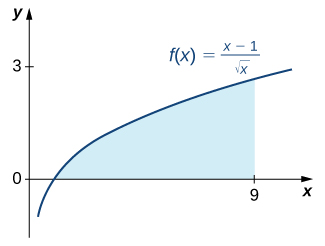
First, eliminate the radical by rewriting the integral using rational exponents. Then, separate the numerator terms by writing each one over the denominator:
まず有理数の指数を使って書き直し、根号をなくす。次に、分子の各項をそれぞれ分母で割った形に分ける。
Use the properties of exponents to simplify:
指数法則を使って簡単にすると、
Now, integrate using the power rule:
累乗の公式で積分すると、
See Figure 5.29.
図5.29を参照。
OpenStax, Rice University; Calculus Volume 1. · CC BY-NC-SA 4.0
Figure 5.29図 5.29
The area under the curve from to can be calculated by evaluating a definite integral.
から までの曲線の下の面積は、定積分で求められる。
Example 5.22例題 5.22
A Roller-Skating Raceローラースケートの競走
James and Kathy are racing on roller skates. They race along a long, straight track, and whoever has gone the farthest after 5 sec wins a prize. If James can skate at a velocity of ft/sec and Kathy can skate at a velocity of ft/sec, who is going to win the race?
英語のヒント
ジェームズとキャシーがローラースケートで競走する。長い直線コースを進み、5秒後に最も遠くへ進んでいたほうが賞品をもらう。ジェームズの速度が フィート毎秒、キャシーの速度が フィート毎秒なら、勝つのはどちらか。
Solution解き方
We need to integrate both functions over the interval and see which value is bigger. For James, we want to calculate
両方の関数を区間 で積分し、大きい値を比べればよい。ジェームズについては、次の積分を求める。
Using the power rule, we have
累乗の公式を使うと、
Thus, James has skated 50 ft after 5 sec. Turning now to Kathy, we want to calculate
したがって、ジェームズは5秒間で50フィート進む。次にキャシーについて、次の積分を求める。
We know is an antiderivative of so it is reasonable to expect that an antiderivative of would involve However, when we differentiate we get as a result of the chain rule, so we have to account for this additional coefficient when we integrate. We obtain
英語のヒント
が の原始関数なので、 の原始関数にも が現れそうだと予想できる。ただし、 を微分すると、連鎖律によって になる。積分するときは、この余分な係数を考慮しなければならない。したがって、
Kathy has skated approximately 50.6 ft after 5 sec. Kathy wins, but not by much!
キャシーは5秒間で約50.6フィート進む。わずかな差だが、キャシーの勝ちである。