第5章積分
5.4 Integration Formulas and the Net Change Theorem5.4 積分公式と正味の変化の定理
Learning Objectives学習目標
- Apply the basic integration formulas.基本的な積分公式を使う。
- Explain the significance of the net change theorem.正味の変化の定理の意味を説明する。
- Use the net change theorem to solve applied problems.正味の変化の定理で応用問題を解く。
- Apply the integrals of odd and even functions.偶関数と奇関数の積分を使う。
In this section, we use some basic integration formulas studied previously to solve some key applied problems. It is important to note that these formulas are presented in terms of indefinite integrals. Although definite and indefinite integrals are closely related, there are some key differences to keep in mind. A definite integral is either a number (when the limits of integration are constants) or a single function (when one or both of the limits of integration are variables). An indefinite integral represents a family of functions, all of which differ by a constant. As you become more familiar with integration, you will get a feel for when to use definite integrals and when to use indefinite integrals. You will naturally select the correct approach for a given problem without thinking too much about it. However, until these concepts are cemented in your mind, think carefully about whether you need a definite integral or an indefinite integral and make sure you are using the proper notation based on your choice.
英語のヒント
この節では、すでに学んだ基本的な積分公式を使って、重要な応用問題を解く。公式が不定積分の形で書かれていることに注意しよう。定積分と不定積分は密接に関係するが、区別すべき点もある。定積分は、積分区間の両端が定数なら一つの数、一方または両方が変数なら一つの関数である。不定積分は、互いに定数だけ異なる関数の族を表す。積分に慣れるにつれて、いつ定積分を使い、いつ不定積分を使うかが自然に判断できるようになる。それまでは、必要なのがどちらなのかをよく考え、選んだ方法に合う記法を使おう。
Basic Integration Formulas基本的な積分公式
Recall the integration formulas given in the table in Antiderivatives and the rule on properties of definite integrals. Let’s look at a few examples of how to apply these rules.
「原始関数」の表で示した積分公式と、定積分の性質を思い出そう。これらをどう使うか、いくつかの例題で確認する。
Example 5.23例題 5.23
Integrating a Function Using the Power Rule累乗の公式を使って積分する
Use the power rule to integrate the function
累乗の公式を使って、 を求めよ。
Solution解き方
The first step is to rewrite the function and simplify it so we can apply the power rule:
まず関数を書き換えて簡単にし、累乗の公式を使える形にする。
Now apply the power rule:
累乗の公式を使うと、
The Net Change Theorem正味の変化の定理
The net change theorem considers the integral of a rate of change. It says that when a quantity changes, the new value equals the initial value plus the integral of the rate of change of that quantity. The formula can be expressed in two ways. The second is more familiar; it is simply the definite integral.
正味の変化の定理は、変化率の積分を扱う定理である。ある量が変化するとき、変化後の値は、初期値にその量の変化率の積分を加えたものになる。公式は二つの形で書ける。二つ目は見慣れた、定積分そのものの形である。
Subtracting from both sides of the first equation yields the second equation. Since they are equivalent formulas, which one we use depends on the application.
英語のヒント
最初の等式の両辺から を引くと、二つ目の等式が得られる。両者は同値なので、どちらを使うかは問題によって決めればよい。
The significance of the net change theorem lies in the results. Net change can be applied to area, distance, and volume, to name only a few applications. Net change accounts for negative quantities automatically without having to write more than one integral. To illustrate, let’s apply the net change theorem to a velocity function in which the result is displacement.
英語のヒント
正味の変化の定理の価値は、その応用にある。面積、距離、体積など、さまざまな量を扱える。複数の積分に分けて書かなくても、負の量が自動的に計算に含まれる。例として、速度関数にこの定理を適用し、変位を求めてみよう。
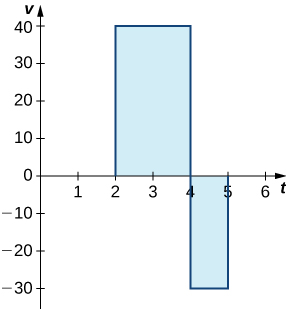
We looked at a simple example of this in The Definite Integral. Suppose a car is moving due north (the positive direction) at 40 mph between 2 p.m. and 4 p.m., then the car moves south at 30 mph between 4 p.m. and 5 p.m. We can graph this motion as shown in Figure 5.32.
英語のヒント
OpenStax, Rice University; Calculus Volume 1. · CC BY-NC-SA 4.0
Figure 5.32図 5.32
The graph shows speed versus time for the given motion of a car.
車の運動について、時刻と速度の関係を示したグラフ。
Just as we did before, we can use definite integrals to calculate the net displacement as well as the total distance traveled. The net displacement is given by
前と同じように、定積分で正味の変位と総移動距離の両方を求められる。正味の変位は、
Thus, at 5 p.m. the car is 50 mi north of its starting position. The total distance traveled is given by
したがって、午後5時には出発位置から北へ50マイルの場所にいる。総移動距離は、
Therefore, between 2 p.m. and 5 p.m., the car traveled a total of 110 mi.
よって、午後2時から5時までに車が走った距離は、合計110マイルである。
To summarize, net displacement may include both positive and negative values. In other words, the velocity function accounts for both forward distance and backward distance. To find net displacement, integrate the velocity function over the interval. Total distance traveled, on the other hand, is always positive. To find the total distance traveled by an object, regardless of direction, we need to integrate the absolute value of the velocity function.
正味の変位では、正方向と負方向の移動を符号付きで数える。速度関数には前進と後退の両方が含まれるので、区間上で速度を積分すれば正味の変位が得られる。一方、総移動距離では向きにかかわらず移動した長さを足す。これを求めるには、速度関数の絶対値を積分する必要がある。
Example 5.24例題 5.24
Finding Net Displacement正味の変位を求める
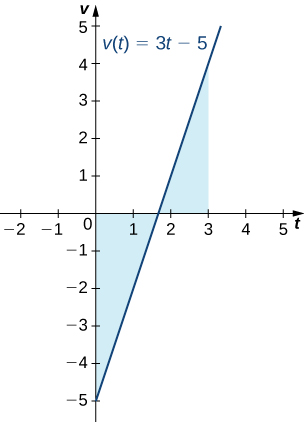
Given a velocity function (in meters per second) for a particle in motion from time to time find the net displacement of the particle.
時刻 から まで、粒子の速度が メートル毎秒で与えられるとする。粒子の正味の変位を求めよ。
Solution解き方
Applying the net change theorem, we have
正味の変化の定理を使うと、
The net displacement is m (Figure 5.33).
正味の変位は m である(図5.33)。
OpenStax, Rice University; Calculus Volume 1. · CC BY-NC-SA 4.0
Figure 5.33図 5.33
The graph shows velocity versus time for a particle moving with a linear velocity function.
速度が時刻の一次関数である粒子について、時刻と速度の関係を示している。
Example 5.25例題 5.25
Finding the Total Distance Traveled総移動距離を求める
Use Example 5.24 to find the total distance traveled by a particle according to the velocity function m/sec over a time interval
例題5.24を用いて、時間区間 で速度 m/s に従って動く粒子の総移動距離を求めよ。
Solution解き方
The total distance traveled includes both the positive and the negative values. Therefore, we must integrate the absolute value of the velocity function to find the total distance traveled.
総移動距離には、速度が正の間の移動も、負の間の移動も含める。そのため、速度関数の絶対値を積分しなければならない。
To continue with the example, use two integrals to find the total distance. First, find the t-intercept of the function, since that is where the division of the interval occurs. Set the equation equal to zero and solve for t. Thus,
この例では、二つの積分を使って総距離を求める。区間を分ける点を知るために、まず関数の t 軸との交点を求めよう。関数を0とおき、t について解くと、
The two subintervals are and To find the total distance traveled, integrate the absolute value of the function. Since the function is negative over the interval we have over that interval. Over the function is positive, so Thus, we have
二つの小区間は と となる。区間 では速度が負なので であり、区間 では正なので である。この絶対値を積分すると、
So, the total distance traveled is m.
したがって、総移動距離は m である。