第5章積分
Total Area総面積
One application of the definite integral is finding displacement when given a velocity function. If represents the velocity of an object as a function of time, then the area under the curve tells us how far the object is from its original position. This is a very important application of the definite integral, and we examine it in more detail later in the chapter. For now, we’re just going to look at some basics to get a feel for how this works by studying constant velocities.
定積分の応用の一つに、速度の関数から変位を求めることがある。 が時刻に対する物体の速度を表すならば、その曲線と横軸の間の符号付き面積から、物体が出発位置からどれだけ移ったかがわかる。これは非常に重要な応用であり、この章の後半で詳しく調べる。ここでは速度が一定の場合を使って、仕組みの基本をつかもう。
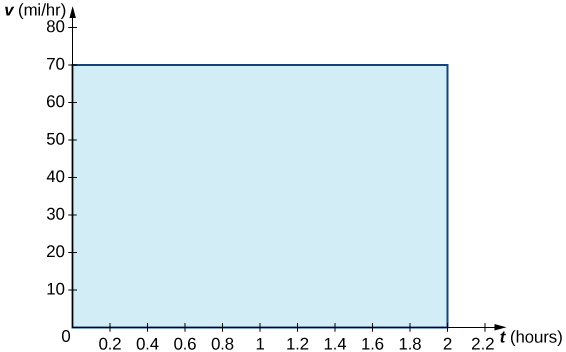
When velocity is a constant, the area under the curve is just velocity times time. This idea is already very familiar. If a car travels away from its starting position in a straight line at a speed of 70 mph for 2 hours, then it is 140 mi away from its original position (Figure 5.20). Using integral notation, we have
速度が一定ならば、曲線の下の面積は、単に速度と時間の積である。これはよく知っている考え方だ。車が出発位置から一直線に、時速70マイルで2時間走れば、出発位置から140マイル離れる(図5.20)。積分の記号では、次のように表せる。
OpenStax, Rice University; Calculus Volume 1. · CC BY-NC-SA 4.0
Figure 5.20図 5.20
The area under the curve tells us how far the car is from its starting point at a given time.
曲線 の下の面積から、ある時刻に車が出発点からどれだけ離れているかがわかる。
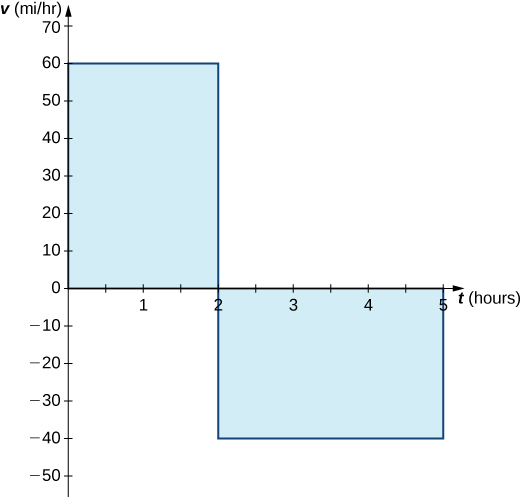
In the context of displacement, net signed area allows us to take direction into account. If a car travels straight north at a speed of 60 mph for 2 hours, it is 120 mi north of its starting position. If the car then turns around and travels south at a speed of 40 mph for 3 hours, it will be back at it starting position (Figure 5.21). Again, using integral notation, we have
英語のヒント
変位を考えるとき、符号付き面積を使うと方向を考慮できる。車が時速60マイルで北へまっすぐ2時間走れば、出発位置から北に120マイル進む。その後、向きを変えて時速40マイルで南へ3時間走れば、出発位置に戻る(図5.21)。これも積分記号で表すと、
In this case the displacement is zero.
この場合、変位は0である。
OpenStax, Rice University; Calculus Volume 1. · CC BY-NC-SA 4.0
Figure 5.21図 5.21
The area above the axis and the area below the axis are equal, so the net signed area is zero.
軸より上の面積と下の面積が等しいため、符号付き面積は0になる。
Suppose we want to know how far the car travels overall, regardless of direction. In this case, we want to know the area between the curve and the x-axis, regardless of whether that area is above or below the axis. This is called the total area.
英語のヒント
向きに関係なく、車が合計でどれだけ走ったかを知りたいとしよう。この場合は、軸の上か下かにかかわらず、曲線と x 軸に挟まれた領域の面積が必要になる。これを総面積という。
Graphically, it is easiest to think of calculating total area by adding the areas above the axis and the areas below the axis (rather than subtracting the areas below the axis, as we did with net signed area). To accomplish this mathematically, we use the absolute value function. Thus, the total distance traveled by the car is
図形として考えるなら、軸より上の面積と下の面積を足せば総面積になる。符号付き面積のときのように、下の面積を引くのではない。これを数式で実現するために、絶対値の関数を使う。したがって、車が走った総距離は、
Bringing these ideas together formally, we state the following definitions.
以上の考えを、次の定義にまとめる。
Example 5.10例題 5.10
Finding the Total Area総面積を求める
Find the total area between and the x-axis over the interval
区間 上で、 と x 軸の間の総面積を求めよ。
Solution解き方
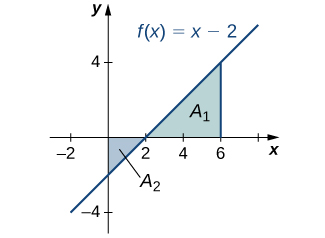
Calculate the x-intercept as (set solve for x). To find the total area, take the area below the x-axis over the subinterval and add it to the area above the x-axis on the subinterval (Figure 5.22).
として x について解くと、x 軸との交点は である。総面積を求めるには、小区間 で x 軸より下の面積と、小区間 で x 軸より上の面積を足せばよい(図5.22)。
OpenStax, Rice University; Calculus Volume 1. · CC BY-NC-SA 4.0
Figure 5.22図 5.22
The total area between the line and the x-axis over is A2 plus A1.
区間 で直線と x 軸の間にある総面積は、A2 と A1 の和である。
We have
次の式が得られる。
Then, using the formula for the area of a triangle, we obtain
三角形の面積公式を使うと、
The total area, then, is
したがって、総面積は、
Properties of the Definite Integral定積分の性質
The properties of indefinite integrals apply to definite integrals as well. Definite integrals also have properties that relate to the limits of integration. These properties, along with the rules of integration that we examine later in this chapter, help us manipulate expressions to evaluate definite integrals.
不定積分の性質は、定積分にも成り立つ。また、定積分には積分区間の端点に関する性質もある。これらの性質と、この章の後半で学ぶ積分の公式を使うと、式を変形して定積分を求められる。
Example 5.11例題 5.11
Using the Properties of the Definite Integral定積分の性質を使う
Use the properties of the definite integral to express the definite integral of over the interval as the sum of three definite integrals.
定積分の性質を使い、区間 上の の定積分を、三つの定積分の和として表せ。
Solution解き方
Using integral notation, we have We apply properties 3. and 5. to get
積分記号で書くと である。性質3と5を使うと、
Example 5.12例題 5.12
Using the Properties of the Definite Integral定積分の性質を使う
If it is known that and find the value of
と がわかっているとき、 の値を求めよ。
Solution解き方
By property 6.,
性質6より、
Thus,
したがって、