第5章積分
Evaluating Definite Integrals定積分の値を求める
Evaluating definite integrals this way can be quite tedious because of the complexity of the calculations. Later in this chapter we develop techniques for evaluating definite integrals without taking limits of Riemann sums. However, for now, we can rely on the fact that definite integrals represent the area under the curve, and we can evaluate definite integrals by using geometric formulas to calculate that area. We do this to confirm that definite integrals do, indeed, represent areas, so we can then discuss what to do in the case of a curve of a function dropping below the x-axis.
英語のヒント
この方法で定積分を求めるのは、計算が複雑でかなり手間がかかる。この章の後半では、リーマン和の極限を計算せずに定積分を求める方法を学ぶ。今の段階でも、定積分が曲線の下の面積を表すことを使えば、幾何学の面積公式から値を求められる。これによって定積分が実際に面積を表すことを確かめ、次に、関数の曲線が x 軸より下へ下がる場合を考えよう。
Example 5.8例題 5.8
Using Geometric Formulas to Calculate Definite Integrals幾何学の公式を使って定積分を求める
Use the formula for the area of a circle to evaluate
円の面積公式を使って、 を求めよ。
Solution解き方
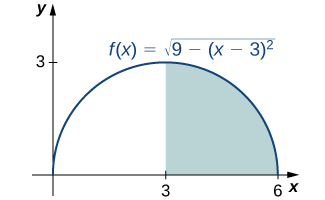
The function describes a semicircle with radius 3. To find
この関数は半径3の半円を表す。次の積分を求めるには、
we want to find the area under the curve over the interval The formula for the area of a circle is The area of a semicircle is just one-half the area of a circle, or The shaded area in Figure 5.16 covers one-half of the semicircle, or Thus,
区間 で曲線の下にある面積を求めればよい。円の面積公式は であり、半円の面積はその半分、すなわち である。図5.16の着色部分はさらに半円の半分なので、 となる。したがって、
OpenStax, Rice University; Calculus Volume 1. · CC BY-NC-SA 4.0
Figure 5.16図 5.16
The value of the integral of the function over the interval is the area of the shaded region.
区間 上で関数 を積分した値は、着色部分の面積に等しい。
Area and the Definite Integral面積と定積分
When we defined the definite integral, we lifted the requirement that be nonnegative. But how do we interpret “the area under the curve” when is negative?
定積分を定義するとき、 が非負でなければならないという条件を外した。では、 が負のとき、「曲線の下の面積」をどう解釈すればよいだろうか。
Net Signed Area符号付き面積
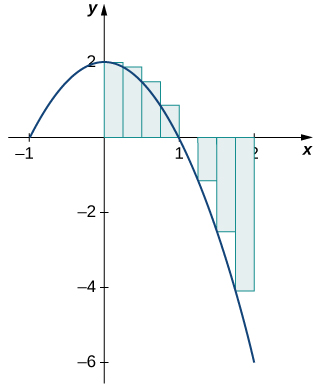
Let us return to the Riemann sum. Consider, for example, the function (shown in Figure 5.17) on the interval Use and choose as the left endpoint of each interval. Construct a rectangle on each subinterval of height and width Δx. When is positive, the product represents the area of the rectangle, as before. When is negative, however, the product represents the negative of the area of the rectangle. The Riemann sum then becomes
リーマン和に戻ろう。例えば、区間 上の関数 を考える(図5.17)。 とし、 を各小区間の左端に選ぶ。各小区間に、高さ 、幅 Δx の長方形を作る。 が正ならば、積 はこれまでと同じく長方形の面積を表す。一方、 が負ならば、積 は長方形の面積に負号を付けた値になる。このとき、リーマン和は次のようになる。
OpenStax, Rice University; Calculus Volume 1. · CC BY-NC-SA 4.0
Figure 5.17図 5.17
For a function that is partly negative, the Riemann sum is the area of the rectangles above the x-axis less the area of the rectangles below the x-axis.
一部で負になる関数では、リーマン和は、x 軸より上にある長方形の面積の和から、x 軸より下にある長方形の面積の和を引いたものになる。
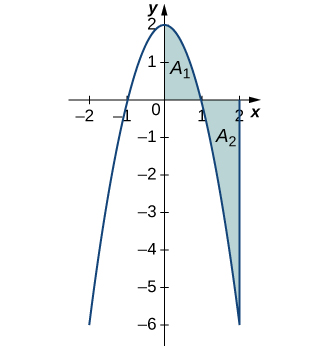
Taking the limit as the Riemann sum approaches the area between the curve above the x-axis and the x-axis, less the area between the curve below the x-axis and the x-axis, as shown in Figure 5.18. Then,
の極限をとると、リーマン和は、図5.18のように、曲線と x 軸の間で軸より上にある部分の面積から、軸より下にある部分の面積を引いた値に近づく。したがって、
The quantity is called the net signed area.
この量 を符号付き面積という。
OpenStax, Rice University; Calculus Volume 1. · CC BY-NC-SA 4.0
Figure 5.18図 5.18
In the limit, the definite integral equals area A1 less area A2, or the net signed area.
英語のヒント
極限をとると、定積分は面積 A1 から面積 A2 を引いた値、すなわち符号付き面積に等しくなる。
Notice that net signed area can be positive, negative, or zero. If the area above the x-axis is larger, the net signed area is positive. If the area below the x-axis is larger, the net signed area is negative. If the areas above and below the x-axis are equal, the net signed area is zero.
符号付き面積は、正にも負にも0にもなる。x 軸より上の面積が大きければ正、x 軸より下の面積が大きければ負である。上下の面積が等しければ0になる。
Example 5.9例題 5.9
Finding the Net Signed Area符号付き面積を求める
Find the net signed area between the curve of the function and the x-axis over the interval
区間 上で、関数 の曲線と x 軸の間の符号付き面積を求めよ。
Solution解き方
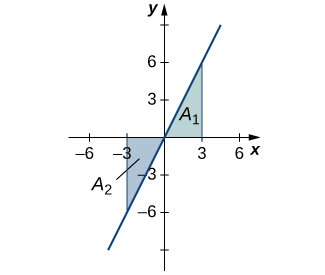
The function produces a straight line that forms two triangles: one from to and the other from to (Figure 5.19). Using the geometric formula for the area of a triangle, the area of triangle A1, above the axis, is
英語のヒント
この関数のグラフは直線であり、 から までと、 から までに、二つの三角形を作る(図5.19)。三角形の面積公式 を使うと、x 軸より上にある三角形 A1 の面積は、
where 3 is the base and is the height. The area of triangle A2, below the axis, is
となる。ここでは底辺が3、高さが である。x 軸より下にある三角形 A2 の面積は、
where 3 is the base and 6 is the height. Thus, the net area is
となる。底辺が3、高さが6だからである。したがって、符号付き面積は、
OpenStax, Rice University; Calculus Volume 1. · CC BY-NC-SA 4.0
Figure 5.19図 5.19
The area above the curve and below the x-axis equals the area below the curve and above the x-axis.
曲線より上かつ x 軸より下の面積は、曲線より下かつ x 軸より上の面積に等しい。