第5章積分
5.7 Integrals Resulting in Inverse Trigonometric Functions5.7 逆三角関数になる積分
Learning Objectives学習目標
- Integrate functions resulting in inverse trigonometric functions積分すると逆三角関数になる関数を積分する。
In this section we focus on integrals that result in inverse trigonometric functions. We have worked with these functions before. Recall from Functions and Graphs that trigonometric functions are not one-to-one unless the domains are restricted. When working with inverses of trigonometric functions, we always need to be careful to take these restrictions into account. Also in Derivatives, we developed formulas for derivatives of inverse trigonometric functions. The formulas developed there give rise directly to integration formulas involving inverse trigonometric functions.
英語のヒント
Integrals that Result in Inverse Sine Functions逆正弦関数になる積分
Let us begin this last section of the chapter with the three formulas. Along with these formulas, we use substitution to evaluate the integrals. We prove the formula for the inverse sine integral.
この章の最後の節を、三つの公式から始めよう。積分の計算には、これらの公式と置換を組み合わせて使う。まず、逆正弦関数になる積分公式を証明する。
Proof証明
Let Then Now let’s use implicit differentiation. We obtain
とおくと である。陰関数微分を使うと、
For Thus, applying the Pythagorean identity we have This gives
である。恒等式 を使うと、 となる。したがって、
Then for and generalizing to u, we have
すると に対して、変数を u と書き直すことで、次の公式が得られる。
□
□
Example 5.49例題 5.49
Evaluating a Definite Integral Using Inverse Trigonometric Functions逆三角関数を使って定積分を求める
Evaluate the definite integral
定積分 を求めよ。
Solution解き方
We can go directly to the formula for the antiderivative in the rule on integration formulas resulting in inverse trigonometric functions, and then evaluate the definite integral. We have
逆三角関数になる積分公式から原始関数を直接求め、その後、定積分を計算できる。すると、
Example 5.50例題 5.50
Finding an Antiderivative Involving an Inverse Trigonometric Function逆三角関数を含む原始関数を求める
Evaluate the integral
積分 を求めよ。
Solution解き方
Substitute Then and we have
と置換すると なので、
Applying the formula with we obtain
として公式を使うと、
Example 5.51例題 5.51
Evaluating a Definite Integral定積分を求める
Evaluate the definite integral
定積分 を求めよ。
Solution解き方
The format of the problem matches the inverse sine formula. Thus,
この問題は逆正弦関数の公式の形に一致する。したがって、
Integrals Resulting in Other Inverse Trigonometric Functionsほかの逆三角関数になる積分
There are six inverse trigonometric functions. However, only three integration formulas are noted in the rule on integration formulas resulting in inverse trigonometric functions because the remaining three are negative versions of the ones we use. The only difference is whether the integrand is positive or negative. Rather than memorizing three more formulas, if the integrand is negative, simply factor out −1 and evaluate the integral using one of the formulas already provided. To close this section, we examine one more formula: the integral resulting in the inverse tangent function.
英語のヒント
逆三角関数は六つあるが、ここで挙げた積分公式は三つである。残りの三つは、使っている公式と符号の関係で結び付くためである。被積分関数の前に負号がある場合は、新たに三つの公式を覚えるより、−1を外に出して、すでに示した公式を使えばよい。この節の最後に、逆正接関数になる積分を調べよう。
Example 5.52例題 5.52
Finding an Antiderivative Involving the Inverse Tangent Function逆正接関数を含む原始関数を求める
Evaluate the integral
積分 を求めよ。
Solution解き方
Comparing this problem with the formulas stated in the rule on integration formulas resulting in inverse trigonometric functions, the integrand looks similar to the formula for So we use substitution, letting then and Then, we have
逆三角関数になる積分公式と比較すると、 の公式に似ている。そこで と置換すると 、 となる。したがって、
Example 5.53例題 5.53
Applying the Integration Formulas積分公式を適用する
Evaluate the integral
積分 を求めよ。
Solution解き方
Apply the formula with Then,
として公式を使うと、
Example 5.54例題 5.54
Evaluating a Definite Integral定積分を求める
Evaluate the definite integral
定積分 を求めよ。
Solution解き方
Use the formula for the inverse tangent. We have
逆正接関数の公式を使うと、
Key Concepts重要な概念
- Formulas for derivatives of inverse trigonometric functions developed in Derivatives of Exponential and Logarithmic Functions lead directly to integration formulas involving inverse trigonometric functions.「指数関数と対数関数の導関数」などで学んだ微分公式から、逆三角関数に関係する積分公式が得られる。
- Use the formulas listed in the rule on integration formulas resulting in inverse trigonometric functions to match up the correct format and make alterations as necessary to solve the problem.逆三角関数になる積分公式の形と照らし合わせ、必要な変形を行って問題を解く。
- Substitution is often required to put the integrand in the correct form.被積分関数を公式に合う形にするには、置換が必要なことが多い。
Key Equations重要な式
Integrals That Produce Inverse Trigonometric Functions 逆三角関数になる積分 |
Exercises 391–396練習問題 391–396
In the following exercises, evaluate each integral in terms of an inverse trigonometric function.
次の各問では、積分を逆三角関数で表せ。
Exercise 391問題 391
Solution解き方
Exercise 392問題 392
Exercise 393問題 393
Solution解き方
Exercise 394問題 394
Exercise 395問題 395
Solution解き方
Exercise 396問題 396
Exercises 397–406練習問題 397–406
In the following exercises, find each indefinite integral, using appropriate substitutions.
次の各問では、適切な置換を使って不定積分を求めよ。
Exercise 397問題 397
Solution解き方
Exercise 398問題 398
Exercise 399問題 399
Solution解き方
Exercise 400問題 400
Exercise 401問題 401
Solution解き方
Exercise 402問題 402
Exercise 403問題 403
Explain the relationship Is it true, in general, that
関係 を説明せよ。一般に は成り立つか。
Solution解き方
So, They differ by a constant.
なので、 である。二つの原始関数の差は定数となる。
Exercise 404問題 404
Explain the relationship Is it true, in general, that
関係 を説明せよ。一般に は成り立つか。
Exercise 405問題 405
Explain what is wrong with the following integral:
次の積分のどこが間違っているか説明せよ:。
Solution解き方
is not defined as a real number when
のとき、 は実数として定義されない。
Exercise 406問題 406
Explain what is wrong with the following integral:
次の積分のどこが間違っているか説明せよ:。
Exercises 407–410練習問題 407–410
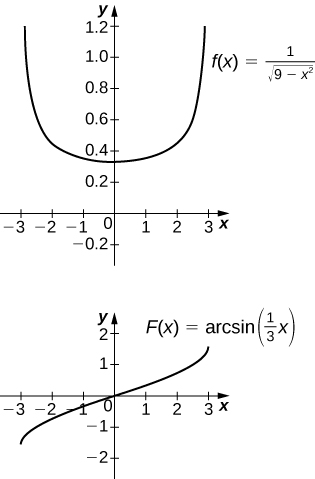
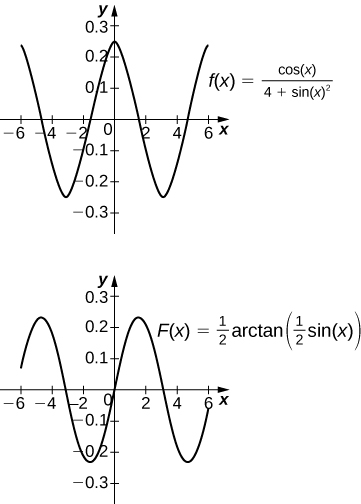
In the following exercises, solve for the antiderivative of f with then use a calculator to graph f and the antiderivative over the given interval Identify a value of C such that adding C to the antiderivative recovers the definite integral
次の各問では、f の原始関数 を として求め、指定区間 で f と原始関数を電卓で描け。原始関数に定数 C を加えて、 に一致させるための C を求めよ。
Exercise 407問題 407
[T] over
[T] 区間 における 。
Solution解き方
OpenStax, Rice University; Calculus Volume 1. · CC BY-NC-SA 4.0
The antiderivative is Taking recovers the definite integral.
原始関数は である。 とすれば、定積分の値が得られる。
Exercise 408問題 408
[T] over
[T] 区間 における 。
Exercise 409問題 409
[T] over
[T] 区間 における 。
Solution解き方
OpenStax, Rice University; Calculus Volume 1. · CC BY-NC-SA 4.0
The antiderivative is Taking recovers the definite integral.
原始関数は である。 とすれば、定積分の値が得られる。
Exercise 410問題 410
[T] over
[T] 区間 における 。
Exercises 411–416練習問題 411–416
In the following exercises, compute the antiderivative using appropriate substitutions.
次の各問では、適切な置換で原始関数を求めよ。
Exercise 411問題 411
Solution解き方
Exercise 412問題 412
Exercise 413問題 413
Solution解き方
Exercise 414問題 414
Exercise 415問題 415
Solution解き方
Exercise 416問題 416
Exercises 417–422練習問題 417–422
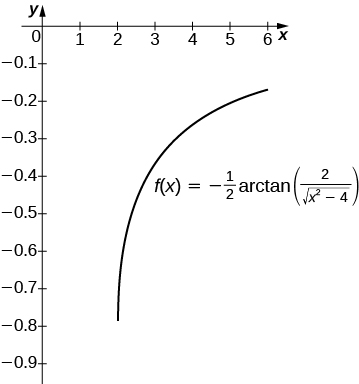
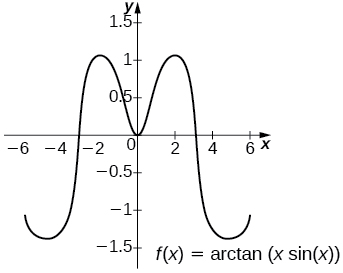
In the following exercises, use a calculator to graph the antiderivative with over the given interval Approximate a value of C, if possible, such that adding C to the antiderivative gives the same value as the definite integral
次の各問では、原始関数 を として求め、区間 で電卓を使って描け。可能であれば、原始関数に C を加えて に一致させるような C を見積もれ。
Exercise 417問題 417
[T] over
[T] 区間 における 。
Solution解き方
OpenStax, Rice University; Calculus Volume 1. · CC BY-NC-SA 4.0
The antiderivative is Taking recovers the definite integral over
原始関数は である。 を選ぶと、区間 で下端から積分した関数に一致する。
Exercise 418問題 418
[T] over
[T] 区間 における 。
Exercise 419問題 419
[T] over
[T] 区間 における 。
Solution解き方
OpenStax, Rice University; Calculus Volume 1. · CC BY-NC-SA 4.0
The general antiderivative is Taking recovers the definite integral.
原始関数の一般形は である。 とすれば、定積分の値が得られる。
Exercise 420問題 420
[T] over
[T] 区間 における 。
Exercise 421問題 421
[T] over
[T] 区間 における 。
Solution解き方
![区間(0,2]の arctan(ln x)のグラフ。増加する曲線で、x 軸と(1,0)で交わる。](media/CNX_Calc_Figure_05_07_209.jpg)
OpenStax, Rice University; Calculus Volume 1. · CC BY-NC-SA 4.0
The general antiderivative is Taking recovers the definite integral.
原始関数の一般形は である。 とすれば、定積分の値が得られる。
Exercise 422問題 422
[T] over
[T] 区間 における 。
Exercises 423–428練習問題 423–428
In the following exercises, compute each integral using appropriate substitutions.
次の各問では、適切な置換を使って積分を求めよ。
Exercise 423問題 423
Solution解き方
Exercise 424問題 424
Exercise 425問題 425
Solution解き方
Exercise 426問題 426
Exercise 427問題 427
Solution解き方
Exercise 428問題 428
Exercises 429–438練習問題 429–438
In the following exercises, compute each definite integral.
次の各問では、定積分を求めよ。
Exercise 429問題 429
Solution解き方
Exercise 430問題 430
Exercise 431問題 431
Solution解き方
Exercise 432問題 432
Exercise 433問題 433
For compute and evaluate the area under the graph of on
とする。 を計算し、 を求めよ。これは 全体にわたる のグラフの下の面積である。
Solution解き方
as
のとき、 となる。
Exercise 434問題 434
For compute and evaluate the area under the graph of over
とする。 を計算し、 を求めよ。これは区間 上の のグラフの下の面積である。
Exercise 435問題 435
Use the substitution and the identity to evaluate (Hint: Multiply the top and bottom of the integrand by
置換 と恒等式 を使って、 を求めよ。(ヒント:被積分関数の分子と分母に を掛ける。)
Solution解き方
Using the hint, one has Set Then, and the integral is If one uses the identity then this can also be written
ヒントを使うと となる。 とおけば なので、積分は となる。適切な区間で恒等式 を使えば、積分定数に定数差を含めて とも書ける。
Exercise 436問題 436
[T] Approximate the points at which the graphs of and intersect to four decimal places, and approximate the area between their graphs to three decimal places.
[T] と のグラフの交点を小数第4位まで求め、二つのグラフに挟まれた面積を小数第3位まで近似せよ。
Exercise 437問題 437
47. [T] Approximate the points at which the graphs of and intersect to four decimal places, and approximate the area between their graphs to three decimal places.
47. [T] と のグラフの交点を小数第4位まで求め、二つのグラフに挟まれた面積を小数第3位まで近似せよ。
Solution解き方
The left endpoint estimate with is 4.781 and these decimals persist for
。 での左端近似は4.781であり、 としてもこの小数部分は変わらない。
Exercise 438問題 438
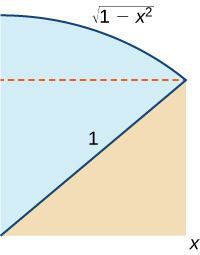
Use the following graph to prove that
次の図を使って、 を証明せよ。
OpenStax, Rice University; Calculus Volume 1. · CC BY-NC-SA 4.0