第5章積分
Substitution for Definite Integrals定積分の置換
Substitution can be used with definite integrals, too. However, using substitution to evaluate a definite integral requires a change to the limits of integration. If we change variables in the integrand, the limits of integration change as well.
置換は定積分にも使える。ただし、被積分関数の変数を変えたら、積分区間の端点も、それに対応する値へ変えなければならない。
Although we will not formally prove this theorem, we justify it with some calculations here. From the substitution rule for indefinite integrals, if is an antiderivative of we have
厳密な証明は省くが、ここで計算によって確かめよう。不定積分の置換公式より、 が の原始関数ならば、
Then
すると、
(5.20)
and we have the desired result.
となり、求める結果が得られた。
Example 5.34例題 5.34
Using Substitution to Evaluate a Definite Integral置換して定積分を求める
Use substitution to evaluate
置換積分を用いて を求めよ。
Solution解き方
Let so Since the original function includes one factor of x2 and multiply both sides of the du equation by Then,
とおくと である。元の式には因子 x2 があり、 なので、du の等式の両辺に を掛ける。すると、
To adjust the limits of integration, note that when and when Then
積分区間を変えるために、、 となることを使う。すると、
Evaluating this expression, we get
この式を計算すると、
Example 5.35例題 5.35
Using Substitution with an Exponential Function指数関数の積分に置換を使う
Use substitution to evaluate
置換積分を用いて を求めよ。
Solution解き方
Let Then, To adjust the limits of integration, we note that when and when So our substitution gives
とおくと である。積分区間は、、 を使って変換する。したがって、
Substitution may be only one of the techniques needed to evaluate a definite integral. All of the properties and rules of integration apply independently, and trigonometric functions may need to be rewritten using a trigonometric identity before we can apply substitution. Also, we have the option of replacing the original expression for u after we find the antiderivative, which means that we do not have to change the limits of integration. These two approaches are shown in Example 5.36.
英語のヒント
定積分を求める際、置換以外の方法も併用することがある。積分の性質や公式は引き続き使えるし、三角関数では、置換の前に三角恒等式で書き換える必要がある場合もある。また、原始関数を求めてから u を元の式に戻す方法も選べる。その場合は、元の変数の積分区間をそのまま使えばよい。例題5.36で、この二つの進め方を示す。
Example 5.36例題 5.36
Using Substitution to Evaluate a Trigonometric Integral三角関数の積分を置換で求める
Use substitution to evaluate
置換積分を用いて を求めよ。
Solution解き方
Let us first use a trigonometric identity to rewrite the integral. The trig identity allows us to rewrite the integral as
まず三角恒等式 を使い、積分を書き換える。
Then,
すると、
We can evaluate the first integral as it is, but we need to make a substitution to evaluate the second integral. Let Then, or Also, when and when Expressing the second integral in terms of u, we have
第1の積分はそのまま求められるが、第2の積分には置換が必要である。 とおくと 、すなわち となる。また、、 である。第2の積分を u で表すと、
Key Concepts重要な概念
- Substitution is a technique that simplifies the integration of functions that are the result of a chain-rule derivative. The term ‘substitution’ refers to changing variables or substituting the variable u and du for appropriate expressions in the integrand.置換積分は、連鎖律による微分の結果になっている関数の積分を簡単にする方法である。被積分関数の適切な部分を u と du に置き換える変数変換を行う。
- When using substitution for a definite integral, we also have to change the limits of integration.定積分を置換した変数で計算する場合は、積分区間の端点も変換する。
Key Equations重要な式
Substitution with Indefinite Integrals 不定積分の置換 |
|
Substitution with Definite Integrals 定積分の置換 |
Exercises 254–255練習問題 254–255
Exercise 254問題 254
Why is u-substitution referred to as change of variable?
u 置換を「変数変換」と呼ぶのはなぜか。
Exercise 255問題 255
2. If when reversing the chain rule, should you take or
2. のとき、連鎖律 を逆に使うには、 と のどちらを選ぶべきか。
Solution解き方
Exercises 256–260練習問題 256–260
In the following exercises, verify each identity using differentiation. Then, using the indicated u-substitution, identify f such that the integral takes the form
英語のヒント
次の各問では、微分を使って恒等式を確かめよ。次に、指定された u 置換で積分を の形にしたときの f を求めよ。
Exercise 256問題 256
Exercise 257問題 257
For
の場合。
Solution解き方
Exercise 258問題 258
Exercise 259問題 259
Solution解き方
Exercise 260問題 260
Exercises 261–270練習問題 261–270
In the following exercises, find the antiderivative using the indicated substitution.
次の各問では、指定された置換で原始関数を求めよ。
Exercise 261問題 261
Solution解き方
Exercise 262問題 262
Exercise 263問題 263
Solution解き方
Exercise 264問題 264
Exercise 265問題 265
Solution解き方
Exercise 266問題 266
Exercise 267問題 267
Solution解き方
Exercise 268問題 268
Exercise 269問題 269
Solution解き方
Exercise 270問題 270
Exercises 271–287練習問題 271–287
In the following exercises, use a suitable change of variables to determine the indefinite integral.
次の各問では、適切な変数変換を使って不定積分を求めよ。
Exercise 271問題 271
Solution解き方
Exercise 272問題 272
Exercise 273問題 273
Solution解き方
Exercise 274問題 274
Exercise 275問題 275
Solution解き方
Exercise 276問題 276
Exercise 277問題 277
Solution解き方
Exercise 278問題 278
Exercise 279問題 279
Solution解き方
Exercise 280問題 280
Exercise 281問題 281
Solution解き方
Exercise 282問題 282
Exercise 283問題 283
Solution解き方
Exercise 284問題 284
Exercise 285問題 285
Solution解き方
Exercise 286問題 286
Exercise 287問題 287
Solution解き方
Exercises 288–291練習問題 288–291
In the following exercises, use a calculator to estimate the area under the curve using left Riemann sums with 50 terms, then use substitution to solve for the exact answer.
次の各問では、50項の左端リーマン和を電卓で計算して、曲線の下の符号付き面積を見積もれ。その後、置換積分で正確な値を求めよ。
Exercise 288問題 288
[T] over
[T] 区間 における 。
Exercise 289問題 289
[T] over
[T] 区間 における 。
Solution解き方
The exact area is
。正確な符号付き面積は である。
Exercise 290問題 290
[T] over
[T] 区間 における 。
Exercise 291問題 291
[T] over
[T] 区間 における 。
Solution解き方
… The exact area is 0.
…となる。正確な符号付き面積は0である。
Exercises 292–297練習問題 292–297
In the following exercises, use a change of variables to evaluate the definite integral.
次の各問では、変数変換を使って定積分を求めよ。
Exercise 292問題 292
Exercise 293問題 293
Solution解き方
Exercise 294問題 294
Exercise 295問題 295
Solution解き方
Exercise 296問題 296
Exercise 297問題 297
Solution解き方
Exercises 298–305練習問題 298–305
In the following exercises, evaluate the indefinite integral with constant using u-substitution. Then, graph the function and the antiderivative over the indicated interval. If possible, estimate a value of C that would need to be added to the antiderivative to make it equal to the definite integral with a the left endpoint of the given interval.
次の各問では、u 置換で不定積分 を求め、 とする。指定区間で元の関数と原始関数のグラフを描け。可能であれば、その原始関数を、区間の左端 a からの定積分 に一致させるために加える定数 C の値を求めよ。
Exercise 298問題 298
[T] over
[T] 区間 における 。
Exercise 299問題 299
[T] on
[T] 区間 上の 。
Solution解き方
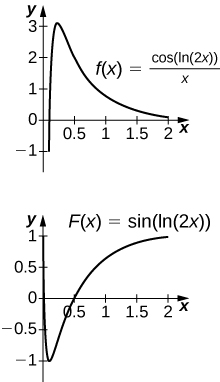
OpenStax, Rice University; Calculus Volume 1. · CC BY-NC-SA 4.0
The antiderivative is Since the antiderivative is not continuous at one cannot find a value of C that would make work as a definite integral.
原始関数は である。 で連続に延長できないので、 を0からの定積分に一致させるような定数 C は存在しない。
Exercise 300問題 300
[T] over
[T] 区間 における 。
Exercise 301問題 301
[T] over
[T] 区間 における 。
Solution解き方
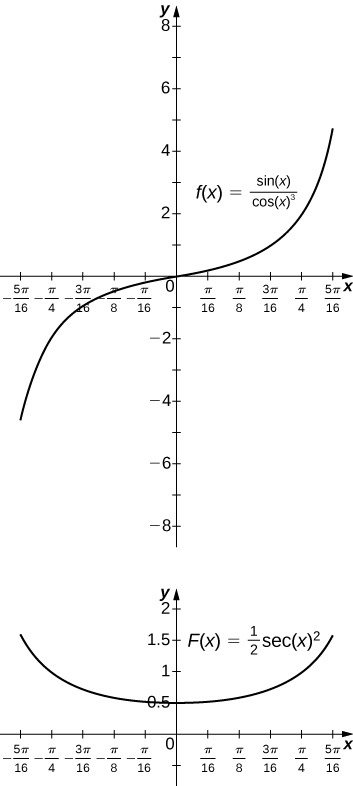
OpenStax, Rice University; Calculus Volume 1. · CC BY-NC-SA 4.0
The antiderivative is You should take so that
原始関数は である。 とするには、 を選ぶ。
Exercise 302問題 302
[T] over
[T] 区間 における 。
Exercise 303問題 303
[T] over
[T] 区間 における 。
Solution解き方
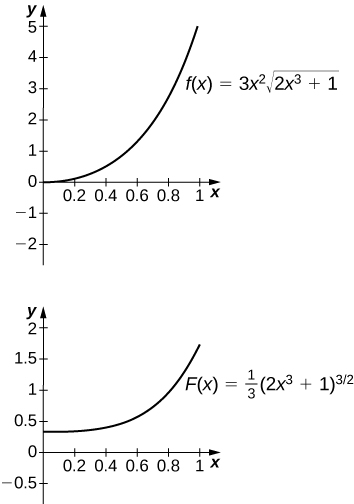
OpenStax, Rice University; Calculus Volume 1. · CC BY-NC-SA 4.0
The antiderivative is One should take
原始関数は であり、 を選べばよい。
Exercise 304問題 304
If in what can you say about the value of the integral?
において ならば、積分の値について何がいえるか。
Exercise 305問題 305
Is the substitution in the definite integral okay? If not, why not?
定積分 に という置換を使ってよいか。使えないなら、その理由を述べよ。
Solution解き方
No, because the integrand is discontinuous at
使えない。被積分関数が で不連続だからである。
Exercises 306–319練習問題 306–319
In the following exercises, use a change of variables to show that each definite integral is equal to zero.
次の各問では、変数変換を使って定積分が0になることを示せ。
Exercise 306問題 306
Exercise 307問題 307
Solution解き方
the integral becomes
とすると、積分は となる。
Exercise 308問題 308
Exercise 309問題 309
Solution解き方
the integral becomes
とすると、積分は となる。
Exercise 310問題 310
Exercise 311問題 311
Solution解き方
the integral becomes
since the integrand is odd.
since the integrand is odd.
とおくと、被積分関数が奇関数なので、積分は となる。
Exercise 312問題 312
Exercise 313問題 313
Show that the average value of over an interval is the same as the average value of over the interval for
とする。区間 上での の平均値と、区間 上での の平均値が等しいことを示せ。
Solution解き方
Setting and gets you
、 とおくと、 が得られる。
Exercise 314問題 314
Find the area under the graph of between and where and is fixed, and evaluate the limit as
、 を満たす a を固定する。 から までの のグラフの下の面積を求め、 の極限を調べよ。
Exercise 315問題 315
Find the area under the graph of between and where and is fixed. Evaluate the limit as
とし、 を満たす a を固定する。 から までの のグラフの下の面積を求め、 の極限を調べよ。
Solution解き方
As the limit is if and the limit diverges to +∞ if
である。 のとき、 なら極限は となり、 なら+∞へ発散する。a=1では別に対数の積分を使い、やはり+∞へ発散する。
Exercise 316問題 316
The area of a semicircle of radius 1 can be expressed as Use the substitution to express the area of a semicircle as the integral of a trigonometric function. You do not need to compute the integral.
半径1の半円の面積は と書ける。 と置換し、面積を三角関数の積分として表せ。積分の値は求めなくてよい。
Exercise 317問題 317
The area of the top half of an ellipse with a major axis that is the x-axis from to and with a minor axis that is the y-axis from to can be written as Use the substitution to express this area in terms of an integral of a trigonometric function. You do not need to compute the integral.
長軸が x 軸上の から 、短軸が y 軸上の から までの楕円について、上半分の面積は と書ける。 と置換し、三角関数の積分として表せ。積分の値は求めなくてよい。
Solution解き方
Exercise 318問題 318
[T] The following graph is of a function of the form Estimate the coefficients a and b, and the frequency parameters n and m. Use these estimates to approximate
[T] 次のグラフは の形の関数である。係数 a、b と周波数を表す n、m を見積もり、それを使って を近似せよ。
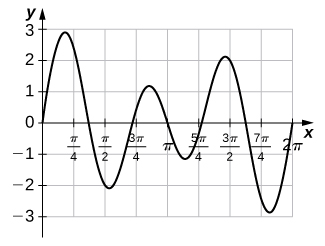
OpenStax, Rice University; Calculus Volume 1. · CC BY-NC-SA 4.0
Exercise 319問題 319
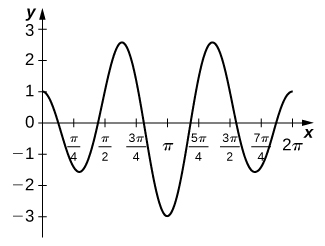
[T] The following graph is of a function of the form Estimate the coefficients a and b and the frequency parameters n and m. Use these estimates to approximate
[T] 次のグラフは の形の関数である。係数 a、b と周波数を表す n、m を見積もり、それを使って を近似せよ。
OpenStax, Rice University; Calculus Volume 1. · CC BY-NC-SA 4.0
Solution解き方
change of variables
変数変換
the substitution of a variable, such as u, for an expression in the integrand
被積分関数の中の式を、u などの変数に置き換えること。
integration by substitution
置換積分
a technique for integration that allows integration of functions that are the result of a chain-rule derivative
連鎖律による微分の結果となっている関数を、変数変換によって積分する方法。