第2章東アジアとインド洋の交流Exchange in East Asia and the Indian Ocean
Korea and Its Neighbors朝鮮とその近隣諸国
After the fall of the Mongols in China, Koreans were divided regarding the nature of their relationship with the Ming dynasty. In the 1380s, Yi Seong-gye and his fellow general Choe Yeong won fame for themselves when they defeated Japanese pirates who were raiding Korea. When the Ming dynasty attempted to annex Korean territory, Choe Yeong declared himself in opposition to the Ming and advised an invasion of China’s Liaodong Peninsula. Yi Seong-gye was chosen to lead the army but instead took the opportunity to seize Korea’s capital and gain control of the government in 1388. In 1392, after ruling for four years through puppet kings, Yi Seong-gye proclaimed himself the head of a new dynasty, the Joseon, named for an earlier Korean dynasty. Ruling as King Taejo, he declared himself a vassal of the far more powerful Ming dynasty and established friendly relations with China.
英語のヒント
中国でモンゴルの支配が終わると、朝鮮の人々は明との関係をどうするかで分かれた。1380年代、李成桂と同僚の将軍崔瑩は、朝鮮を襲う日本の海賊を破って名声を得た。明が朝鮮の領土を併合しようとすると、崔瑩は明への反対を表明し、中国の遼東半島への侵攻を勧めた。李成桂が軍を率いることになったが、彼はその機会を利用して、1388年に朝鮮の首都を奪い、政府を掌握した。傀儡の王を通して4年間統治した後、1392年、李成桂は、古代の朝鮮王朝にちなんで名付けた新王朝「朝鮮」の長であると宣言した。太祖として統治し、はるかに強大な明の臣下となることを宣言して、中国と友好関係を築いた。
Taejo embraced Confucian principles, which, unlike Buddhism, focus on the maintenance of the family and of social hierarchies instead of the well-being of the individual. Korean society was divided into rigidly defined classes. At the top was a ruling class of civil bureaucrats and military officials called the yangban, who ruled the country along with the king. Membership in this class depended on doing well on the imperial exams, which were based on knowledge of the Confucian classics, like similar exams in China. As in China, wealthy families and nobility of the former dynasty dominated the exams, because only the men in these families had the time and money to acquire the education necessary to do well. Membership in a yangban family also conferred the right to serve on local ruling councils and thus control their affairs. Eventually, membership in the yangban became hereditary when only the sons of these families were allowed to take the imperial exams. The yangban were supported by the labor of the sangmin, indentured servants who worked the land.
英語のヒント
太祖は儒教の原則を受け入れた。儒教は仏教と異なり、個人の幸福よりも家族と社会的序列の維持を重視する。朝鮮社会は厳格に定められた階級に分けられていた。頂点には、文官と武官から成る両班という支配階級があり、国王とともに国を治めた。この階級に属するには、中国の同様の試験と同じく、儒教古典の知識に基づく科挙でよい成績を収める必要があった。中国の場合と同様、裕福な家や前王朝の貴族が試験を独占した。よい成績に必要な教育を受ける時間と金を持っていたのは、そうした家の男性だけだったからである。両班の家に属することは、地方の統治会議に参加して地方の事務を支配する権利も与えた。やがて科挙を受けられるのがこれらの家の息子だけになると、両班の身分は世襲となった。両班を支えたのは、土地を耕す年季契約労働者である常民の労働だった。
Unlike the yangban, the seonbi were scholarly, highly educated men who devoted themselves to lives of study and served the public without financial reward. They did not covet riches and preferred scholarly pursuits, believing their role was to serve as moral exemplars for the rest of society. They valued integrity above all else and served as advocates of the common people even if that meant risking the displeasure of the king. Even though they came from the same class as the yangban, their lack of interest in attaining wealth and power set them apart.
英語のヒント
両班とは異なり、ソンビは学問に富み、高い教育を受け、研究の生活に身を捧げ、金銭的な報酬なしに公に仕えた人々だった。富を欲しがらず、社会の他の人々の道徳的模範となるのが自らの役割だと考え、学問的な営みを好んだ。何よりも誠実さを重んじ、王の不興を買う危険があっても、庶民の代弁者となった。両班と同じ階級の出身であっても、富や権力の獲得に関心を持たないことが、彼らを区別した。
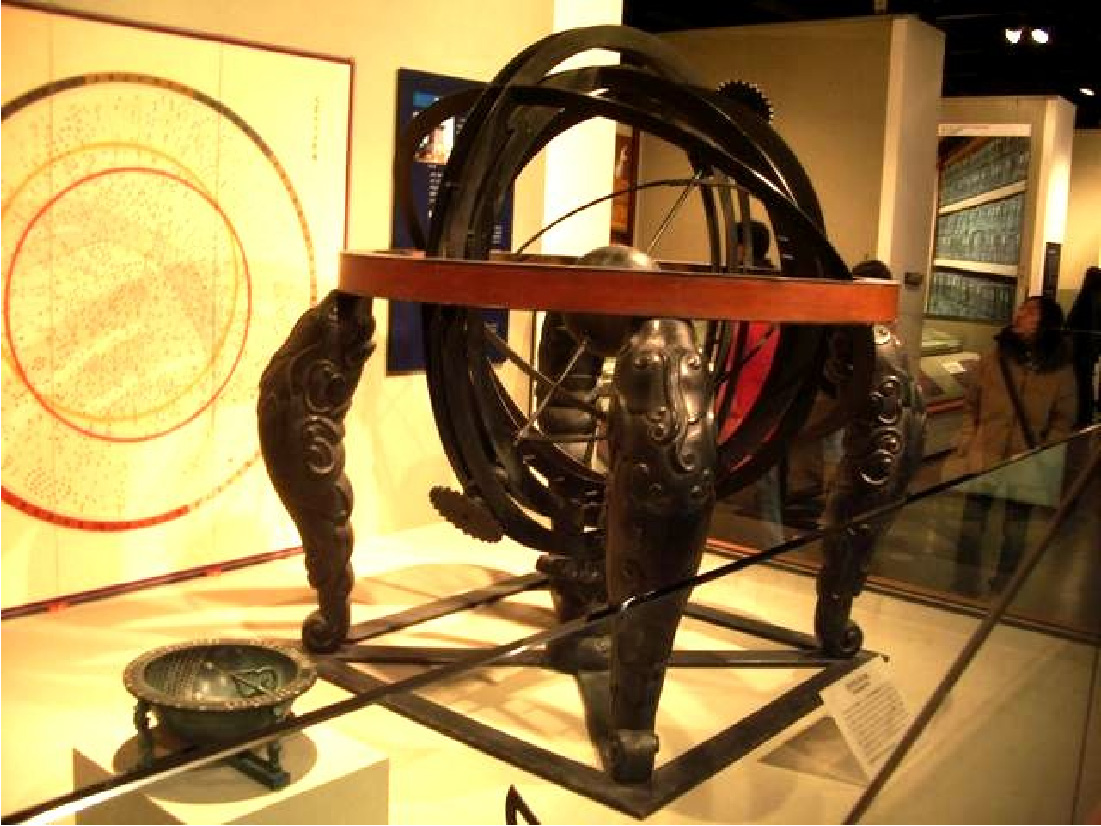
The love of study and learning that characterized the seonbi flourished in the reign of King Sejong, the fourth king of Korea. In 1442, Korean scholars developed a device to accurately gauge rainfall. Scholars also developed a means of measuring the direction and velocity of the wind. An astronomical observatory was constructed, and a variety of sundials and water clocks were invented to measure time (Figure 2.22). Triangulation devices and surveying rods were used to measure the elevation of land. Sejong recruited scholars from the institution of research he had founded, known as the Hall of Worthies, to help him develop hangul, an alphabet that could capture the sounds of Korean speech. Hangul, which Sejong introduced in 1446, was intended to be used by common people instead of the Chinese characters with which the elite yangban wrote.
英語のヒント
ソンビを特徴付ける研究と学問への愛は、朝鮮第4代王、世宗の治世に花開いた。1442年、朝鮮の学者は雨量を正確に測る装置を開発した。風向と風速を測る方法も開発した。天文台が建設され、時刻を測るさまざまな日時計や水時計が発明された(図2.22)。土地の高さを測るため、三角測量の装置や測量棒も使われた。世宗は自ら設けた研究機関、集賢殿から学者を集め、朝鮮語の音を表せる文字ハングルの開発を助けさせた。1446年に世宗が公布したハングルは、上層の両班が書く際に用いる漢字に代わって、庶民が使うことを意図した文字だった。
A Map of the Heavens.天の地図。
(credit: “Korean armillary sphere” by Wikimachine/Wikimedia Commons, Public Domain) · Public Domain
Figure 2.22 This fifteenth-century celestial globe, used to make astronomical observations, was invented by Jang Yeong-Sil during the reign of Korea’s King Sejong. (credit: “Korean armillary sphere” by Wikimachine/Wikimedia Commons, Public Domain)
図2.22 天体観測に使われたこの15世紀の天球儀は、朝鮮の世宗の治世に蔣英実が発明した。(出典:Wikimachine/Wikimedia Commons「Korean armillary sphere」。パブリックドメイン)
After the reign of Sejong, the Joseon dynasty encountered numerous difficulties. In 1592 and again in 1597, Japan invaded Korea. In the following century, the Manchus attacked Korea several times between 1627 and 1636. In addition to problems caused by attacks from without, great division was created by fights between factions of the yangban class. These factions, the Easterners and the Westerners, engaged in violent conflict that persisted from generation to generation.
英語のヒント
世宗の治世の後、朝鮮王朝は多くの困難に直面した。1592年と1597年には日本が侵攻した。次の世紀、1627年から1636年にかけては満洲人が数回攻撃した。外からの攻撃による問題に加え、両班の派閥間の争いも大きな分裂を生んだ。東人と西人と呼ばれるこれらの派閥は、何世代にもわたって暴力的な対立を続けた。
Beginning in the late seventeenth century, disgust at the conflict among the yangban elites led many scholars, officials, and common people to support the Silhak movement, which promoted the study of the physical sciences and technology in order to solve practical problems instead of focusing narrowly on the Confucian classics (silhak means “practical learning”). Silhak proponents also advocated numerous social reforms, including land reform and revision of Korea’s rigid social structure. These reformers argued that learning should promote the welfare of the people. They stressed social equality and the importance of Korean culture.
英語のヒント
17世紀後半から、両班エリートの争いに対する嫌悪は、多くの学者、官吏、庶民を実学運動の支持へ向かわせた。実学は、儒教古典だけに狭く集中するのでなく、現実の問題を解くため自然科学や技術を研究することを進めた。silhakという語は「実用の学問」を意味する。実学の支持者は、土地改革や朝鮮の硬直した社会構造の改変など、多くの社会改革も唱えた。学問は人々の福祉を増進すべきだと主張し、社会的平等と朝鮮文化の重要性を強調した。
Concern for the preservation of Korean culture was undoubtedly influenced by Korea’s relationship to the countries that surrounded it. Buddhism and Confucianism, the philosophy on which the Joseon dynasty was based, were both introduced by the Chinese. Korean writing, painting, architecture, and pottery were also influenced by China. For centuries, Korean scholars wrote with Chinese characters. Over the centuries, Korea had been invaded by Chinese, Khitans, Mongols, Japanese, and Manchus. Nevertheless, the constant influx of foreign ideas and material goods helped to reinforce in Koreans the separate sense of a distinctive Korean identity. Trying to differentiate themselves from Chinese, Mongols, and Japanese, Koreans like the Silhak reformers emphasized the importance of maintaining a Korean identity based on Korean history and culture.
英語のヒント
朝鮮文化の保存への関心には、周辺諸国との関係が影響していたことは疑いない。仏教も、朝鮮王朝の基礎となる哲学である儒教も、中国人が伝えたものだった。朝鮮の文字、絵画、建築、陶磁器も中国の影響を受けていた。何世紀にもわたり、朝鮮の学者は漢字で文章を書いた。また長い歴史の中で、朝鮮は中国人、契丹人、モンゴル人、日本人、満洲人の侵攻を受けてきた。それでも、外来の思想や物品が絶えず流入したことは、朝鮮人の中に、他と区別される固有の朝鮮人としての自己認識を強める助けとなった。中国人、モンゴル人、日本人と自らを区別しようと、実学の改革者のような朝鮮人は、朝鮮の歴史と文化に基づく自己認識を保つことの重要性を強調した。