第2章東アジアとインド洋の交流Exchange in East Asia and the Indian Ocean
The Manchus were members of an ethnic group that lived northeast of the Great Wall in southern Manchuria. They were descended from Jurchen pastoralists who had established the Jin dynasty that ruled northern China from 1115 to 1234 until their defeat by the Mongols. The Manchus had then settled down and become farmers. In the late sixteenth century, the Manchu leader Nurhaci formed the Manchu tribes into a state that paid tribute to the Ming emperor. In 1616, as the Ming dynasty began to collapse, the Manchus attacked Chinese settlements on the Liaodong Peninsula. They forced artisans to provide weapons for their army and farmers to provide food. Officials and army officers who were willing to submit to them were given positions in the Manchu administration. Those who rebelled were massacred.
英語のヒント
満洲人は、万里の長城の北東、満洲南部に暮らす民族だった。彼らは、1115年から1234年まで北中国を支配し、モンゴルに敗れた金朝を建てた女真人の牧畜民の子孫だった。その後、満洲人は定住して農民となった。16世紀後半、指導者ヌルハチは満洲の諸部族を一つの国家にまとめ、明の皇帝に朝貢した。1616年、明が崩れ始めると、満洲人は遼東半島の中国人の居住地を攻撃した。職人には軍への武器の供給、農民には食料の供給を強制した。服従する意思のある官吏や軍の将校には、満洲の行政機構での地位を与えた。反抗した者は虐殺された。
Following Nurhaci’s death in 1626, his son Hong Taiji proclaimed himself the leader of the Qing (“pure,” “clear”) dynasty. As he expanded Manchu control over Chinese territory, he adopted Chinese forms of administration and incorporated greater numbers of Chinese officials in his government. Chinese bureaucrats and army officers, disgusted with the corruption of the Ming government and its inability to respond to the country’s problems, began to defect to the Manchus in large numbers. Fearing ongoing chaos following Li Zicheng’s capture of Beijing, Ming general Wu Sangui, who was charged with guarding the eastern end of the Great Wall, allowed the Manchu armies through. On May 27, 1644, Wu Sangui’s troops and Manchu forces defeated Li Zicheng’s army and took control of Beijing. The Manchu armies swept south, but Ming resistance there was fierce, and it was not until 1683 that all of China was brought under Manchu control.
英語のヒント
1626年にヌルハチが死去すると、息子ホンタイジは清(「清らか」「澄んだ」の意)王朝の指導者であると宣言した。中国領への満洲人の支配を広げるにつれて、中国式の行政を採用し、より多くの中国人官吏を政府へ組み入れた。明政府の腐敗と、国の問題に対処できないことに失望した中国人の官僚や軍の将校は、大挙して満洲側へ寝返り始めた。李自成の北京占領後も混乱が続くことを恐れた明の将軍呉三桂は、万里の長城東端の守備を担当していたが、満洲軍の通過を許した。1644年5月27日、呉三桂の軍と満洲軍は李自成軍を破り、北京を支配した。満洲軍は南へ進撃したが、南方での明の抵抗は激しく、中国全土が満洲の支配下に入ったのは1683年になってからだった。
Despite what many Chinese had feared, the early Qing emperors proved good rulers. They strove to preserve their identity as Manchus, but they also embraced Chinese culture. The first Qing emperor, Kangxi, toured China to acquaint himself with his new domain. He adopted the Chinese bureaucratic apparatus and ordered that each of the government’s six major ministries be led by Manchu and Han Chinese co-administrators. Kangxi governed according to Confucian principles and maintained the system of imperial examinations for government jobs.
英語のヒント
多くの中国人が恐れたこととは反対に、清初の皇帝たちは優れた支配者となった。満洲人としての独自性を保とうと努める一方、中国文化も受け入れた。清の初代皇帝である康熙帝は、新たな領土をよく知るため中国を巡幸した。中国の官僚機構を採用し、政府の六つの主要な省庁は、満洲人と漢人の共同の長官が率いるよう命じた。康熙帝は儒教の原則に従って統治し、官職を得るための科挙制度を維持した。
The Manchu were careful to maintain their superior positions, however, and demanded loyalty from the Chinese. For example, local positions in government were usually given to Han Chinese bureaucrats, but supervisory positions were given to Manchus. All males were also required to demonstrate their acceptance of Manchu rule by wearing the distinctive Manchu hairstyle; the front part of the head was shaved, and the hair in the back was grown long and braided into a single queue. After 1645, men who did not wear their hair in this fashion were subject to execution.
英語のヒント
しかし満洲人は、自らの優越した地位を慎重に守り、中国人に忠誠を要求した。たとえば地方の官職は通常、漢人の官僚に与えたが、監督する地位は満洲人に与えた。男性は全員、満洲人特有の髪形によって、その支配を受け入れたことを示すよう求められた。頭の前部を剃り、後ろの髪を長く伸ばして一つに編む辮髪である。1645年以降、この髪形にしない男性は処刑の対象となった。
Like other Chinese rulers, Kangxi also supported Buddhism. He tolerated other religions, including Christianity, which was permitted so long as Chinese Christians continued to be filial sons and daughters who venerated their ancestors, a practice the Jesuits supported. The Jesuits’ efforts to learn the Chinese language and their respect for Chinese culture made them more successful at winning converts than the Dominicans and Franciscans. But members of these other orders grew jealous and complained to the Pope about the Jesuits’ willingness to accommodate Chinese practices. When the Vatican ruled that all church services must be conducted in Latin and that Chinese Christians must be ordered to abandon their ancestral rites, Kangxi decreed that missionaries who complied would have to leave China.
英語のヒント
ほかの中国の君主と同じく、康熙帝は仏教も支援した。キリスト教を含む他の宗教も容認した。ただし、中国のキリスト教徒が祖先を敬う孝行な息子や娘であり続けることが条件であり、イエズス会もこの慣行を支持していた。中国語を学ぶ努力と中国文化への敬意によって、イエズス会士はドミニコ会士やフランシスコ会士よりも改宗者の獲得に成功した。しかし他会の人々は嫉妬を募らせ、中国の慣習を認めるイエズス会の姿勢について教皇に訴えた。ヴァティカンが、すべての典礼はラテン語で行い、中国のキリスト教徒には祖先祭祀を捨てるよう命じなければならないと裁定すると、康熙帝は、その裁定に従う宣教師は中国を去らなければならないと命じた。
Kangxi and his successors Yongzheng and Qianlong attempted to redress the problems that had seemed to lead to the downfall of the Ming. They placed China on secure financial footing, and fearing that the Ming had succumbed to lax moral standards brought on by wealth and luxury, Qing scholars returned to the teachings of Zhu Xi. Morally suspect plays and novels were banned, and great emphasis was placed on traditional Confucian values. For example, Qianlong visited his mother every day to display his devotion to her (Figure 2.21). Female chastity was encouraged, and so many memorial arches were erected by communities to commemorate “chaste widows,” women who had refused to remarry after the death of their husbands, that the government attempted to bring an end to the practice in the nineteenth century by declaring that only women who committed suicide upon becoming widows could be so memorialized.
英語のヒント
康熙帝と後継者の雍正帝、乾隆帝は、明の滅亡につながったと思われる問題を是正しようとした。中国の財政基盤を安定させるとともに、富とぜいたくがもたらす道徳の弛緩によって明が倒れたのだと恐れた清の学者は、朱熹の教えへ戻った。道徳的に疑わしい戯曲や小説は禁じられ、儒教の伝統的価値観が強調された。たとえば乾隆帝は、母への孝行を示すため毎日母を訪ねた(図2.21)。女性の貞節も奨励された。夫の死後に再婚を拒んだ「貞節な寡婦」を記念する牌坊が各共同体によってあまりに多く建てられたため、19世紀には政府がこの慣行に歯止めをかけようとした。寡婦になった際に自殺した女性だけが、そのように顕彰される資格を持つと定めたのである。
Emperor Qianlong.乾隆帝。
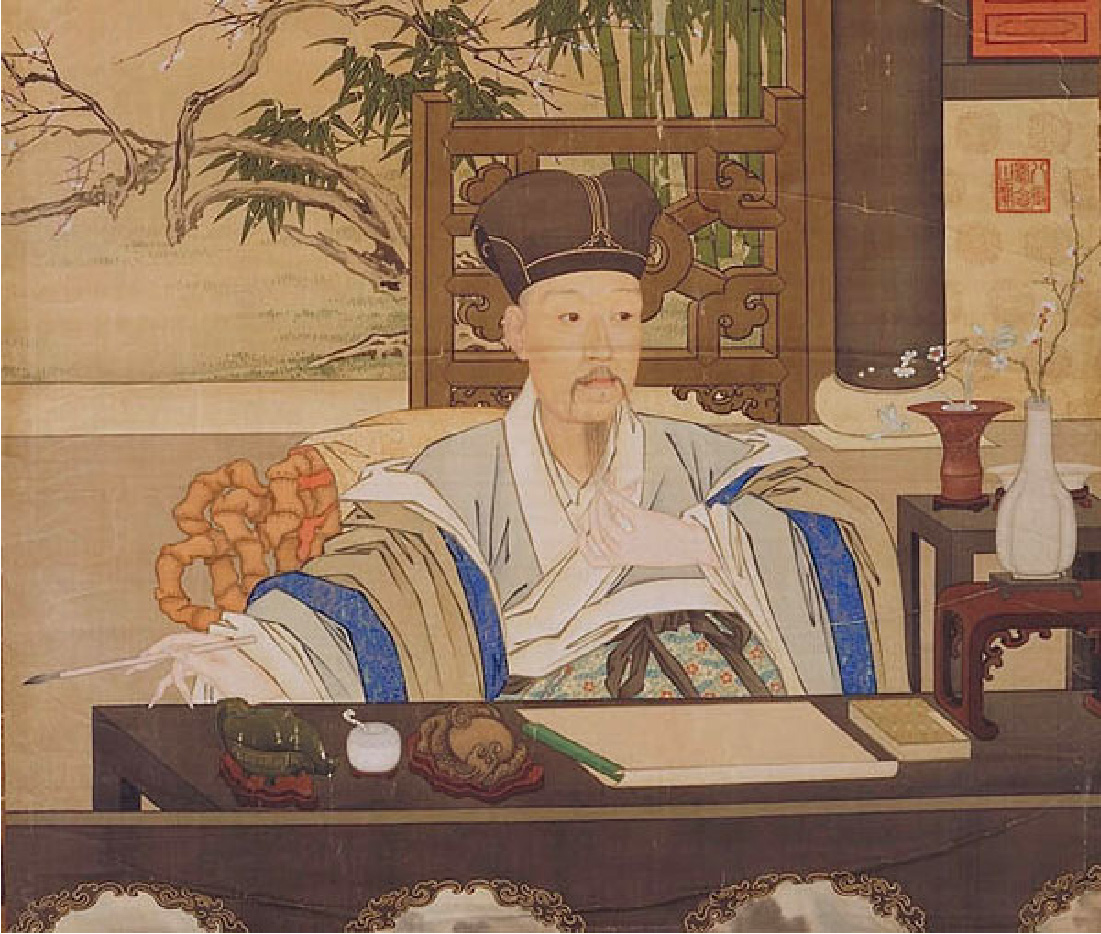
(credit: “Qianlong in his studies” by Chiumei Ho/Wikimedia Commons, Public Domain) · Public Domain
Figure 2.21 Although he was a Manchu, Emperor Qianlong embraced Confucian values and tried to live the life of a Confucian scholar. Every day he spent hours working on affairs of state, visited his mother, and then dedicated himself to writing poetry and admiring works of art. This eighteenth-century painting of him in his study was made by Giuseppe Castiglione, an Italian Jesuit at Qianlong’s court. (credit: “Qianlong in his studies” by Chiumei Ho/Wikimedia Commons, Public Domain)
図2.21 満洲人であった乾隆帝は儒教の価値観を受け入れ、儒学者のような生活を送ろうとした。毎日何時間も国政に取り組み、母を訪ね、その後は詩作と美術鑑賞に専念した。書斎の彼を描いたこの18世紀の絵は、宮廷に仕えたイタリア人イエズス会士ジュゼッペ・カスティリオーネによる。(出典:Chiumei Ho/Wikimedia Commons「Qianlong in his studies」。パブリックドメイン)
The Qing, however, continued the Ming policy of interacting with other countries as little as possible. Like the Ming, they did intervene in Asia where it seemed their interests were at stake. For example, in 1683, the island of Taiwan, a base for pirates and a refuge for fleeing Ming loyalists, was made part of China. In 1720, Qing armies took control of the city of Lhasa, the capital of Tibet. In the 1750s, they fought Mongols and Uighurs in central Asia and incorporated the province of Xinjiang (“new province”) into China.
英語のヒント
しかし清は、できるだけ外国と関わらないという明の政策を続けた。明と同様、アジアで自らの利害がかかっていると見れば介入した。たとえば1683年、海賊の拠点であり、逃れてきた明の遺臣の避難先でもあった台湾を、中国の一部とした。1720年、清軍はチベットの都ラサを支配した。1750年代には中央アジアのモンゴル人やウイグル人と戦い、新疆(「新たな省」の意)を中国に組み込んだ。
During the Qing dynasty, China continued to rely on foreign trade income, and European demand for Chinese products did not cease. The Qing remained wary of Europeans, however, and wished to minimize contact with foreigners as the Japanese had done. Non-Chinese were allowed to reside in Macao, but after 1759 they could conduct trade only through the port of Guangzhou and trade only with the Co-hong, the official Chinese merchant guild. While in the city on business, they had to stay in a special quarter for Europeans. When they had finished their transactions, they had to depart.
英語のヒント
清代の中国も対外貿易の収入に依存し続け、ヨーロッパの中国製品需要も途絶えなかった。しかし清はヨーロッパ人への警戒を保ち、日本がそうしたように外国人との接触を最小限にしようとした。中国人以外もマカオへの居住は認められたが、1759年以降、交易できる港は広州だけ、相手は中国の公認商人組合である公行だけとなった。市内で商売をする間は、ヨーロッパ人専用の居留区に滞在し、取引が終われば立ち去らなければならなかった。
In the eyes of the Chinese, Europe was an inferior place that possessed nothing of interest. Although European scientific knowledge was impressive to some, most Chinese merchants and officials maintained a disdainful attitude toward the West that was reflected in the way in which Qianlong received Lord George Macartney, who visited China in 1793 on behalf of the British king. Qianlong demanded that Macartney, as the representative of an inferior monarch, demonstrate his respect by kneeling and knocking his head on the ground, the traditional way in which vassals greeted the emperor. Macartney refused to do so, and Qianlong announced that he was willing to accept the British monarch as a vassal but did not consider him an equal. He also refused Britain’s request to establish a permanent embassy in China. China, he noted, already had everything it needed, and Britain had nothing of value to offer.
英語のヒント
中国人の目には、ヨーロッパは興味を引くものを何も持たない劣った土地だった。ヨーロッパの科学知識に感銘を受ける者もいたが、多くの中国商人や官吏は西洋を見下す態度を保った。その態度は、イギリス王の使節として1793年に来訪したジョージ・マカートニー卿への乾隆帝の対応に表れた。乾隆帝は、マカートニーは下位の君主の代表なのだから、ひざまずいて額を地につけ、敬意を示すよう要求した。これは臣下が皇帝に拝礼する伝統的な方法だった。マカートニーが拒むと、乾隆帝は、イギリスの君主を臣下として受け入れる用意はあるが、対等な存在とはみなさないと述べた。また、中国に常駐の大使館を設けるというイギリスの要請も断った。中国は必要なものをすでにすべて持ち、イギリスには提供できる価値ある品は何もない、と彼は指摘した。