第2章東アジアとインド洋の交流Exchange in East Asia and the Indian Ocean
The Rise of the Maratha Empireマラーター王国の興隆
Aurangzeb I was the last of the exceptional Mughal rulers in India. In 1658, he seized control of the Mughal throne and set about attempting to conquer rulers of states on the Deccan Plateau in southcentral India. He also led an Islamic revival in the Mughal domains. A pious man who frequently stopped in the midst of battle to perform the required daily prayers, Aurangzeb sought to eliminate all non-Islamic practices from his court. He refused to hunt, which had been a traditional pastime of Mughal rulers, and did not listen to music, although members of his court continued to do so. He eliminated the debates of scholars of different religions that his predecessors had sponsored, as well as other practices such as weighing himself against an equivalent amount of gold on the anniversaries of his birth and coronation, because he considered it an inappropriate display of excess. Aurangzeb patronized Muslim scholars and had them compile a collection of Islamic law written in the Persian language.
英語のヒント
アウラングゼーブ1世は、インドにおける傑出したムガル支配者の最後の一人だった。1658年にムガルの王位を奪取すると、インド中南部のデカン高原にある諸国の支配者の征服に取りかかった。また、ムガル領内でイスラーム復興も進めた。彼は信仰に篤く、戦闘の最中でも義務である日々の礼拝のためにしばしば手を止めた。宮廷からイスラームに基づかない慣行をすべて取り除こうとした。ムガルの支配者の伝統的な娯楽であった狩猟をせず、音楽も聴かなかった。ただし、宮廷の人々は音楽を聴き続けた。先代の皇帝たちが後援していた異なる宗教の学者による討論会も廃止した。誕生日や戴冠の記念日に、自分の体重と同じ重さの金を天秤に載せるといった慣行も、不適切なぜいたくの誇示だと考えてやめた。アウラングゼーブはムスリムの学者を保護し、ペルシア語で書かれたイスラーム法の集成を編纂させた。
A skilled commander in battle, Aurangzeb expanded the bounds of the Mughal state. However, he proved unable to easily incorporate non-Muslims into his empire. Although at times he gave money to Hindu temples as previous Mughal emperors had done, at other times he ordered the destruction of the temples of Hindus who resisted his rule. He also imposed a special tax on Hindu pilgrims and, eventually, a tax on all non-Muslims. Hindus who served in his administration did not have to pay this tax; nevertheless, they often received less compensation than did Muslim administrators. Muslim immigrants to India were also favored over Indian-born Hindus for important positions in Aurangzeb’s administration.
英語のヒント
アウラングゼーブは戦場では巧みな指揮官であり、ムガル国家の領域を拡大した。だが、非ムスリムを帝国へ円滑に組み込むことはできなかった。先代のムガル皇帝と同様、ヒンドゥー寺院に資金を与えることもあった一方で、支配に抵抗するヒンドゥー教徒の寺院の破壊を命じることもあった。また、ヒンドゥー教の巡礼者に特別税を課し、最終的にはすべての非ムスリムに税を課した。行政に仕えるヒンドゥー教徒はその税を払う必要がなかったものの、報酬はムスリムの行政官より少ないことが多かった。アウラングゼーブの行政機構では、重要な地位に就ける際にも、インド生まれのヒンドゥー教徒より、インドへ移住してきたムスリムが優遇された。
Aurangzeb clashed with Sikhs in northern India. The religion of Sikhism, a monotheistic faith that combines elements of Hinduism and Islam, was established in the Punjab region of northwestern India in the fifteenth century. The Mughals persecuted the Sikhs, and Aurangzeb sought to control the succession of Sikh gurus, the community’s religious and political leaders. His execution of the guru Tegh Bahadur inspired even greater resistance to Mughal authority.
英語のヒント
アウラングゼーブは北インドのシク教徒とも衝突した。ヒンドゥー教とイスラームの要素を組み合わせた一神教であるシク教は、15世紀にインド北西部のパンジャーブ地方で成立した。ムガル帝国はシク教徒を迫害し、アウラングゼーブは、共同体の宗教的・政治的指導者であるグルの後継者選びを支配しようとした。彼がグル・テーグ・バハードゥルを処刑したことで、ムガルの権威に対する抵抗はさらに強まった。
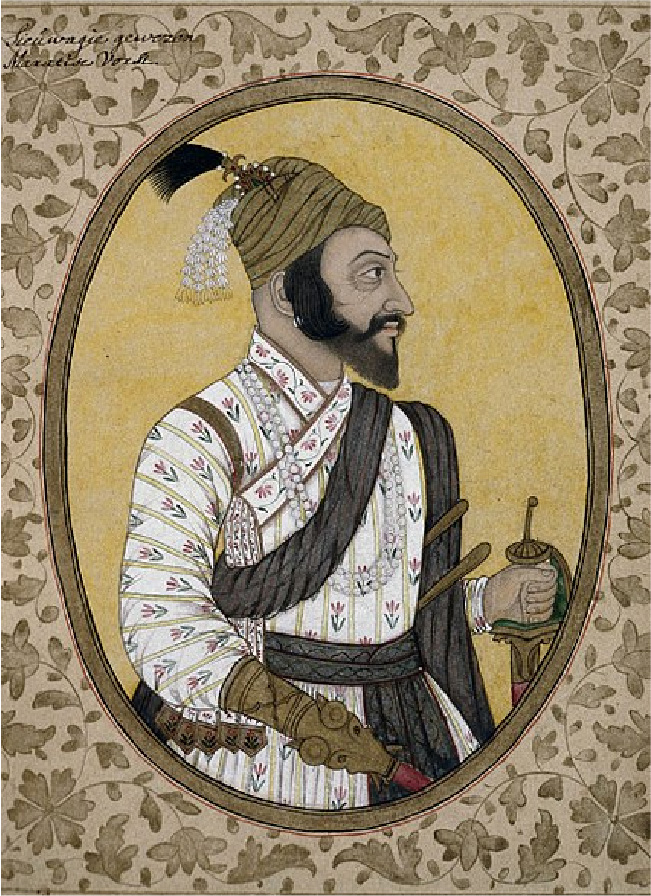
Among the many Hindus who opposed Aurangzeb were the Marathas, a group from the western uplands of the Deccan Plateau. Many Marathas had gained experience as soldiers in the armies of both the Muslim and Hindu rulers. The most powerful of their leaders, Shivaji, had acquired his military experience in this way (Figure 2.9). When he led his own armies into battle against Mughal forces, he proved a formidable opponent, defeating Aurangzeb’s commanders time after time. Shivaji’s success on the field of battle and the rich spoils that fell to his troops attracted many followers. In 1663, he defeated a much larger Mughal army after withstanding a siege for more than two years. Less than a year after this victory, Shivaji’s forces invaded Gujarat and seized control of the port of Surat.
英語のヒント
アウラングゼーブに抵抗した多くのヒンドゥー教徒の中に、デカン高原西部の高地出身の集団、マラーターがいた。多くのマラーターは、ムスリムとヒンドゥー教徒の双方の支配者の軍で兵士として経験を積んでいた。その指導者のうち最も強力だったシヴァージーも、このようにして軍事経験を得ていた(図2.9)。自らの軍を率いてムガル軍と戦うようになると、恐るべき敵であることを示し、アウラングゼーブの指揮官たちを何度も打ち破った。戦場での勝利と、部下が手に入れた豊かな戦利品は、多くの支持者を引き付けた。1663年には、2年以上に及ぶ包囲に耐えたのち、はるかに大きなムガル軍を破った。この勝利から1年もたたないうちに、シヴァージー軍はグジャラートへ侵攻し、スーラト港を奪った。
Emperor Shivaji of the Maratha.マラーターのシヴァージー王。
(credit: “Portrait of Shivaji” by The British Museum/Wikimedia Commons, Public Domain) · Public Domain
Figure 2.9 This portrait, painted in the 1680s, depicts the Maratha emperor Shivaji dressed for battle. (credit: “Portrait of Shivaji” by The British Museum/Wikimedia Commons, Public Domain)
図2.9 1680年代に描かれたこの肖像画は、戦いの装いをしたマラーターの王シヴァージーを表している。(出典:The British Museum/Wikimedia Commons「Portrait of Shivaji」。パブリックドメイン)
Aurangzeb attempted to make an ally of Shivaji, summoning him to the Mughal court in 1666 and awarding his son, who was still a child, a royal title. Shivaji was treated with contempt by his Mughal hosts, however, and following Aurangzeb’s attempts to detain him, he escaped and resumed war against the Mughals. Eight years later, Shivaji had himself declared an emperor on par with Aurangzeb, in effect declaring his right to rule his own territory and placing himself in a position of authority above other Maratha leaders.
英語のヒント
アウラングゼーブはシヴァージーを味方にしようとし、1666年にムガル宮廷へ呼び寄せ、まだ子どもだったその息子に王家の称号を授けた。ところがシヴァージーは、迎え入れたムガル側の人々に侮辱的に扱われた。アウラングゼーブが彼を留め置こうとすると、脱出してムガルとの戦争を再開した。その8年後、シヴァージーは自らをアウラングゼーブと対等な皇帝であると宣言させた。これは事実上、自分の領土を統治する権利を宣言するとともに、他のマラーター指導者の上に立つ権威を確立する行為だった。
Shivaji sought to eliminate Mughal influence by making the local language of Marathi the vernacular of his court instead of Persian, the language of the Mughals. He ran his court according to Hindu tradition and replaced Persian political terminology with terms from Sanskrit, the sacred language of Hinduism. All educated Hindus were familiar with Sanskrit, unlike Marathi, which Hindus in other parts of India could not be expected to speak. Sanskrit served a function in Shivaji’s kingdom similar to that served by Latin in medieval Europe or Chinese in East Asia: It was the language of the educated elite. Shivaji led processions to local Hindu holy sites and also patronized Sanskrit scholars. Despite his dedication to Hinduism, however, he gave money to Islamic institutions and did not discriminate against Muslims. When Aurangzeb imposed a tax on non-Muslims in the Mughal Empire, Shivaji wrote to inform him that he could not be a good Muslim if he did not understand that God had created all people, not only Muslims.
英語のヒント
シヴァージーは、ムガルの言語であるペルシア語の代わりに、地元のマラーティー語を宮廷の日常語にすることで、ムガルの影響を取り除こうとした。宮廷はヒンドゥーの伝統に従って運営し、ペルシア語の政治用語を、ヒンドゥー教の聖なる言語であるサンスクリットの用語に置き換えた。教育を受けたヒンドゥー教徒は皆サンスクリットに通じていたが、マラーティー語はインドの他地域のヒンドゥー教徒まで話せるとは期待できなかった。シヴァージーの王国でサンスクリットが果たした役割は、中世ヨーロッパのラテン語や東アジアの漢文と似ており、教養あるエリートの言語だったのである。シヴァージーは地元のヒンドゥーの聖地への行列を率い、サンスクリット学者も保護した。だが、ヒンドゥー教に傾倒していても、イスラームの施設に資金を与え、ムスリムを差別しなかった。アウラングゼーブがムガル帝国で非ムスリムに税を課すと、シヴァージーは書簡を送り、神はムスリムだけでなくすべての人々を創造したことを理解できないのであれば、よきムスリムではありえないと伝えた。
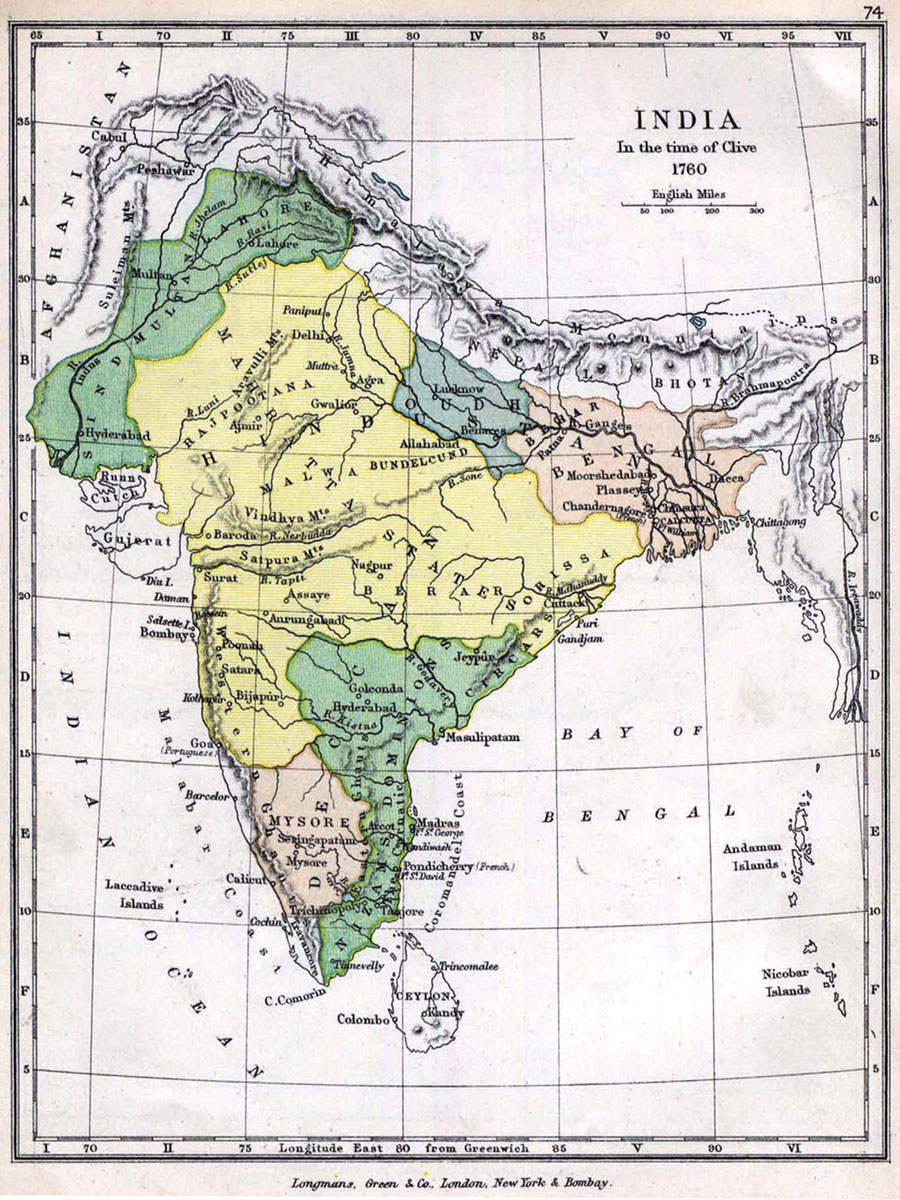
Beginning in 1674, Shivaji embarked on a campaign to subdue the southern and central parts of the Indian subcontinent and bring them under the control of the Maratha Empire (Figure 2.10). Although he died in 1680, the war between the Mughals and the Marathas continued. Years of fighting emptied Mughal coffers, and in 1705 Maratha armies gained control of the Gujarat coast. Stretched too thin, the Mughals began their retreat from Maratha territory.
英語のヒント
1674年から、シヴァージーはインド亜大陸の南部と中部を征服してマラーター王国の支配下に置く軍事行動を始めた(図2.10)。彼は1680年に死んだが、ムガルとマラーターの戦争は続いた。長年の戦闘でムガルの国庫は空になり、1705年にはマラーター軍がグジャラート海岸を支配した。力を広い範囲に分散させすぎたムガルは、マラーター領からの撤退を始めた。
The Maratha Empire.マラーター王国。
(credit: modification of work “The India subcontinent in 1760” by Charles Colbeck/Wikimedia Commons, Public Domain) · Public Domain
Figure 2.10 This illustration from a 1760 English schoolbook shows, in yellow, the extent of the Maratha Empire after its defeat of the Mughals. (credit: modification of work “The India subcontinent in 1760” by Charles Colbeck/Wikimedia Commons, Public Domain)
図2.10 1760年のイングランドの学校教科書から取ったこの図は、ムガルに勝利した後のマラーター王国の範囲を黄色で示している。(出典:Charles Colbeck/Wikimedia Commons「The India subcontinent in 1760」を改変。パブリックドメイン)
As the Mughals grew weaker, the Marathas grew stronger. Over the course of the next twenty years, Maratha armies gained control of roughly one-third of India. The Maratha bid to dominate all of India was brought to a halt, however, when Ahmad Shah Durrani, the king of Afghanistan, marched eastward against both the Mughal and Maratha empires, seeking to expand his domain. As Indians and Afghans made war on one another, European colonizers steadily gained control of India.
英語のヒント
ムガルが弱まるにつれて、マラーターは強大になった。その後の20年間で、マラーター軍はインドのおよそ3分の1を支配するに至った。しかし、アフガニスタン王アフマド・シャー・ドゥッラーニーが領土拡大を求めて東へ進み、ムガル帝国とマラーター王国の双方を攻撃すると、マラーターによるインド全土の支配の試みは止められた。インド人とアフガン人が互いに戦争をしている間に、ヨーロッパの植民者は着実にインドの支配を進めた。