第2章東アジアとインド洋の交流Exchange in East Asia and the Indian Ocean
2.1 India and International Connections2.1 インドと国際的なつながり
Learning Objectives学習の目標
By the end of this section, you will be able to:
この節を読み終えると、次のことができるようになる。
Explain the roles of Babur and Akbar in the rise of the Mughal Empire
英語のヒント
ムガル帝国の興隆において、バーブルとアクバルが果たした役割を説明する。
Describe the distinctive aspects of the Mughal Empire’s hybrid culture
英語のヒント
ムガル帝国の混成文化の特色を説明する。
Analyze the effects of geography, conquest, and immigration on Gujarat’s role in Indian Ocean trade networks
インド洋交易網でグジャラートが果たした役割に、地理、征服、移住が与えた影響を分析する。
Discuss the rise of the Maratha Empire
マラーター王国の興隆を論じる。
Explain how internal conflicts in India contributed to the success of European colonization
英語のヒント
インド内部の対立が、ヨーロッパ諸国による植民地化の成功にどのようにつながったかを説明する。
At the center of world trade in the sixteenth century was India, especially the ports on its western coast, such as the cities in the Sultanate of Gujarat. Through these harbors came the wealth and the people of the Indian Ocean world, creating a society notable for its prosperity and diversity. The desire to control this wealth attracted both European explorers and Indian dynasties, such as the Mughals and Marathas, and eventually, it brought them into conflict.
英語のヒント
16世紀の世界交易の中心にはインド、とりわけグジャラート・スルタン朝の諸都市など、西海岸の港があった。これらの港を通してインド洋世界の富と人々が流れ込み、繁栄と多様性を特色とする社会を作り出した。この富を支配したいという欲望に引き付けられたのは、ヨーロッパの探検家たちだけでなく、ムガル朝やマラーターのようなインドの王朝も同じだった。やがて、この欲望が彼らを争いへと導いた。
The Mughal Empireムガル帝国
Zahir al-Din Muhammad Babur had always dreamed of founding a great empire. His father, the ruler of a small central Asian state named Fergana in what is now Uzbekistan, was a descendant of the famous conqueror Timur. His mother came from the family of the Mongol leader Chinggis Khan. In 1494, at the age of eleven, Babur became ruler of Fergana following his father’s unexpected death, and he set himself the task of gaining control of all the lands that had once fallen to his illustrious ancestor Timur. In 1504, he made a bold move. Striking out across the Hindu Kush mountains accompanied only by his family and two hundred fighting men, he conquered the city of Kabul in Afghanistan. In 1526, using tactics he had learned from the Persians, with whom he had allied in the past, including the use of artillery, Babur defeated the much larger army of the Delhi Sultanate, a Muslim state in northern India, and established the Mughal (the Persian pronunciation of Mongol) Empire.
英語のヒント
ザヒールッディーン・ムハンマド・バーブルは、偉大な帝国を築くことを常に夢見ていた。父は、現在のウズベキスタンにあった中央アジアの小国フェルガナの支配者で、著名な征服者ティムールの子孫だった。母はモンゴルの指導者チンギス・カンの一族の出身だった。1494年、父が急死すると、11歳のバーブルはフェルガナの支配者となり、かつて高名な祖先ティムールが征服した土地をすべて手に入れることを自らの課題とした。1504年、彼は大胆な行動に出た。家族と200人の戦士だけを伴ってヒンドゥークシュ山脈を越え、アフガニスタンのカーブルを征服した。1526年には、以前同盟を結んでいたペルシア人から学んだ大砲の使用などの戦術を用い、北インドのイスラーム国家デリー・スルタン朝の、はるかに大きな軍隊を破った。そしてムガル帝国を建国した。「ムガル」は「モンゴル」のペルシア語での発音である。
Despite his desire to become ruler of India and his fascination with his new land, Babur did not adopt Indian culture. Although he was intrigued by the subcontinent’s animals, plants, and climate, he had little interest in its people or in the Hindu religion. He described the people of India as lacking both personal beauty and manners. He admired the land’s wealth but strove to re-create for himself and his family a taste of his homeland by designing gardens in the Persian style. He remained firmly oriented toward central Asia and maintained a post road and waystations connecting the Mughal capital of Agra to Kabul. When he died, he was interred at Agra, but to honor his wishes, his body was later taken home to Kabul for burial.
英語のヒント
インドの支配者になりたいと願い、新たに得た土地に魅了されてもいたが、バーブルはインド文化を受け入れなかった。インド亜大陸の動物、植物、気候には興味を抱いたものの、住民やヒンドゥー教にはほとんど関心を示さなかった。彼はインドの人々を、容姿の美しさも礼儀も欠くと評した。この土地の富には感嘆したが、自分と家族のためにペルシア式庭園を設計し、故郷の雰囲気を再現しようと努めた。彼の関心は一貫して中央アジアに向けられ、ムガル帝国の首都アーグラとカーブルを結ぶ郵便路と中継所を維持した。死後はいったんアーグラに葬られたが、本人の願いを尊重して、遺体はのちに故郷カーブルへ運ばれ、埋葬された。
When Babur died in 1530, his eldest son Humayun inherited Mughal India. Humayun’s reign was not a successful one. After only ten years, he was forced to flee after being defeated in battle by Sher Shah Suri, the ruler of the Indian state of Bihar. Humayun sought refuge at the court of the Safavid Shah Tahmasp in Persia, where he became deeply immersed in Persian culture. In 1555, he returned to India and won back his throne, but his victory was short-lived. Only a few months after retaking the Indian city of Delhi, Humayun died after tripping on a steep staircase.
英語のヒント
1530年にバーブルが死去すると、長男フマーユーンがムガル帝国のインド支配を引き継いだ。フマーユーンの治世は成功したものではなかった。わずか10年後、インドのビハール国の支配者シェール・シャー・スーリーに戦いで敗れ、逃亡を余儀なくされた。フマーユーンはペルシアのサファヴィー朝のシャー、タフマースプの宮廷に保護を求め、そこでペルシア文化に深く浸った。1555年にインドへ戻って王位を奪い返したが、その勝利は長続きしなかった。デリーを奪還してわずか数か月後、急な階段で足を踏み外して死去した。
Humayun’s fourteen-year-old son Akbar inherited the throne. Although he was illiterate, possibly because of severe dyslexia, Akbar became the greatest of the Mughal emperors. Unlike his father and grandfather, who had remained oriented toward central Asia, Akbar embraced India. He actively sought to incorporate Indians, both Muslim and Hindu, into his kingdom. Although he was aggressive militarily and expanded the bounds of the Mughal Empire across the northern part of the subcontinent and into the central plains to the south, he allowed local rulers to retain control of their lands so long as they submitted to him.
英語のヒント
フマーユーンの14歳の息子アクバルが王位を継承した。おそらく重度のディスレクシア(読み書きの困難)のため文字を読めなかったが、アクバルはムガル帝国の皇帝のうち最も偉大な人物となった。中央アジアを向き続けていた父や祖父とは異なり、彼はインドを受け入れた。ムスリムであるかヒンドゥー教徒であるかを問わず、インド人を積極的に自らの王国へ組み込もうとした。軍事面では攻勢を取り、ムガル帝国の領域を亜大陸北部全体から南の中央平原にまで広げたが、地方の支配者が服従するかぎり、彼らに領地の支配を続けることを認めた。
To consolidate his hold on India, Akbar married the sisters and daughters of local rulers, both Muslim and Hindu. He did not force his Hindu wives to convert to Islam, and their marriage ceremonies included both Hindu and Muslim elements. Akbar, did, however, introduce to India an institution found elsewhere in the Muslim world: The women of the royal family were physically secluded in a harem. Women’s separation from the men of the court did not mean they were not influential, and wives, mothers, and even nursemaids often played a role in important political decisions. Nevertheless, during Akbar’s reign, efforts to remove women from public life also led to the disappearance of their names from official records, and the practice of segregating them spread from Mughal households to those of the Hindu ruling classes, who adopted the custom.
英語のヒント
インド支配を固めるため、アクバルはムスリムとヒンドゥー教徒の双方の地方支配者の姉妹や娘と結婚した。ヒンドゥー教徒の妻にイスラームへの改宗を強制せず、婚礼にはヒンドゥー教とイスラームの両方の要素が取り入れられた。だがアクバルは、イスラーム世界のほかの地域に存在した制度もインドに導入した。王家の女性たちをハーレムに住まわせ、物理的に隔離したのである。宮廷の男性から女性を隔てても、女性が影響力を持たなくなったわけではなかった。妻、母、さらには乳母も、重要な政治的決定に関わることがよくあった。それでも、アクバルの治世に女性を公的生活から遠ざけようとしたことは、公式記録から女性の名が消える結果も生んだ。女性を隔離する慣行はムガルの家々からヒンドゥー教の支配階級の家々にも広がり、彼らもその慣行を取り入れた。
Although Hindus were undoubtedly influenced by Mughal customs, Akbar made no effort to enforce conformity to Islamic customs or to impose the Muslim religion on his subjects. In 1568, he abolished the jizya, a tax imposed on non-Muslims. He allowed new Hindu temples to be built, which had previously been prohibited, and provided several of them with money to support their activities. Sharia, the legal code of Islam, was applied only to Muslims, and a Hindu law code governed Hindus. Both Hindus and Muslims were welcomed into the army and Akbar’s administration.
英語のヒント
ヒンドゥー教徒がムガルの慣習の影響を受けたことは確かだが、アクバルはイスラームの慣習への同調を強制しようとも、臣民にイスラーム信仰を押し付けようともしなかった。1568年、非ムスリムに課される税、ジズヤを廃止した。それまで禁じられていた新たなヒンドゥー寺院の建設を認め、いくつかの寺院には活動を支える資金も与えた。イスラームの法規範であるシャリーアはムスリムにのみ適用され、ヒンドゥー教徒にはヒンドゥー法が適用された。軍隊にもアクバルの行政機構にも、ヒンドゥー教徒とムスリムの双方が迎え入れられた。
Akbar revolutionized his empire’s bureaucratic apparatus. The realm was divided into provinces, and each province was assigned a governor, a chief judge, a military commander, and a financial administrator. Akbar appointed civil servants known as mansabdars. Promotion was based on effort: Acting in ways that displeased Akbar could result in demotion or transfer to a less desirable location. Each mansabdar was also responsible for recruiting cavalry to serve in the Mughal army.
英語のヒント
アクバルは帝国の官僚機構を一新した。領土は州に分けられ、各州に総督、首席裁判官、軍司令官、財政官が配置された。アクバルはマンサブダールと呼ばれる官吏を任命した。昇進は働きぶりに基づいて決まり、アクバルの意に沿わない行動は降格や条件の悪い場所への転任を招くことがあった。また各マンサブダールは、ムガル軍に従軍する騎兵を集める責任も負った。
Akbar ordered his empire to be surveyed and fields assessed to determine how much revenue they would yield. The mansabdars were then compensated for their labor with taxes collected on specific units of farmland. As they rose higher in rank, more land was assigned to them. These lands were also periodically reassigned, however, and upon a mansabdar’s death, all his wealth reverted to Akbar. A mansabdar’s son might be allowed to inherit his father’s property, should the emperor choose. These policies ensured that those charged with administering the empire remained loyal to Akbar.
英語のヒント
アクバルは帝国の土地を測量し、農地がどれほどの税収を生むかを評価するよう命じた。マンサブダールには、特定の農地の区画から徴収した税が勤務への報酬として与えられた。地位が上がれば、より多くの土地が割り当てられた。ただし、その土地は定期的に再配分され、マンサブダールが死ぬと、その財産はすべてアクバルに返還された。皇帝が認めれば、息子が父の財産の継承を許されることもあった。これらの政策によって、帝国の行政を任された者たちがアクバルへの忠誠を保つようにした。
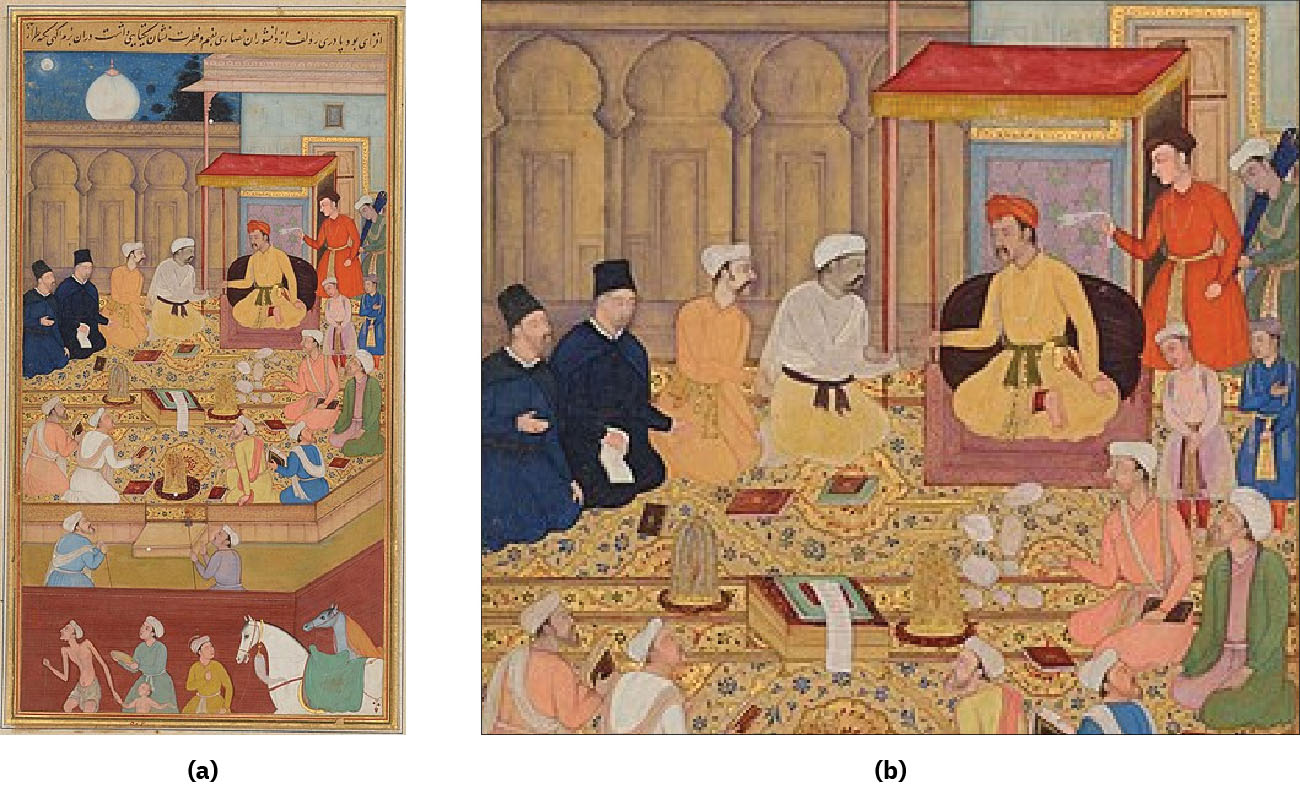
Not only did Akbar marry Hindu women and welcome Hindus into his administration, but he also proved tolerant of other religions and their adherents. He erected a hall to serve as a venue for religious debate (Figure 2.4). At first, only Muslim scholars took part, arguing matters of law and theology among themselves and answering questions Akbar posed. Soon, however, Akbar grew dissatisfied and came to regard some of their positions as too rigid. He then invited representatives of other religions to participate, including Portuguese Jesuit missionaries. Akbar found Christianity interesting, but he rejected the Jesuits’ teachings regarding the divinity of Jesus and reportedly found their insistence on monogamous marriage amusing.
英語のヒント
アクバルはヒンドゥー教徒の女性と結婚し、ヒンドゥー教徒を行政に迎え入れただけではなかった。他の宗教やその信徒にも寛容さを示した。宗教討論の会場とするための建物を設けた(図2.4)。当初はムスリムの学者だけが参加し、法と神学の問題を論じ合い、アクバルの質問に答えた。だが、やがてアクバルは不満を抱き、一部の学者の見解は硬直しすぎていると考えるようになった。そこで、ポルトガル人のイエズス会宣教師など、他宗教の代表者も招いて参加させた。キリスト教には興味を持ったが、イエスの神性に関するイエズス会の教えは退けた。また、彼らが一夫一婦制に固執することを面白がったとも伝えられている。
Emperor Akbar.アクバル帝。
(credit a and b: modification of work “Jesuits at Akbar's court” by Chester Beatty/Wikimedia Commons, Public Domain) · Public Domain
Figure 2.4 In this miniature painting from 1605 (a), Emperor Akbar, shown in detail seated beneath a red canopy (b), listens to religious debates among members of many different faiths. The men in black attire are Portuguese Jesuits. (credit a and b: modification of work “Jesuits at Akbar's court” by Chester Beatty/Wikimedia Commons, Public Domain)
英語のヒント
図2.4 1605年のこの細密画(a)で、赤い天蓋の下に座るアクバル帝は、さまざまな宗教の人々による討論を聞いている。拡大図(b)にはその姿がよく見える。黒い服の男たちはポルトガル人のイエズス会士である。(a・bの出典:Chester Beatty/Wikimedia Commons「Jesuits at Akbar's court」を改変。パブリックドメイン)
Akbar eventually abandoned all recognized religions, however, and created his own personal cult called Din-i Ilahi (the Divine Faith). This religion combined elements of many different faiths, and Akbar assumed a prominent role at its center. In 1579, he issued a decree proclaiming that all religious questions were to be decided by him. He was regarded by adherents of his cult as the agent of God who, in his role as representative of the divine, was bound to tolerate all religions. Akbar ceased performing the obligatory five prayers that Muslims must intone every day and began to worship “divine light.” He also began the practice of appearing daily to his subjects on a balcony so they could view him, reminiscent of a Hindu practice in which worshippers receive blessings by viewing the image of a deity. All these changes greatly disturbed Muslims in Akbar’s court.
英語のヒント
しかし最終的に、アクバルは既存の宗教をすべて離れ、ディーニ・イラーヒー(神の信仰)という自らの個人的な信仰を作り出した。この宗教はさまざまな信仰の要素を組み合わせ、アクバル自身がその中心で大きな役割を担った。1579年には、宗教に関わるすべての問題は自分が決定するという布告を出した。その信奉者はアクバルを神の代理人とみなし、神を代表する役割ゆえにすべての宗教を寛容に受け入れる義務があると考えた。アクバルはムスリムが毎日唱えなければならない5回の礼拝を行わなくなり、「神聖な光」を崇拝し始めた。また、臣民が自分の姿を見られるように、毎日バルコニーに現れる習慣も始めた。これは信者が神像を拝むことで祝福を受けるヒンドゥー教の慣行を思わせるものだった。こうした変化はすべて、アクバルの宮廷のムスリムたちを大いに動揺させた。
For the most part, however, India prospered under Akbar. His conquests left much of the subcontinent united and peaceful. Although illiterate himself, he amassed a large library of books in many languages, employed large numbers of translators and scholars, and established schools for both Muslims and Hindus. Domestic and international trade flourished. Gold and silver flowed into India in exchange for textiles, spices, and precious gems. Handicraft industries boomed, and merchants grew wealthy. The peasants were heavily taxed to pay for the empire’s bureaucracy, but they were excused from paying in full in times of drought or other natural disasters.
英語のヒント
それでも全体としては、アクバルの下でインドは繁栄した。彼の征服により、亜大陸の大部分が統一され、平和になった。本人は文字を読めなかったものの、多言語の書物を集めて大規模な図書館を作り、多数の翻訳者や学者を雇い、ムスリムとヒンドゥー教徒の両方の学校を設立した。国内交易も国際交易も栄えた。織物、香辛料、宝石と引き換えに金と銀がインドへ流れ込み、手工業が活況を呈し、商人たちは富を蓄えた。帝国の官僚機構を維持するため、農民には重税が課されたが、干ばつなどの自然災害の際には全額の納税を免除された。
Among those who benefited from the prosperity of Akbar’s reign were wealthy Mughal women, who reinvested in commerce the revenues derived from landed estates, gifts of the emperor and his predecessors to female relatives. They used the profits they earned to endow mosques, build shelters for travelers, support artists and poets, and fund charitable endeavors. They also used their wealth to give gifts to the emperor and court officials, one of the ways in which they attempted to influence the workings of the Mughal government.
英語のヒント
アクバルの治世の繁栄から利益を得た人々には、ムガルの裕福な女性たちもいた。彼女たちは所領から得た収入を商業に再投資した。その所領は皇帝や先代の皇帝が女性の親族に贈ったものだった。得た利益は、モスクへの寄進、旅人の宿泊所の建設、芸術家や詩人への援助、慈善事業への資金提供に使った。また、その富を用いて皇帝や宮廷の役人に贈り物をした。これは、彼女たちがムガル政府の運営に影響を及ぼそうとする方法の一つだった。
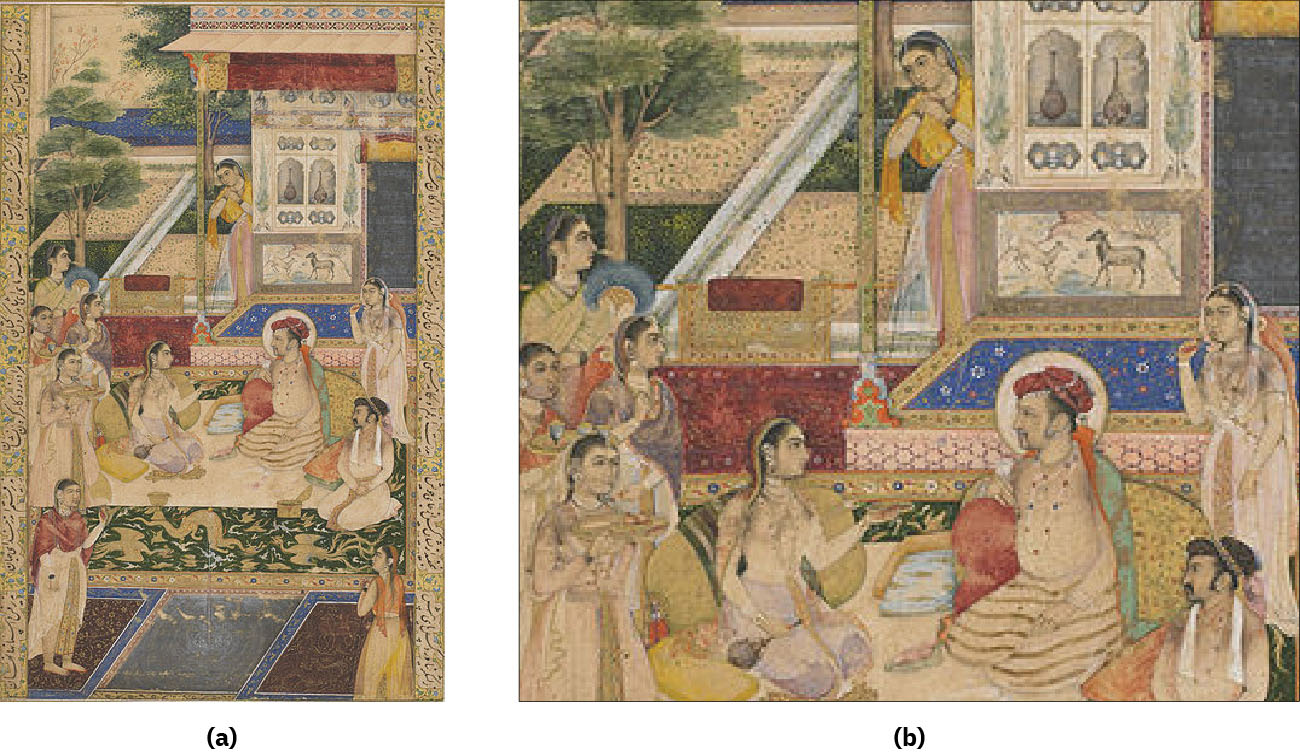
Akbar’s successors could not equal his achievements. When he died in 1605, his son Jahangir assumed the throne. Jahangir wanted to outshine his father and employed a large studio of artists who portrayed him in countless images as superior to other rulers. The paintings produced in Jahangir’s studio were influenced by European paintings, especially portraits, that were given to him by the English, with whom he had established a commercial relationship. Jahangir patronized Muslim scholars, who had been scandalized by Akbar’s religious policies. But like his father, he established an imperial cult, and devotees claimed Jahangir appeared to them in dreams and could heal them. Also like Akbar, he welcomed people of many religions at his court and married both Muslim and Hindu women. Like his grandfather Humayun, Jahangir often drank heavily, which took a toll on his health. As he weakened physically, he allowed his favorite wife Nur Jahan, a Persian Muslim, to assume significant power in his government. She took part in public rituals, engaged in diplomacy, and issued imperial edicts. She also helped Jahangir choose a son to succeed him and arranged a marriage between this son, Shah Jahan, and her niece (Figure 2.5).
英語のヒント
アクバルの後継者たちは彼の業績に並ぶことができなかった。1605年にアクバルが死ぬと、息子ジャハーンギールが即位した。ジャハーンギールは父をしのごうと、大勢の画家を抱える工房を設け、ほかの君主よりも優れた姿で自分を描いた無数の絵を作らせた。工房の作品はヨーロッパ絵画、とりわけ彼が交易関係を結んだイングランド人から贈られた肖像画の影響を受けていた。ジャハーンギールは、アクバルの宗教政策に憤慨していたムスリムの学者を保護した。だが父と同じく皇帝を崇敬する信仰を作り、その信奉者は、ジャハーンギールが夢に現れたり病気を治したりできると主張した。またアクバルと同じく、さまざまな宗教の人々を宮廷に迎え、ムスリムとヒンドゥー教徒の双方の女性と結婚した。祖父フマーユーンと同様に大酒を飲むことが多く、それが健康を損なった。体が弱るにつれ、ペルシア人のムスリムである最愛の妻ヌール・ジャハーンに、政治上の大きな権力を委ねるようになった。彼女は公の儀式に参加し、外交に携わり、皇帝の勅令を発した。また、後継者となる息子をジャハーンギールが選ぶのを助け、その息子シャー・ジャハーンと自分の姪の結婚を取り決めた(図2.5)。
Emperor Jahangir.ジャハーンギール帝。
(credit a and b: modification of work “Jahangir and Prince Khurram Entertained by Nur Jahan” by Smithsonian National Museum of Asian Art/Wikimedia Commons, Public Domain) · Public Domain
Figure 2.5 In this painting from about 1640 to 1650 (a), Emperor Jahangir, shown in detail with his head framed by a golden disc (b), relaxes with his favorite wife Nur Jahan and his son Shah Jahan in a garden. Nur Jahan loved gardens and paid for many to be designed. (credit a and b: modification of work “Jahangir and Prince Khurram Entertained by Nur Jahan” by Smithsonian National Museum of Asian Art/Wikimedia Commons, Public Domain)
図2.5 1640~1650年ごろのこの絵画(a)には、最愛の妻ヌール・ジャハーン、息子シャー・ジャハーンとともに庭園でくつろぐジャハーンギール帝が描かれている。拡大図(b)では、頭の後ろに金色の円がある姿が見える。ヌール・ジャハーンは庭園を好み、多くの庭園の設計費用を出した。(a・bの出典:Smithsonian National Museum of Asian Art/Wikimedia Commons「Jahangir and Prince Khurram Entertained by Nur Jahan」を改変。パブリックドメイン)
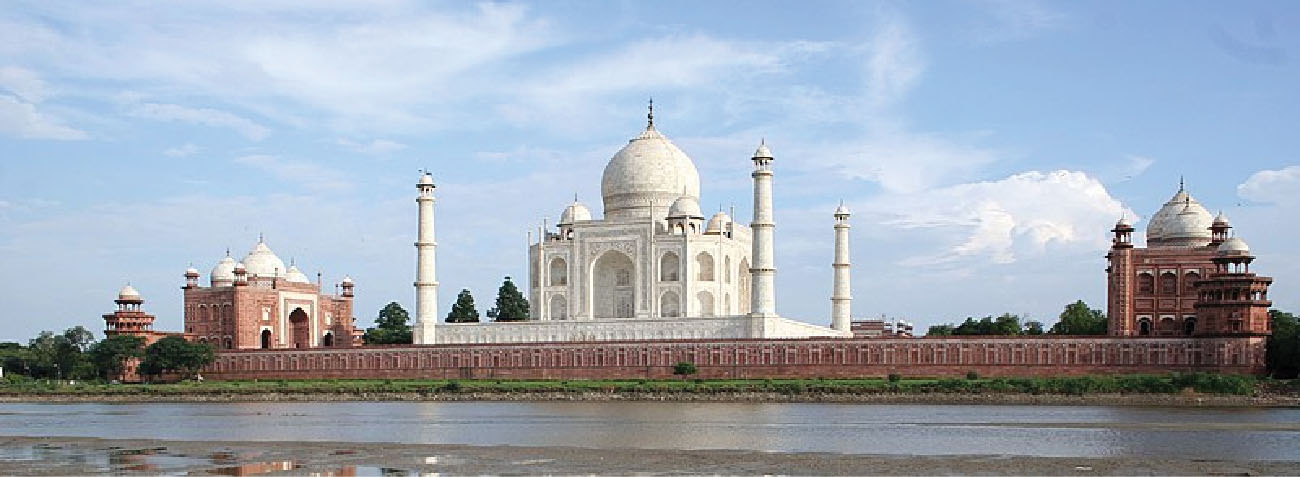
Following Jahangir’s death, Shah Jahan assumed the throne in 1628. To impress his subjects and other rulers with his importance, he commissioned the building of the Peacock Throne, an elevated platform covered by a vault ornamented with gold, semiprecious stones, and peacock sculptures, and he embarked upon numerous building projects. The most beautiful of these was the Taj Mahal, a tomb erected in 1631 for Shah Jahan’s favorite wife Mumtaz Mahal, who had died the previous year giving birth to their fourteenth child (Figure 2.6). The tomb, in the city of Agra, perfectly reflects the hybridized Indo-Islamic culture of the Mughal dynasty and is considered an exemplary work of Persianate architecture. It was built in a garden at one end of a reflecting pool and features a large dome surrounded by four free-standing minarets, towers from which the Muslim faithful are called to prayer. While tombs in that part of India were normally made of common materials such as sandstone, the Taj Mahal is covered in white marble in a style befitting the resting place of a Muslim holy man. It is embellished with semiprecious stones and bears verses in elegant calligraphy, chosen from the Quran by Shah Jahan himself.
英語のヒント
ジャハーンギールの死後、1628年にシャー・ジャハーンが即位した。臣民や他国の君主に自らの偉大さを印象付けるため、彼は孔雀の玉座を作らせた。それは金、半貴石、孔雀の彫刻で飾った覆いを備える高い台座だった。さらに、数々の建設事業に乗り出した。なかでも最も美しかったのが、最愛の妻ムムターズ・マハルのため1631年に建てた墓廟、タージ・マハルである。彼女は前年、14人目の子を産む際に死去していた(図2.6)。アーグラにあるこの墓廟は、ムガル王朝におけるインドとイスラームの混成文化を見事に表しており、ペルシア風建築の模範的な作品とされている。庭園の水鏡となる池の一端に建ち、大きなドームの周囲には、独立した4本のミナレットが立つ。ミナレットとはムスリムに礼拝を呼びかける塔である。インドのこの地域では、通常、墓は砂岩などのありふれた材料で作られたが、タージ・マハルはイスラームの聖者の安息の場にふさわしい様式で、白い大理石に覆われている。半貴石がちりばめられ、シャー・ジャハーン自身がクルアーンから選んだ章句が、優美な書体で記されている。
The Taj Mahal.タージ・マハル。
(credit: “Taj Mahal” by David Castor/Wikimedia Commons, Public Domain) · Public Domain
Figure 2.6 The Taj Mahal, an opulent royal tomb built in 1631, sits on the banks of the Yamuna River in Agra. On either side of it are sandstone mosques. (credit: “Taj Mahal” by David Castor/Wikimedia Commons, Public Domain)
英語のヒント
図2.6 1631年に建てられた豪華な王家の墓廟タージ・マハルは、アーグラのヤムナー川の岸辺に立つ。その両側には砂岩造りのモスクがある。(出典:David Castor/Wikimedia Commons「Taj Mahal」。パブリックドメイン)
In 1648, Shah Jahan moved the capital of the Mughal Empire from Agra to Delhi, where he embarked on another massive building project, the Red Fort. Inside this red sandstone fortress, palaces and administrative buildings were constructed, many of white marble or stucco polished or adorned with glazed tiles to resemble marble. Canals and Persian water wheels supplied the city with water, and a sewage system carried it away. Perfumed water flowed in channels through the city. Within the city walls, officials erected grand houses of their own. Mosques and gardens were built, many paid for by wealthy Mughal women. These building projects, while they greatly enhanced the beauty of Agra and Delhi, drained the treasury and led to increases in the tax burden of India’s peasants.
英語のヒント
1648年、シャー・ジャハーンはムガル帝国の首都をアーグラからデリーへ移し、そこでレッド・フォート(赤い城)という別の大規模な建設事業を始めた。この赤い砂岩の要塞の内側には、宮殿や行政用の建物が建設された。多くは白い大理石で作られ、あるいは大理石に見えるよう、漆喰を磨いたり施釉タイルで飾ったりして仕上げられた。運河とペルシア式揚水機が都市に水を供給し、下水道が水を排出した。香りを付けた水が市内の水路を流れた。城壁の内側では、役人たちも自分の壮麗な邸宅を建てた。モスクや庭園も造られ、その多くの費用を裕福なムガルの女性たちが負担した。これらの建設事業はアーグラとデリーを大いに美しくしたが、国庫を枯渇させ、インドの農民の税負担を増やすことになった。