第17章オスマン朝・マムルーク朝・明The Ottomans, the Mamluks, and the Ming
17.3 Gunpowder and Nomads in a Transitional Age17.3 移行期の火薬と遊牧民
Learning Objectives学習の目標
By the end of this section, you will be able to:
この節を学ぶと、次のことができるようになる。
Describe gunpowder weaponry and its effect on early modern society
火薬兵器と、それが近世社会に与えた影響を説明する。
Explain the reasons for the decline in nomadic societies in this period and beyond
この時代およびその後に、遊牧社会が衰退した理由を説明する。
The development of gunpowder and firearms technology in the late Middle Ages and early modern era had a tremendous impact on many societies. Firearms changed the nature of siege warfare and reduced the effectiveness of mounted warriors in battle, which in turn influenced the decisions of governments and the social organization of many states. Firearms also had an effect on nomadic societies that, before the early modern era, had often managed to dominate settled societies.
英語のヒント
中世末から近世にかけての火薬と火器の発達は、多くの社会に大きな影響を及ぼした。火器は都市や要塞を包囲する戦争の性格を変え、騎乗戦士の戦場での有効性を低下させた。その変化は、各国政府の判断や社会の組織にも影響した。火器は遊牧社会にも影響を与えた。近世以前には、遊牧社会が定住社会を支配することも多かったのである。
Social Change and the Adoption of Gunpowder火薬の採用と社会変化
Societies like those of the Turks and the Mongols had originally gained power as a result of their prowess as mounted warriors. Turkish fighters, whether Janissaries or mamluks, were renowned for their archery and equestrian abilities. The Mongols also awed their opponents with their skills as archers and riders. In the tenth century, however, the invention of gunpowder transformed the manner in which these societies and others made war.
英語のヒント
テュルク人やモンゴル人の社会は、もともと騎乗戦士としての優れた力によって台頭した。イェニチェリであれマムルークであれ、テュルク人の戦士は弓術と馬術の能力で名高かった。モンゴル人も、射手・騎手としての技能で敵を畏怖させた。しかし10世紀に火薬が発明されると、これらの社会やほかの社会の戦い方が変わった。
The first recorded use of gunpowder in battle occurred in China in 919. Scholars believe gunpowder was invented as a by-product of experiments conducted by Chinese alchemists, a group of people who pursued ways to turn ordinary metals into gold. A painting from Dunhuang in western China depicts a figure holding a tube from which flames are issuing forth (Figure 17.26). In 1126, a Chinese army was described as using similar tubes made of bamboo to fire projectiles at their opponents. Only six years later, another Chinese army made use of a bamboo cannon on wheels to destroy the walls of a city to which they had laid siege. By the thirteenth century, the Chinese were forging cannons from bronze.
英語のヒント
火薬を戦闘に使った最初の記録は、919年の中国にある。研究者は、普通の金属を金に変える方法を探していた中国の錬金術師の実験から、副産物として火薬が発明されたと考えている。中国西部の敦煌の絵には、火炎を噴き出す筒を持った人物が描かれている(図17.26)。1126年、中国軍が同様の竹筒を用いて敵に飛び道具を放ったという記述がある。そのわずか6年後、別の中国軍は、車輪に載せた竹製の大砲を使い、包囲していた都市の城壁を破壊した。13世紀までには、中国人は青銅製の大砲を製造するようになっていた。
An Early Image of Gunpowder?火薬を描いた初期の画像か。
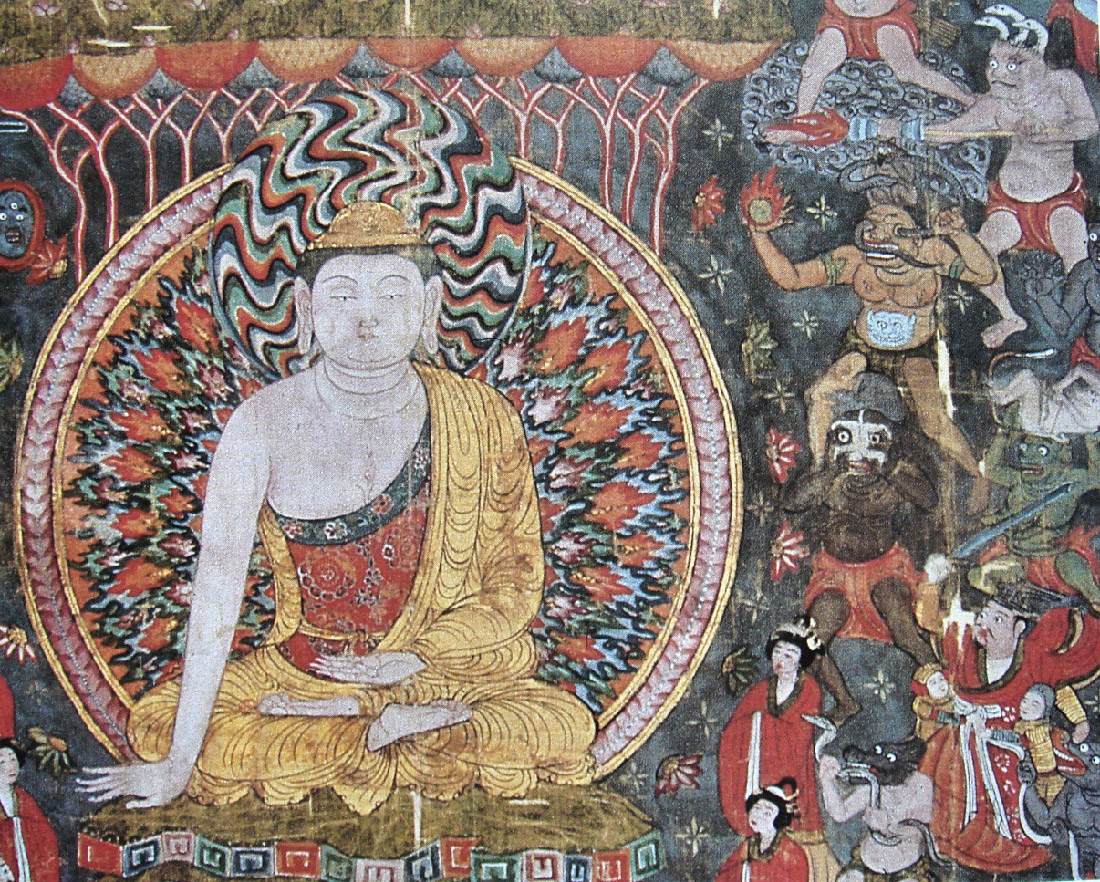
(credit: “First illustration of Fire Lance and a Grenade, 10th Century, Dunhuang” by Unknown/Wikimedia Commons, Public Domain) · Public Domain
Figure 17.26 This mid-tenth-century silk painting from Dunhuang, China, believed to show Buddha tempted by the demon Mara, depicts a figure in the upper right holding a tube from which fire emerges. Below him, another figure holds what appears to be a flaming bomb or grenade. (credit: “First illustration of Fire Lance and a Grenade, 10th Century, Dunhuang” by Unknown/Wikimedia Commons, Public Domain)
図17.26 中国の敦煌出土の10世紀半ばの絹本画。魔王マーラの誘惑を受ける仏陀を描いたものと考えられる。右上には、火が出る筒を持つ人物があり、その下の別の人物は、燃える爆弾または手榴弾らしき物を持っている。(出典: “First illustration of Fire Lance and a Grenade, 10th Century, Dunhuang”/作者不詳/Wikimedia Commons, パブリックドメイン)
Gunpowder and guns, along with the knowledge of how to manufacture them, spread westward from China with invading Mongol armies. This was not entirely new technology, however. The Arabs of this region already knew how to create flammable substances using petroleum, and the Byzantines employed a substance made from naphtha, called “Greek fire,” to set enemy ships alight (Figure 17.27). Arab texts of the thirteenth century contain numerous recipes for gunpowder and descriptions of rockets and other weapons that made use of it. The Mongols employed gunpowder and incendiary devices when laying siege to cities but did not adopt guns for fighting on horseback. The Arabs and Turks did, however. At the Battle of Ain Jalut in 1260, the mamluk forces that successfully fought off a Mongol army and prevented it from conquering Egypt were armed with an early type of cannon.
英語のヒント
火薬と銃砲、その製造法の知識は、侵攻するモンゴル軍とともに、中国から西へ広がった。ただし、まったく新しい技術ばかりではなかった。この地域のアラブ人は、石油から可燃物を作る方法をすでに知っていた。ビザンツ人もナフサから作った「ギリシアの火」という物質で、敵船に火を放っていた(図17.27)。13世紀のアラビア語文献には、火薬の多くの配合法と、それを使うロケットやその他の兵器の記述がある。モンゴル軍は都市の包囲で火薬や焼夷装置を使ったが、馬上戦闘に銃を採用することはなかった。アラブ人とテュルク人は採用した。1260年のアイン・ジャールートの戦いで、モンゴル軍を撃退してエジプト征服を防いだマムルーク軍は、初期型の大砲で武装していた。
Greek Fire.ギリシアの火。
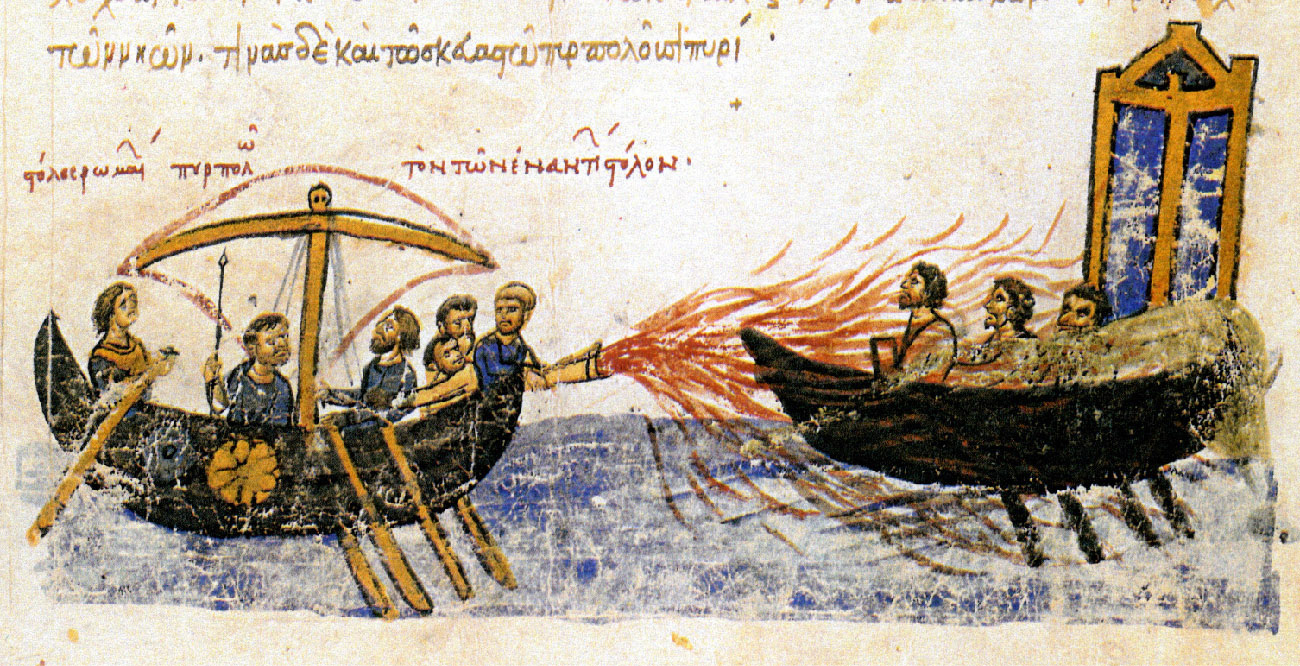
(credit: “Greek Fire, from Codex Skylitzes Matritensis” by Unknown/Wikimedia Commons, Public Domain) · Public Domain
Figure 17.27 A twelfth-century codex illustration shows the Byzantines using Greek fire to burn an enemy ship during a rebellion of the ninth century. The use of Greek fire in a variety of forms was a critical weapon for the Byzantines for centuries and made them a formidable force on the seas. (credit: “Greek Fire, from Codex Skylitzes Matritensis” by Unknown/Wikimedia Commons, Public Domain)
図17.27 12世紀の写本の挿絵。9世紀の反乱の際に、ビザンツ人がギリシアの火で敵船を焼く様子を示す。さまざまな形態で用いられたギリシアの火は、何世紀にもわたってビザンツ人の重要な兵器となり、海上で手ごわい勢力にした。(出典: “Greek Fire, from Codex Skylitzes Matritensis”/作者不詳/Wikimedia Commons, パブリックドメイン)
Europeans probably first encountered early versions of firearms in Russia, where the Mongols had introduced Chinese technology. Western Europeans discovered recipes for gunpowder in Arabic texts brought back from the Crusades or, in the case of Spain, introduced by the Muslims who established kingdoms there from the eighth through the fifteenth centuries. By the fifteenth century, numerous European countries had begun to use gunpowder and guns in battle. Some of the earliest weapons employed exploding gunpowder to fire arrows. By the thirteenth century, European and Ottoman armies were using early cannons called bombards to destroy the walls of cities and fortresses.
英語のヒント
ヨーロッパ人が初期の火器に初めて接したのは、おそらくロシアだった。モンゴル人がそこへ中国の技術を持ち込んでいたからである。西ヨーロッパ人は、十字軍が持ち帰ったアラビア語文献の中に、火薬の配合法を見いだした。スペインでは、8~15世紀に王国を築いたムスリムがそうした知識をもたらした。15世紀までに、ヨーロッパの多くの国が戦闘で火薬と銃砲を使い始めていた。最初期の兵器には、火薬の爆発で矢を飛ばすものもあった。13世紀までには、ヨーロッパ軍とオスマン軍はボンバルドと呼ばれる初期の大砲で、都市や要塞の壁を破壊していた。
The use of early firearms, cannons, and gunpowder transformed the ways in which wars were fought and also changed the societies that adopted this technology. On the battlefield, explosions could not only kill soldiers but also panic horses ridden by mounted warriors and thwart cavalry charges. Before the adoption of bombards and cannon, sieges of cities could drag on interminably; some lasted for years. So long as the people within the city walls had food and water, they would not surrender. Bombards and cannon allowed armies to breach stone walls, however; even a modest opening gave enemy attackers the opportunity to enter the city and do battle with the forces within. It was the use of cannon that finally allowed the Ottomans to destroy the walls of Constantinople and bring an end to the Byzantine Empire in 1453 (Figure 17.28). Earlier attempts to defeat the city had failed because armies could not break through the walls and were unable to carry on a prolonged siege that could reduce the Byzantines to starvation. The ability to destroy fortifications helped rulers assert power both in battle and at home. Nobles found it difficult to challenge the power of rulers whose cannon could destroy their castles.
英語のヒント
初期の銃器、大砲、火薬の使用は、戦い方を変えるとともに、それらを採用した社会を変えた。戦場の爆発は兵士を殺傷するだけでなく、騎乗戦士の馬をおびえさせ、騎兵の突撃を妨げることができた。ボンバルド砲や大砲の採用以前には、都市の包囲が際限なく長引き、何年も続くものもあった。城壁内の人々に食料と水がある限り、降伏しなかった。しかし大砲は石壁に突破口を開くことを可能にした。小さな開口部でも、攻撃側は市内へ入り、内部の守備軍と戦う機会を得られた。オスマン軍がついにコンスタンティノープルの城壁を破壊し、1453年にビザンツ帝国を終わらせられたのは、大砲を使ったためだった(図17.28)。以前の攻略は、城壁を突破できず、ビザンツ人を飢えに追い込むほど長期の包囲も続けられなかったため、失敗していた。防御施設を破壊する能力は、戦場でも国内でも、君主の権力行使を助けた。貴族は自分の城を大砲で破壊できる君主に、対抗しにくくなった。
The Dardanelles Gun.ダーダネルス砲。
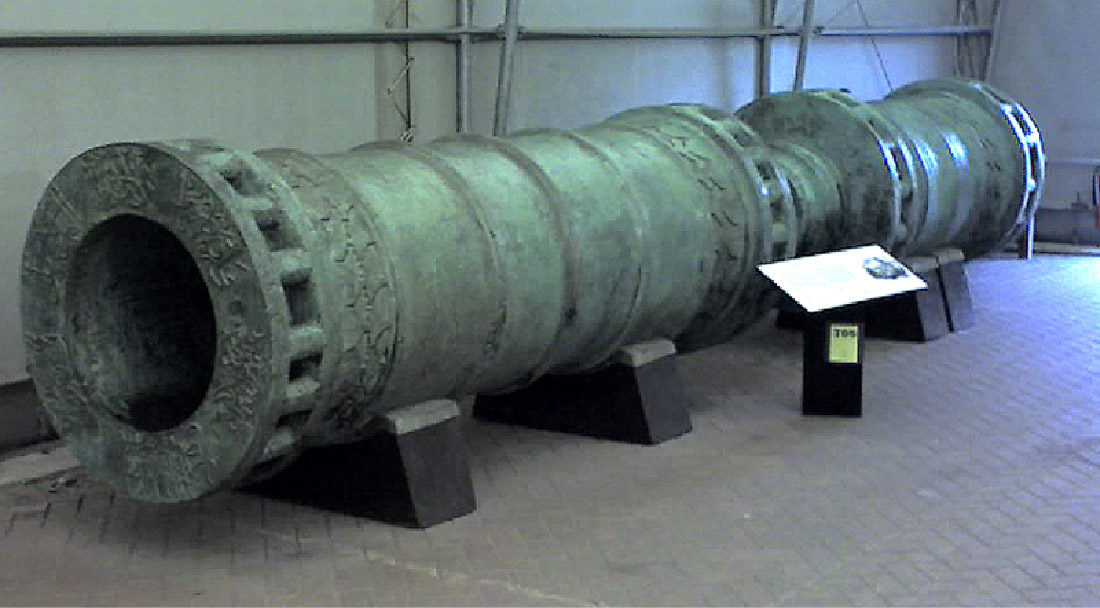
(credit: “Dardanelles Gun Turkish Bronze 15c” by “The Land”/Wikimedia Commons, Public Domain) · Public Domain
Figure 17.28 Cannons like this Dardanelles gun allowed the Ottoman Empire to conquer Constantinople in 1453. The Dardanelles gun was still in use nearly four hundred years later. (credit: “Dardanelles Gun Turkish Bronze 15c” by “The Land”/Wikimedia Commons, Public Domain)
図17.28 このダーダネルス砲のような大砲によって、オスマン帝国は1453年にコンスタンティノープルを征服できた。ダーダネルス砲は、それから約400年後にも使われていた。(出典: “Dardanelles Gun Turkish Bronze 15c”/“The Land”/Wikimedia Commons, パブリックドメイン)
The use of cannon also changed the nature of military defenses. To give added strength to city or fortress walls, earthen banks were built up inside them. Fortresses and city defenses were designed in the shape of stars so guns could be aimed in all directions, preventing an enemy from bringing artillery within reach of the walls (Figure 17.29). Engineers who knew how to build or destroy the new styles of fortress were in high demand. Paying for their expertise and for cannon, gunpowder, and cannon balls was expensive; rulers in societies that adopted guns taxed peasants heavily to pay for this new style of warfare.
英語のヒント
大砲の使用は、軍事的な防御のあり方も変えた。都市や要塞の壁を強めるため、その内側に土塁が築かれた。要塞と都市の防御施設は星形に設計され、どの方向にも砲を向けられるようにして、敵が城壁を射程に収める位置へ大砲を近づけるのを防いだ(図17.29)。新型の要塞を築き、または破壊する方法を知る技術者は、強く求められた。その専門知識に加え、大砲、火薬、砲弾の調達にも費用がかかった。銃砲を採用した社会の君主は、新たな戦争の形を支払うため、農民に重税を課した。
A Star Fort.星形要塞。
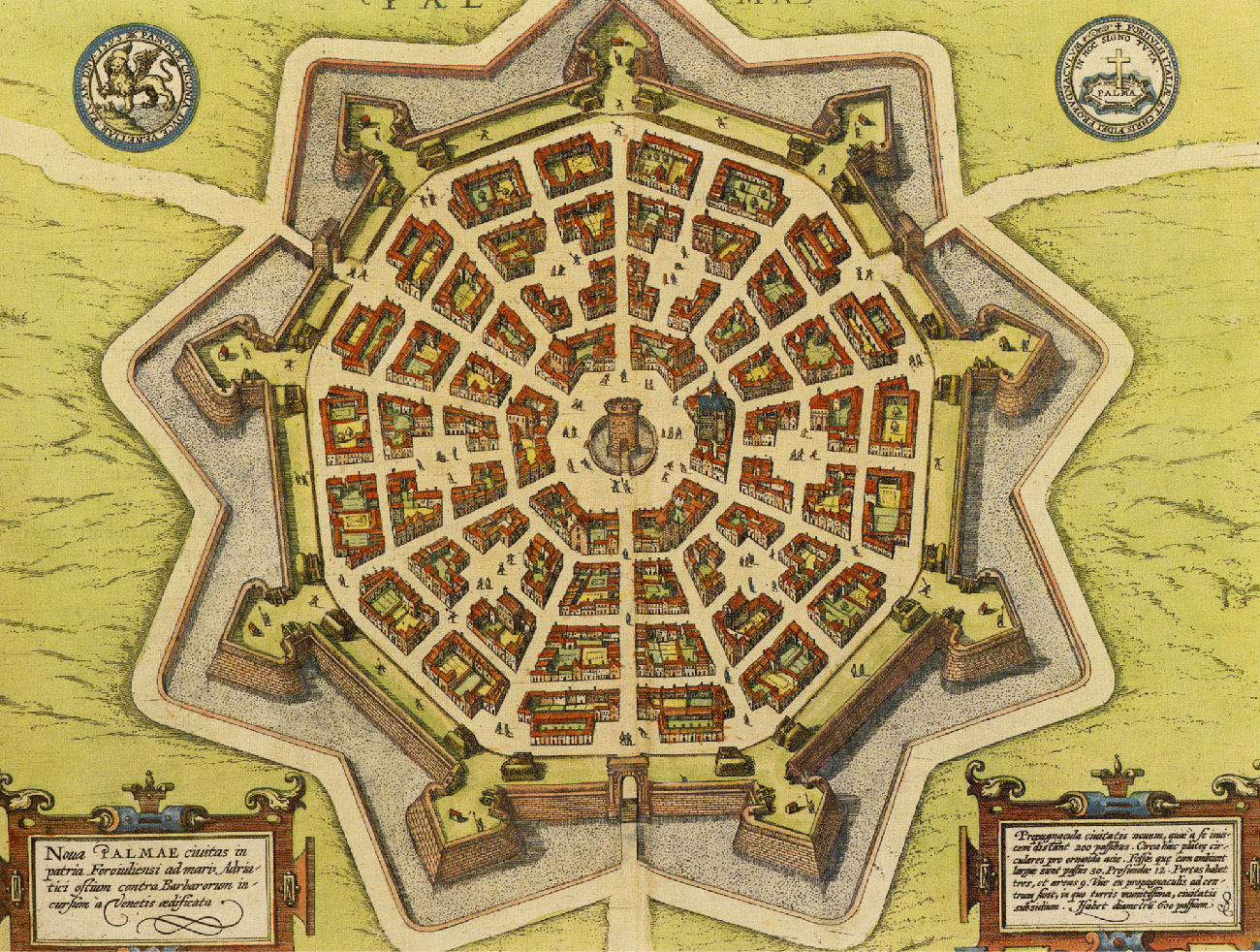
(credit: “Palmanova1600” by Unknown/Wikimedia Commons, Public Domain) · Public Domain
Figure 17.29 This anonymous artist’s seventeenth-century illustration of the Italian city of Palmanova shows its walls designed in the shape of a star for improved defense. (credit: “Palmanova1600” by Unknown/Wikimedia Commons, Public Domain)
図17.29 作者不詳の17世紀の図。イタリアの都市パルマノーヴァの城壁が、防御を高めるため星形に設計されている様子を示す。(出典: “Palmanova1600”/作者不詳/Wikimedia Commons, パブリックドメイン)
The nature of armies changed as well. Before the invention of gunpowder, cavalry were the most effective troops a commander could place in the field. Mounted warriors could attack and escape much faster than soldiers on foot, and they could reach down from horseback to deliver fatal blows to infantry or trample them underfoot. Guns deprived the cavalry of these advantages because they could kill riders and their mounts before they came within striking distance of opponents on the ground.
英語のヒント
軍隊の性格も変わった。火薬の発明以前には、騎兵が、司令官の投入できる最も有効な部隊だった。騎乗戦士は徒歩の兵よりはるかに速く攻撃して離脱でき、馬上から下へ致命傷を与えたり、歩兵を踏みつぶしたりできた。銃は騎兵からこうした利点を奪った。地上の敵に打撃を与えられる距離へ来る前に、騎手と乗馬を殺すことができたからである。
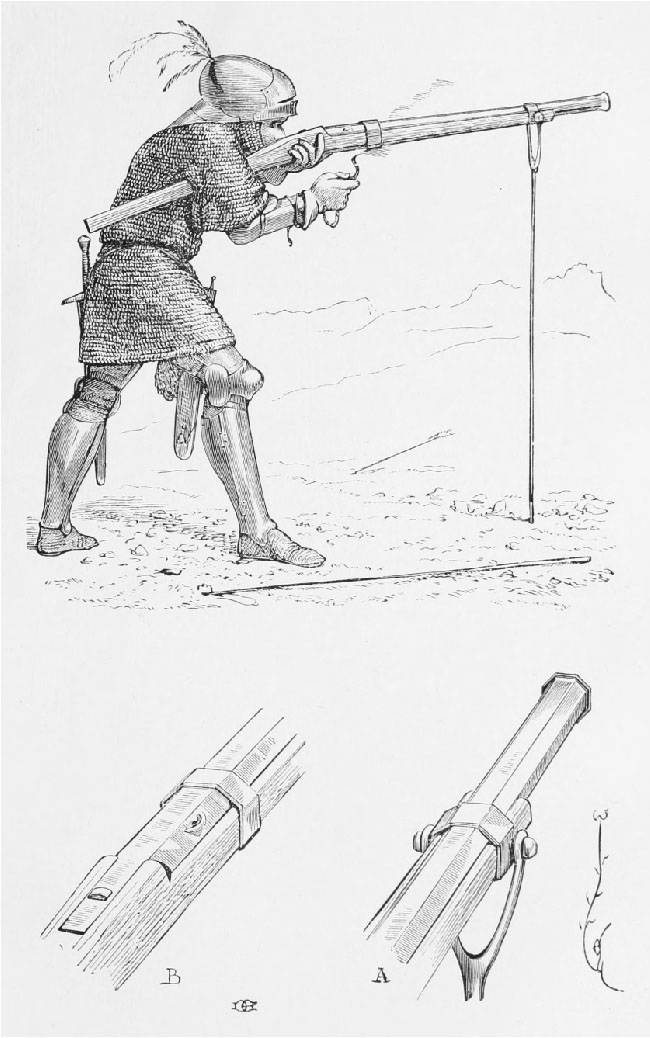
The development of handheld guns for individual soldiers lagged behind improvements in large artillery pieces like cannon. Early firearms were heavy and difficult to carry and maneuver. An arquebus, one of the earliest guns, had to be propped up on pieces of wood to be fired because it was too heavy to hold easily (Figure 17.30). Early firearms were also unreliable, inaccurate, and slow to load. A skilled archer like a mamluk soldier could fire several arrows in the time it took to reload a gun. Indeed, even after firearms were introduced, many armies still relied on infantry armed with bows and arrows. The Ottomans, for example, used peasant soldiers called azebs who carried bows and arrows, sabers, and sometimes halberds (weapons that combined a spear and an axe). Azebs bore the brunt of the enemy’s frontal attack before moving to the side and allowing cannon and Janissaries with guns, who had been stationed behind them, to fire at the oncoming foe.
英語のヒント
兵士が一人で持つ銃の開発は、大砲など大型火器の改良より遅れた。初期の火器は重く、運搬や操作が難しかった。最も初期の銃の一つ、アーケバス銃は、楽に手で持つには重すぎたため、木片で支えて発射しなければならなかった(図17.30)。初期の銃は作動も不確実で、命中精度が低く、装填にも時間がかかった。マムルーク兵のような熟練した射手なら、銃を一度再装填する間に何本もの矢を放てた。実際、火器が導入されても、多くの軍は弓矢を持つ歩兵に頼り続けた。たとえばオスマン軍はアゼブと呼ばれる農民兵を使い、弓矢、サーベル、ときには槍と斧を組み合わせた武器ハルバードを持たせた。アゼブは敵の正面攻撃の矢面に立った後、左右へ退き、後方に配置された大砲と銃を持つイェニチェリが、迫る敵に射撃できるようにした。
The Arquebus.アーケバス銃。
(credit: “Dictionnaire raisonné du mobilier français de l’époque carlovingienne à la Renaissance - illustration Tome 6” by Viollet-le-Duc/Wikimedia Commons, Public Domain) · Public Domain
Figure 17.30 The arquebus, an early gun, was so large and difficult to maneuver that it had to be propped on forked rods before it could be fired. (credit: “Dictionnaire raisonné du mobilier français de l’époque carlovingienne à la Renaissance - illustration Tome 6” by Viollet-le-Duc/Wikimedia Commons, Public Domain)
図17.30 初期の銃であるアーケバスは非常に大きく操作が難しかったため、発射前に先端が二股の棒で支える必要があった。(出典: “Dictionnaire raisonné du mobilier français de l’époque carlovingienne à la Renaissance - illustration Tome 6”/Viollet-le-Duc/Wikimedia Commons, パブリックドメイン)
The adoption of firearms like the arquebus required the development of new military tactics to enable them to be used effectively in battle. For example, military commanders adapted the technique of volley fire, which had been used by archers and crossbow fighters, to the use of firearms. Because early guns like the arquebus were so inaccurate and took so long to reload, a row of soldiers was trained to fire and then immediately move to the rear behind other rows of troops who, in turn, stepped to the front, fired, and then moved back. The soldiers in the rear had time to reload their guns as others fired their volleys. To help soldiers remember the complex series of steps to be followed in loading their guns, the Ming general Qi Jiguang composed a song listing them in turn.
英語のヒント
アーケバス銃などの火器を採用するには、それを戦場で有効に使う新たな戦術が必要だった。たとえば司令官たちは、射手や弩兵が使っていた一斉射撃の技法を、銃に適用した。初期の銃は命中精度が低く、再装填に長い時間がかかった。そのため兵士は、横一列で発射したら直ちに後列の後ろへ移動し、別の列が順に前へ出て撃ち、また後ろへ回るよう訓練された。後ろに回った兵は、他の列が一斉射撃する間に銃を装填できた。明の将軍、戚継光は、装填の複雑な手順を兵士が覚えられるよう、順番を列挙した歌を作った。
In most societies, male members of the nobility, often the only ones who could afford to purchase and pay for the upkeep of horses, had formed the core of the fighting forces. Their role as society’s defenders helped to justify the exalted position their class occupied. When handheld guns became common, armed peasant infantrymen supplanted the mounted elite. The loss of their warrior role often marked the beginning of the decline in the power of the aristocracy, and the loss of privileges that other social classes had not shared.
英語のヒント
多くの社会では、貴族の男性が戦闘部隊の中核を成していた。彼らはしばしば、馬を購入し、飼養費を負担できる唯一の人々だった。社会の防衛者という役割は、貴族階級の高い地位を正当化する助けとなった。手持ちの銃が普及すると、銃を持つ農民歩兵が騎乗するエリートに取って代わった。戦士としての役割を失うことは、しばしば貴族権力の衰退と、他の階級には認められていなかった特権の喪失の始まりを意味した。
As societies adopted the use of guns, some states developed a decisive advantage over others. Rulers who had access to metal to forge guns and the chemicals to make gunpowder were better able to impose their will on societies that did not. As the cost of handheld guns decreased, rulers such as Matthias I of Hungary created corps of armed infantry. Matthias armed approximately one-quarter of his foot soldiers with arquebuses in the fifteenth century. Countries with centralized governments and well-developed bureaucracies that were able to effectively tax their populations had the money to pay for these developments and found it easier to locate and recruit soldiers into the army. States with these advantages grew even more powerful.
英語のヒント
各社会が銃を採用するなかで、他国に決定的な優位を持つ国が現れた。銃を作る金属と火薬を作る化学物質を入手できる君主は、それができない社会に自分の意志を押し付けやすくなった。手持ち銃の価格が下がると、ハンガリーのマーチャーシュ1世のような君主が、武装した歩兵軍団を作った。マーチャーシュは15世紀に、歩兵のおよそ4分の1にアーケバス銃を持たせた。中央集権的な政府と、住民へ効果的に課税できる発達した官僚機構を持つ国は、こうした改良に資金を使うことができ、兵士を見つけて軍へ徴集するのも容易だった。これらの優位を持つ国家は、さらに強力になった。
Gunpowder thus helped to develop centralized states in Europe. These changes did not happen everywhere, though. States like the Ottoman Empire and Ming China already possessed centralized governments before they adopted gunpowder technology, and the use of firearms did not have a significant impact on the position of their nobility. In the Ottoman Empire, the non-noble Janissaries had formed the core of the Ottoman military before the widespread adoption of gunpowder and remained an elite force afterward. For the military portion of the Janissary corps, the adoption of gunpowder weapons combined with their intense training from a young age made them a formidable fighting force indeed, especially when using weapons that were not simple to use effectively. In Japan, the daimyo elite and their samurai vassals retained their privileged position in society until the nineteenth century, hundreds of years after the Japanese adopted guns. The arrival of guns brought change to a society, but not all societies responded in the same way.
英語のヒント
このように火薬は、ヨーロッパで中央集権国家を発展させる助けとなった。しかし、どこでも同じ変化が起きたわけではない。オスマン帝国や明代の中国は、火薬技術を採用する以前から中央集権的な政府を持ち、火器の使用は貴族の地位に大きな影響を与えなかった。オスマン帝国では、火薬が広く採用される以前から、貴族ではないイェニチェリが軍の中核を成し、採用後も精鋭部隊であり続けた。イェニチェリ軍団の軍事部門では、幼少期からの厳しい訓練に火薬兵器の採用が加わり、きわめて強力な戦闘部隊となった。特に、効果的に扱うのが容易ではない兵器を使う場合、その力が発揮された。日本では銃の採用から数百年後の19世紀まで、大名とその家臣の武士は社会の特権的地位を保った。銃の到来は社会を変えたが、すべての社会が同じ反応を示したわけではなかった。