第17章オスマン朝・マムルーク朝・明The Ottomans, the Mamluks, and the Ming
The Renaissanceルネサンス
The fall of Constantinople was lamented in Europe as signaling that no significant force remained to counter the Muslim advance westward. For many historians, it also marks the end of the European Middle Ages. As the Byzantine Empire collapsed, many Greeks sought refuge in other lands, often wealthy merchants and state officials who brought their riches with them. Many settled in Italy, especially in Venice and Rome. Those who came to Venice were assisted by Anna Notaras, a wealthy Byzantine noblewoman who had taken up residence in the city before Constantinople fell.
英語のヒント
ヨーロッパでは、コンスタンティノープル陥落は、ムスリムの西進に対抗できる有力な勢力がもはや残っていないことの表れとして嘆かれた。多くの歴史家にとっても、この出来事はヨーロッパ中世の終わりを示している。ビザンツ帝国が崩壊すると、多くのギリシア人が他国に避難した。その多くは、財産を携えた裕福な商人や国家官僚だった。多くがイタリア、特にヴェネツィアとローマに定住した。ヴェネツィアへ来た人々は、コンスタンティノープル陥落以前からこの都市に住んでいた裕福なビザンツ貴族の女性、アンナ・ノタラスの援助を受けた。
Byzantine scholars, theologians, artists, writers, and astronomers also fled westward to Europe, bringing with them the knowledge of ancient Greece and Rome that had been preserved in the eastern half of the Roman Empire after the western half fell. Among the texts they brought were the complete works of Plato and copies of Aristotle’s works in the original Greek. Access to these and other writings, many of which had been either unknown in western Europe or known only in the form of Arabic translations that arrived at the time of the Crusades, greatly influenced the course of the Italian Renaissance.
英語のヒント
ビザンツの学者、神学者、芸術家、著述家、天文学者も、西のヨーロッパへ逃れた。彼らは、ローマ帝国の西半分が滅んだ後も東半分で保存されていた、古代ギリシアとローマの知識を携えていた。持ち込んだ文献には、プラトンの全著作と、ギリシア語原文によるアリストテレスの著作の写本があった。これらを含む多くの著作は、それまで西ヨーロッパでは知られていないか、十字軍の時代に伝わったアラビア語訳でしか知られていなかった。そうした著作を読めるようになったことは、イタリア・ルネサンスの展開に大きな影響を及ぼした。
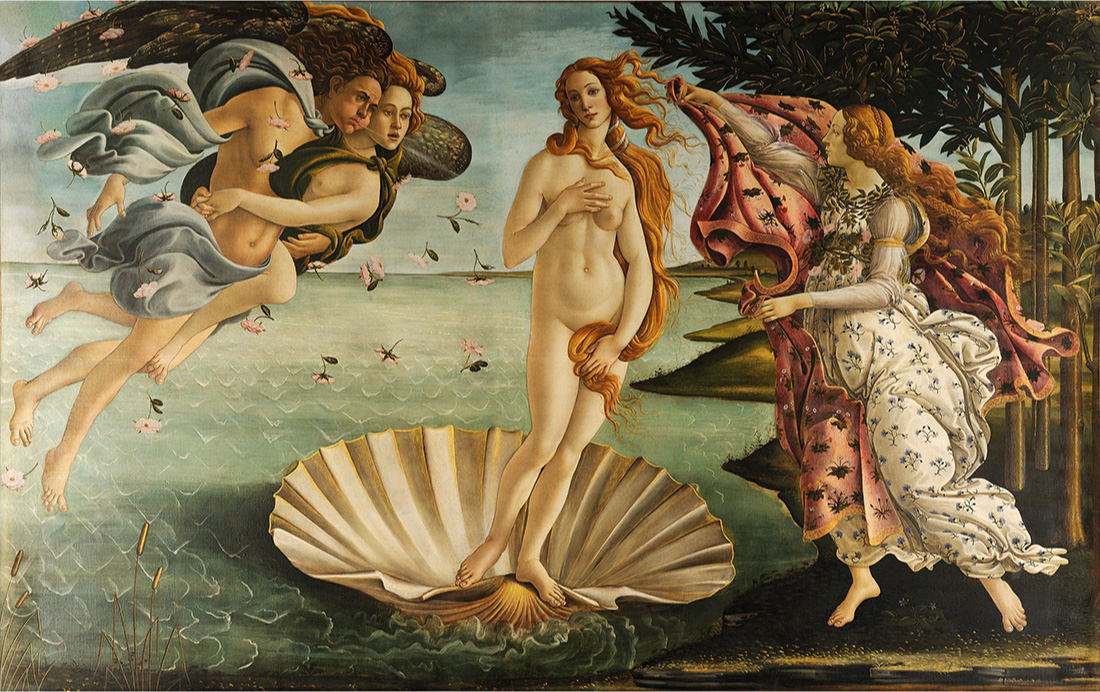
The Renaissance, which means “rebirth” in French, was a period of intellectual and artistic renewal inspired by the cultural achievements of ancient Greece and Rome and marking the dawn of the early modern world. It began in the city-states of northern Italy that had grown wealthy through trade, especially trade with the Ottomans. Beginning in the 1300s, scholars there turned to the works of Western antiquity—the writings of the ancient Greeks and Romans—for wisdom and a model of how to live (Figure 17.15). Among these scholars was Petrarch, who encouraged writers to adopt the “pure” Classical Latin in which the poets and lawmakers of the Roman Empire had written instead of the form of Latin used by medieval clergy. He advocated imitating the style of the Roman orator Cicero and the foremost of the Roman poets, Virgil.
英語のヒント
ルネサンスはフランス語で「再生」を意味する。古代ギリシアとローマの文化的成果に刺激された、知と芸術の刷新の時代であり、近世世界の夜明けを示すものだった。交易、特にオスマン勢力との交易で豊かになった北イタリアの都市国家で始まった。1300年代から、当地の学者たちは知恵と生き方の手本を求め、西洋古代の作品、すなわち古代ギリシア人とローマ人の著作に目を向けた(図17.15)。その一人ペトラルカは、中世の聖職者が使う形のラテン語ではなく、ローマ帝国の詩人や立法者が書いた「純粋な」古典ラテン語を使うよう、著述家たちに勧めた。彼は、ローマの弁論家キケロと、ローマを代表する詩人ウェルギリウスの文体をまねるべきだと説いた。
The Birth of Venus.ヴィーナスの誕生。
(credit: modification of work “The Birth of Venus” by Sandro Botticelli/Wikimedia Commons, Public Domain) · Public Domain
Figure 17.15 Sandro Botticelli’s 1485 painting The Birth of Venus shows the Roman goddess of love and beauty perched on a seashell after having emerged from the water. During the Renaissance, the depiction of scenes from Greek and Roman mythology became common in European art. (credit: modification of work “The Birth of Venus” by Sandro Botticelli/Wikimedia Commons, Public Domain)
図17.15 サンドロ・ボッティチェリによる1485年の『ヴィーナスの誕生』。愛と美を司るローマの女神が、水から生まれ出た後、貝殻に立つ姿を示す。ルネサンス期には、ギリシア・ローマ神話の場面を描くことが、ヨーロッパ美術で一般的になった。(出典: 原作品を加工:“The Birth of Venus”/Sandro Botticelli/Wikimedia Commons, パブリックドメイン)
Petrarch has been called the father of humanism. Humanism was a movement born in Italy in the fourteenth century that focused on the study of human beings, human nature, and human achievements, as opposed to the study of God. Humanists stressed the beauty and dignity of humanity instead of focusing on its sinful, “fallen” nature. They believed the classical worlds of ancient Greece and Rome could provide contemporary people with untold wisdom and a model for life.
英語のヒント
ペトラルカは人文主義の父と呼ばれてきた。人文主義は14世紀のイタリアに生まれ、神の研究ではなく、人間、人間の本性、人間の成し遂げたことを研究の中心に置く運動だった。人文主義者は、人間の罪深く「堕落した」性質に目を向けるよりも、人間の美しさと尊厳を強調した。古代ギリシアとローマの古典世界は、同時代の人々に、計り知れない知恵と人生の手本を与えてくれると考えた。
Before the arrival of Byzantine scholars and their copies of Plato and Aristotle, Italian humanists had focused primarily on the study of rhetoric and ethics. They displayed little interest in metaphysics, the philosophical study of the nature of existence. Access to Plato’s complete works changed that, and many scholars were influenced by Byzantine Neoplatonism, an intellectual movement that sought to synthesize the ideas of Plato, Aristotle, the Stoic philosophers, and Arabic philosophy. One of the most important of the Italian Neoplatonists was Marsilio Ficino, who translated all of Plato’s works from ancient Greek to Latin and synthesized Platonic thought with the teachings of Christianity.
英語のヒント
ビザンツの学者がプラトンやアリストテレスの写本を携えて到来する以前、イタリアの人文主義者は主として修辞学と倫理学を研究していた。存在の本質を哲学的に研究する形而上学には、ほとんど関心を示していなかった。プラトンの全著作を読めるようになると、この状況は変わった。多くの学者が、プラトン、アリストテレス、ストア派哲学者、そしてアラビア哲学の思想を統合しようとする知的運動、ビザンツの新プラトン主義に影響された。イタリアの新プラトン主義者の中でも、マルシリオ・フィチーノは特に重要な人物だった。彼はプラトンの全著作を古代ギリシア語からラテン語へ翻訳し、プラトン思想とキリスト教の教えを統合した。
In the Neoplatonic conception, the universe was an ordered hierarchy with God, “the One,” at the top, and everything else existing as “emanations” of God at descending levels with the earth at the bottom. If God was perfect, the physical world in which humans lived was least perfect. However, Ficino argued, the human soul existed at the center of the universe, because it combined aspects of both the godly world and the physical world in which humans lived. Because humans possessed a soul, they were thus the center of creation. Ficino’s ideas fit well with the humanist perception of human beings as special creatures and worthy of study.
英語のヒント
新プラトン主義の考えでは、宇宙は秩序ある階層構造を成していた。頂点に神である「一者」があり、それ以外のすべては神からの「流出」として段階的に低い位置に存在し、最下層に地上世界があった。神が完全であるなら、人間の暮らす物質世界は最も不完全だった。しかしフィチーノは、人間の魂は神的な世界と、人間の暮らす物質世界の両方の性質を併せ持つため、宇宙の中心に位置すると論じた。したがって、魂を持つ人間は創造された世界の中心だった。フィチーノの思想は、人間を特別な存在、研究に値する存在と考える人文主義の見方によく合った。
Another Neoplatonist, Nicholas of Cusa (Nicholas Cusanus), also had a profound effect on the Italian Renaissance and one of its most important legacies, the Scientific Revolution of the sixteenth and seventeenth centuries. The Greek philosopher Aristotle had stressed the study of the world through direct observation, a method known as empiricism. For Plato, however, the world of ideas, of abstract concepts, was superior to the components of the physical world. Thus, mathematical thought was superior to sensory observation as a way of arriving at ultimate knowledge of the “truth” of the world. Nicholas also stressed that mathematical knowledge of the world was superior to knowledge derived from mere observation. He went so far as to state that through mathematics, humans could know the very mind of God.
英語のヒント
もう一人の新プラトン主義者ニコラウス・クザーヌスも、イタリア・ルネサンスと、その重要な遺産の一つである16~17世紀の科学革命に、深い影響を与えた。ギリシアの哲学者アリストテレスは、直接観察によって世界を研究することを重視した。この方法は経験論と呼ばれる。しかしプラトンにとって、イデア、すなわち抽象的な概念の世界は、物質世界を構成するものより優れていた。したがって世界の「真理」について究極的な知識に到達する方法としては、感覚による観察より数学的思考が優れていた。ニコラウスも、世界についての数学的知識は、単なる観察から得られる知識より優れると強調した。数学を通じて人間は神の精神そのものを知ることができる、とまで述べた。
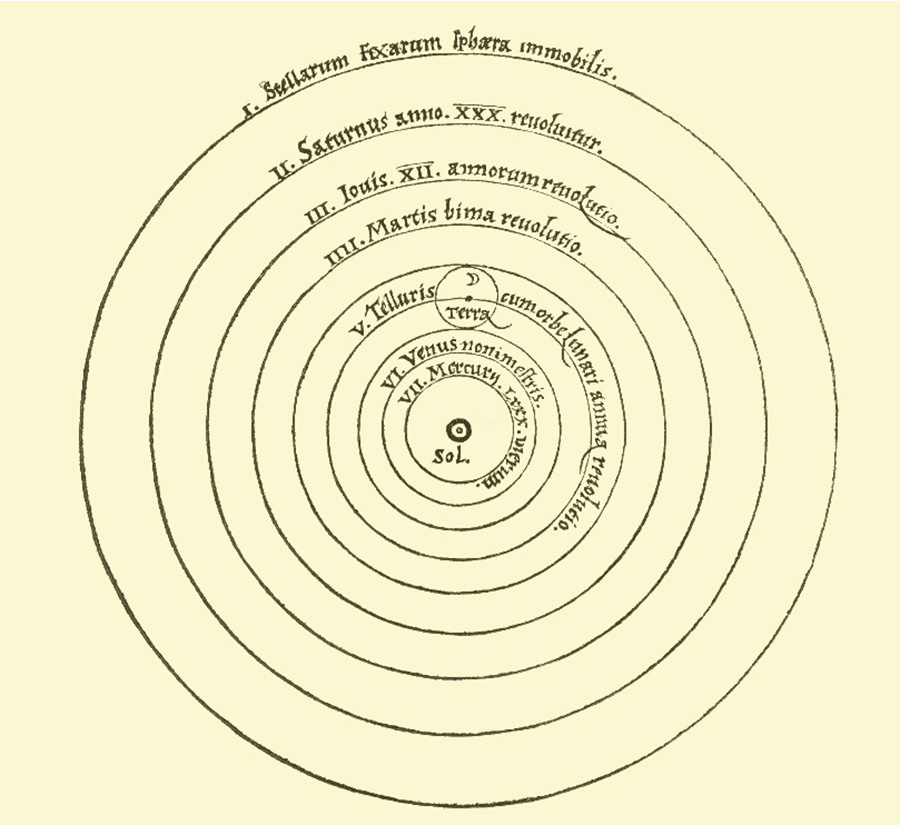
The idea that the physical world could best be understood through mathematical formulas was espoused by Johannes Kepler, the German astronomer who believed the model of the universe that made the most sense mathematically was the true model. It was through mathematics that Kepler discovered three of the laws of planetary motion and was able to explain how the planets moved in the heliocentric, or sun-centered, model of the universe earlier proposed by Nicolaus Copernicus (Figure 17.17). This was the same view of the universe held by the Italian astronomer Galileo Galilei: the true nature of the universe could be discovered only through mathematics.
英語のヒント
物質世界は数式によって最もよく理解できるという考えを支持したのが、ドイツの天文学者ヨハネス・ケプラーである。彼は、数学的に最も筋が通る宇宙模型こそ、真の模型だと考えた。ケプラーが惑星運動の三つの法則を発見し、それ以前にニコラウス・コペルニクスが提案した太陽中心の宇宙模型で惑星がどう動くかを説明できたのは、数学を通じてだった(図17.17)。これはイタリアの天文学者ガリレオ・ガリレイの宇宙観とも同じだった。宇宙の真の性質を発見できるのは、数学によってのみであるという考えだ。
The Heliocentric Universe.太陽中心の宇宙。
(credit: modification of work “Image of heliocentric model from “De revolutionibus orbium coelestium”” by Nicolaus Copernicus/Wikimedia Commons, Public Domain) · Public Domain
Figure 17.17 In 1543, Nicolaus Copernicus proposed a model of the universe with the sun at the center, which differed from the medieval Ptolemaic model with the earth in the center. Copernicus’s model does not show any planets beyond Saturn. In his model, beyond Saturn there are only fixed stars. (credit: modification of work “Image of heliocentric model from “De revolutionibus orbium coelestium”” by Nicolaus Copernicus/Wikimedia Commons, Public Domain)
図17.17 1543年、ニコラウス・コペルニクスは太陽を中心に据えた宇宙模型を提案した。これは、地球を中心とする中世のプトレマイオス模型とは異なる。コペルニクスの模型には土星より外の惑星はなく、その外側には恒星だけがある。(出典: 原作品を加工:“Image of heliocentric model from “De revolutionibus orbium coelestium””/Nicolaus Copernicus/Wikimedia Commons, パブリックドメイン)
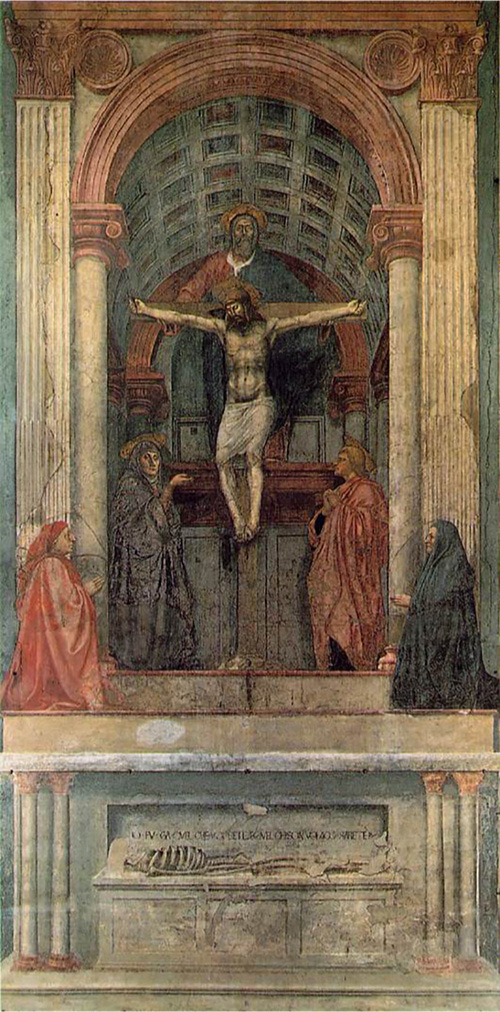
Although the Neoplatonists did not value Aristotle’s empiricism, they did not completely cast his ideas aside. First, his concept of “virtue” influenced the humanists’ idea of human excellence. And his emphasis on acquiring knowledge through observation influenced scientists in fields other than astronomy. Observation of nature became of importance not only to scientists but also to the visual artists of the Renaissance. The fifteenth-century Florentine painter Masaccio was the first to incorporate the principles of linear perspective into painting (Figure 17.18). The use of linear perspective had been a “secret” known to the ancient Greeks and Romans but lost and then “rediscovered” by the Florentine architect Filippo Brunelleschi, whose drawings inspired Masaccio. This technique created a sense of realism in visual imagery that had been lacking in medieval art. Later artists such as Leonardo da Vinci conducted studies of animal and human anatomy to make their works more realistic. Michelangelo went beyond attempting to make human beings look realistic and instead idealized the body, in keeping with the new position into which the thinkers of the Renaissance had elevated humans.
英語のヒント
新プラトン主義者はアリストテレスの経験論を高く評価しなかったが、彼の思想を完全に捨てたわけではない。まず、彼の「徳」の概念は、人間の卓越性についての人文主義者の考えに影響した。また、観察によって知識を得ることを重視する姿勢は、天文学以外の分野の科学者に影響した。自然観察は、科学者だけでなくルネサンスの視覚芸術家にとっても重要になった。15世紀のフィレンツェの画家マサッチオは、線遠近法の原理を絵画に取り入れた最初の人物だった(図17.18)。線遠近法の使用は、古代ギリシア人とローマ人が知っていたものの失われた「秘訣」であり、フィレンツェの建築家フィリッポ・ブルネレスキがそれを「再発見」した。彼の描画がマサッチオを刺激したのである。この技法は、中世美術に欠けていた現実感を画像に生み出した。後代のレオナルド・ダ・ヴィンチなどの芸術家は、作品をより写実的にするため、動物と人間の解剖学を研究した。ミケランジェロは、人間を現実らしく見せようとする試みをさらに進め、身体を理想化した。それは、ルネサンスの思想家が人間を高めて置いた、新たな地位にふさわしい表現だった。
Linear Perspective.線遠近法。
(credit: modification of work “Holy Trinity” by Masaccio/Wikimedia Commons, Public Domain) · Public Domain
Figure 17.18 The fresco Trinity with the Virgin, Saint John the Evangelist, and Donors, painted around 1427 in the church of Santa Maria Novella in Florence, shows Masaccio’s use of linear perspective to create a realistic image of the interior of a building. (credit: modification of work “Holy Trinity” by Masaccio/Wikimedia Commons, Public Domain)
図17.18 1427年頃、フィレンツェのサンタ・マリア・ノヴェッラ教会に描かれたフレスコ画『聖母、福音書記者聖ヨハネ、寄進者を伴う三位一体』。マサッチオは線遠近法を使って、建物内部の写実的な像を作り出している。(出典: 原作品を加工:“Holy Trinity”/Masaccio/Wikimedia Commons, パブリックドメイン)