第17章オスマン朝・マムルーク朝・明The Ottomans, the Mamluks, and the Ming
17.1 The Ottomans and the Mongols17.1 オスマン勢力とモンゴル人
Learning Objectives学習の目標
By the end of this section, you will be able to:
この節を学ぶと、次のことができるようになる。
Discuss the origins of the Ottoman Empire
オスマン帝国の起源について論じる。
Describe how the conflict between the Ottomans and Timur influenced the development of the Ottoman state
オスマン勢力とティムールの対立が、オスマン国家の発展にどう影響したかを説明する。
Describe the effect of the conquest of the Byzantine Empire on Europe and the Ottoman Empire
ビザンツ帝国の征服が、ヨーロッパとオスマン帝国に与えた影響を説明する。
Describe the intellectual, cultural, and artistic developments of the Renaissance
ルネサンスの知的・文化的・芸術的発展を説明する。
As the people of western Europe remade their societies following the collapse of the western half of the Roman Empire, the Byzantines in the east preserved Roman cultural practices for centuries, seeing themselves always as the continuation of a proud and strong Mediterranean empire. By the eleventh century, however, the Byzantines found their power challenged by the arrival of Turkic tribes such as the Seljuks, who settled in the eastern half of their domains and gradually wrested control of the area from them. As different Turkic tribes arrived and settled in the region, one group, the Ottomans, soon rose to prominence over others. Withstanding the last major Mongol onslaught, the Ottomans went on to dominate Asia Minor, invade Europe, and eventually deprive the Byzantines of their last remnants of power. The fall of the Byzantine Empire in 1453 sent many Greek scholars and theologians fleeing to the city-states of Italy, where they contributed to the intellectual and artistic transformation of western Europe in the period known as the Renaissance. By the end of the fifteenth century, the Ottomans had transformed the eastern Mediterranean.
英語のヒント
ローマ帝国の西半分の崩壊後、西ヨーロッパの人々が社会を作り直していた頃、東のビザンツ人はローマの文化的慣行を何世紀にもわたって守り続けた。自分たちは誇り高く強力な地中海帝国の連続した存在だと、常に考えていたのである。しかし11世紀までに、セルジューク人などのテュルク系部族の到来がビザンツの権力を脅かした。彼らはビザンツ領の東半分に定住し、徐々にその地域の支配権を奪った。さまざまなテュルク系部族が流入して定着するなか、一集団であるオスマン勢力が、ほどなく他をしのいで台頭した。モンゴルによる最後の大規模な猛攻に耐えたオスマン勢力は、その後、小アジアを支配し、ヨーロッパへ侵入し、ついにはビザンツ人から最後に残った権力を奪った。1453年にビザンツ帝国が滅びると、多くのギリシア人学者や神学者がイタリアの都市国家へ逃れた。彼らは、ルネサンスと呼ばれる時期に、西ヨーロッパの知と芸術の変容に貢献した。15世紀末までに、オスマン勢力は東地中海を一変させていた。
Ottoman Growthオスマン勢力の成長
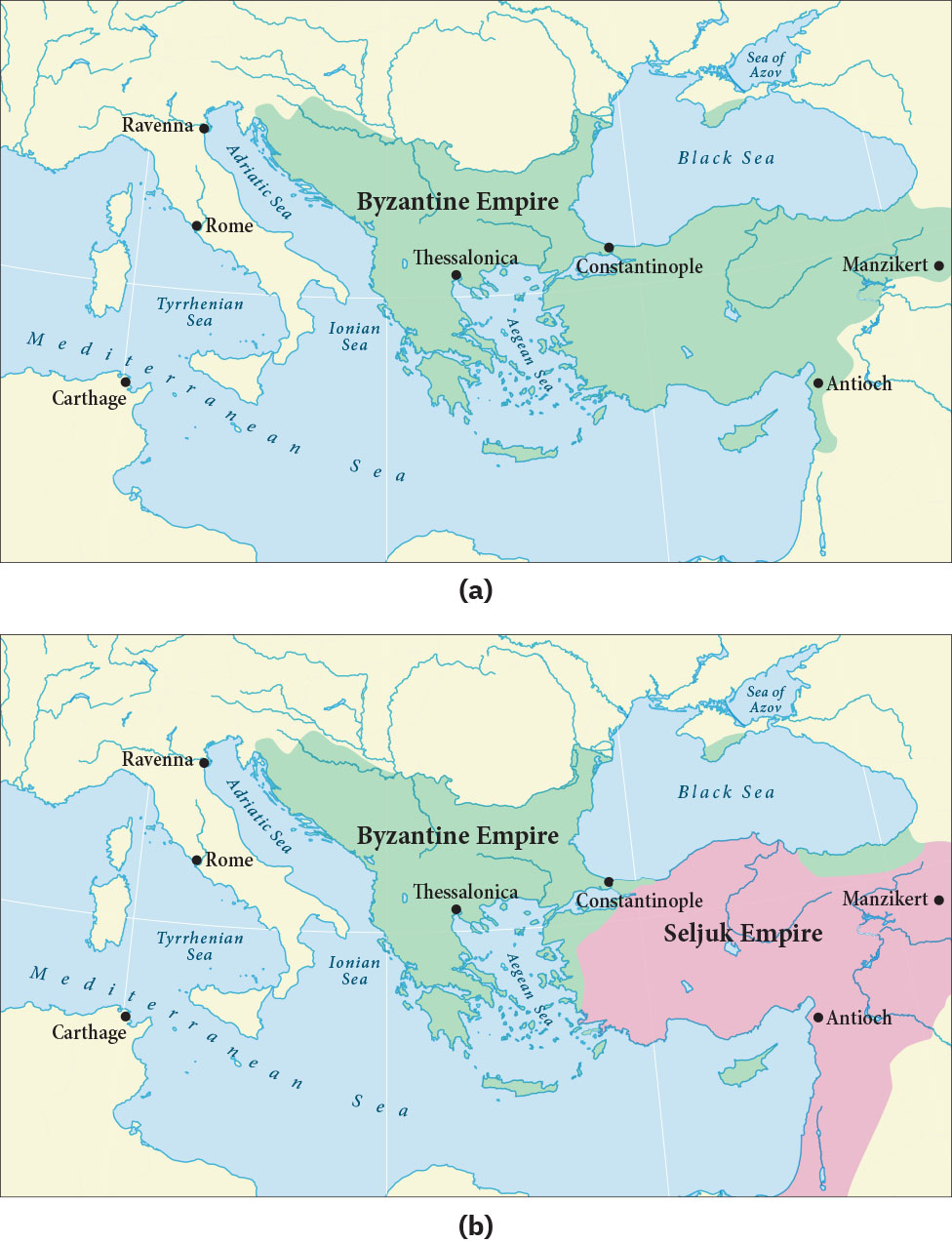
With an empire that bordered both the western and eastern worlds, the Ottoman Turks began to play an important role in Asian and European affairs in the thirteenth century. They were not the first Turkic-speaking people to do so, however. In the tenth and eleventh centuries, a group of Turkic speakers from central Asia arrived first through the Iranian plateau before continuing westward into the area that is now modern Turkey. This group, called the Seljuks after their ruler, converted to Islam in the tenth century. Accomplished archers and riders, they were originally employed by the armies of the Islamic Karakhanid and Ghaznavid dynasties of central Asia before carving out an empire of their own in Persia, Mesopotamia, and eastern Asia Minor. Seizing control of Baghdad, the capital of the Abbasid Empire and home to the Sunni caliph, in 1055, the Seljuks came to regard themselves as defenders of the Islamic faith and established the Seljuk Empire. Defeating the forces of the Byzantine Empire in 1071 at the Battle of Manzikert in eastern Anatolia (another name for Asia Minor), the Seljuks soon dominated that region as well (Figure 17.4).
英語のヒント
オスマン・トルコは東西両世界に接する帝国を築き、13世紀にアジアとヨーロッパの情勢で重要な役割を担い始めた。ただし、そうした役割を果たした最初のテュルク語系集団ではなかった。10~11世紀には、中央アジアからテュルク語系の言葉を話す一集団が、まずイラン高原を通り、さらに西へ進んで現在のトルコにあたる地域へ入っていた。支配者の名からセルジュークと呼ばれたこの集団は、10世紀にイスラームへ改宗した。巧みな射手であり騎手でもあった彼らは、初めは中央アジアのイスラーム王朝であるカラ・ハン朝とガズナ朝の軍隊に雇われていた。その後、ペルシア、メソポタミア、小アジア東部に、自らの帝国を切り開いた。1055年、アッバース朝の首都で、スンナ派カリフの居所でもあったバグダードを掌握すると、イスラーム信仰の守護者を自任するようになり、セルジューク帝国を成立させた。1071年にはアナトリア東部のマンジケルトの戦いでビザンツ帝国軍を破り、まもなくその地域も支配した。アナトリアは小アジアの別名である(図17.4)。
Incursions of the Seljuk Empire against the Byzantines.セルジューク帝国のビザンツ領への侵入。
(attribution: Copyright Rice University, OpenStax, under CC BY 4.0 license) · CC BY 4.0
Figure 17.4 Before the arrival of the Seljuk Turks, the Byzantine Empire laid claim to most of Asia Minor (a). Over the course of the eleventh century, the empire’s holdings in Asia Minor steadily shrank as the Byzantines were replaced by the Seljuk Turks (b). (attribution: Copyright Rice University, OpenStax, under CC BY 4.0 license)
図17.4 セルジューク・トルコが来る以前、ビザンツ帝国は小アジアの大半を自領と主張していた(a)。11世紀を通じて、ビザンツ人に代わってセルジューク・トルコが支配するようになり、帝国の小アジア領は着実に縮小した(b)。(出典: 著作権:Rice University, OpenStax/CC BY 4.0)
In 1077, the Seljuks established a state in Anatolia they called the Sultanate of Rum (“Rome”) because the territory had been taken from the Byzantine Empire, the Eastern Roman Empire. The sultanate steadily absorbed other Turkish tribes in Anatolia and brought them under its control, forming a confederation of tribes more than a unified state. The sultanate’s ruler was primarily a military leader, and the provinces were governed by military commanders. Within the provinces, different regions were controlled by different groups of warriors who often fought with one another and sometimes sold their military services to Byzantine rulers.
英語のヒント
1077年、セルジューク人はアナトリアに国家を建て、「ローマ」を意味するルーム・スルタン朝と名づけた。その領土を東ローマ帝国であるビザンツ帝国から奪ったためである。このスルタン朝はアナトリアの他のテュルク系部族を着実に吸収して支配下に収めたが、統一国家というより部族の連合体を形づくっていた。君主は主として軍事指導者で、各州も軍司令官が統治した。州の内部では異なる地域を異なる戦士集団が支配し、しばしば互いに争い、ときにはビザンツの君主に軍事力を売ることもあった。
Seljuk rulers built mosques and madrasas—schools where scholars taught subjects such as science, theology, and Islamic law—especially in Iconium (now Konya), one of the cities that served as the capital of the Sultanate of Rum. They also established caravansaries, inns where merchants traveling along the Silk Roads could safely rest and conduct business. Trade attracted merchants and artisans, and religious scholars took up residence in the Turkish cities. As the Byzantine Empire lost control of Anatolia, Orthodox Christian clergy and monks fled, loosening the peasants’ ties to Christianity and making it easier for many to convert to Islam. Gradually, Anatolia became more Islamic in appearance and nature, and the Byzantine emperors’ grip on the region grew ever weaker.
英語のヒント
セルジュークの君主はモスクとマドラサを建てた。マドラサは、学者が科学、神学、イスラーム法などを教える学校である。こうした建設は特に、ルーム・スルタン朝の首都となった都市の一つ、イコニウム(現在のコンヤ)で進んだ。また、シルクロードを旅する商人が安全に休み、商売できる宿であるキャラヴァンサライも設けた。交易は商人と職人を引きつけ、宗教学者もテュルク人の都市に住みついた。ビザンツ帝国がアナトリアの支配を失うにつれて、正教会の聖職者と修道士は逃れ、農民とキリスト教とのつながりが弱まった。これが多くの農民にとって、イスラームへの改宗を容易にした。アナトリアは次第に、景観の面でも社会の性格の面でもイスラーム色を強め、ビザンツ皇帝によるこの地域の掌握は、ますます弱まった。
The Seljuk Empire, centered as it was in Baghdad in Mesopotamia, faced many struggles both from within and from outside forces. The arrival into the region of the western crusaders at the very end of the eleventh century and the establishment of the Crusader States caused major political and social shifts in the region, even though those states would eventually be defeated. The Seljuks were defeated by the Khwarezm-Shah, a central Asian dynasty, whose founder had been enslaved by the Seljuks.
英語のヒント
メソポタミアのバグダードを中心に据えていたセルジューク帝国は、内部からも外部勢力からも、多くの困難に直面した。11世紀のまさに終わり頃に西方の十字軍がこの地域へ到来し、十字軍国家が建てられると、地域の政治と社会は大きく変わった。これらの国家はいずれ敗れることになるが、影響は大きかった。セルジューク朝を破ったのは、中央アジアのホラズム・シャー朝だった。その創始者は、かつてセルジューク朝に奴隷として仕えていた。
As the Seljuk dynasty lost control of the region, the Seljuk Sultanate of Rum—a splinter state of the original group—was left as the sole center of Seljuk power in Anatolia. Even there, however, political and military change continued. Following the Mongols’ invasion of eastern Anatolia and their decisive victory over the Seljuks at the Battle of Köse Dağ in 1243, the Sultanate of Rum splintered into numerous small, independent states called beyliks. In the fourteenth century, one of these beyliks began to rise to prominence as Seljuk fortunes declined in the wake of the Mongol invasions. This beylik was led by a man named Osman, and his followers came to be known as the “Osmanli” or “Ottomans.”
英語のヒント
セルジューク朝がこの地域の支配を失うと、元の勢力から分かれたルーム・スルタン朝が、アナトリアにおけるセルジューク権力の唯一の拠点として残った。しかしそこでも、政治と軍事の変化は続いた。モンゴルがアナトリア東部へ侵攻し、1243年のキョセ・ダグの戦いでセルジューク軍に決定的勝利を収めると、ルーム・スルタン朝はベイリクと呼ばれる多数の小さな独立国家に分裂した。モンゴル侵入後にセルジュークの勢運が衰えるなか、14世紀には、その一つが台頭し始めた。このベイリクを率いていたのはオスマンという人物で、彼の従う人々は「オスマンル」または「オットマン」として知られるようになった。
The Ottomans were Turkic-speaking pastoralists who occupied lands in northwestern Anatolia. Like the Seljuks, they regarded themselves as ghazis, warriors who fought to expand and protect the borders and influence of Islam, and this recognition came to form an important part of Ottoman Turkish identity. The Ottomans had originally stepped into the power vacuum left in northwestern Anatolia by the attack on Constantinople in 1204, when European crusaders raided, ransacked, and demolished parts of the city. Civilians were brutally assaulted and killed. Priceless religious relics were looted and destroyed, erasing ties to the history of the Byzantine Empire. After this “sack” of Constantinople, Venice and its allies divided the empire, and political upheaval took place in the years that followed. Although the Byzantines attempted to rebuild their capital and state, they were no match for the Ottomans. The empire lasted another two hundred years, but it controlled relatively little territory in Anatolia. The Ottomans laid siege to the Byzantine cities of Anatolia, conquered them, and made one, Bursa, the capital of a growing Ottoman state with imperial ambitions. They built mosques and madrasas in the city, turning it into an important religious center.
英語のヒント
オスマン勢力は、アナトリア北西部の土地を占めていた、テュルク語系の言葉を話す牧畜民だった。セルジューク人と同じく、イスラームの境界と影響力を広げ、守るために戦う戦士、ガーズィーを自任した。この自覚は、オスマン・トルコの自己認識の重要な部分となった。オスマン勢力が最初に入り込んだのは、1204年のコンスタンティノープル攻撃の結果、アナトリア北西部に生じた権力の空白だった。このときヨーロッパの十字軍は都市を襲い、略奪し、一部を破壊した。市民は残虐に襲撃され、殺害された。かけがえのない聖遺物も略奪・破壊され、ビザンツ帝国の歴史とのつながりが失われた。このコンスタンティノープル略奪後、ヴェネツィアとその同盟勢力は帝国を分割し、以後の年月に政治的混乱が起きた。ビザンツ人は首都と国家の再建を試みたが、オスマン勢力には太刀打ちできなかった。帝国はその後さらに200年間存続したものの、アナトリアの領土は比較的わずかだった。オスマン勢力はアナトリアのビザンツ都市を包囲して征服し、その一つのブルサを、帝国建設の野心を抱く成長期のオスマン国家の首都とした。市内にモスクとマドラサを建て、重要な宗教中心地へと変えた。
Following Osman’s death, his son Orhan I, who took the title of sultan, expanded Ottoman territory into Europe. In 1354, his troops established a base on the European peninsula of Gallipoli, on the northern side of the Dardanelles, one of the straits that separate Asia Minor from Europe. Control of Gallipoli gave the Ottomans control over oceanic traffic between the Mediterranean and the Black Sea. It also gave them the ability to interfere with ships bound for Constantinople, which sat on the European side of the straits of the Bosporus, should they so desire. The Ottomans steadily took control of the European portion of the Byzantine Empire, the area that is now northern Greece, southern Bulgaria, and Thrace, the western part of modern Turkey.
英語のヒント
オスマンの死後、スルタンの称号を取った息子オルハン1世は、オスマン領をヨーロッパへ広げた。1354年、彼の軍は、小アジアとヨーロッパを隔てる海峡の一つであるダーダネルス海峡の北側、ヨーロッパ側のガリポリ半島に拠点を築いた。ガリポリの支配によって、オスマン勢力は地中海と黒海の間の海上交通を握った。また、ボスポラス海峡のヨーロッパ側に位置するコンスタンティノープルへ向かう船舶に対し、望めば干渉できるようになった。オスマン勢力はビザンツ帝国のヨーロッパ領、現在のギリシア北部、ブルガリア南部、そして現在のトルコ西部にあたるトラキアを、着実に支配下へ収めていった。
Orhan’s son Murad I established a new capital at Edirne, on the European side of the Dardanelles, in 1362. Turks from Anatolia were invited to settle in Ottoman-controlled territory in Europe and take over the lands of fleeing European landowners. The European peasants who came under Ottoman control did not necessarily resent their new masters; the majority were Orthodox Christians, and they were allowed to practice their faith without interference so long as they paid the special tax, the jizya, and recognized their status as Ottoman subjects. The Ottomans also realized that non-Muslim clergy could help in the governing of their empire, because people were accustomed to turning to their religious leaders for direction on a variety of issues. To win the assistance of Christian clergy, therefore, the Ottomans refrained from efforts to stamp out their religion. Many peasants likely regarded the religiously tolerant Ottomans as better overlords than the European Roman Catholic soldiers, who had attacked the Greek Orthodox Byzantine Empire on more than one occasion. They also welcomed the lighter tax burden imposed by the Ottomans.
英語のヒント
オルハンの息子ムラト1世は1362年、ダーダネルス海峡のヨーロッパ側にあるエディルネに新しい首都を置いた。アナトリアのテュルク人は、オスマン支配下のヨーロッパ領へ入植し、逃亡したヨーロッパの地主の土地を引き継ぐよう招かれた。オスマンの支配下に入ったヨーロッパの農民は、必ずしも新しい支配者に反感を抱かなかった。大半は正教徒であり、ジズヤという特別な税を払い、オスマンの臣民としての地位を認める限り、干渉を受けずに信仰を実践することが許された。オスマン側も、非ムスリムの聖職者が帝国統治に役立つと理解していた。人々はさまざまな問題で、宗教指導者に指針を求めることに慣れていたからである。そのためキリスト教の聖職者の協力を得るべく、オスマン側はその宗教を根絶しようとはしなかった。多くの農民は、ギリシア正教のビザンツ帝国を何度も攻撃したヨーロッパのローマ・カトリックの兵士より、宗教に寛容なオスマンの方が、上位の支配者として望ましいと考えた可能性が高い。オスマンが課した税負担の軽さも歓迎した。
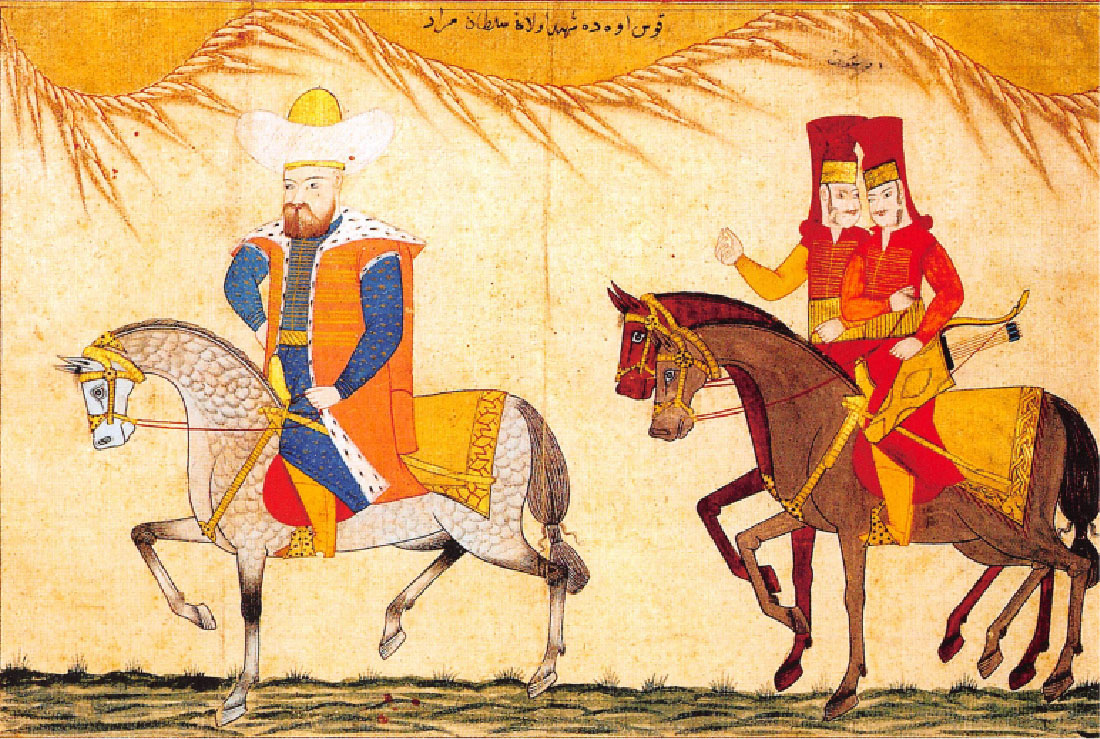
Murad sought to take advantage of the death of the Serbian king in 1355 and incorporate his land into the Ottoman domains as well. At the Battle of Kosovo in 1389, the Ottomans defeated the Serbian army and made Serbia, the last major Orthodox Christian state, a vassal of the empire. Both Murad and the Serbian ruler Prince Lazar died in the battle, although Serbian myth claims that a Serbian soldier used trickery to secretly kill the Ottoman sultan in his tent (Figure 17.5).
英語のヒント
ムラトは1355年のセルビア王の死を利用し、その領土もオスマン領へ組み込もうとした。1389年のコソヴォの戦いでオスマン軍はセルビア軍を破り、最後の主要な正教国家であったセルビアを帝国の属国とした。ムラトとセルビアの君主ラザル公は、ともにこの戦いで死んだ。ただしセルビアの伝説では、セルビア兵が策略を用い、天幕の中のオスマンのスルタンをひそかに殺したとされる(図17.5)。
Sultan Murad I.スルタン、ムラト1世。
(credit: modification of work “Sultan Murad I šahīd” by Unknown/Wikimedia Commons, Public Domain) · Public Domain
Figure 17.5 In this image created by an Ottoman artist two centuries after Murad’s death, the sultan (left, followed by his guards) is described in the caption at the top as “the Kosovo martyr.” (credit: modification of work “Sultan Murad I šahīd” by Unknown/Wikimedia Commons, Public Domain)
図17.5 ムラトの死から2世紀後にオスマンの画家が描いた図。護衛を従えた左のスルタンは、上部の銘文で「コソヴォの殉教者」と呼ばれている。(出典: 原作品を加工:“Sultan Murad I šahīd”/作者不詳/Wikimedia Commons, パブリックドメイン)
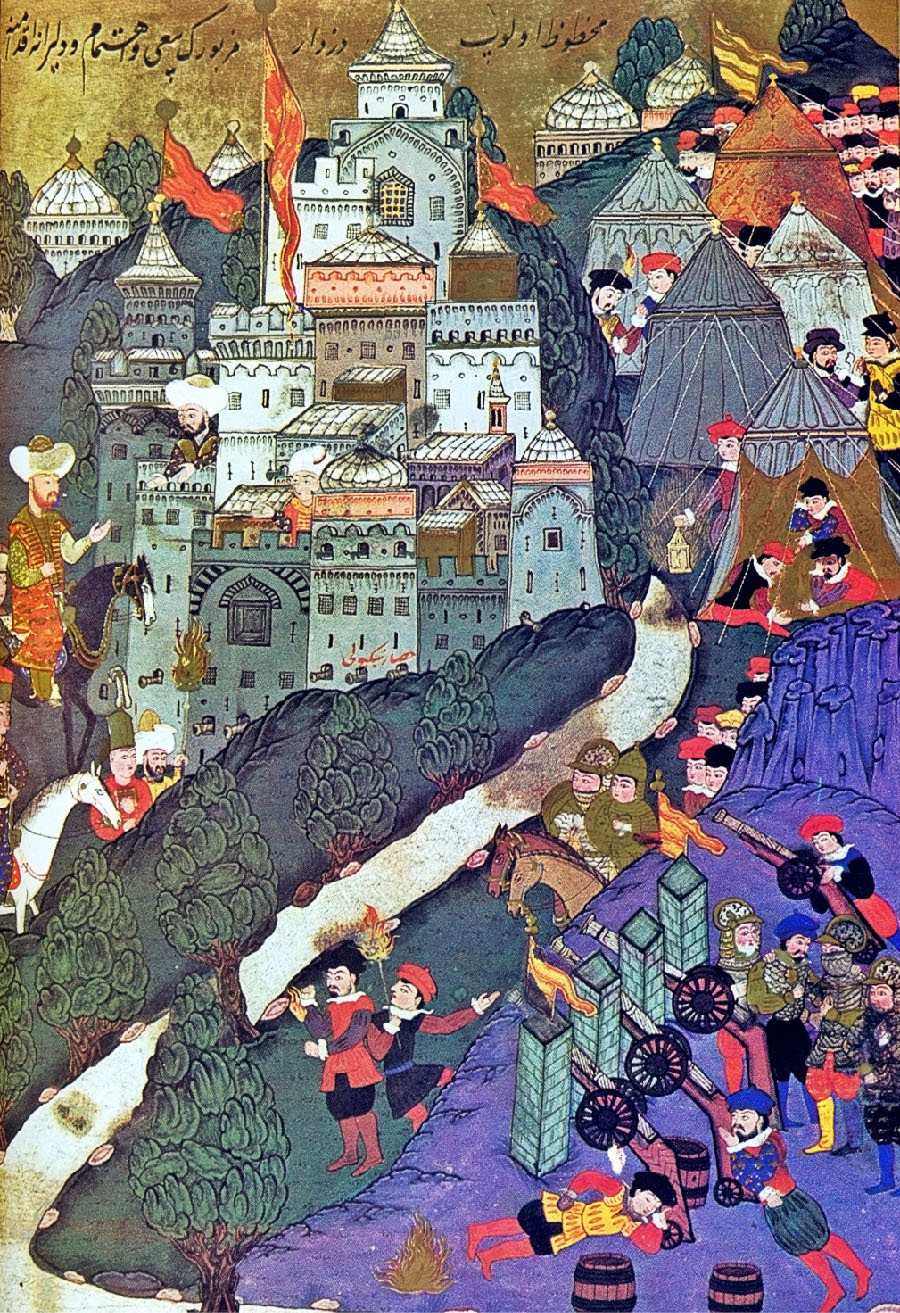
Murad’s son and successor Bayezid I (called “the Thunderbolt”) attempted unsuccessfully to eliminate all remaining Byzantine governance in the region by capturing Constantinople. In 1396, the Ottomans blockaded the city, but the pleas of the Byzantine emperor led Pope Boniface IX to call for a crusade to rescue the Greek Orthodox Christians from the Muslim Turks. Roman Catholic knights from throughout Europe responded. Ottoman troops, fighting alongside Bayezid’s Serbian vassals, crushed the crusader army at the Battle of Nicopolis on the Danube River (Figure 17.6). The blockade of Constantinople ultimately failed, however, for the Ottomans had no way to break through the city’s walls, and Bayezid soon found himself facing a more formidable foe, the Mongol conqueror Timur.
英語のヒント
ムラトの息子で後継者のバヤジット1世は「雷帝」と呼ばれ、コンスタンティノープルを攻略して、この地域に残るビザンツの統治をすべて取り除こうとしたが、成功しなかった。1396年、オスマン勢力は都市を封鎖した。しかしビザンツ皇帝の訴えを受けた教皇ボニファティウス9世は、イスラーム教徒のテュルク人からギリシア正教徒を救うため、十字軍を呼びかけた。ヨーロッパ全域のローマ・カトリックの騎士が応じた。オスマン軍はバヤジットに従うセルビア勢力とともに戦い、ドナウ川沿いのニコポリスの戦いで十字軍を粉砕した(図17.6)。しかしコンスタンティノープルの封鎖は結局失敗した。オスマン側には城壁を突破する手段がなく、ほどなくバヤジットは、さらに手ごわい敵、モンゴルの征服者ティムールに直面することになったためである。
The Battle of Nicopolis.ニコポリスの戦い。
(credit: “Battle of Nicopolis, 1396” by Géza Fehér/Wikimedia Commons, Public Domain) · Public Domain
Figure 17.6 This 1523 painted miniature by an Ottoman artist depicts the triumphant Ottoman army on the left, defeating the European knights who opposed them at the Battle of Nicopolis in 1396. A miniature painting such as this, which appeared in bound books and manuscripts, was a popular medium of artistic expression throughout Ottoman history. (credit: “Battle of Nicopolis, 1396” by Géza Fehér/Wikimedia Commons, Public Domain)
図17.6 オスマンの画家による1523年の細密画。左には勝利するオスマン軍が描かれ、1396年のニコポリスの戦いで、対抗したヨーロッパの騎士を破っている。このように製本された書物や写本に描かれる細密画は、オスマン史を通じて人気のある芸術表現だった。(出典: “Battle of Nicopolis, 1396”/Géza Fehér/Wikimedia Commons, パブリックドメイン)