第17章オスマン朝・マムルーク朝・明The Ottomans, the Mamluks, and the Ming
The Timurids and the Aftermath of the Battle of Ankaraティムール朝とアンカラの戦いのその後
Timur was a Mongol from the Barlas tribe, which had been exposed to and assimilated Turkic culture. He was born in central Asia, in a part of the Chagatai Khanate (now modern Uzbekistan), in the 1320s or 1330s. At some point early in his life, he suffered an injury that left him lame in one leg and without two fingers. According to some stories, he had been wounded while attempting to steal sheep, but he may well have sustained his injuries in battle.
英語のヒント
ティムールはバルラス部族のモンゴル人だった。この部族はテュルク文化に触れ、それを取り入れていた。彼は1320年代または1330年代、中央アジアのチャガタイ・ハン国の一部、現在のウズベキスタンにあたる地域で生まれた。若い頃のある時期に負傷し、片脚が不自由になり、指も2本失った。羊を盗もうとして傷を負ったという話もあるが、戦場で負傷した可能性も十分にある。
Timur sought to rebuild the empire that Chinggis Khan had controlled at the time of his death. Because he could not establish descent from Chinggis, he could not claim the title of khan himself. In the 1360s, he gained control of part of the Chagatai Khanate and placed one of Chinggis’s descendants, Soyurgatmish, on the throne, claiming to act in his name. He also married a female descendant of Chinggis and adopted the title “Royal Son-in-Law.”
英語のヒント
ティムールは、チンギス・ハンが死の時点で支配していた帝国を再建しようとした。しかしチンギスの子孫であると証明できなかったため、自らハンの称号を名乗れなかった。1360年代、彼はチャガタイ・ハン国の一部を支配下に置き、チンギスの子孫の一人ソユルガトミシュを王位に据え、その名において行動すると称した。さらにチンギスの血を引く女性と結婚し、「王家の婿」という称号を採用した。
Timur soon looked beyond central Asia for lands to control. In the 1380s and 1390s, he conquered Persia, portions of Iraq and Afghanistan, and Syria. He taxed the inhabitants of vanquished cities heavily and sent skilled artisans to work in his capital in Samarkand, but he spared people’s lives. Cities that did not submit were treated brutally, however. For example, when the city of Isfahan, in Persia, surrendered peacefully, he treated the residents leniently. However, when the people later rose in revolt, Timur responded unequivocally: he killed an enormous portion of the city’s population, with some reports claiming that 100,000 to 200,000 people were killed. Eyewitness accounts report his soldiers amassing piles of severed heads. Timur’s troops then turned north to the Russian territory controlled by a former follower named Tokhtamish, the khan of the Golden Horde, who sought the same lands in central Asia that Timur claimed. After destroying the Russian cities of Astrakhan and Ryazan, Timur defeated Tokhtamish’s army in 1391.
英語のヒント
ティムールはほどなく、中央アジアの外にも支配する土地を求めた。1380~1390年代には、ペルシア、イラクとアフガニスタンの一部、シリアを征服した。降伏した都市の住民には重い税を課し、熟練職人を首都サマルカンドで働かせるために送ったが、人々の命は助けた。しかし服従しない都市には、残虐な扱いを加えた。例えばペルシアのイスファハーンが平和裏に降伏したとき、住民を寛大に扱った。しかし後に人々が反乱を起こすと、ティムールは断固とした形で応じた。都市人口の莫大な部分を殺害し、報告によっては死者は10万~20万人に達したという。兵士が切断した首を山積みにしたとの目撃記録もある。その後ティムール軍は北へ向かい、かつての従者であるキプチャク・ハン国のハン、トクタミシュが支配するロシアの領域へ進んだ。トクタミシュはティムールも権利を主張する中央アジアの同じ土地を狙っていた。ロシアのアストラハンとリャザンの都市を破壊した後、ティムールは1391年にトクタミシュ軍を破った。
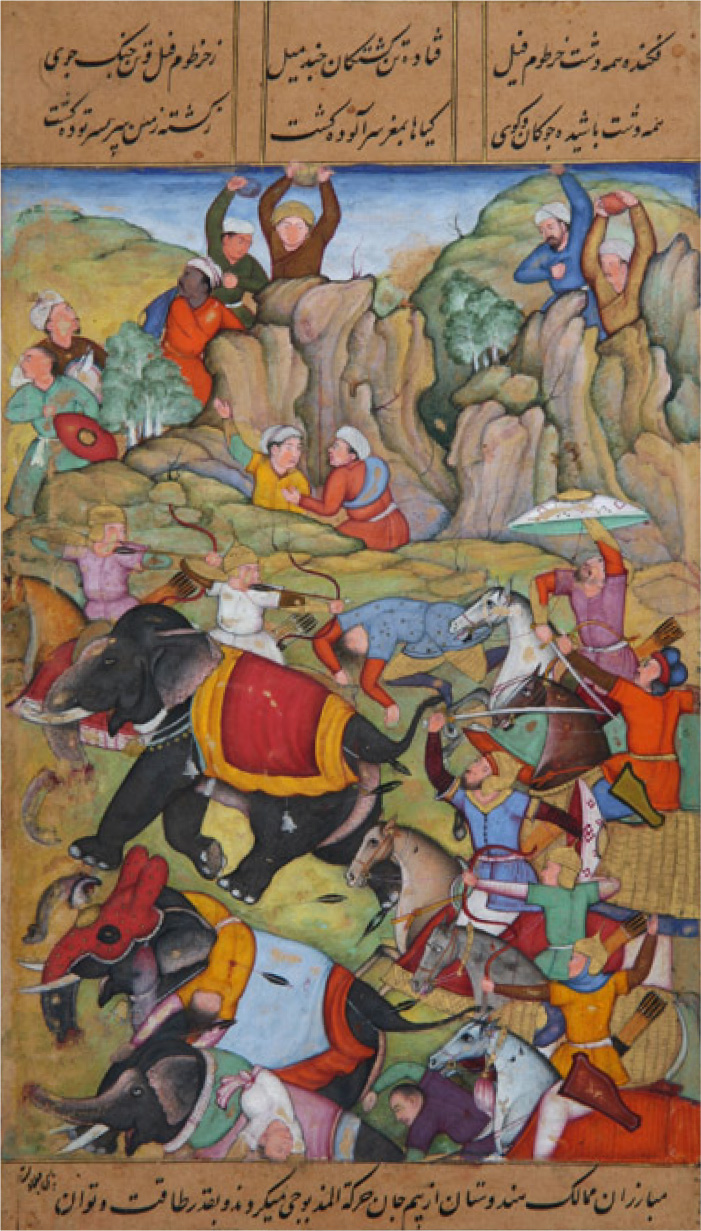
In the late 1390s, Timur turned eastward toward India. In 1398, he attacked the city of Delhi, the capital of the Muslim-ruled Delhi Sultanate. The sultan’s army rode into battle on war elephants clad in chain mail, frightening Timur’s troops, who had not seen elephants before (Figure 17.7). Timur piled hay on the backs of his camels, set the hay on fire, and sent the burning, panicked animals into the enemy’s lines, scattering the elephants. Victorious, Timur then destroyed Delhi.
英語のヒント
1390年代後半、ティムールは東へ向かい、インドを目指した。1398年には、イスラーム教徒が支配するデリー・スルタン朝の首都デリーを攻めた。スルタンの軍は、鎖帷子をまとった戦象に乗って戦場へ進み、象を見たことのなかったティムール軍の兵士を恐れさせた(図17.7)。ティムールはラクダの背に干し草を積んで火をつけ、燃え上がって恐慌状態になったラクダを敵陣へ送り込み、象を散り散りにした。勝利したティムールは、その後デリーを破壊した。
Timur Defeats the Sultan of Delhi.デリーのスルタンを破るティムール。
(credit: “Timur defeats the sultan of Delhi” by Zafarnama of Sharaf Al-Din ’Ali Yazdi/Wikimedia Commons, Public Domain) · Public Domain
Figure 17.7 In this image produced in India around 1600, Timur’s Mongol forces, wearing golden helmets, defeat the troops of the sultan of Delhi, who are shown sprawled across the backs of their war elephants. (credit: “Timur defeats the sultan of Delhi” by Zafarnama of Sharaf Al-Din ’Ali Yazdi/Wikimedia Commons, Public Domain)
図17.7 1600年頃にインドで制作された図。金の兜を着けたティムールのモンゴル軍がデリーのスルタンの軍を破り、敗兵は戦象の背に投げ出された姿で描かれている。(出典: “Timur defeats the sultan of Delhi”/Zafarnama of Sharaf Al-Din ’Ali Yazdi/Wikimedia Commons, パブリックドメイン)
Timur also coveted lands in Syria that were controlled by the Mamluk Sultanate and territory in Anatolia that was claimed by the Ottomans. Bayezid I had been steadily conquering weaker rulers in Anatolia and forcing them to become his vassals. In 1397, he defeated the ruler of the beylik of Karaman and went on to subdue smaller Anatolian states. Unwilling to submit to his domination, however, Turkish tribes and Ottoman vassals who Bayezid I believed owed allegiance to him turned to Timur, considering him their means of achieving independence from Ottoman rule. In turn, enemies of Timur such as Kara Yusuf, the leader of the Black Sheep Turks, and Sultan Ahmed, the ruler of the Persian Mongol Jalayir dynasty whose lands Timur had conquered, turned to Bayezid for assistance. Timur wrote to Bayezid, demanding that the Ottoman ruler cease aiding his enemies. Bayezid responded with insults and sent his forces to attack an ally of Timur’s in Armenia.
英語のヒント
ティムールは、マムルーク朝が支配するシリアの土地と、オスマン側が権利を主張するアナトリアの領土も欲していた。バヤジット1世はアナトリアの弱い支配者を着実に征服し、臣従を強いていた。1397年にはカラマンのベイリクの君主を破り、さらに小さなアナトリア諸国を屈服させた。しかし、その支配への服従を望まないテュルク系部族やオスマンの臣下たちは、ティムールを頼った。バヤジット1世は彼らが自分への忠誠を負うと考えていたが、彼らはティムールをオスマン支配から独立する手段と見なしたのである。これに対し、ティムールの敵はバヤジットに助けを求めた。黒羊朝を率いるカラ・ユースフや、ティムールに領土を征服されたペルシアのモンゴル系ジャライル朝の君主、スルタン・アフマドなどである。ティムールはバヤジットに書簡を送り、自分の敵を援助するのをやめるよう要求した。バヤジットは侮辱の言葉で応じ、アルメニアにいるティムールの同盟者を攻撃させた。
In 1400, Timur struck back, destroying the city of Sivas in Anatolia, part of Bayezid’s domain. He then went on to wage war against the Mamluk sultans in Egypt in Syria, preventing Bayezid from turning to them for help. He also entered into an allegiance with the Byzantines against the Ottomans, amassed forces from throughout his empire, and headed for Anatolia. Bayezid broke off his siege of Constantinople, which had begun in 1396, and rushed to meet him. In July 1402, Timur’s troops clashed with the Ottoman army at the Battle of Ankara in Anatolia.
英語のヒント
1400年、ティムールは反撃し、バヤジット領の一部であるアナトリアのシヴァスを破壊した。続いてエジプトとシリアのマムルーク・スルタンたちと戦い、バヤジットが彼らに援助を求める道を塞いだ。さらにオスマンに対抗してビザンツと同盟し、帝国全域から軍を集め、アナトリアへ向かった。バヤジットは1396年以来のコンスタンティノープル包囲を打ち切り、急いで迎撃に向かった。1402年7月、ティムール軍とオスマン軍は、アナトリアのアンカラの戦いで衝突した。
On the field at Ankara, one of the great weaknesses of Bayezid’s Ottoman state was revealed. The Ottomans had built their empire in Anatolia by conquering other Turkish states and absorbing their rulers and the rulers’ descendants into their administration. These men, Bayezid’s unwilling vassals, had no wish to risk their lives for their Ottoman overlords. In addition, Bayezid had chosen to live primarily at Edirne, in Thrace. He had adopted elements of Greek culture and, as part of a strategy to build alliances with other rulers, had taken as wives or concubines a number of non-Turkish women, including the daughter of Prince Lazar. This decision further alienated him from the Turkish nobility of Anatolia. When Timur’s forces attacked at Ankara, therefore, many of Bayezid’s Turkish vassals abandoned the field and left Bayezid to his fate, happy to be free of Ottoman control. The Ottomans were defeated, and Bayezid and his sons Musa and Mustafa were captured by Timur. Bayezid remained Timur’s prisoner until he died a few months later.
英語のヒント
アンカラの戦場では、バヤジットのオスマン国家が持つ大きな弱点の一つが露呈した。オスマンはアナトリアの他のテュルク系国家を征服し、その支配者と子孫を行政組織に取り込むことで帝国を築いていた。しぶしぶ臣従したこれらの人々には、オスマンの上位君主のために命を危険にさらす気はなかった。またバヤジットは、主にトラキアのエディルネで暮らすことを選んでいた。ギリシア文化の要素を取り入れ、他の君主との同盟戦略の一環として、ラザル公の娘を含む何人もの非テュルク系女性を妻や側室に迎えていた。この選択は、アナトリアのテュルク系貴族を彼からいっそう遠ざけた。そのためアンカラでティムール軍が攻撃すると、バヤジットのテュルク系臣下の多くは戦場を放棄し、彼を成り行きに任せて見捨てた。オスマンの支配から自由になれることを喜んでいたのである。オスマン軍は敗れ、バヤジットと息子ムーサー、ムスタファはティムールの捕虜となった。バヤジットは数か月後に死ぬまで、ティムールの捕虜のままだった。
Following his rout of the Ottomans and having conquered most of the domains of Chinggis Khan and his sons and grandsons, Timur turned eastward to claim his last prize—China. In 1368, the Mongol Yuan dynasty in China had come to an end. Its successor, the Chinese Ming dynasty, sought to make a tributary vassal of Timur, but the Ming emissaries and the soldiers who accompanied them had instead been imprisoned in Samarkand, the capital of Timur’s empire, in the Mongol heartland near the place of his birth. In December 1404, Timur set out to cross central Asia on his way to China. Within a few months, however, he fell ill, and in February 1405 he died. The invasion of China ended before it had begun, and the Chinese emissaries were released.
英語のヒント
オスマン軍を敗走させ、チンギス・ハンとその息子や孫たちの領地の大半を征服すると、ティムールは最後の獲物である中国を手に入れるため、東へ目を向けた。中国では1368年にモンゴル人の元朝が終わり、その後を中国人の明朝が継いでいた。明はティムールを朝貢する臣下にしようとしたが、その使節と護衛の兵士は、逆にサマルカンドへ投獄された。サマルカンドはティムール帝国の首都で、彼の出生地に近いモンゴル勢力の中心地域に位置していた。1404年12月、ティムールは中国を目指し、中央アジアを横断する遠征に出発した。しかし数か月もたたないうちに病に倒れ、1405年2月に死去した。中国侵攻は始まる前に終わり、中国の使節たちは解放された。
At the time of his death, Timur had conquered much of the land claimed in the original Mongol conquests of Chinggis Khan and his descendants. Unlike them, however, Timur made no real effort to rule the places he seized outside Persia. His armies conquered, plundered the riches of the defeated cities, seized artisans and whoever else might be of use to Timur, and sent the wealth and captives on to Samarkand. Thus, it was relatively easy for most places that Timur had conquered to regain their independence. Anatolia is a good example. Following his defeat of Bayezid I, Timur departed, leaving Bayezid’s sons to battle among themselves for control of their father’s lands. Although Bayezid’s son Mehmed declared himself a vassal of Timur, Timur did not assist him in his civil war against his brothers. Following Timur’s death, his own sons and grandsons fought over the lands he had conquered (Figure 17.8). In 1409, his son Shah Rukh emerged as his successor and the next head of the Timurids, the name given to the dynasty founded by Timur.
英語のヒント
死の時点で、ティムールはチンギス・ハンとその子孫が最初のモンゴル征服で獲得した土地の多くを征服していた。しかし彼らとは異なり、ペルシア以外で奪った地域を統治するための本格的な努力はしなかった。彼の軍隊は都市を征服して富を略奪し、職人をはじめティムールに役立ちそうな人々を捕らえて、財宝も捕虜もサマルカンドへ送った。そのため、征服された地域の大半が独立を取り戻すのは、比較的容易だった。アナトリアは好例である。バヤズィト1世を破るとティムールは去り、バヤズィトの息子たちは父の領土の支配権をめぐって争った。息子のメフメトは自分がティムールの臣下であると宣言したが、兄弟との内戦でティムールの援助は得られなかった。ティムールの死後には、今度は彼自身の息子や孫が、彼の征服地をめぐって争った(図17.8)。1409年、息子のシャー・ルフが後継者の座を確保し、ティムールが建てた王朝であるティムール朝の次の君主となった。
The Timurid Empire.ティムール帝国。
(attribution: Copyright Rice University, OpenStax, under CC BY 4.0 license) · CC BY 4.0
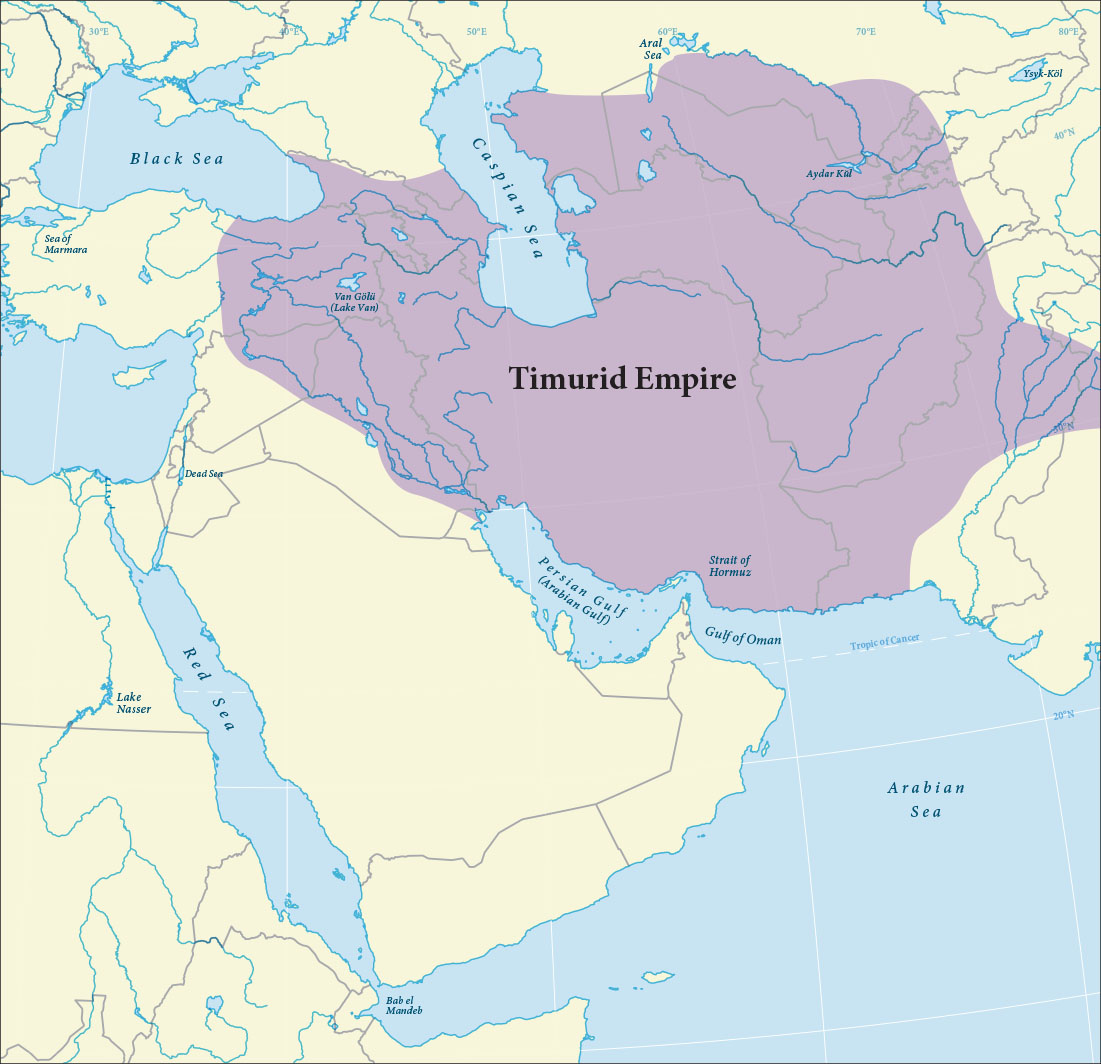
Figure 17.8 By the time of Timur’s death in 1405, his empire stretched from the border of Anatolia in the west to northern India in the east, and from modern Uzbekistan in the north to the Gulf of Hormuz in the south. (attribution: Copyright Rice University, OpenStax, under CC BY 4.0 license)
図17.8 ティムールが1405年に死去する頃には、その帝国は西のアナトリアとの境界から東の北インドまで、北の現在のウズベキスタンから南のホルムズ湾まで広がっていた。(出典: 著作権:Rice University, OpenStax/CC BY 4.0)
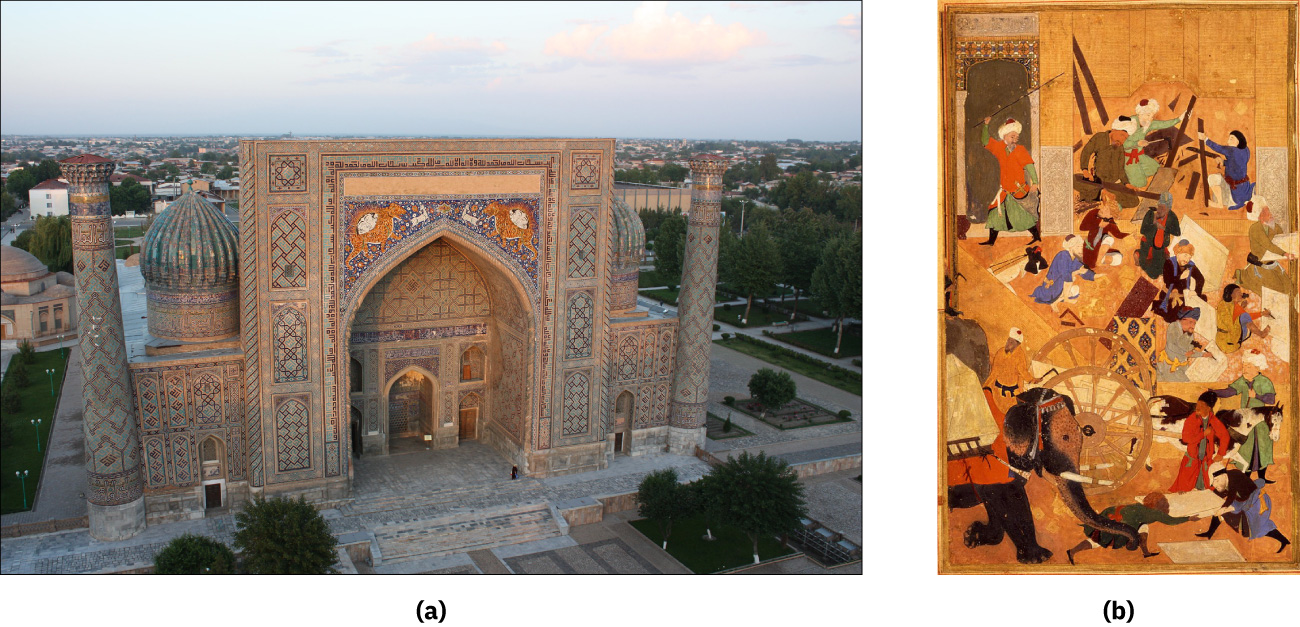
While many in Asia regarded Timur as a villain, he was a hero of the Turks and Mongols of central Asia. Ibn Khaldun, the North African Muslim historian, credited him with unifying the world’s Muslims into a single empire. Timur’s greatest legacy may be an artistic one. Although conquered people might have been met with brutality, artists, architects, and artisans were spared and sent to Samarkand. During Timur’s lifetime, the city was in a constant state of construction, and buildings like the Bibi Khanum Mosque were erected or remodeled to please him. The Muslim traveler Ibn Battuta praised the city’s beauty, and its gardens made visitors forget the arid lands that surrounded it (Figure 17.9). Timur’s grandson Ulugbek built a madrasa (an Islamic school) and an observatory in Samarkand and invited Muslim mathematicians and astronomers to the city, making it an important site of learning in the fifteenth century. Many Europeans of the time also regarded Timur, whom they called Tamerlane (“Timur, the Lame”), as a hero.
英語のヒント
アジアではティムールを悪人と見なす人が多かったが、中央アジアのテュルク人とモンゴル人にとっては英雄だった。北アフリカのムスリム歴史家イブン・ハルドゥーンは、世界のムスリムを一つの帝国に統合した功績を彼に認めた。ティムールが残した最大の遺産は、芸術面にあるのかもしれない。征服された人々には残酷な仕打ちが加えられることもあったが、芸術家、建築家、職人は命を助けられ、サマルカンドへ送られた。ティムールの生前、この都市では絶えず建設が続き、ビービー・ハーヌム・モスクなどの建築物が、彼を喜ばせるために建てられたり改築されたりした。ムスリム旅行家イブン・バットゥータは都市の美しさをたたえ、その庭園は訪れた人に、周囲の乾燥した土地を忘れさせた(図17.9)。ティムールの孫ウルグ・ベクはサマルカンドにマドラサ(イスラームの学校)と天文台を建て、ムスリムの数学者や天文学者を招いた。これにより、15世紀のサマルカンドは重要な学問の拠点となった。当時のヨーロッパ人の多くもティムールを英雄と見なし、「タメルラン」(「足の不自由なティムール」の意)と呼んだ。
The Registan.レギスタン。
(credit a: modification of work “Samarkand, Registan, Sher-Dor Madrasah” by Arian Zwegers/Flickr, CC BY 2.0 ; credit b: modification of work “Building of the Great Mosque in Samarkand” by Bihzad/Wikimedia Commons, Public Domain) · CC BY 2.0 + Public Domain
Figure 17.9 (a) A word meaning “country of sand” in Persian, the Registan of Samarkand was the public square of Timur’s splendid capital city of Samarkand in what is today Uzbekistan. A center for public gatherings, it was also a center of learning in the city and region, as evidenced by the three madrasas flanking the central square. (b) This image from the Zafarnama (“Book of Victories”), an account of Timur’s campaigns, depicts the construction of the Great Mosque for Timur's new capital in Samarkand. (credit a: modification of work “Samarkand, Registan, Sher-Dor Madrasah” by Arian Zwegers/Flickr, CC BY 2.0 ; credit b: modification of work “Building of the Great Mosque in Samarkand” by Bihzad/Wikimedia Commons, Public Domain)
図17.9 (a) レギスタンはペルシア語で「砂の地」を意味する。現在のウズベキスタンにある、ティムールの壮麗な首都サマルカンドの公共広場だった。集会の中心であると同時に、中央広場を囲む三つのマドラサが示すように、都市と地域の学問の中心でもあった。(b) ティムールの遠征を記した『ザファル・ナーメ』(「勝利の書」)の挿絵。ティムールの新首都サマルカンドで大モスクを建設する様子を描く。(出典a: 原作品を加工:“Samarkand, Registan, Sher-Dor Madrasah”/Arian Zwegers/Flickr, CC BY 2.0 ;出典 b: 原作品を加工:“Building of the Great Mosque in Samarkand”/Bihzad/Wikimedia Commons, パブリックドメイン)