第17章オスマン朝・マムルーク朝・明The Ottomans, the Mamluks, and the Ming
17.2 From the Mamluks to Ming China17.2 マムルーク朝から明代の中国へ
Learning Objectives学習の目標
By the end of this section, you will be able to:
この節を学ぶと、次のことができるようになる。
Describe the system of slavery that existed within the Islamic world
イスラーム世界に存在した奴隷制を説明する。
Explain the unique political and social organization of the Mamluk Sultanate
マムルーク朝の独特な政治・社会組織を説明する。
Describe Ming dynasty China in the fifteenth century and its responses to foreign influences
15世紀の明代中国と、外国の影響に対するその対応を説明する。
In the thirteenth century, a new state came into existence in Egypt and the Levant. Although it grew out of the existing Ayyubid Sultanate, the Mamluk Sultanate was unique among world societies in that it was administered and defended by educated, elite, formerly enslaved men. The Mamluk state grew so powerful that it was able to fend off the advances of the Mongols. At the opposite end of Asia, the Mongols also found themselves displaced by the Han Chinese of the Ming dynasty.
英語のヒント
13世紀、エジプトとレヴァントに新しい国家が生まれた。既存のアイユーブ朝から生じたものの、マムルーク朝は、教育を受けた元奴隷のエリート男性によって行政と防衛が担われた点で、世界の社会の中でも独特だった。マムルーク国家は、モンゴルの進撃を撃退できるほど強力になった。アジアの反対側でも、モンゴル人は明朝の漢人によって支配者の座を追われた。
The Slave Soldier System奴隷兵士の制度
Many of the Islamic states formed in western Asia over the centuries relied upon a unique means of staffing their armies and administrations—the creation of a highly trained, foreign-born enslaved (or formerly enslaved) elite. Beginning in the ninth century in the Abbasid Caliphate, rulers purchased Turks from beyond the Oxus River in central Asia to serve as soldiers for the state. Enslaved adult men raised outside the state were loyal to their purchaser and not to the state itself, however, and thus they were more willing to revolt if they were not well treated. Briefly losing control of the state in the ninth century because of such uprisings was a lesson for Muslim rulers. Thereafter, they sought to enslave young boys who could be educated and trained within and by the state, ensuring they were more invested in the society they served as adults. Non-Muslim children were chosen because Islam forbade the enslaving of fellow Muslims.
英語のヒント
数世紀にわたり西アジアで成立した多くのイスラーム国家は、軍隊と行政機構の人材を確保するため、独特の方法に頼った。外国生まれの奴隷、または元奴隷から、高度な訓練を受けたエリートを作り出す方法である。9世紀のアッバース朝で始まり、君主たちは中央アジアのオクサス川の向こうからテュルク人を購入し、国家の兵士として仕えさせた。しかし、国外で育ってから奴隷にされた成人男性は、国家そのものではなく購入者に忠誠を向けたため、十分な待遇を受けなければ反乱を起こしやすかった。9世紀にはこうした蜂起によって、君主が一時的に国家の統制を失い、それがムスリムの支配者への教訓となった。以後、君主たちは幼い少年を奴隷にし、国家の内部で国家自身が教育と訓練を施そうとした。成人して仕える社会に、より深い利害とつながりを持たせるためだった。イスラームは同じムスリムを奴隷にすることを禁じていたため、ムスリムではない子どもが選ばれた。
Known as mamluks (from an Arabic word meaning “someone owned”), the boys were taken primarily from Turkic tribes in central Asia, as well as from the Caucasus and eastern Europe, and then converted to Islam and educated. Because they were freed upon completing their training, the rule against enslaving other Muslims was not violated. The largest part of their instruction consisted of training in riding, archery, and military tactics (Figure 17.19). Some were given a formal education in the bureaucracy, in a bid to develop smart and capable administrators for the state.
英語のヒント
少年たちは、「所有されている者」を意味するアラビア語に由来するマムルークの名で知られた。主に中央アジアのテュルク系部族から、またコーカサスや東ヨーロッパからも連れてこられ、イスラームに改宗させられて教育を受けた。訓練を終えると解放されたので、ほかのムスリムを奴隷にすることを禁じる規則には反しないとされた。教育の大半は、乗馬、弓術、軍事戦術の訓練だった(図17.19)。国家のために賢明で有能な行政官を育てようと、官僚業務について正式な教育を受ける者もいた。
The Art of Horsemanship.馬術。
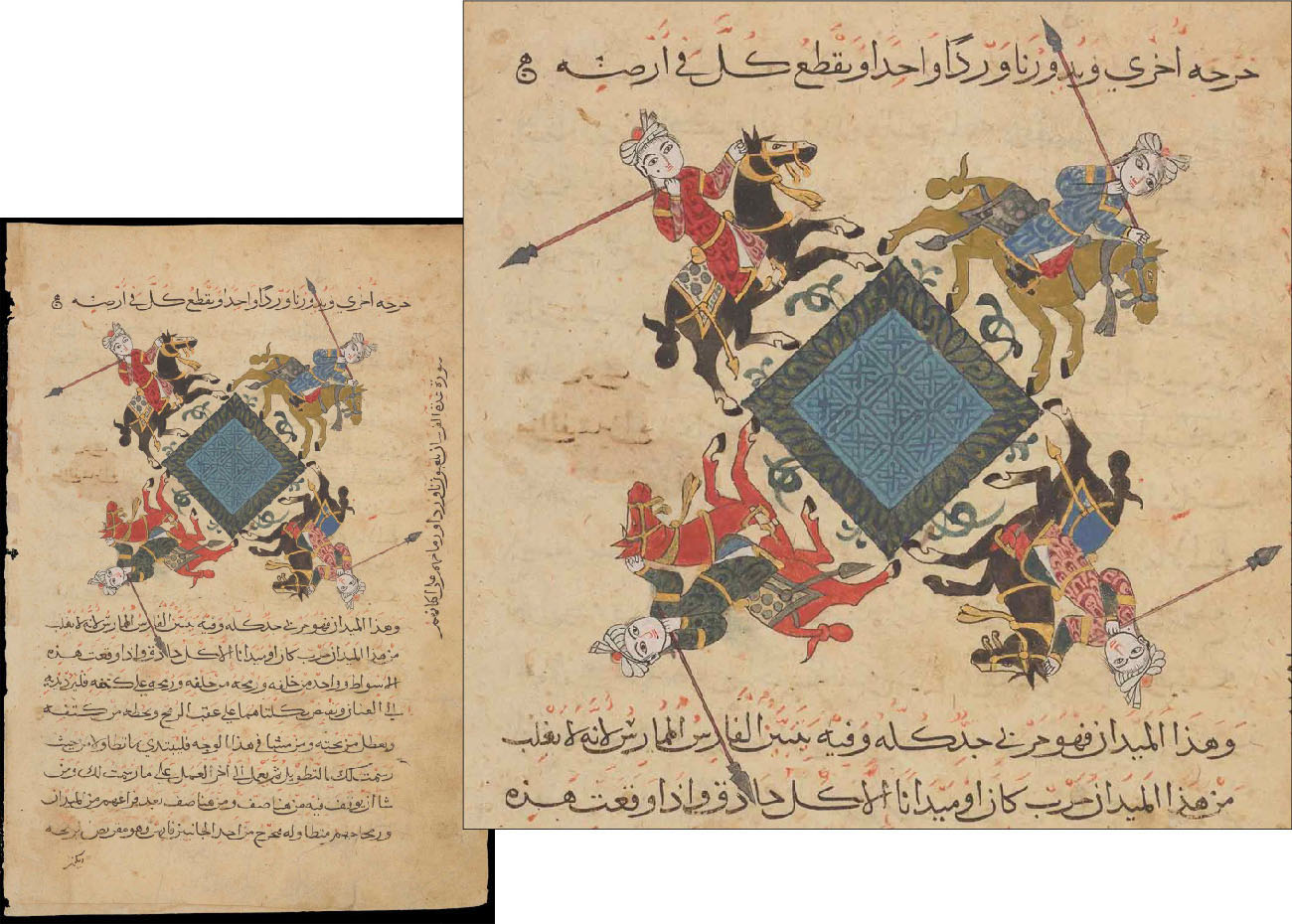
(credit: modification of work “Manual on the Arts of Horsemanship by al-Aqsara’i” by Unknown/Wikimedia Commons, Public Domain) · Public Domain
Figure 17.19 This fourteenth-century illustration from the Manual of the Arts of Horsemanship by al-Aqsara’i depicts mounted competitors carrying spears in a game that required great physical skill. As part of their training, young mamluks were taught to ride at a gallop while aiming projectiles at a swinging target. (credit: modification of work “Manual on the Arts of Horsemanship by al-Aqsara’i” by Unknown/Wikimedia Commons, Public Domain)
図17.19 アル=アクサラーイーの『馬術の技法の手引き』にある14世紀の挿絵。高い身体技能を要する競技で、槍を持って馬に乗る競技者を描く。若いマムルークは訓練の一環として、馬を全速で走らせながら、揺れる標的に飛び道具を向けることを学んだ。(出典: 原作品を加工:“Manual on the Arts of Horsemanship/al-Aqsara’i”/作者不詳/Wikimedia Commons, パブリックドメイン)
When the young men’s education was completed, they were set free in a special ceremony. They were then allowed to grow beards, marry, and establish their own households, into which they could introduce purchased mamluks of their own. They might, however, remain in the household of their former owner, the ruler to whom they were expected to remain loyal. In this way, the mamluks somewhat resembled the freed people of ancient Rome, who often retained ties to their former masters.
英語のヒント
若者たちの教育が終わると、特別な儀式で自由の身とされた。その後はひげを伸ばし、結婚し、自分の家を構えることが許され、自分で購入したマムルークをその家に加えることもできた。もっとも、元の所有者である君主の家に、そのままとどまることもあった。彼らには、その君主への忠誠を保つことが期待された。この点でマムルークは、元の主人とのつながりをしばしば維持した古代ローマの解放奴隷に、いくらか似ていた。
The relationship between mamluks and their masters was often conceived of as familial in nature, and mamluks often referred to one another as “brother” and to their master as “father.” When their training had ended, their “father” would find a place for them in the ruler’s service. Most mamluks found positions in the army, and from there they often went on to hold administrative positions. In the Ayyubid Sultanate, the mamluks eventually gained control over the government after deposing the sultan and proceeded to rule the state as the Mamluk Sultanate.
英語のヒント
マムルークと主人の関係は、しばしば家族的な性質を持つものと理解された。マムルーク同士は互いを「兄弟」、主人を「父」と呼ぶことが多かった。訓練を終えると、「父」が君主への奉仕の場を見つけてくれた。大半は軍に職を得て、そこから行政職に進むことも多かった。アイユーブ朝では、マムルークは最終的にスルタンを廃位して政権を掌握し、その後はマムルーク朝として国家を治めた。
In Mamluk Egypt, having been an enslaved soldier was often the path to the greatest success and standing in society. Important positions were given to mamluks, such as provincial governor and commander of the yearly pilgrimage to Mecca. The sultan himself was a mamluk. Appointed mamluks were regarded as more entitled to positions of power and authority than were a man’s biological sons, and while Egyptian mamluks married and produced children, it was considered inappropriate if these offspring were awarded important roles in government when true mamluks were available. The mamluks were displeased when this happened, and it was they who usually determined who became the sultan.
英語のヒント
マムルーク朝エジプトでは、かつて奴隷兵士であったことが、社会で最も大きな成功と高い地位を得る道になることが多かった。地方総督や毎年のメッカ巡礼の指揮者など、重要な役職はマムルークに与えられた。スルタン自身もマムルークだった。任用されたマムルークは、ある人物の実の息子より、権力と権威ある地位に就く資格を持つと見なされた。エジプトのマムルークも結婚して子を持ったが、本来のマムルークがいるのに、その子どもを政府の要職に就けるのは不適切とされた。実際にそうした任命が行われると、マムルークたちは不満を抱いた。そして通常、誰をスルタンにするかを決めたのは、彼らだった。
While it might seem like a risk to entrust important governmental and military positions to men who had once been enslaved, the Ayyubids, who had broken away from the Abbasid state to found their own dynasty in the eleventh century, adopted the system because of its advantages. The mamluks were highly trained and well educated, and thus well prepared to occupy the offices given to them. A ruler could pick and choose the most able of them, whereas biology might leave a sultan with children entirely unsuited to occupy positions of authority. The fact that the mamluks were of non-Arab origin and had been taken from their homes in foreign lands as children also meant they were likely to remain loyal to the “father” who had been responsible for their training, and to whom they owed their position in society. While the offspring of the Arab nobility might act to advance the fortunes of their families in ways that did not suit the interests of the sultan, the sultan usually did not need to fear that his mamluks would favor the interests of far-distant, long-absent biological relatives over his own.
英語のヒント
かつて奴隷であった男性に政府と軍の重要な役職を任せるのは、危険に見えるかもしれない。しかし、アッバース朝から分かれて11世紀に自らの王朝を建てたアイユーブ朝は、その利点からこの制度を採用した。マムルークは高度な訓練と十分な教育を受けており、与えられる役職に就く準備が整っていた。君主はその中から最も有能な者を選べたが、実子の場合、権威ある地位にまったく不向きな子どもしか生まれないこともあった。またマムルークはアラブ人ではなく、子どもの頃に外国の故郷から連れ去られていたため、自分を訓練し、社会的地位を与えてくれた「父」に忠誠を保つ可能性が高かった。アラブ貴族の子弟は、スルタンの利益に合わない方法で、自分の一族の勢力を伸ばそうとするかもしれない。しかしスルタンは通常、マムルークが、自分の利益よりも、遠く離れ、長く会っていない血縁者の利益を優先することを恐れる必要がなかった。
Enslaved men occupied a similar position in the Ottoman Empire. Beginning in the fourteenth century, the Ottomans purchased enslaved people or used prisoners of war to fill the ranks of their armies. With their invasion of the Balkans, however, the Ottoman sultans soon turned to gathering Christian children from the European lands they occupied, in order to counter the power of the Turkish nobles who controlled the army and the state’s administration.
英語のヒント
オスマン帝国でも、奴隷にされた男性は同様の地位を占めた。14世紀から、オスマン勢力は奴隷を購入したり、戦争捕虜を使ったりして、軍隊の兵員を満たした。しかしバルカン半島へ侵攻すると、ほどなくスルタンたちは、占領したヨーロッパの土地からキリスト教徒の子どもを集める方法へ転じた。軍と国家行政を握るテュルク系貴族の権力に対抗するためだった。
In a system known as the devshirme (“gathering”), Ottoman agents recruited Christian boys as part of the tax imposed on their European subjects (Figure 17.20). Approximately every three to five years, agents of the sultan took boys, ideally aged between eight and ten, to serve the Ottoman state. They were taught to speak Turkish and brought to Istanbul where they were educated and made to convert to Islam. When they became adolescents, they were trained to become scribes, palace administrators, or soldiers. Those selected to serve in the palace at the end of their training often rose to occupy important positions, including Grand Vizier. In addition, many were awarded timars in exchange for their service and had the opportunity to become wealthy.
英語のヒント
デヴシルメ(「徴集」)と呼ばれる制度では、オスマンの役人がヨーロッパの臣民に課す税の一部として、キリスト教徒の少年を徴集した(図17.20)。およそ3~5年ごとにスルタンの役人が、できれば8~10歳の少年を連れ去り、オスマン国家に仕えさせた。少年たちはトルコ語を教えられ、イスタンブルへ連れていかれて教育を受け、イスラームへの改宗を強制された。思春期になると、書記、宮廷の行政官、兵士になるための訓練を受けた。訓練の最後に宮廷で仕える者として選ばれると、大宰相を含む要職に昇ることが多かった。また奉仕の見返りにティマールを授かる者も多く、富を得る機会があった。
The Devshirme.デヴシルメ。
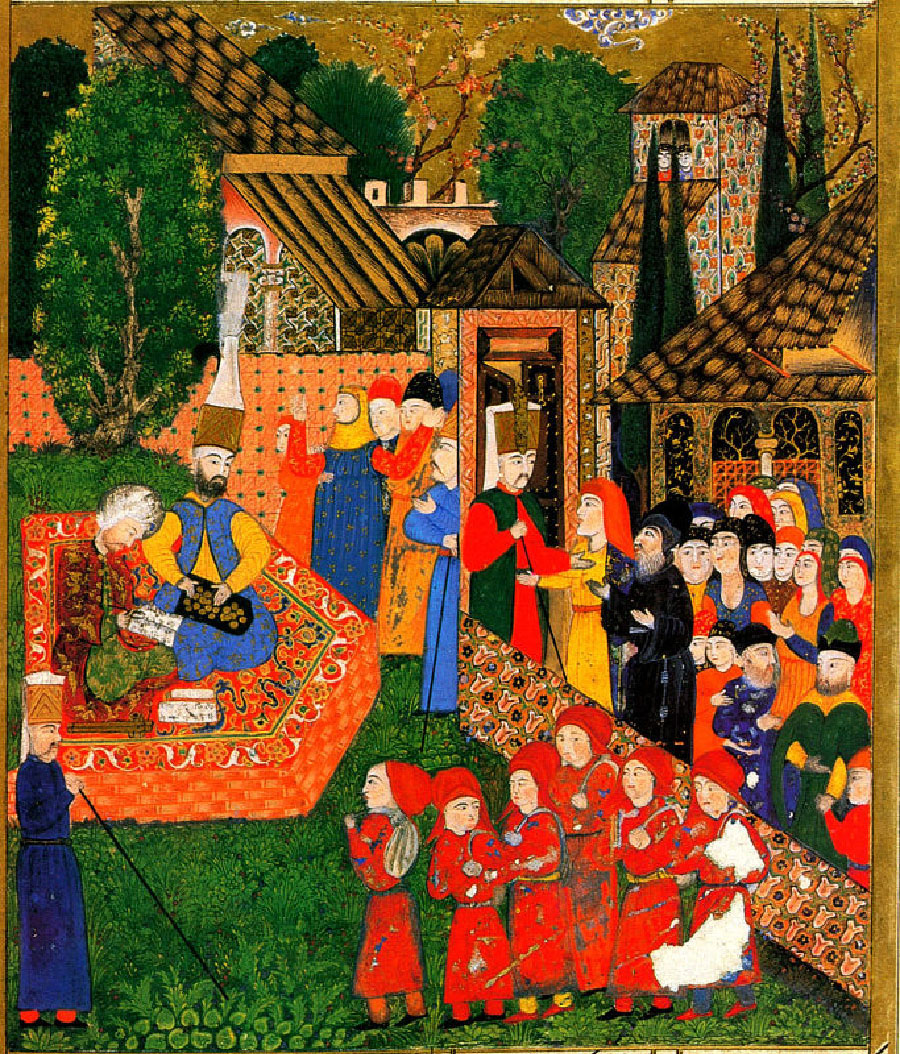
(credit: “Janissary Recruitment in the Balkans” by Ali Amir Beg/Wikimedia Commons, Public Domain) · Public Domain
Figure 17.20 In this Ottoman miniature painting from 1558, Christian parents look on as their sons are led away to be enslaved by the sultan. The children carry a few personal possessions in sacks over their shoulders as the seated Ottoman official registers them. (credit: “Janissary Recruitment in the Balkans” by Ali Amir Beg/Wikimedia Commons, Public Domain)
図17.20 1558年のオスマンの細密画。キリスト教徒の親たちが見守るなか、息子たちはスルタンの奴隷にされるため連れていかれる。子どもたちはわずかな私物を入れた袋を肩に掛け、座ったオスマンの役人が登録している。(出典: “Janissary Recruitment in the Balkans”/Ali Amir Beg/Wikimedia Commons, パブリックドメイン)
The majority of boys were trained as soldiers, some of whom became members of the elite infantry corps called the Janissaries (from the Turkish words yeni cheri, or “new soldier”). They accompanied the sultan into battle and served as his household guard. Like the mamluks, the Janissaries were expected to be loyal to their master, the Ottoman sultan. In fact, the sultans believed the Janissaries would prove more dependable than the noble vassals, because they were entirely dependent upon the sultans for their status and privileges, and because they had been cut off from the biological families to whom they might otherwise have owed their first loyalty. The risk of trusting in the Turkish nobility had become clear at the Battle of Ankara when Bayezid I’s Turkish vassals fled, abandoning him to the Mongols.
英語のヒント
少年の大半は兵士として訓練され、その一部はイェニチェリという精鋭歩兵軍団に入った。この名は、トルコ語の「新しい兵士」を意味するイェニ・チェリに由来する。彼らはスルタンに従って戦場へ行き、その身辺を守る近衛兵も務めた。マムルークと同じく、主人であるオスマンのスルタンへの忠誠が期待された。実際、スルタンたちはイェニチェリを貴族の家臣より頼りになると考えた。地位と特権を全面的にスルタンに依存しており、本来なら最優先で忠誠を向けるかもしれない血縁家族から切り離されていたからである。テュルク系貴族を信頼する危険は、アンカラの戦いで明白になっていた。バヤズィト1世のテュルク人家臣が逃走し、彼をモンゴル軍のもとへ置き去りにしたのである。
The Janissaries held high status in Ottoman society. Although many parents protested the taking of their children and sometimes rebelled against the system, others who hoped to provide their sons with a means of advancing in society reportedly bribed Ottoman officials to select them. Some Muslim parents, whose sons were not subject to the devshirme, supposedly even lied about their religion to secure a spot for them in the sultan’s service.
英語のヒント
イェニチェリはオスマン社会で高い地位を占めた。多くの親は子どもの連行に抗議し、ときには制度に反抗したが、息子に社会的上昇の道を与えたいと考える別の親たちは、選んでもらうため役人に賄賂を渡したとも伝えられる。息子がデヴシルメの対象ではないムスリムの親の中にも、スルタンへの奉仕の口を確保するため、自分たちの宗教について嘘をついた者さえいたという。
The sultans also kept other kinds of enslaved people. Christian women from foreign lands were purchased in slave markets, and others were given to the sultan as gifts or taken as prisoners of war. They were placed in the sultan’s harem, where they lived among his children and female relatives and served the ladies of the court as attendants. Women in the harem were ranked according to a strict hierarchy in which they could advance based on talent and length of service. The minority chosen to become sexual partners of the sultan were also elevated, especially if they bore him children. Some became the mothers of future sultans and were given the title “lady.” They might hold great power. While some of these women held great power, most remained servants, and after a few years of service, they were usually released from their duties and married to palace officials. Guarding the Ottoman harem were enslaved eunuchs, castrated men who were usually purchased in slave markets in Africa and whose perceived differences in sexuality led them to be assigned made them well suited to important roles such as managing the household of the ruler and other nobles. Despite their enslaved status, the control these men exerted over the harem gave them great power.
英語のヒント
スルタンは、ほかの種類の奴隷も所有した。外国のキリスト教徒の女性が奴隷市場で購入され、贈り物や戦争捕虜としてスルタンに与えられる女性もいた。彼女たちはスルタンのハレムに置かれ、彼の子どもや女性の親族とともに暮らし、宮廷の女性たちの侍女として働いた。ハレムの女性には厳密な序列があり、才能と勤続年数に応じて昇進できた。スルタンの性的な相手に選ばれた少数の女性も、特にその子どもを産むと、地位を高められた。将来のスルタンの母となり、「貴婦人」の称号を与えられる者もいた。そのような女性は大きな権力を持つことがあった。ただし大半は使用人のままで、通常、数年間仕えた後には職務から解放され、宮廷の役人と結婚した。ハレムを守ったのは、奴隷身分の宦官だった。彼らは去勢された男性で、通常はアフリカの奴隷市場で購入された。性的なあり方が他の男性とは異なると認識されたことから、君主や貴族の家政管理などの重要な役割に適すると見なされ、任用された。奴隷身分であっても、ハレムを管理する権限が大きな力を与えた。
Although the mamluks and enslaved men and women who served the Ottoman sultan were considered among the elite of their societies and occupied relatively privileged positions, people other than sultans owned enslaved people who performed hard physical labor on farms or as domestic servants. They might be poorly fed and clothed and were neither paid nor educated. They also could not expect to gain their freedom. As property, they could be pawned or sold at their owner’s whim, and regardless of age, they might be sexually abused. The experiences of these people were far more typical and representative of the enslaved, including Africans enslaved in the Americas beginning in the sixteenth century, than were those of the mamluks, the Janissaries, or the women of the Ottoman harem.
英語のヒント
マムルークや、オスマンのスルタンに仕えた奴隷の男女は、その社会のエリートに数えられ、比較的特権的な地位を占めていた。しかしスルタン以外の所有者も奴隷を持ち、農場での重労働や家内奉公をさせていた。こうした人々は十分な食物や衣服を与えられないことがあり、賃金も教育も受けなかった。自由を得る期待も持てなかった。財産として所有者の気まぐれで質に入れられたり売られたりし、年齢にかかわらず性的虐待を受けることもあった。奴隷にされた人々の経験としては、マムルーク、イェニチェリ、オスマンのハレムの女性よりも、こうした人々の経験のほうがはるかに一般的で代表的だった。そこには16世紀以降、アメリカ大陸で奴隷にされたアフリカ人も含まれる。