第17章オスマン朝・マムルーク朝・明The Ottomans, the Mamluks, and the Ming
The Ottoman Conquest of the Byzantine Empireオスマンによるビザンツ帝国征服
Following the Battle of Ankara in 1402, the sons of Bayezid who had remained free—Mehmed, Suleyman, and Isa—fought among themselves for control of the Ottoman domains. Suleyman held the Ottoman lands in Europe, Isa controlled Anatolia, and Mehmed I ruled Amasya, a region on the Black Sea coast. When Musa was released from Mongol custody, he also joined the fight, and Mustafa later contended for the throne as well.
英語のヒント
1402年のアンカラの戦い後、捕虜になるのを免れたバヤズィトの息子たち――メフメト、スレイマン、イーサー――は、オスマン領の支配をめぐって争った。スレイマンはヨーロッパのオスマン領を押さえ、イーサーはアナトリアを支配し、メフメト1世は黒海沿岸地域のアマスィヤを治めた。ムーサーもモンゴルの拘束から解放されると争いに加わり、後にはムスタファも王位を争った。
In 1413, Mehmed emerged victorious in the civil war with his brothers. He and his son and heir Murad II reorganized and expanded the domains of the Ottomans. Members of the cavalry and other highly placed members of the Ottoman administrative and military elite were each granted a timar, the right to collect taxes from merchants, farmers, and artisans in a particular geographical area (Figure 17.10). Timars were awarded regardless of religion or ethnicity, and occasionally elite women were given them as well. At times, conquered local elites were allowed to retain control of their former lands as timariots (holders of a timar). The taxes they collected supported them, so the state did not need to pay them a salary or hire tax collectors.
英語のヒント
1413年、メフメトは兄弟との内戦を制した。彼と、その息子で後継者のムラト2世は、オスマン領を再編して拡大した。騎兵と、行政・軍事の上層に属するその他の有力者には、それぞれティマールが与えられた。これは、一定の地域の商人、農民、職人から税を取り立てる権利である(図17.10)。ティマールは宗教や民族にかかわらず与えられ、ときには上層階級の女性も授けられた。征服された土地の有力者が、ティマールの保有者であるティマリオットとして、以前の領地の支配を保つことを認められる場合もあった。徴収した税が彼らの生活を支えたため、国家は俸給を払う必要も、徴税人を雇う必要もなかった。
A Member of the Ottoman Cavalry.オスマンの騎兵。
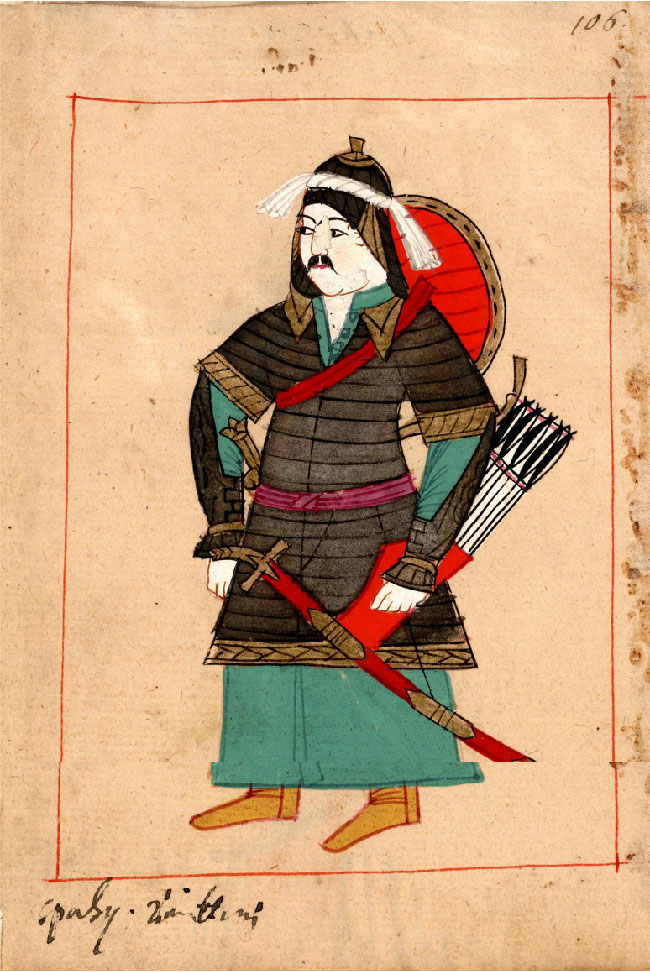
(credit: “Ralamb Sipahi” by Unknown/Wikimedia Commons, Public Domain) · Public Domain
Figure 17.10 Administrators and other elites, like this member of the light Ottoman cavalry, were granted timars to reward them for their service and enable them to support themselves. The image is from a mid-seventeenth-century book of miniature drawings of costumes, possibly made in Constantinople. (credit: “Ralamb Sipahi” by Unknown/Wikimedia Commons, Public Domain)
図17.10 行政官や、この軽騎兵のような上層の人々には、奉仕への報酬を与え、自活できるようにするため、ティマールが授けられた。この図は、コンスタンティノープルで作られた可能性がある、17世紀半ばの衣装細密画集に収められている。(出典: “Ralamb Sipahi”/作者不詳/Wikimedia Commons, パブリックドメイン)
The practice of awarding timars to members of the military ensured their loyalty. The land ultimately belonged to the sultan, who would revoke a timar if the holder did not continue in his service. A timar might also be lost if the population of the land declined; this encouraged timariots to treat the people on their holdings well. Timariots also tried to make the lands they controlled more agriculturally productive. The more crops produced, the more taxes they could collect. They were responsible for maintaining order on their lands, but they could not impose punishments without the permission of a judge appointed by the sultan. The timar was nonhereditary; upon the timariot’s death, the sultan awarded the vacant timar to someone else. This prevented the development of an independent hereditary class of timariots.
英語のヒント
軍人にティマールを与える慣行は、彼らの忠誠を確保した。土地は最終的にはスルタンのものであり、保有者が彼に仕えるのをやめれば、スルタンはティマールを取り消した。領内の人口が減った場合にも失う可能性があったため、ティマリオットには、領民をよく扱う動機が生まれた。ティマリオットは、自分の管理する土地の農業生産力も高めようとした。作物が多くできるほど、多くの税を徴収できたからである。領内の秩序を維持する責任も負ったが、スルタンが任命した裁判官の許可がなければ、刑罰を科すことはできなかった。ティマールは世襲ではなかった。保有者が死ぬと、スルタンは空いたティマールを別の人に授けた。これにより、独立した世襲的なティマリオット階級が成立することを防いだ。
The main goal of Mehmed I and Murad II was to conquer Constantinople. Muslim rulers since the seventh century had attempted to capture the Byzantine capital and had always failed. Both Mehmed and Murad realized that in order to rebuild the Ottoman state, they had to drive out the Byzantine rulers. The Byzantine emperor Manuel II had assisted Mehmed’s rivals for the Ottoman throne, attempting to keep the Ottomans weak by prolonging the civil war. The Byzantines were also close allies of the Venetians and Genoese, who controlled trade in the Aegean and the Black Seas and whose ships could interfere with Ottoman efforts to control both sides of the Dardanelles.
英語のヒント
メフメト1世とムラト2世の最大の目標は、コンスタンティノープル征服だった。7世紀以来、ムスリムの君主たちはこのビザンツの首都を奪おうとして、ことごとく失敗していた。メフメトもムラトも、オスマン国家を立て直すにはビザンツの支配者を追い出さなければならないと認識していた。ビザンツ皇帝マヌエル2世は、内戦を長引かせてオスマン勢力を弱体なままにとどめようと、オスマン王位をめぐるメフメトの競争相手を援助していた。ビザンツ人はヴェネツィア人やジェノヴァ人とも緊密な同盟関係にあった。彼らはエーゲ海と黒海の交易を支配しており、その船は、ダーダネルス海峡の両岸を押さえようとするオスマン勢力の試みを妨害できた。
Murad II laid siege to Constantinople in 1422, but the effort failed because the Ottomans lacked artillery to destroy the city walls. Murad was also distracted from the siege by his need to combat yet another claimant to the Ottoman throne. As they had done before, the Byzantines called upon European Christians for assistance against the Ottomans. The pope called for a new crusade, and the Roman Catholic knights of Europe responded. Murad defeated them in 1444 at the Battle of Varna, in eastern Bulgaria (Figure 17.11). Nevertheless, Constantinople stood firm. The city was only a shadow of what it had once been. At its height, somewhere between 500,000 and one million people had lived within its walls, but the bubonic plague and Ottoman sieges had reduced the number to perhaps fifty thousand. Nevertheless, so long as Constantinople stood on the western shore of the Bosporus controlling access to the Black Sea, the Ottomans could not rest easy in their domains.
英語のヒント
ムラト2世は1422年にコンスタンティノープルを包囲したが、城壁を破壊する大砲を欠いていたため失敗した。さらに別のオスマン王位請求者と戦う必要も生じ、包囲に専念できなかった。ビザンツ人は従来と同じように、オスマン軍に対抗する援助をヨーロッパのキリスト教徒に求めた。教皇は新たな十字軍を呼びかけ、ヨーロッパのローマ・カトリックの騎士たちが応じた。しかしムラトは1444年、ブルガリア東部のヴァルナの戦いで彼らを破った(図17.11)。それでもコンスタンティノープルは持ちこたえた。ただし、都市の姿はかつての面影にすぎなくなっていた。最盛期には50万から100万人が城壁の内側で暮らしていたが、腺ペストとオスマン軍の包囲によって、人口はおそらく5万人ほどまで減っていた。それでも、コンスタンティノープルがボスポラス海峡の西岸にあり、黒海への出入りを押さえている限り、オスマン勢力は自領で安心してはいられなかった。
The Death of Władysław III.ヴワディスワフ3世の死。
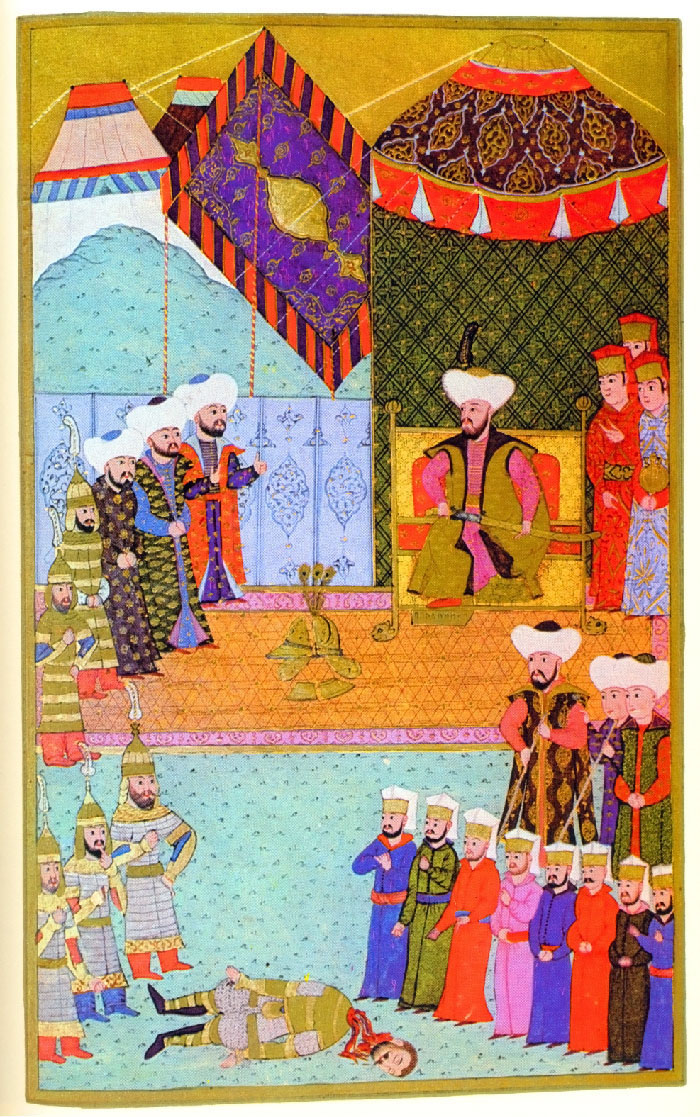
(credit: “Murad II and the imaginary beheading of Władysław III of Poland” by Géza Fehér/Wikimedia Commons, Public Domain) · Public Domain
Figure 17.11 According to legend, at the Battle of Varna in which he led Ottoman forces against European Christians, Murad II prayed for victory. When the Polish king Władysław III charged Murad’s troops, the sultan’s guards beheaded him, an event depicted in this Ottoman miniature. (credit: “Murad II and the imaginary beheading of Władysław III of Poland” by Géza Fehér/Wikimedia Commons, Public Domain)
図17.11 伝説によれば、ヨーロッパのキリスト教徒に対してオスマン軍を率いたヴァルナの戦いで、ムラト2世は勝利を祈った。ポーランド王ヴワディスワフ3世がムラトの軍に突撃すると、スルタンの護衛が彼を斬首した。このオスマンの細密画は、その出来事を描いている。(出典: “Murad II and the imaginary beheading of Władysław III of Poland”/Géza Fehér/Wikimedia Commons, パブリックドメイン)
It fell to Murad II’s son Mehmed II (also called Mehmed the Conqueror and Mehmed the Great) to destroy the Byzantine threat. He was better prepared than his father had been. In 1453, he summoned his Muslim and Christian vassals from Anatolia, Thrace, and the Balkans. With the vassals and a core of six thousand elite professional soldiers, he marched to the Bosporus. Ottoman forces included more than one hundred newly constructed ships to prevent Constantinople from receiving reinforcements and supplies via the sea. He also summoned European gunsmiths, the most important of whom was the Hungarian named Urban, to craft bombards, an early form of cannon. One gun was so large that it could fire a twelve-hundred-pound granite ball more than a mile. Constantinople’s defensive walls, which had guarded the city since the fifth century, could not withstand the Ottoman artillery (Figure 17.12).
英語のヒント
ビザンツの脅威を取り除く役目は、ムラト2世の息子メフメト2世が担うことになった。彼は征服王メフメト、またはメフメト大王とも呼ばれる。父より周到な準備を整え、1453年、アナトリア、トラキア、バルカン半島から、ムスリムとキリスト教徒の家臣を召集した。彼らと、軍の中核となる6,000人の精鋭職業軍人を率いて、ボスポラス海峡へ進軍した。オスマン軍には新造船100隻以上も加わり、コンスタンティノープルが海から援軍と補給を受けるのを阻止した。メフメトはヨーロッパの銃砲職人も召し抱え、初期の大砲であるボンバルド砲を製造させた。そのうち最も重要だったのが、ウルバンというハンガリー人である。一門の大砲は、重さ1,200ポンドの花崗岩の弾を1マイル以上飛ばせるほど巨大だった。5世紀以来都市を守ってきたコンスタンティノープルの城壁も、オスマン軍の砲撃には耐えられなかった(図17.12)。
The Walls of Constantinople.コンスタンティノープルの城壁。
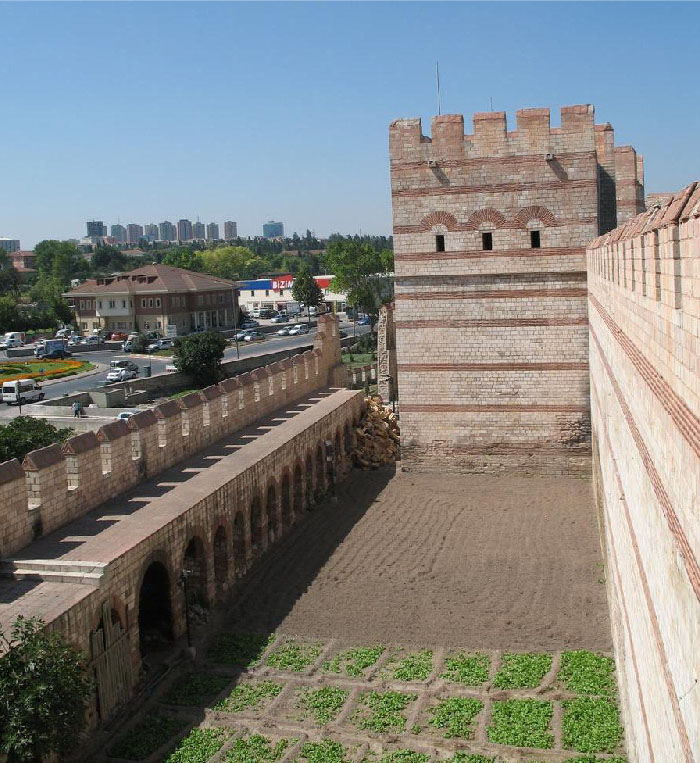
(credit: modification of work “Theodosian Walls in Constantinople” by “CrniBombarder!!!”/Wikimedia Commons, Public Domain) · Public Domain
Figure 17.12 The walls that protected Constantinople were massive. On the right is the inner wall, the city’s last defense. In places it was up to six meters thick. On the left is the outer wall. Below this was yet a third wall, and beyond that a moat. (credit: modification of work “Theodosian Walls in Constantinople” by “CrniBombarder!!!”/Wikimedia Commons, Public Domain)
図17.12 コンスタンティノープルを守る城壁は巨大だった。右が都市の最後の防衛線である内壁で、場所によって厚さは6メートルに達する。左が外壁で、その下にはさらに第三の壁があり、その向こうに堀があった。(出典: 原作品を加工:“Theodosian Walls in Constantinople”/“CrniBombarder!!!”/Wikimedia Commons, パブリックドメイン)
On the morning of May 29, 1453, after a siege of fifty-seven days, the Ottoman guns breached the walls, and Mehmed’s soldiers rushed into the city. Perhaps twenty thousand people were left to defend it, including the last Byzantine emperor, Constantine XI Palaeologus, who died fighting for his city. After their Genoese commander was wounded, many defenders abandoned their posts along the walls, leaving them deserted during battle. Constantinople’s residents carried religious icons to the walls and prayed for deliverance. However, they put up little resistance, and the city fell to the Ottomans.
英語のヒント
1453年5月29日の朝、57日間の包囲の末、オスマン軍の大砲が城壁を破り、メフメトの兵が市内へなだれ込んだ。守備に残っていたのは、おそらく2万人ほどだった。その中には最後のビザンツ皇帝コンスタンティノス11世パレオロゴスもおり、彼は自分の都市を守って戦死した。ジェノヴァ人の指揮官が負傷すると、多くの守備兵が城壁沿いの持ち場を捨て、戦闘中にもかかわらず無人となった。住民は聖像を城壁へ運び、救いを祈った。しかし抵抗はわずかで、都市はオスマン軍の手に落ちた。
Many Muslim scholars believed the conquest of Constantinople had been predicted in a hadith, an account of the sayings and actions of the prophet Muhammad. After his capture of the city, Mehmed turned eastward, incorporating the Turkish state of Karaman, the home of the important Islamic religious center of Konya, and other lands ruled by Turkish tribes in eastern Anatolia. In 1461, he sent the Ottoman fleet to conquer Trebizond, an offshoot of the Byzantine Empire and an important trading center on the Black Sea. In Europe, he gained control of most of the southern part of Greece, defeating the Byzantine princes who ruled the area, as well as Bosnia and Albania. He also wrested the Black Sea port of Kaffa from the control of Genoese merchants. At his death, the Ottoman Empire controlled all of Anatolia and nearly all of the Balkans.
英語のヒント
多くのムスリム学者は、コンスタンティノープル征服はハディース――預言者ムハンマドの言行を伝える記録――の中で予言されていたと信じていた。都市を奪った後、メフメトは東へ向かい、重要なイスラーム宗教都市コンヤを含むテュルク系国家カラマンと、アナトリア東部でテュルク系部族が支配していたその他の土地を併合した。1461年にはオスマン艦隊を送り、ビザンツ帝国から分かれた国家であり、黒海の重要な交易拠点でもあったトレビゾンドを征服した。ヨーロッパでは、ビザンツの諸公を破ってギリシア南部の大半を支配し、ボスニアとアルバニアも手に入れた。さらに、黒海の港カッファをジェノヴァ商人の支配から奪った。彼が死んだとき、オスマン帝国はアナトリア全土とバルカン半島のほぼ全域を支配していた。
Mehmed II, despite being referred to regularly as “the Conqueror” by historians, was a builder more than a destroyer, however. Upon conquering Constantinople, he declared it the new capital of the Ottoman Empire, replacing the city of Edirne. He dispatched soldiers to clear away the ruins left from the siege and the Ottoman assault, and he immediately set about appointing a mayor and other important city officials to establish and maintain order. Rather than drive out the city’s European merchants, he allowed them to stay, to retain their property, and to continue to worship in their churches. He demanded only that the Genoese merchants remove the walls that surrounded Galata, the Genoese trading quarter of Constantinople, and surrender their armaments. To protect his new Christian subjects, he forbade his Turkish troops to enslave the Europeans.
英語のヒント
しかし、歴史家がしばしば「征服王」と呼ぶメフメト2世は、破壊者以上に建設者だった。コンスタンティノープルを征服すると、エディルネに代わるオスマン帝国の新首都と宣言した。包囲とオスマン軍の攻撃で生じた瓦礫を除去するために兵を派遣し、直ちに市長や重要な都市官吏の任命に取りかかって、秩序を築き維持しようとした。都市のヨーロッパ商人を追い出すのではなく、居住と財産の保有、教会での礼拝の継続を認めた。ジェノヴァ商人に要求したのは、彼らの交易地区ガラタを囲む城壁の撤去と、武器の引き渡しだけだった。新たに臣民となったキリスト教徒を守るため、テュルク人の兵がヨーロッパ人を奴隷にすることを禁じた。
Mehmed regarded himself not as a usurper but as the rightful successor to the Byzantines. He declared himself Caesar, the heir to the old Roman imperial throne. He appointed a new leader of the Eastern Orthodox Church, Gennadius II, who in turn recognized Mehmed’s claim as the legitimate heir of the last Byzantine emperor. The last emperor’s actual heirs, his nephews, were taken into Mehmed’s service and occupied important administrative positions in the empire. One served as Grand Vizier, or chief minister, under Mehmed’s successor Bayezid II.
英語のヒント
メフメトは、自分を簒奪者ではなく、ビザンツの正統な継承者と見なした。かつてのローマ帝位の後継者であるカエサルを名乗り、東方正教会の新たな指導者としてゲンナディオス2世を任命した。これに対してゲンナディオスも、最後のビザンツ皇帝の正統な後継者だというメフメトの主張を認めた。最後の皇帝の実際の相続人である甥たちも、メフメトに仕え、帝国内の重要な行政職に就いた。その一人はメフメトの後継者バヤズィト2世のもとで、大宰相、すなわち首席大臣を務めた。
Mehmed embarked on an ambitious campaign to rebuild Constantinople, now called Istanbul. He built the new Topkapi Palace, where he ruled the empire. The palace also contained his private household, or harem. He ordered that the Byzantine cathedral of Hagia Sophia be left intact and converted into a mosque. He rebuilt the city walls, constructed a weapons foundry, and established a hospital. He also ordered a new mosque, the Fatih Mosque (“Conqueror’s Mosque”), to be built in the city (Figure 17.13). Near the mosque, he erected numerous madrasas in which Muslim scholars taught science, Islamic law, and theology.
英語のヒント
メフメトは、今やイスタンブルと呼ばれるコンスタンティノープルを再建する、意欲的な事業に乗り出した。新たにトプカプ宮殿を建て、そこから帝国を統治した。宮殿には、彼の私的な家政空間であるハレムもあった。ビザンツの大聖堂ハギア・ソフィアは壊さず残し、モスクに変えるよう命じた。また、城壁を再建し、武器鋳造所を建設し、病院を設立した。さらに都市に新しいモスク、ファーティフ・モスク(「征服者のモスク」)を建てるよう命じた(図17.13)。その近くには多くのマドラサを設け、ムスリムの学者が科学、イスラーム法、神学を教えた。
Fatih Mosque.ファーティフ・モスク。
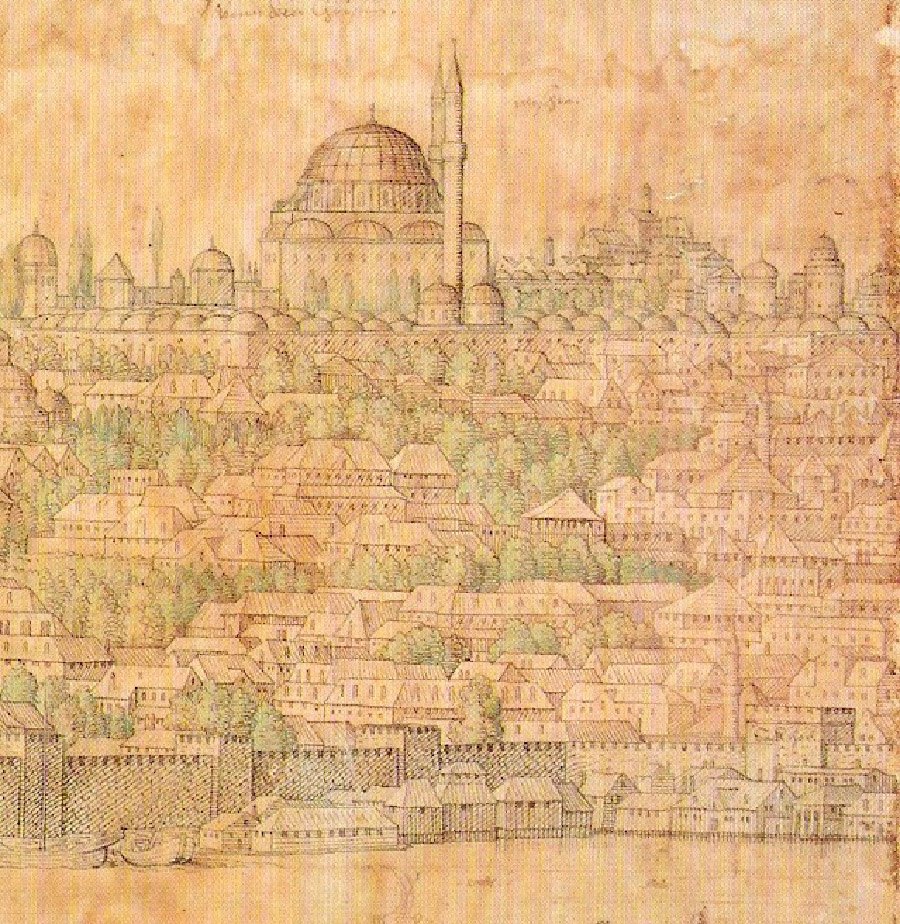
(credit: “Fatih Complex” by Melchior Lorichs/Wikimedia Commons, Public Domain) · Public Domain
Figure 17.13 In Melchior Lorck’s painting of Istanbul from 1559, the Fatih Mosque rises above the rooftops of the city. The building was destroyed by an earthquake in 1766, and a mosque built according to a different plan was subsequently constructed on the site. (credit: “Fatih Complex” by Melchior Lorichs/Wikimedia Commons, Public Domain)
図17.13 メルヒオール・ロルクが1559年に描いたイスタンブルの絵では、ファーティフ・モスクが街の屋根より高くそびえる。この建物は1766年の地震で壊れ、その後、同じ敷地に異なる設計のモスクが建てられた。(出典: “Fatih Complex”/Melchior Lorichs/Wikimedia Commons, パブリックドメイン)
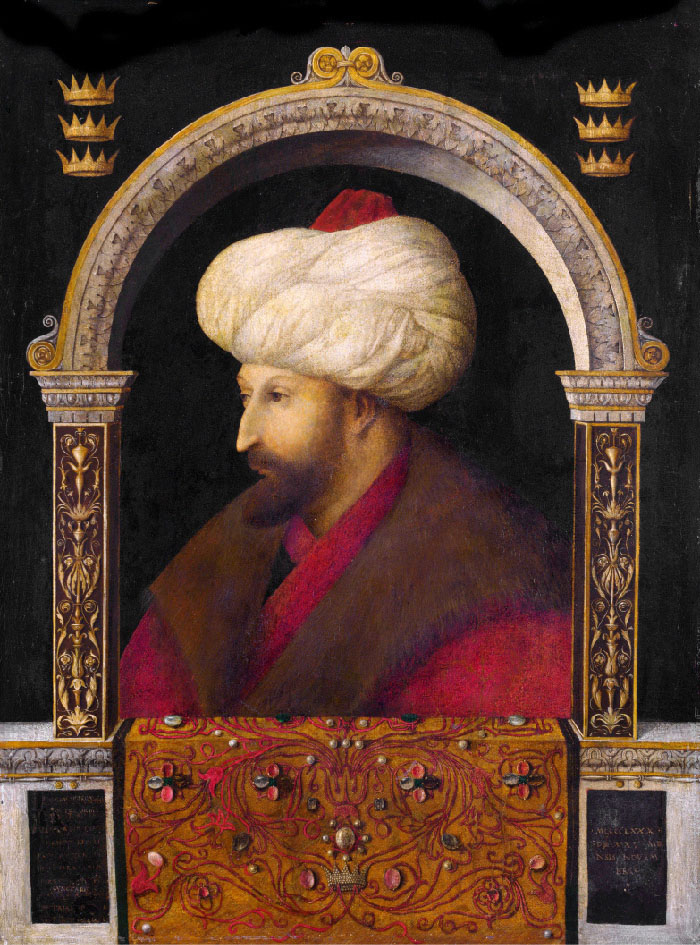
Mehmed had a great thirst for knowledge. He spoke many languages and amassed a library filled with works in Turkish, Greek, Latin, Persian, and Arabic. He invited Muslim scientists to Istanbul and attended debates of religious scholars. He collected Greek antiquities and brought Greek scholars and Italian artists to Istanbul. Some of these artists, such as the Italians Gentile Bellini and Paolo Veronese, painted portraits of him (Figure 17.14).
英語のヒント
メフメトは知識への強い渇望を抱いていた。多くの言語を話し、トルコ語、ギリシア語、ラテン語、ペルシア語、アラビア語の著作を集めた図書館を築いた。ムスリムの科学者をイスタンブルへ招き、宗教学者の討論にも出席した。ギリシアの古代遺物を収集し、ギリシア人学者やイタリア人芸術家もイスタンブルへ呼び寄せた。イタリアのジェンティーレ・ベッリーニやパオロ・ヴェロネーゼなど、これらの芸術家の中には、メフメトの肖像画を描いた者もいた(図17.14)。
Mehmed II.メフメト2世。
(credit: “The Sultan Mehmet II” by Gentile Bellini/Wikimedia Commons, Public Domain) · Public Domain
Figure 17.14 The meeting of East and West is evident in this portrait of Sultan Mehmed II. Painted in 1480 by the Italian artist Gentile Bellini, it depicts an Eastern ruler in a Western artistic style. (credit: “The Sultan Mehmet II” by Gentile Bellini/Wikimedia Commons, Public Domain)
図17.14 このスルタン、メフメト2世の肖像には、東西の出会いがはっきり表れている。イタリアの画家ジェンティーレ・ベッリーニが1480年に描き、東方の君主を西洋の美術様式で表現している。(出典: “The Sultan Mehmet II”/Gentile Bellini/Wikimedia Commons, パブリックドメイン)
As Mehmed conquered other parts of the Balkans and of Anatolia, including beyliks that had broken free of Ottoman control following Bayezid I’s defeat at the Battle of Ankara, he brought artisans and prisoners of war to Istanbul to rebuild the city. As earlier Ottoman rulers had done, Mehmed allowed Christians and Jews in his lands to worship as they pleased. This arrangement was an early appearance of the Ottoman millet system, in which religious communities were allowed a substantial degree of autonomy and were governed by their own leaders and their own law codes. In addition to naming a head of the Eastern Orthodox Church, Mehmed established the position of hakham bashi (“chief rabbi”) to lead the Ottoman Empire’s Jewish community. He also invited the head of the Armenian Apostolic Church to establish a house of worship in Istanbul; because the Eastern Orthodox Church, the religion of the Byzantine rulers, regarded the Armenian church as heretical, it had been banned from the Byzantine capital. And although the Roman Catholic Church refused to recognize his right to rule Istanbul, Mehmed allowed Catholic clergy to travel throughout Ottoman lands and worship freely.
英語のヒント
メフメトは、バルカン半島とアナトリアの他の地域を征服するにつれて、職人と戦争捕虜をイスタンブルへ連れてきて都市を再建した。征服地には、バヤズィト1世がアンカラの戦いに敗れた後、オスマン支配から離脱したベイリクも含まれていた。先代のオスマン君主たちと同様に、メフメトは領内のキリスト教徒とユダヤ教徒が、自分たちの望むとおりに礼拝することを認めた。これは後のオスマン帝国のミッレト制が早い段階で現れたものだった。宗教共同体には相当の自治が認められ、各共同体が自分たちの指導者と法によって統治された。メフメトは東方正教会の首長を任命したほか、帝国のユダヤ教共同体を率いるハハム・バシュ(「首席ラビ」)の職を設けた。また、アルメニア使徒教会の首長にも、イスタンブルに礼拝所を設けるよう招いた。ビザンツの支配者が信仰した東方正教会はアルメニア教会を異端と見なしていたため、それまで同教会はビザンツの首都から排除されていた。ローマ・カトリック教会はメフメトがイスタンブルを統治する権利を認めなかったが、彼はカトリック聖職者がオスマン領内を自由に旅し、礼拝することを認めた。
Mehmed also moved to exert authority over Islamic clergy in his domains. He made teachers at madrasas employees of the Ottoman state. He issued kanun, laws made by the sultan, as opposed to sharia (religious law) interpreted by Islamic judges, and compiled them in the Kanun-name (“Book of the Law”). Kanun dealt with issues that sharia often did not address, such as taxation or punishment for certain crimes. Mehmed also made use of kanun to centralize his authority and gain unchallenged control over the Ottoman state.
英語のヒント
メフメトは領内のイスラーム聖職者にも権力を及ぼそうとした。マドラサの教師をオスマン国家の職員とし、イスラームの裁判官が解釈する宗教法シャリーアとは別に、スルタンが定める法カーヌーンを発布して、『カーヌーン・ナーメ』(「法の書」)に編纂した。カーヌーンは、課税や特定の犯罪への処罰など、シャリーアでは十分扱われないことの多い問題を対象とした。メフメトはカーヌーンを使って権力を中央に集め、オスマン国家への異論を許さない支配を確立しようともした。
With the fall of the Byzantine Empire and the collapse of Timurid authority, the Ottoman state could now assert its authority in both the East and the West, effectively making itself a gatekeeper between the two worlds. Following their defeat of the Byzantine Empire and their capture of Constantinople, the Ottomans gained control of part of the Silk Roads that brought silk, spices, and other luxury goods from East Asia. Besides controlling the overland route, the Ottomans commanded Red Sea ports in Egypt after defeating the Mamluk Sultanate in 1517, which gave them additional control over the spice trade. By the late fifteenth century, Ottoman ships were trading with India, and goods such as Chinese silks and porcelains furnished the homes of the wealthy in Istanbul. The Ottomans also dominated trade on the Black Sea, which until then had been the province of the Venetians and Genoese. The exclusion of Italian merchants from their traditional trade routes, the heavy taxes imposed on goods that traveled overland, many Europeans’ dislike for transacting business with Muslims, and the expense of overland trade led western Europeans to seek all-water oceanic routes to South and East Asia.
英語のヒント
ビザンツ帝国が倒れ、ティムール朝の権力も崩れると、オスマン国家は東西の双方で権力を主張できるようになり、事実上、二つの世界の通過点を押さえる存在となった。ビザンツ帝国を破ってコンスタンティノープルを奪った後、東アジアから絹、香辛料、その他の奢侈品を運ぶシルクロードの一部を支配した。陸路を押さえたうえ、1517年にマムルーク朝を破ると、エジプトの紅海沿岸の港も手中に収め、香辛料交易への支配力をさらに強めた。15世紀末までには、オスマンの船はインドと交易しており、イスタンブルの富裕層の家は、中国の絹や磁器などで飾られていた。オスマン勢力は、それまでヴェネツィア人とジェノヴァ人の活動領域だった黒海交易も支配した。イタリア商人が従来の交易路から排除されたこと、陸路の交易品に重税が課されたこと、多くのヨーロッパ人がムスリムとの商取引を好まなかったこと、そして陸路交易そのものの費用が、西ヨーロッパの人々を、南アジアと東アジアへすべて海路で到達する航路の探索へと向かわせた。