第17章オスマン朝・マムルーク朝・明The Ottomans, the Mamluks, and the Ming
The Mamluk Sultanateマムルーク朝
The mamluks of Egypt reached the pinnacle of their unusually high status in 1250. In that year, they deposed the last Ayyubid sultan, then only a child, and took control of the state.
英語のヒント
エジプトのマムルークは1250年、その例外的に高い地位の頂点に達した。この年、まだ子どもだった最後のアイユーブ朝スルタンを廃位し、国家の支配権を握った。
The Ayyubids, who ruled the Levant and Egypt beginning in the eleventh century, had established their dynasty by breaking away from the Abbasid Caliphate. In the early 1200s, as the members of the Ayyubid ruling family competed with one another for supremacy, they amassed large numbers of mamluk guards and soldiers, consisting mostly of Kipchak Turks from the steppes north of the Black Sea, to assist them. When rulers defeated brothers and uncles in their quest for power, they also took control of their mamluk forces. Soon the mamluk troops vastly outnumbered the members of the Ayyubid Arab ruling class.
英語のヒント
11世紀からレヴァントとエジプトを治めたアイユーブ朝は、アッバース朝から分かれて王朝を建てた。1200年代初め、支配者一族の人々が互いに覇権を争うなかで、援軍として多くのマムルークの護衛と兵士を集めた。その大半は、黒海の北のステップ出身のキプチャク・テュルク人だった。君主たちは権力を求めて兄弟やおじを破ると、そのマムルーク軍も支配下に収めた。やがてマムルークの兵数は、アイユーブ朝のアラブ人支配階級の人数を圧倒的に上回った。
In 1249, Sultan as-Salih Ayyub died. His son replaced him but was assassinated by mamluks in 1250. As-Salih’s widow, Shajur al-Durr, also ruled briefly, but she was soon deposed. The Ayyubid commander of the city of Aleppo in Syria initially challenged mamluk rule and took an army to Egypt to reclaim control of the state, prompting the mamluk commander Aybak, whom Shajur al-Durr had married to bolster her own claim to power, to place an Ayyubid royal child on the throne as a puppet ruler and his nominal “master.” Following his defeat of the Ayyubid forces, Aybak deposed the child sultan and took power in his own right, permanently ending Ayyubid rule in Egypt and formally establishing the Mamluk Sultanate. When Aybak was assassinated in 1257, his teenage son took the throne, but true power in Egypt was wielded by another mamluk commander, Saif ad-Din Qutuz.
英語のヒント
1249年、スルタンのアッ=サーリフ・アイユーブが死去した。息子が継いだが、1250年にマムルークによって暗殺された。アッ=サーリフの未亡人シャジャル・アッ=ドゥッルも短期間統治したが、まもなく退位させられた。当初、シリアの都市アレッポのアイユーブ朝の司令官がマムルーク支配に異議を唱え、国家の支配を取り戻そうと軍をエジプトへ進めた。これを受けてマムルークの司令官アイバクは、アイユーブ家の幼い王族を傀儡君主として王位に据え、自分の名目上の「主人」とした。シャジャル・アッ=ドゥッルは、自らの権力の根拠を強めるため、このアイバクと結婚していた。アイユーブ朝の軍を破った後、アイバクは幼いスルタンを廃位し、自らの名で権力を握った。こうしてエジプトでのアイユーブ朝支配は最終的に終わり、マムルーク朝が正式に成立した。アイバクが1257年に暗殺されると10代の息子が王位に就いたが、エジプトの実権は、別のマムルーク司令官サイフ・アッディーン・クトゥズが握った。
The new Mamluk Sultanate soon found its power tested by the arrival of invading Mongol forces. In 1258, Hulagu Khan attacked and destroyed Baghdad, the seat of the Abbasid Caliphate. His troops then took the city of Damascus, which lay within the territory claimed by the Mamluk Sultanate. Hulagu demanded that Qutuz surrender Egypt, but the sultan refused. In 1260, the Mongol and Mamluk armies clashed at the Battle of Ain Jalut, in what is today modern-day Israel, and the Mamluks were triumphant. This halted the Mongol advance in western Asia and prevented them from invading North Africa.
英語のヒント
新しいマムルーク朝は、ほどなく侵攻するモンゴル軍の到来によって、その力を試された。1258年、フレグ・ハンがアッバース朝の都バグダードを攻撃し、破壊した。その軍は続いて、マムルーク朝が自領と主張する範囲にあったダマスクスを奪った。フレグはクトゥズにエジプトの明け渡しを要求したが、スルタンは拒否した。1260年、現在のイスラエルにあたる地域でアイン・ジャールートの戦いが起き、モンゴル軍とマムルーク軍が激突した。マムルーク軍が勝利し、モンゴルの西アジアでの進撃を止め、北アフリカへの侵攻を防いだ。
Qutuz did not live to relish the Mamluk victory over the Mongols, however. Shortly after his triumph at Ain Jalut, he was assassinated, and a rival mamluk commander, Baybars, claimed the throne as sultan. Baybars established the Bahri dynasty, named for the location in Cairo of the mamluk barracks from which he had come. The rulers of the Bahri dynasty were mamluks of primarily Turkish origin. Unlike members of most dynasties, they were not generally descendants of the founder. Two of Baybars’ sons succeeded to the throne following his death, but they were quickly deposed by rival mamluk army factions. This was the case for most Mamluk sultans, who each ruled for an average of only seven years, and often much less.
英語のヒント
しかしクトゥズは、モンゴルに対する勝利を長く喜ぶことはできなかった。アイン・ジャールートで勝った直後に暗殺され、対抗するマムルーク司令官バイバルスが、スルタンとして王位を手に入れた。バイバルスは、自分の出身であるカイロのマムルーク兵営の立地にちなんだ名を持つ、バフリー朝を成立させた。この王朝の君主は、主にテュルク系のマムルークだった。多くの王朝とは違い、通常、創始者の子孫ではなかった。バイバルスの死後には息子2人が相次いで王位を継いだが、対立するマムルーク軍の派閥にまもなく廃位された。大半のマムルーク朝スルタンも同様で、在位は平均わずか7年、しばしばそれよりずっと短かった。
Stability was a constant problem for the Mamluk Sultanate. Although it remained in control of Egypt and the Levant until it was defeated by the Ottomans in 1517, the sultans’ rule was never secure. Sultans were routinely deposed—and often murdered—by rival claimants to the throne. Provincial administrators often rebelled against the authority of Cairo as well. The problem lay in the origin of the mamluks themselves. Having undergone rigorous training and the experience of enslavement, and having risen through the ranks based solely on their abilities, the mamluks were scornful of those who had not had a similarly harsh upbringing and won their position based on merit. Thus, when sultans attempted to establish their biological sons as their heirs, the army often regarded them as unworthy and refused to follow them. Furthermore, while mamluk soldiers were loyal to their masters, they did not feel similar loyalty to other commanders. When a sultan died or was deposed, his mamluks were not inclined to obey the person who took his place. The succession to the throne of the Mamluk Sultanate thus always remained uncertain as the army continued to assert its right to choose (and depose) the ruler. Mamluk history was marked by repeated attempts by individual commanders to seize power, and by the army’s removal of “unworthy” rulers in favor of others.
英語のヒント
マムルーク朝にとって、政権の安定は常に課題だった。1517年にオスマン軍に敗れるまでエジプトとレヴァントを支配したものの、スルタンの地位は決して安泰ではなかった。対抗する王位請求者による廃位や、しばしば殺害が繰り返された。地方の行政官も、カイロの権威にたびたび反抗した。問題は、マムルーク自身の成り立ちにあった。厳格な訓練と奴隷身分を経験し、自分の能力だけで昇進した彼らは、同じような厳しい育ちを経ず、実力で地位を勝ち取っていない者を軽蔑した。そのため、スルタンが実子を後継者に据えようとすると、軍はその息子をふさわしくないと見なし、従うことを拒むことが多かった。さらに、マムルーク兵は自分の主人に忠誠を尽くしたが、ほかの司令官に同じ忠誠を感じなかった。スルタンが死去したり廃位されたりしても、そのマムルークたちは後任者に従う気にはならなかった。軍が君主を選ぶ権利、そして廃位する権利を主張し続けたため、王位継承は常に不確実なままだった。個々の司令官が権力奪取を繰り返し試み、軍が「ふさわしくない」君主を排除して別の者を立てることが、マムルークの歴史の特徴となった。
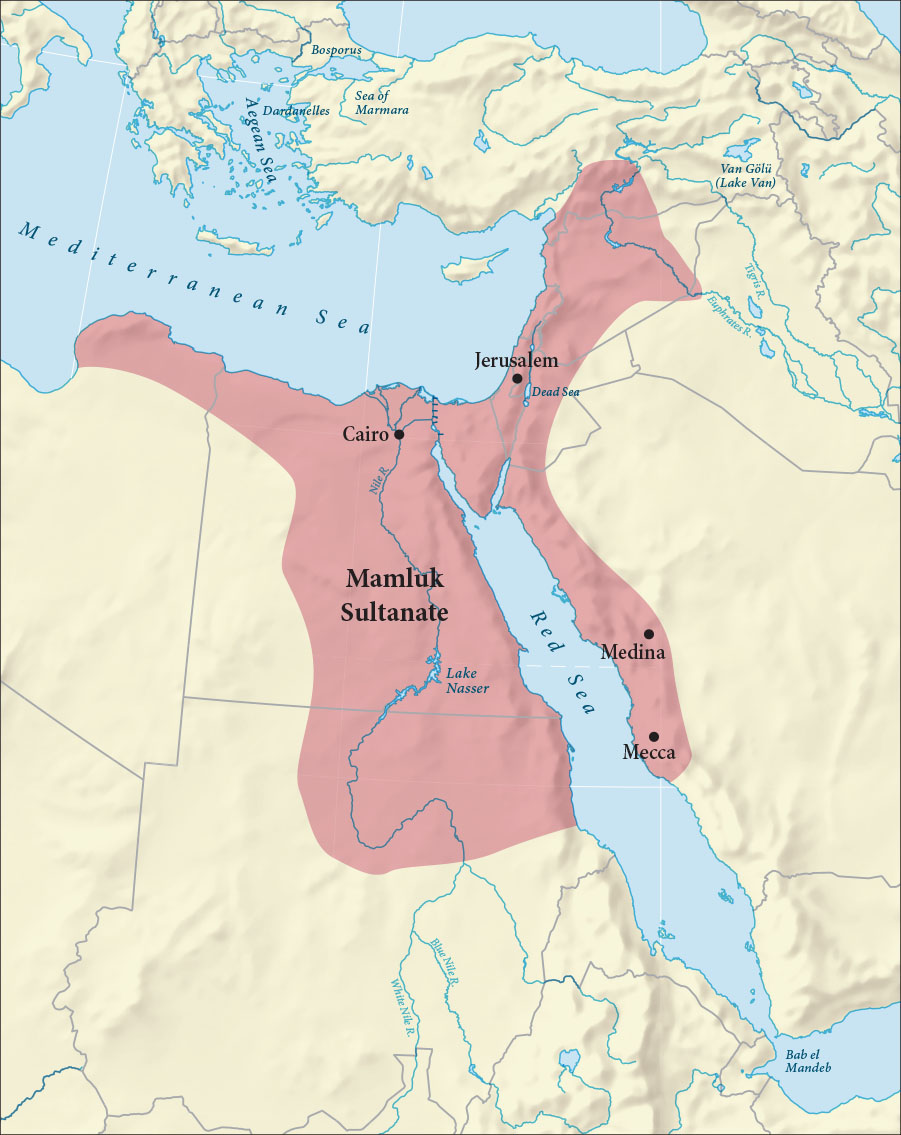
Despite the fact that the line of succession always remained unclear, the Mamluk Sultanate was a force to be reckoned with, and its troops were successful at defeating their enemies. Beginning during the rule of Baybars, for example, the Mamluks gradually retook control of the Christian Crusader States in the Levant, either razing their fortresses or converting them to Mamluk garrisons. The final Christian stronghold, Acre, fell in 1291. The Mamluks also defeated the Christian Armenian Kingdom of Cilicia and stopped an attempted Mongol invasion of Syria in 1313 before establishing a peace treaty with the Ilkhanate Mongols in Persia in 1322 (Figure 17.21).
英語のヒント
王位継承の順序は常に不明確だったが、マムルーク朝は侮れない勢力であり、その軍は敵を打ち破ることに成功した。たとえばバイバルスの治世から、レヴァントのキリスト教徒の十字軍国家を少しずつ奪い返し、その要塞を徹底的に破壊するか、マムルークの駐屯地に転用した。最後のキリスト教徒の拠点アッコンは1291年に陥落した。マムルーク軍はキリスト教徒のキリキア・アルメニア王国も破り、1313年にはモンゴルによるシリア侵攻の試みを阻止した。その後1322年、ペルシアのイル・ハン国のモンゴル人との間に和平条約を結んだ(図17.21)。
The Mamluk Sultanate.マムルーク朝。
(attribution: Copyright Rice University, OpenStax, under CC BY 4.0 license) · CC BY 4.0
Figure 17.21 This map shows the territory claimed by the Mamluk Sultanate at its greatest extent in 1317. The empire controlled access to the eastern Mediterranean, the Red Sea, and the Nile as well as the holy cities of Mecca, Medina, and Jerusalem. (attribution: Copyright Rice University, OpenStax, under CC BY 4.0 license)
図17.21 マムルーク朝が最大領域を持った1317年に、その領土と主張した範囲を示す地図。帝国は東地中海、紅海、ナイル川への出入りに加え、聖地メッカ、メディナ、エルサレムを支配していた。(出典: 著作権:Rice University, OpenStax/CC BY 4.0)
During the first century of Mamluk rule, the time of the Bahri dynasty, the empire flourished. Following the capture of Baghdad by the Mongols in 1258 and the execution of Caliph al-Musta’sim, members of the Abbasid family sought refuge in Egypt. In 1261, Baybars proclaimed al-Mustansir, the nephew of al-Musta’sim, the new caliph. In return, al-Mustansir recognized Baybars’s authority to rule over the lands once held by the Abbasids. Thus, while the Mamluk sultans never claimed the caliphate for themselves, they sought legitimacy for their rule through their role as protectors of the caliph.
英語のヒント
マムルーク支配の最初の1世紀にあたるバフリー朝の時代、帝国は繁栄した。1258年にモンゴル軍がバグダードを奪い、カリフのアル=ムスタアスィムを処刑すると、アッバース家の人々はエジプトに避難した。1261年、バイバルスはアル=ムスタアスィムの甥アル=ムスタンスィルを、新たなカリフと宣言した。その見返りにアル=ムスタンスィルは、かつてアッバース朝が保有した領土をバイバルスが統治する権限を認めた。こうしてマムルークのスルタンたちは自らカリフ位を要求することはなく、カリフの保護者という役割を通じて、自分たちの支配に正統性を求めた。
Mamluk rulers were pious Muslims who protected pilgrims bound for the holy cities of Mecca, Medina, and Jerusalem. They built mosques and madrasas, and Cairo grew into an important center of religious scholarship. Unwilling to risk the displeasure of Muslim judges, the mamluks supported all four major schools of Islamic law. They also built hospitals, primary schools, and public fountains to provide the poor with clean drinking water. Their championing of Islam and their building of charitable institutions provided them with an important connection to their non-Turkish subjects, who might otherwise have resented their rule.
英語のヒント
マムルークの支配者は敬虔なムスリムで、聖地メッカ、メディナ、エルサレムへ向かう巡礼者を保護した。モスクとマドラサを建設し、カイロは宗教学の重要な中心地に成長した。ムスリムの裁判官の不興を買う危険を避けるため、マムルークはイスラーム法の四大法学派すべてを支援した。また病院、初等学校、公共の泉を建て、貧しい人々に清潔な飲み水を提供した。イスラームの擁護と慈善施設の建設は、非テュルク人の臣民との重要なつながりをもたらした。そうしたつながりがなければ、臣民は彼らの支配に不満を抱いたかもしれない。
In the late fourteenth century, a new Mamluk dynasty came to power—the Burji, also named for the location of its mamluk barracks. The Burji sultans were mamluks of primarily Circassian and Georgian origin, unlike the Turks of the Bahri dynasty. The first Burji sultan, al-Zahir Barquq, assumed the throne in 1382. Almost immediately, plots emerged to remove him, one headed by the caliph who hoped to rule in his own right and another by Turkish tribes in Syria. Both attempts were defeated, but the peace did not last long. In 1399, 1434, and 1437, soldiers rioted in the streets of Cairo. Sometimes the riots began as conflicts between rival mamluk factions that spread to the streets and involved civilians. At other times, soldiers rioted when they had not been paid. In 1441, riots were sparked by food shortages and the perception that the grain trade, from which government officials profited, was inefficient and the prices unfair. Merchants’ stores were plundered by angry mobs. In the second half of the fifteenth century, mamluk-initiated chaos erupted nearly every year as soldiers fought in the streets and attacked the homes of the wealthy and government officials. Even religious scholars were not safe.
英語のヒント
14世紀後半、新しいマムルーク王朝、ブルジー朝が権力を握った。その名も兵営の立地に由来する。バフリー朝のテュルク人とは異なり、ブルジー朝のスルタンは主にチェルケス人とジョージア人のマムルークだった。初代スルタン、アッ=ザーヒル・バルクークは1382年に即位した。ほとんど直ちに彼を排除する陰謀が起こった。一つは自ら統治しようと望むカリフが率い、もう一つはシリアのテュルク系部族によるものだった。両方とも鎮圧されたが、平穏は長続きしなかった。1399年、1434年、1437年には、兵士がカイロの街頭で暴動を起こした。対立するマムルーク派閥同士の争いが街へ広がり、民間人を巻き込む場合もあれば、給料の未払いから兵士が暴れる場合もあった。1441年の暴動は、食料不足と、官吏が利益を得る穀物交易は非効率で価格も不当だという認識をきっかけに起こった。怒った群衆は商店を略奪した。15世紀後半には、マムルークが起こす混乱がほとんど毎年噴出した。兵士は街頭で戦い、富裕層や官吏の家を襲い、宗教学者さえ安全ではなかった。
Unable to maintain order in their own capital, Mamluk rulers also had to confront rebellions in more far-flung parts of their domain. The Mamluks had difficulty establishing control over Syrian Arabs and the nomadic and seminomadic Bedouin tribes of Upper Egypt. Bedouin rebels were punished severely; men were impaled or burned alive, while women and children were enslaved. The heads of rebels were placed on the gates of Cairo as a warning against future revolts. Syrian Arabs were punished less harshly because their assistance was needed to repel attacks by Mongols and the Ottomans.
英語のヒント
首都で秩序を保てないマムルークの支配者は、領土のさらに遠い地域での反乱にも対処しなければならなかった。シリアのアラブ人や、上エジプトの遊牧・半遊牧のベドウィン諸部族を支配下に置くことは困難だった。反乱を起こしたベドウィンは厳しく処罰された。男は串刺し刑や火あぶりにされ、女と子どもは奴隷にされた。反逆者の首は、今後の反乱への警告としてカイロの門に掲げられた。シリアのアラブ人に対する処罰は、それほど苛烈ではなかった。モンゴル軍やオスマン軍の攻撃を撃退するため、彼らの援助が必要だったからである。
Although they remained an elite class in Egypt until 1811, the Mamluks found their sovereignty over the region threatened when they lost control of Syria to the Ottomans in 1516. The Ottoman sultan Selim I then conquered Cairo in 1517. Rather than depose the Mamluks, however, the Ottomans allowed them to rule their old domains on their conquerors’ behalf, though true power lay with the Ottomans in Istanbul.
英語のヒント
マムルークは1811年までエジプトのエリート階級として残ったが、1516年にシリアをオスマン軍に奪われると、この地域に対する主権が脅かされた。続いてオスマンのスルタン、セリム1世は1517年にカイロを征服した。しかしオスマン勢力はマムルークを排除せず、征服者の代理として旧領を治めることを認めた。実権はイスタンブルのオスマン側にあった。