第17章オスマン朝・マムルーク朝・明The Ottomans, the Mamluks, and the Ming
Ming China and Its Neighbors明代の中国と周辺諸国
The ascendance of the Turks and the decline of Mongol rule in western Asia in the thirteenth century were soon followed by the decline of Mongol dominance in East Asia as well. By the second half of the thirteenth century, China found itself beset by problems. The Yuan dynasty emperor Kublai Khan waged a series of expensive campaigns against the kingdoms of Burma (now Myanmar), Annam, and Champa in Southeast Asia, and Java in the Indian Ocean. Two attempts to invade Japan failed, and revolts against Mongol rule erupted.
英語のヒント
13世紀に西アジアでテュルク勢力が台頭し、モンゴル支配が衰えると、ほどなく東アジアでもモンゴルの優勢が揺らいだ。13世紀後半までに、中国はさまざまな問題に悩まされていた。元の皇帝フビライ・ハンは、東南アジアのビルマ(現在のミャンマー)、安南、チャンパ、さらにインド洋のジャワの諸王国に対し、多額の費用を要する遠征を繰り返した。日本への二度の侵攻も失敗し、モンゴル支配に対する反乱が起こった。
One of these revolts was the Ispah Rebellion, which began in Quanzhou. A major port city in southeastern China’s Fujian Province, Quanzhou was on the Maritime Silk Road, an ocean trading route that connected China to other trading ports in Southeast Asia, the Indian Ocean, India, the Arabian Peninsula, East Africa, and Egypt. Along this route, highly sought-after Chinese goods like porcelain and silk flowed westward to Europe, Africa, India, and western Asia.
英語のヒント
その一つが、泉州で始まった亦思巴奚(イスパ)軍の乱だった。中国南東部、福建省の主要港湾都市である泉州は、海のシルクロード上にあった。これは、中国を東南アジア、インド洋、インド、アラビア半島、東アフリカ、エジプトの交易港と結ぶ海上交易路である。この航路を通じて、磁器や絹など需要の高い中国の商品が、ヨーロッパ、アフリカ、インド、西アジアへと西向きに流れた。
Quanzhou had a population of more than two million, making it the largest port in China and likely in the world in the thirteenth century. Most of the population were foreign-born merchants from Arabia, Persia, India, Armenia, and other lands. The Muslims who lived in Quanzhou were among the many Arabs, Persians, and Turks from western and central Asia who had come to China to trade or to serve the Yuan government. Though they encouraged Muslims from elsewhere in Asia to settle in China, Yuan officials often discriminated against them, forbidding the butchering of animals according to Islamic law and interfering with Muslim marriage laws and efforts by the Muslim community to govern themselves. In 1357, Muslims in Quanzhou rose against the Mongols. The rebellion was not crushed until 1367.
英語のヒント
泉州は200万人を超える人口を持ち、13世紀には中国最大、おそらく世界最大の港だった。住民の大半は、アラビア、ペルシア、インド、アルメニアなどから来た外国生まれの商人だった。泉州のムスリムも、交易や元政府への奉仕のため中国へ来た、西アジア・中央アジア出身の多くのアラブ人、ペルシア人、テュルク人の一部だった。元の役人は、アジアの他地域のムスリムが中国に定住することを奨励したが、しばしば差別もした。イスラーム法に従った動物の屠畜を禁じ、ムスリムの婚姻法や、共同体による自治の試みに干渉した。1357年、泉州のムスリムはモンゴル人に対して蜂起した。反乱が鎮圧されたのは、1367年になってからだった。
Attempts to suppress such revolts, which continued after the death of Kublai, drained the treasury, as had Kublai’s unsuccessful military campaigns. His successors often mismanaged the treasury and sometimes held the throne for only brief periods of time. By the first half of the fourteenth century, natural disasters were compounding the difficulties China already faced. Droughts and floods led to food shortages and famines. Inflation and scarcity combined to raise the price of food beyond the reach of many peasants. Unusually cold weather worsened people’s suffering, and from the 1330s through the 1350s, epidemics swept through various parts of the country, killing millions. Bandits roamed the countryside, and the army made little effort to hunt down the numerous outlaws who preyed on the populace.
英語のヒント
こうした反乱はフビライの死後も続いた。その鎮圧は、フビライの失敗した軍事遠征と同じように、国庫を消耗させた。後継の皇帝たちはしばしば財政運営を誤り、在位がごく短いこともあった。14世紀前半までには、自然災害が中国の既存の困難をさらに深めた。干ばつと洪水が食料不足と飢饉を招き、物価上昇と品不足が重なって、食料価格は多くの農民には手の届かない水準になった。異常な寒さも苦しみを増し、1330年代から1350年代にかけて各地を疫病が襲い、数百万人が死亡した。盗賊が農村を徘徊したが、住民を食い物にする多数の無法者を捕らえるため、軍はほとんど努力しなかった。
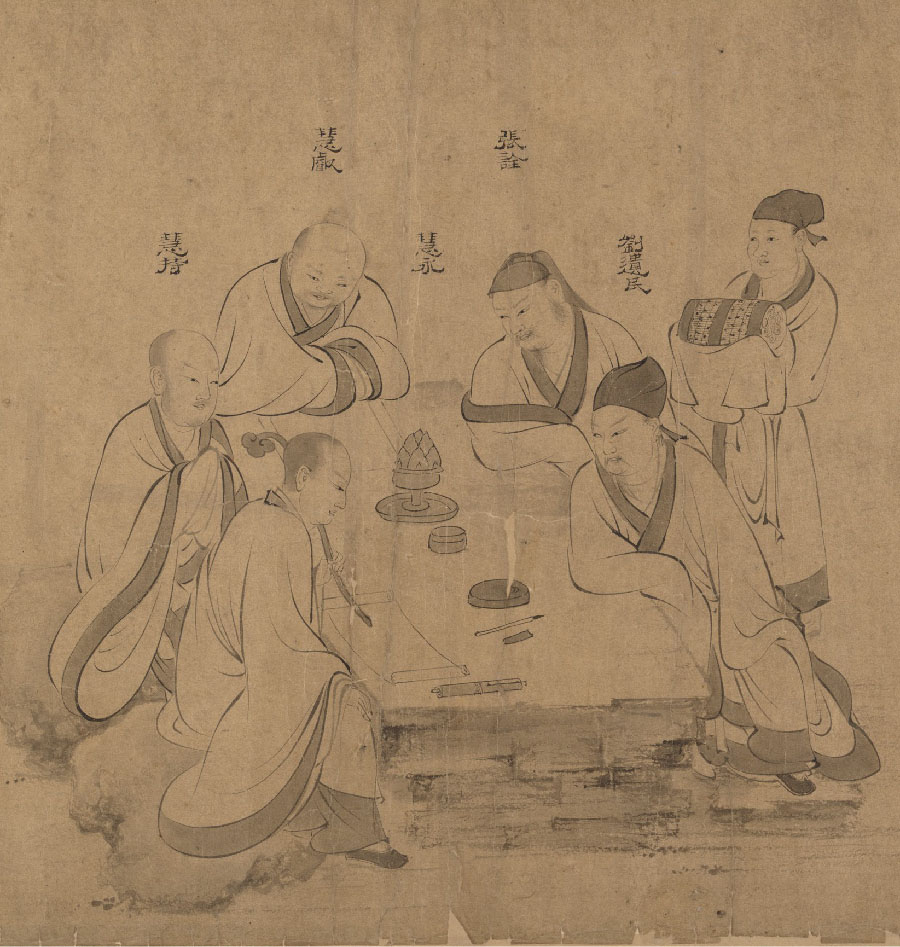
A number of religious sects arose foretelling the end of days. One of these was the White Lotus, a sect of Buddhism that announced the coming of a new Buddha and thus a new age (Figure 17.22). Seizing on the White Lotus prophecy, a secret peasant society named the Red Turbans called for the overthrow of Mongol rule and the return of the Song dynasty. Armed rebellion broke out in 1351. In 1352, a young wandering Buddhist monk named Zhu Yuanzhang joined the Red Turbans and married the daughter of one of its leaders. In 1356, his forces captured the southern Chinese city of Nanjing. After eliminating his rivals within the Red Turbans, in 1368 Zhu defeated the last Yuan emperor, who then abandoned China. Zhu destroyed the Yuan palace in the capital of Dadu (Beijing), proclaimed himself emperor with the name of Hongwu, meaning vast and martial, and dubbed his new dynasty the Ming (“bright”).
英語のヒント
終末を予告する宗教的な集団がいくつも現れた。その一つが仏教系の白蓮教で、新たな仏の到来、ひいては新時代の到来を告げた(図17.22)。農民の秘密結社である紅巾軍は、この白蓮教の予言を取り上げ、モンゴル支配の打倒と宋朝の復興を呼びかけた。1351年、武装反乱が始まった。1352年、放浪する若い仏教僧、朱元璋が紅巾軍に加わり、その指導者の一人の娘と結婚した。1356年には、その軍が中国南部の都市南京を攻略した。紅巾軍内部の競争相手を排除した後、1368年、朱元璋は元の最後の皇帝を破り、その皇帝は中国から退去した。朱元璋は首都大都(北京)の元の宮殿を破壊し、広大さと武威を意味する「洪武」の名で皇帝を称し、新王朝を「明るい」を意味する明と名づけた。
The White Lotus Society.白蓮社。
(credit: “White Lotus Society” by Unknown/John Stewart Kennedy Fund, 1913/The Metropolitan Museum of Art, Public Domain) · Public Domain
Figure 17.22 The White Lotus Society, a meeting of which is depicted in ink on this fifteenth-century paper handscroll, was originally established in China to spread the teachings of a novel sect of Buddhism that foresaw the coming of a new age. (credit: “White Lotus Society” by Unknown/John Stewart Kennedy Fund, 1913/The Metropolitan Museum of Art, Public Domain)
図17.22 15世紀の紙の巻物に墨で描かれた、白蓮社の集まり。白蓮社は当初、新時代の到来を予見する新たな仏教の一派の教えを広めるため、中国で設けられた。(出典: “White Lotus Society”/作者不詳/John Stewart Kennedy 基金、1913年/メトロポリタン美術館, パブリックドメイン)
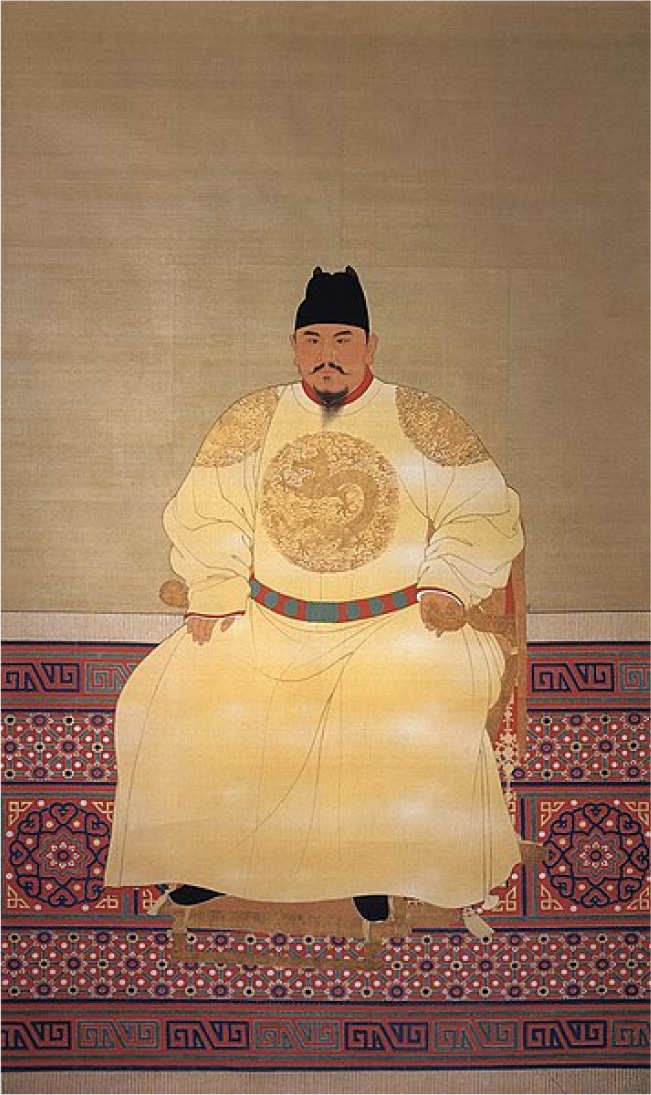
Hongwu began by enforcing his power and bolstering China’s security as the Ming dynasty’s first emperor (Figure 17.23). Although he tried to resolve social disparities by abolishing slavery and increasing taxes on the wealthy, the cost of his army put a significant strain on the Chinese economy. He was never able to fully bridge the gap between rich and poor, and his attempts to protect China from invasion and rebellion led to repressive domestic policies. Nevertheless, with the restoration of agricultural productivity and political stability, the early Ming era was a time of significant wealth and power for China.
英語のヒント
明の初代皇帝となった洪武帝は、まず権力を徹底させ、中国の安全を強化した(図17.23)。奴隷制を廃し、富裕層への税を増やして社会的格差の解消を試みたが、軍の維持費は中国経済に大きな負担をかけた。貧富の差を完全に埋めることはできず、中国を侵略と反乱から守ろうとする試みは、国内で抑圧的な政策につながった。それでも、農業生産力と政治的安定が回復した明初は、中国にとって豊かで強力な時代だった。
Zhu Yuanzhang.朱元璋。
(credit: “Official court painting of the Hongwu Emperor” by Unknown/Wikimedia Commons, Public Domain) · Public Domain
Figure 17.23 This hanging scroll silk painting of the fourteenth century is an official court portrait of the first emperor of the Ming dynasty. It is about 8 feet high by about 5 feet wide. (credit: “Official court painting of the Hongwu Emperor” by Unknown/Wikimedia Commons, Public Domain)
図17.23 14世紀の絹本掛軸。明の初代皇帝を描いた、宮廷の公式肖像画である。高さ約8フィート、幅約5フィート。(出典: “Official court painting of the Hongwu Emperor”/作者不詳/Wikimedia Commons, パブリックドメイン)
Hongwu’s reign was marked by efforts to consolidate his own power, to protect himself from attack, and to reassert and expand Chinese influence. He eliminated the office of chief minister so that he might govern without interference, established a force of secret police, and ordered the execution of thousands of people who he believed disagreed with his polices. He also acted swiftly to stamp out rebellions. A revolt by the Miao ethnic group in Hunan Province in the southwest was crushed. The Kingdom of Dali, where Mongol forces had taken refuge in what is now Yunnan Province in the southeast, was defeated and the region incorporated into China. In 1387, Ming forces invaded Manchuria in the northeast, where Mongols loyal to the Yuan dynasty had also established a foothold. To protect the borders in underpopulated areas, Hongwu made military service in these regions hereditary. He forced the mass relocation of peasants from the south to augment the population in parts of central and northern China that had been hard hit by crop failures and epidemics.
英語のヒント
洪武帝の治世は、自分の権力を固め、攻撃から身を守り、中国の影響力を再び確立して拡大する試みに特徴づけられる。干渉を受けずに統治するため宰相職を廃し、秘密警察を設け、自分の政策に反対していると考えた数千人の処刑を命じた。反乱も速やかに取り締まった。南西部の湖南省ではミャオ族の蜂起を鎮圧した。南東部の現在の雲南省にあり、モンゴル軍が逃れた大理王国も破り、その地域を中国に組み込んだ。1387年には、元朝に忠実なモンゴル人が拠点を築いていた北東部の満洲に、明軍を侵攻させた。人口の少ない地域で国境を守るため、洪武帝はその地域での兵役を世襲にした。また、凶作と疫病で大きな打撃を受けた中国中部・北部の人口を増やそうと、南方の農民を大規模に強制移住させた。
Hongwu’s efforts to expand Chinese power continued under his successor, his son Zhu Di, known as the Yongle emperor. From 1406 to 1427, Chinese forces tried unsuccessfully to invade and subdue the kingdom of Vietnam, and to counter the continuing Mongol threat, the Great Wall of China was repaired and lengthened. In other ways, though, Zhu Di reversed his father’s policies. Hongwu had wanted to isolate China from dangerous foreign influences and so had forbidden nearly all maritime trade. The Yongle emperor strove instead to establish relations with foreign lands in order to make their rulers aware of China’s wealth and power. To this end, he dispatched Admiral Zheng He on seven naval expeditions between 1405 and 1433. Chinese fleets consisting of thousands of ships sailed to Southeast Asia, India, Arabia, and East Africa. Zheng He presented foreign rulers with gifts of porcelain, silk, and gold to impress upon them the splendor of the Ming dynasty, and he returned with tribute for the emperor in the form of ivory and exotic animals such as zebras and ostriches.
英語のヒント
中国の勢力を広げようとする洪武帝の試みは、後継者である息子の朱棣、すなわち永楽帝のもとでも続いた。1406~1427年、中国軍はベトナム王国に侵攻して服属させようとしたが、成功しなかった。また、続くモンゴルの脅威に対抗するため、万里の長城を修復し、延長した。しかし別の面では、朱棣は父の政策を逆転させた。洪武帝は危険な外国の影響から中国を隔てようとして、ほとんどすべての海上交易を禁じていた。それに対し永楽帝は、外国の君主に中国の富と力を知らせるため、海外との関係を築こうと努めた。その目的で鄭和を派遣し、1405~1433年の間に7回の海上遠征を行わせた。数千隻の船から成る中国の艦隊が、東南アジア、インド、アラビア、東アフリカへ航海した。鄭和は外国の君主に磁器、絹、金を贈り、明朝の壮麗さを印象づけた。帰国時には、象牙やシマウマ、ダチョウなどの珍しい動物を、皇帝への貢ぎ物として持ち帰った。
Zhu Di also established diplomatic relations with Shah Rukh, the son and heir of Timur, as well as with rulers in the Philippines and the Indian Ocean. China had no direct contact with the Ottoman state, however. When he ascended the throne, Hongwu sent an announcement to the Byzantine emperor, who he believed was still in power in Constantinople. After this, however, there was no correspondence or direct contact between the two states for at least a century.
英語のヒント
朱棣は、ティムールの息子で後継者のシャー・ルフ、フィリピンやインド洋の君主とも外交関係を築いた。しかし中国とオスマン国家の間に直接の接触はなかった。洪武帝は即位時、コンスタンティノープルでなお権力を握っていると考えていたビザンツ皇帝へ、その知らせを送った。しかし、その後少なくとも1世紀は、両国間に書簡のやり取りも直接の接触もなかった。
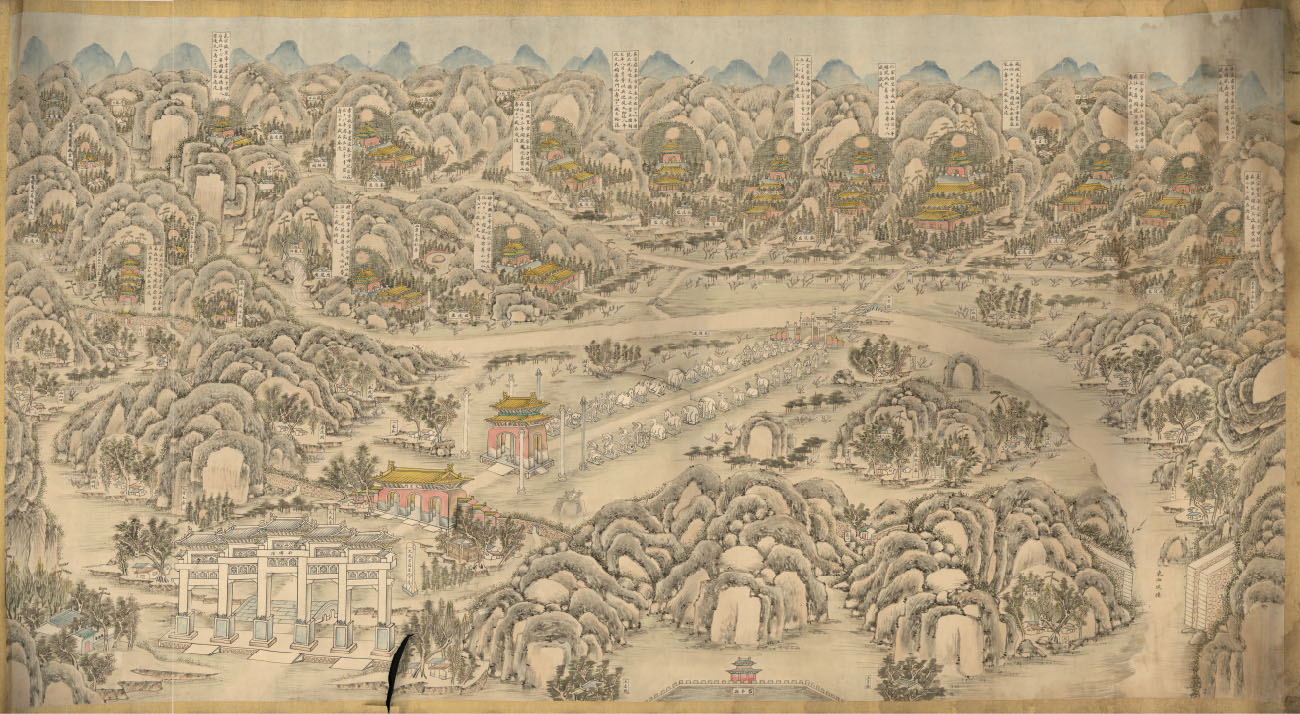
The Yongle emperor moved the capital of China from Nanjing to Beijing, in the center of which he began construction of the new Forbidden City, a walled compound consisting of palaces, temples, and gardens for use by the emperor and the members of his household. In 1420, he also ordered the building of an elaborate tomb north of Beijing, where other members of the dynasty also built final resting places for themselves (Figure 17.24). All these structures conveyed an image of China’s power, wealth, and magnificence.
英語のヒント
永楽帝は首都を南京から北京へ移し、その中央で新しい紫禁城の建設を始めた。紫禁城は、皇帝とその家の人々が使う宮殿、寺院、庭園から成る、壁で囲まれた一区画だった。1420年には北京の北に壮麗な陵墓を建てるよう命じた。王朝の他の皇帝たちも、その地に自分の永眠の場所を築いた(図17.24)。これらの建造物はすべて、中国の力、富、壮麗さを伝えた。
Ming Tombs.明の陵墓。
(credit: “Ming shi san ling tu” by Arthur W. Hummel/Library of Congress, Geography and Map Division, Public Domain) · Public Domain
Figure 17.24 Ming dynasty emperors built thirteen tombs at the foot of the Jundu Mountains near Beijing, shown here in a nineteenth-century ink and watercolor image. The three red arches in the lower left mark the beginning of the Spirit Way, a four-mile road that runs through the valley. (credit: “Ming shi san ling tu” by Arthur W. Hummel/Library of Congress, Geography and Map Division, Public Domain)
図17.24 明の皇帝たちは北京近郊の軍都山の麓に十三の陵墓を建てた。これは19世紀の墨と水彩による図。左下の三つの赤いアーチは、谷を通る全長4マイルの参道、神道の起点を示している。(出典: “Ming shi san ling tu”/Arthur W. Hummel/米国議会図書館・地理地図部, パブリックドメイン)
Despite their wealth and power, the Ming emperors could still find themselves helpless in the face of Mongol aggression. The Yongle emperor tried unsuccessfully to subdue the Oirats, the westernmost of the Mongol tribes, who lived in what is now western Mongolia and the Altai region of Siberia. In 1449, the Oirat leader Esen took the twenty-one-year-old Ming emperor Yingzong hostage after the Mongol army defeated a much larger Chinese military force at the Battle of Tumu Fortress. The Ming responded by demoting Yingzong to the rank of “retired emperor” and placed his younger half-brother on the throne instead.
英語のヒント
富と力を持つ明の皇帝も、モンゴルの攻撃を前に無力となることがあった。永楽帝は、モンゴルの諸部族のうち最も西に位置し、現在のモンゴル西部とシベリアのアルタイ地方に住むオイラトを服従させようとしたが、成功しなかった。1449年、オイラトの指導者エセンは、土木堡の戦いで、はるかに大きな中国軍をモンゴル軍が破った後、21歳の明の皇帝、英宗を人質に取った。明側は、英宗を「退位した皇帝」の位へ降格し、代わりに異母弟を帝位に据えた。
Esen’s efforts to return Yingzong to Beijing—after conveniently marrying the captive emperor to his daughter—failed, and Mongol efforts to take Beijing by force were repulsed. Yingzong remained a prisoner of the Oirat until a member of his court ransomed him and returned him to Beijing, where he was placed under house arrest in a palace in the Forbidden City by his half-brother, who had no intention of giving up the throne. It was another seven years before Yingzong managed to unseat (and kill) his half-brother and reclaim his throne.
英語のヒント
エセンは捕虜の皇帝を自分の娘と結婚させたうえで、都合よく北京へ返そうとしたが、うまくいかなかった。モンゴル軍が北京を武力で奪う試みも撃退された。英宗は宮廷の一員が身代金を払い、北京へ連れ帰るまで、オイラトの捕虜のままだった。帰還後は、帝位を手放すつもりのない異母弟によって、紫禁城内の宮殿に軟禁された。さらに7年たって、英宗はようやく異母弟を退け、殺害し、帝位を取り戻した。
Yingzong was forced to confront Mongol forces again in 1461 when the Chinese general Cao Qin attempted a coup with the assistance of Mongol soldiers. The emperor was saved only when a timely downpour foiled efforts to burn the gates that blocked the rebels’ entry to the Forbidden City.
英語のヒント
1461年、中国の将軍、曹欽がモンゴル人の兵士の援助を受けてクーデターを試みると、英宗は再びモンゴル軍と対峙しなければならなくなった。反乱軍の紫禁城への侵入を阻む門を焼こうとする試みが、折よい豪雨で失敗したことによってのみ、皇帝は救われた。