第9章古代のアフリカAfrica in Ancient Times
The climax of the war came at the Battle of Actium in 31 BCE, during which the naval forces of Octavian and Marcus Agrippa met to defeat those of Marc Antony and Cleopatra. Octavian pursued the vanquished pair, and soon after he invaded Egypt in 30 BCE, Marc Antony and Cleopatra died by suicide. Cleopatra’s death ushered in the start of Roman rule in Egypt as it marked the end of the Ptolemaic dynasty.
英語のヒント
戦争の頂点は前31年のアクティウムの海戦だった。オクタウィアヌスとマルクス・アグリッパの艦隊が、アントニウスとクレオパトラの艦隊を破った。オクタウィアヌスは敗れた二人を追い、前30年にエジプトへ侵入した。その直後、アントニウスとクレオパトラは自殺した。クレオパトラの死はプトレマイオス朝の終焉を意味し、エジプトにおけるローマ支配の幕開けとなった。
Rome’s conquest of Egypt added yet another layer of complexity to Egyptian society. While Latin-speaking governors and administrators continued to run the affairs of state from Alexandria, they did so in Greek, which remained the language of government. Rome invested heavily in the development of Egypt’s largest cities and creating inviting cosmopolitan spaces eventually inhabited by Greeks, Jewish people, Romans, and assimilated Egyptians. Still, under the Romans, the majority of Egyptian subjects lived in rural areas. In more than two thousand villages scattered throughout the Nile delta and along the Nile valley, people labored to produce the tons of grain that supplied the imperial capital with bread. These people were also hardest hit by Roman taxation, a circumstance that inspired periodic revolts against the empire.
英語のヒント
ローマによる征服は、エジプト社会の複雑さに新たな層を加えた。ラテン語を母語とする総督や官僚がアレクサンドリアから国務を運営したが、その際に使ったのは、引き続き行政言語であったギリシア語だった。ローマはエジプトの大都市の整備に多額の資金を投じ、魅力ある国際的な空間を作った。やがてそこにはギリシア人、ユダヤ人、ローマ人、同化したエジプト人が暮らすようになった。それでもローマ支配下のエジプトでは、臣民の大多数は農村に住んでいた。ナイル・デルタとナイル渓谷沿いに点在する2,000以上の村で、人々は大量の穀物を作るために働いた。その穀物が、帝国の首都へパンを供給した。ローマの課税で最も大きな打撃を受けたのも、この人々だった。この事情が、帝国に対する周期的な反乱を生んだ。
Roman imperial administration over North Africa remained constant until the fourth and fifth centuries CE, when the weakened Western Roman Empire confronted a new series of challenges, including widespread barbarian invasions. One invading group was the Vandals. A Germanic people originating in present-day Poland, the Vandals migrated westward in the second century CE and settled in the region of Silesia. By the third century, they had been contained in the Roman province of Pannonia (a sizable territory that included parts of modern-day Hungary, Austria, Croatia, Serbia, Bosnia and Herzegovina, and Slovenia), but they pushed west in the face of the advance of the Huns, nomadic steppe people from central Asia.
英語のヒント
北アフリカでのローマ帝国の統治は、紀元後4〜5世紀まで続いた。この時代、弱体化した西ローマ帝国は、「蛮族」による広範な侵入など、新たな一連の課題に直面した。侵入集団の一つがヴァンダル人だった。現在のポーランドに起源を持つゲルマン系の人々で、紀元後2世紀に西へ移動し、シレジア地方に定住した。3世紀までには、パンノニア属州内にとどめられていた。この広い属州は、現在のハンガリー、オーストリア、クロアチア、セルビア、ボスニア・ヘルツェゴビナ、スロベニアの一部を含んでいた。だがヴァンダル人は、中央アジアの草原遊牧民フン人の前進を受けて、さらに西へ進んだ。
By the fifth century, Vandals had migrated to Gaul and the Iberian Peninsula. Around 430, under their leader Genseric, they were invited by Bonifacius, Rome’s governor in North Africa, to help him establish himself as a ruler independent of Rome. For the next several years, the Vandals fought Rome’s imperial forces on behalf of Bonifacius, who died at the Battle of Remini in Italy in 432. Rome finally agreed to a peace treaty that granted the Vandals control of Mauretania and the western half of Numidia. Unsatisfied, Genseric then pursued a plan to extend his control over Roman North Africa by breaking the treaty and invading Carthage, which he seized in 439.
英語のヒント
5世紀までにヴァンダル人は、ガリアとイベリア半島へ移動していた。430年ごろ、指導者ゲイセリックに率いられた彼らは、北アフリカのローマ総督ボニファティウスから招かれた。ローマから独立した支配者になろうとする、総督の企てを助けるためだった。その後数年間、ヴァンダル人はボニファティウスのためにローマ帝国軍と戦った。ボニファティウスは432年、イタリアのリミニの戦いで死んだ。ローマはついに、マウレタニアとヌミディア西半分の支配権をヴァンダル人に認める講和条約に同意した。それでも満足しなかったゲイセリックは、条約を破ってカルタゴに侵攻し、439年にこれを奪った。そうして、ローマ領北アフリカにおける支配をさらに広げようとしたのである。
The Vandals remained in control of the Maghreb region of Roman North Africa until the early sixth century, when Byzantine forces under the general Belisarius reconquered the territory and forced the Vandal king Gelimer to surrender in 534. Less than a century later, a new power from the east threatened the Byzantine position in North Africa. Beginning in the 640s, the armies of Islam advanced, conquering Byzantine Egypt in 642. Using Egypt as a forward position, they then launched successive invasions across the region until the final Byzantine strongholds of North Africa including Carthage fell. By 709, the whole of North Africa had been conquered.
英語のヒント
ヴァンダル人は6世紀初めまで、ローマ領北アフリカのマグリブを支配した。その後、将軍ベリサリウスが率いるビザンツ軍がこの地を再征服し、534年にヴァンダル王ゲリメルを降伏させた。それから1世紀もたたないうちに、東から来た新たな勢力が、北アフリカでのビザンツ帝国の地位を脅かした。640年代にイスラームの軍が進出を始め、642年にビザンツ領エジプトを征服した。エジプトを前進拠点として、彼らは地域各地への侵攻を繰り返した。やがてカルタゴを含む、北アフリカに残った最後のビザンツの拠点が陥落した。709年までに、北アフリカ全域が征服された。
North African and Trans-Saharan Trade北アフリカの交易とサハラ縦断交易
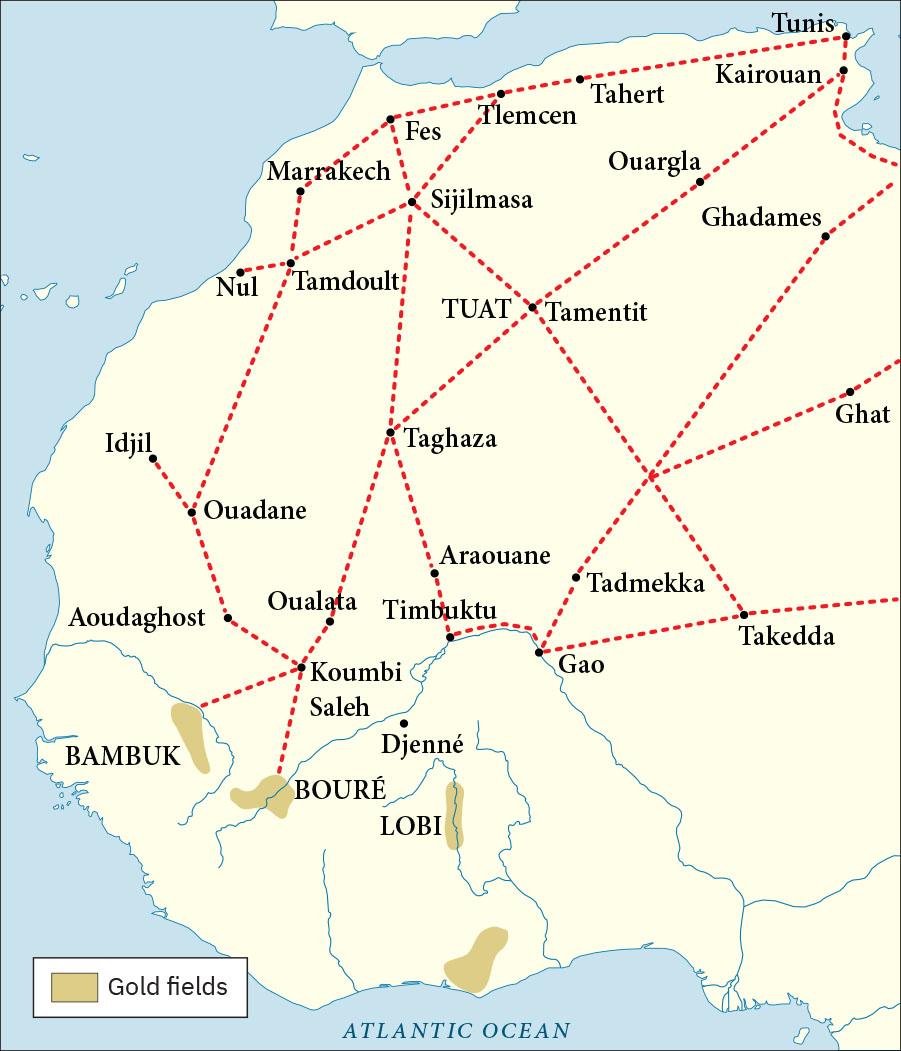
Trans-Saharan trade—the movement of goods between oases and larger settlements in North and West Africa—has existed in one form or another since at least the ninth century BCE. Over time, this system grew from the relatively localized trade in agricultural products and iron goods centered on the Phoenician city of Carthage. It became a continent-wide system of exchange that moved commodities such as copper, salt, ivory, enslaved people, textiles, and gold between what is now Senegal in West Africa and Egypt in the east, reaching as far south as Niger and as far east as Somalia in the Horn of Africa (Figure 9.24). At its height, the trans-Saharan exchange of goods influenced commerce and finance across the whole of North Africa, as well as the economies of Europe and the Near East. This system of trade was made possible by the nomadic peoples of North and West Africa.
英語のヒント
サハラ縦断交易、すなわち北アフリカと西アフリカのオアシスや大きな居住地の間で物資を運ぶ交易は、少なくとも前9世紀以来、何らかの形で存在してきた。初めは、フェニキア人の都市カルタゴを中心とする、農産物や鉄製品の比較的地域的な交易だった。それが次第に、大陸規模の交換網へ成長した。銅、塩、象牙、奴隷とされた人々、織物、金などが、西の現在のセネガルから東のエジプトへと運ばれ、南はニジェール、東は「アフリカの角」のソマリアにまで達した(図9.24)。最盛期には、サハラを越える物資の交換は、北アフリカ全域の商業と金融に加え、ヨーロッパや近東の経済にも影響した。この交易網を可能にしたのは、北アフリカと西アフリカの遊牧民だった。
Trans-Saharan Trade.サハラ縦断交易
(credit: modification of work “Trade routes of the Western Sahara c. 1000-1500” by “Aa77zz”/Wikimedia Commons, CC0 1.0) · CC0 1.0
Figure 9.24 This map shows trans-Saharan trade routes in the western Sahara around 1000–1500 CE, linking cities on both sides of the desert. (credit: modification of work “Trade routes of the Western Sahara c. 1000-1500” by “Aa77zz”/Wikimedia Commons, CC0 1.0)
図9.24 紀元後1000〜1500年ごろの西サハラの交易路を示す地図。砂漠の両側の都市を結んだ中世の交易網である。(クレジット:「Aa77zz」による「Trade routes of the Western Sahara c. 1000-1500」/Wikimedia Commonsを改変、CC0 1.0)
In the ninth century BCE, African farmers supplied the Phoenician towns of North Africa with food. In exchange, the Phoenicians introduced these peoples to innovative technologies such as ironworking. Over centuries of interaction, the two groups intermarried and became an integral part of North African society. From around the seventh century BCE, Phoenician merchants relied on the herders of the Atlas Mountains (in present-day Morocco) and the stretch of the northern Sahara to the south.
英語のヒント
前9世紀、アフリカの農民は北アフリカのフェニキア人の都市へ食料を供給した。その見返りとして、フェニキア人は製鉄などの新しい技術を伝えた。何世紀にもわたる交流の中で、二つの集団は通婚し、北アフリカ社会に欠かせない一部となった。前7世紀ごろから、フェニキアの商人たちは、現在のモロッコにあるアトラス山脈と、その南に広がるサハラ北部の牧畜民に頼るようになった。
Indigenous peoples of North Africa had long maintained contact across the Sahara, but it could be tenuous due to the inherent risks of desert travel, including attacks on trading caravans and slave raids by the Garamantes desert people of Libya. Helping facilitate contact in the desert extremes were small settlements of seminomadic peoples at a fragile line of oases forging a point-to-point trading system. Thus, early trade in the Sahara was a matter not of transporting goods across the vast desert expanse but rather of passing them from oasis to oasis. A principal commodity exchanged during this early stage of trade was salt, which was carried to the south and acted as a sort of currency. Salt was highly prized in the agricultural communities south of the Sahara where the mineral is scarce. This is because humans require salt to maintain healthy bodily functions and must regularly consume salt to replace its loss through sweat and urination. The Saharan traders knew where the salt was located, accessed it for themselves, and traded in the substance for goods they could otherwise obtain. Only gradually were highly valuable trading goods introduced, such as gold and copper, which were then brought across the desert from tropical West Africa to the far reaches of the North African coast.
英語のヒント
北アフリカの先住民は、古くからサハラを越えて接触を保っていた。しかし、そのつながりは不安定になり得た。砂漠の旅には、隊商への襲撃や、リビアの砂漠民ガラマンテス人による奴隷狩りなど、本質的な危険が伴ったからである。過酷な砂漠での交流を支えたのは、頼りないほど点々と続くオアシスにある、半遊牧民の小さな居住地だった。それらが、拠点から拠点へ物資を送る交易網を形作った。したがって初期のサハラ交易は、広大な砂漠を一度に横断して運ぶものではなく、オアシスから次のオアシスへ物資を渡していくものだった。初期に交換された主要な品の一つは塩で、南へ運ばれ、貨幣のような役割も果たした。塩の乏しいサハラ以南の農業社会では、とりわけ価値が高かった。人間は健康な身体機能を保つために塩分を必要とし、汗や尿で失った分を定期的に補わなければならないからである。サハラの交易者は、塩のある場所を知り、自ら入手し、ほかの方法でも入手できる品物と交換した。金や銅のように高価な交易品が加わるのは、ゆっくりとした過程だった。これらは、熱帯西アフリカから砂漠を越え、遠い北アフリカ沿岸まで運ばれるようになった。
During the period of Carthaginian dominance in Tunisia, goods were carried by pack animals such as mules, horses, and donkeys between the Phoenician imperial capital and the independent African kingdoms in the mountainous and coastal regions to its west. These kingdoms, known to the Romans as Mauretania and Numidia, had extended their control of much of North Africa by the second century BCE as Carthage declined and Rome ascended. For a time, the Romans and the North African kingdoms enjoyed a relatively peaceful and prosperous alliance, but gradual Roman interference in the domestic political affairs of the Numidian state caused their relations to sour, and eventually Rome conquered both Numidia and Mauretania.
英語のヒント
カルタゴがチュニジアを支配していた時代、物資はラバ、馬、ロバなどの荷役動物によって運ばれた。運搬経路はフェニキア人の帝国の都と、その西側の山地・沿岸部にある独立したアフリカの諸王国を結んでいた。ローマ人がマウレタニアやヌミディアと呼んだこれらの王国は、カルタゴの衰退とローマの台頭に伴い、前2世紀までに北アフリカの広い範囲へ支配を伸ばした。しばらくの間、ローマと北アフリカ諸王国は、比較的平和で繁栄をもたらす同盟を保った。だが、ローマがヌミディアの内政に次第に干渉するようになると、関係は悪化した。やがてローマは、ヌミディアとマウレタニアの両方を征服した。
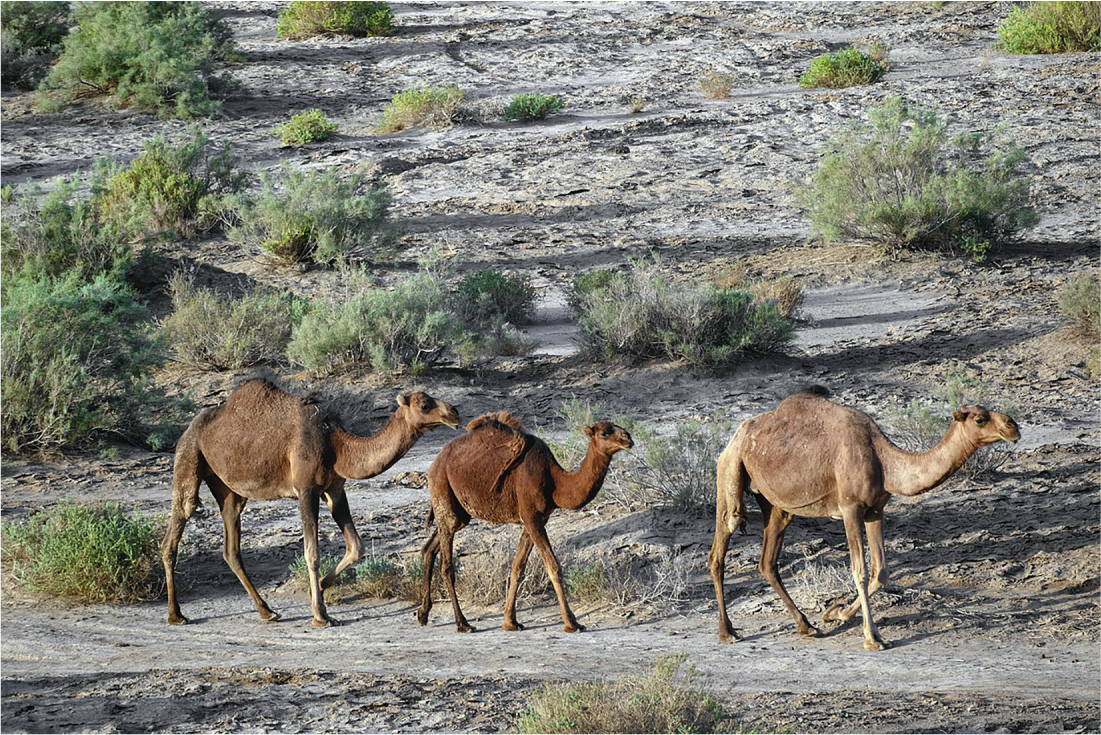
In typical fashion, the Romans established large estates as well as towns in the newly conquered territories. Their administration outside these enclaves reached only so far, however. Beyond them, the region remained under the dominance of the people native to the area, in both language and culture. But it was in the strategic interests of Rome to secure the southernmost frontiers of these new provinces. Doing so effectively required not only establishing a border but also patrolling it. This was impossible with horses, so the Romans used the dromedary camel (one-hump camel) (Figure 9.25). Biologically equipped to survive desert extremes, the camel was the ideal means to help secure Rome’s new southernmost frontier.
英語のヒント
ローマ人はいつものように、新たに征服した土地に大農園や都市を築いた。しかし、その飛び地のような拠点の外まで、行政支配が行き届いたわけではなかった。拠点の外では、言語と文化の両面で、その土地に元から暮らす人々が引き続き優位を保った。それでも、新属州の最南端の境界を確保することは、ローマの戦略的利益にかなっていた。効果的に守るには、国境を定めるだけでなく、巡回する必要がある。それは馬では不可能だったため、ローマ人はヒトコブラクダを用いた(図9.25)。ラクダの身体は砂漠の過酷な環境に耐えられるようにできており、ローマの新しい南の境界を守るのに理想的な手段だった。
The Dromedary Camel.ヒトコブラクダ
(credit: “Animals of Iran - Kavir National Park - Qom Province - Deir-e Gachin Caravansarai 20” by Mostafameraji/Wikimedia Commons, CC0 1.0) · CC0 1.0
Figure 9.25 The widespread use of dromedary camels by the Romans in North Africa helped to popularize the animal's use in trans-Saharan trade. (credit: “Animals of Iran - Kavir National Park - Qom Province - Deir-e Gachin Caravansarai 20” by Mostafameraji/Wikimedia Commons, CC0 1.0)
図9.25 北アフリカでローマ人がヒトコブラクダを広く使ったことは、サハラ縦断交易でも利用が普及する助けとなった。(クレジット:「Animals of Iran - Kavir National Park - Qom Province - Deir-e Gachin Caravansarai 20」、Mostafameraji/Wikimedia Commons、CC0 1.0)
The introduction of the dromedary camel originally from Arabia into North Africa revolutionized the trans-Saharan trade, but its adoption across the region was slow. The first camels in North Africa may have reached Egypt by as early as the ninth century BCE, but it was not until the third and fourth centuries CE that its use spread to the African nomad groups of the northern Sahara, likely helped along by Roman use of the animal. By the fifth century, it had become a major form of transportation in the region. The camel had many advantages over other pack animals. It could maintain a steady pace over much longer distances than oxen, and it could carry upward of three hundred pounds of goods an average of fifteen to eighteen miles a day. Further, the camel’s capacity to store fat and water enabled it to travel up to ten days without stopping for fresh water, more than twice the time and distance of almost every other pack animal. Added to this was the camel’s unique splayed foot, which allowed it to walk easily in the soft, sandy conditions of the Saharan environment.
英語のヒント
アラビアを原産地とするヒトコブラクダが北アフリカに導入されると、サハラ縦断交易は一変した。ただし、地域全体への普及はゆっくりだった。北アフリカ最初のラクダは、早ければ前9世紀にはエジプトへ来ていた可能性がある。しかし、サハラ北部の遊牧集団へ利用が広がったのは、紀元後3〜4世紀になってからだった。ローマ人が利用したことも、その広がりを助けたと考えられる。5世紀までに、ラクダは地域の主要な輸送手段となっていた。他の荷役動物と比べて、ラクダには多くの利点があった。牛よりはるかに長い距離を一定の速度で進め、300ポンド、約136キログラムを超える荷物を背負い、1日平均15〜18マイル、約24〜29キロメートルを歩けた。さらに、脂肪と水を蓄える能力によって、水を補給せずに最長10日間進むことができた。これは、ほぼすべての他の荷役動物の2倍以上の時間と距離だった。それに加え、ラクダ特有の広がった足は、サハラの柔らかい砂地でも歩きやすくした。
The camel enabled desert nomads to reach more distant oases than ever before and so open entirely new routes across the desert. Although desert travel remained precarious and filled with risk, it certainly became more reliable. For the first time, it was possible for desert travelers to consider dispatching large-scale and regular long-distance trading caravans across the Sahara. Despite this, desert transport remained largely in the hands of the nomadic peoples of the region, principally the Sanhaja in the west and the Tuareg of the central and southern Sahara. Although trans-Saharan trade was growing at this time, it was not yet full-time work, so these groups remained largely nomadic pastoralists, harvesting date palms and grazing their flocks and herds at oases.
英語のヒント
ラクダによって、砂漠の遊牧民は以前より遠いオアシスへ到達できるようになり、砂漠を横切る新たな経路が開かれた。砂漠の旅はなお不安定で危険を伴ったが、確実性は高まった。初めて、サハラを横断する大規模で定期的な長距離隊商を送り出すことが、現実的な選択肢となった。それでも、砂漠での輸送の大部分は、地域の遊牧民が担い続けた。中心となったのは、西のサンハージャと、サハラ中部・南部のトゥアレグだった。サハラ縦断交易は成長していたが、まだ専業の仕事ではなかった。そのため、これらの集団の多くは遊牧の牧畜民であり続け、オアシスでナツメヤシを収穫し、羊・山羊などの群れや牛などの群れを放牧した。
In many cases, they tended goats and sheep, but they often also had camel and cattle and occasionally horses. These animals all had to graze, and when they were unable to do so at oases because of either distance or weather, the nomads were forced to find other grazing land. This was particularly the case during the hottest and driest seasons, when the nomads migrated their flocks and herds to the better grazing areas of the Maghreb in the north or the Sahel in the south. Inevitably, this brought them into contact with the more settled agricultural peoples of these areas, and often into conflict as they competed for precious resources in a hostile environment. Beyond these settlements, the nomadic pastoralists dominated the Sahara. Yet there were other peoples in the desert, including small groups such as the Haratin who also called the oases home. They harvested dates and dug salt to exchange for food but were often kept in a subordinate position by the nomads, who controlled the oases.
英語のヒント
彼らの多くは山羊と羊を飼い、ラクダや牛を持つこともしばしばあり、ときには馬も飼った。これらの動物には草を食べさせる必要があった。距離や天候のためにオアシスで放牧できないとき、遊牧民は別の牧草地を探さざるを得なかった。特に暑く乾燥する季節には、群れを、よりよい草地のある北のマグリブや南のサヘルへ移した。その結果、これらの地域の定住農耕民と必然的に接触した。厳しい環境で貴重な資源を奪い合うため、争いになることも多かった。こうした居住地の外では、遊牧牧畜民がサハラを支配していた。それでも砂漠には、オアシスを故郷とするハラティンなど、他の小集団もいた。彼らはナツメヤシの実を収穫し、塩を掘り出して食料と交換したが、オアシスを支配する遊牧民によって、従属的な地位に置かれることが多かった。
As the camel transformed desert transport, the products of sub-Saharan Africa became more readily available to the Mediterranean world. Trade in West African gold expanded, demand increased for such goods as ivory and ostrich feathers, and large animals were hunted to extinction in North Africa. As cross-desert traffic grew, several new settlements developed to aid the movement of goods north and south of the Sahara, including Sijilmasa, Ghat, Gao, Awdaghust, and Kano. At sites such as these, goods were exchanged, and camel caravans were unloaded and replenished to continue their journey across the desert. While the desert traffic in goods remained in the hands of nomads, the actual demand for and exchange of goods was largely the work of peoples of settled societies to the north and south of the Sahara.
英語のヒント
ラクダが砂漠の輸送を変えるにつれて、地中海世界はサハラ以南の産物を、より容易に手に入れられるようになった。西アフリカの金の交易が拡大し、象牙やダチョウの羽根などへの需要が増えた。北アフリカでは、大型動物が狩猟によって絶滅に追い込まれた。砂漠横断の往来が増すと、サハラの南北に物資を運びやすくするため、新しい居住地が発展した。シジルマーサ、ガート、ガオ、アウダゴスト、カノなどである。こうした場所では品物が交換され、ラクダの隊商は荷を下ろして補給を受け、砂漠の旅を続けた。砂漠での運搬は遊牧民が担い続けたが、商品の需要を生み、実際に交換を行う中心となったのは、サハラの北と南に暮らす定住社会の人々だった。