第9章古代のアフリカAfrica in Ancient Times
The Bantu Migrationsバントゥー系の人々の移動
The word “Bantu” is a modern term invented by linguists who have studied the languages of Africa. The word is made up of the common stem “ntu” and the plural prefix “ba” which put together literally means “people.” It describes a large and geographically widespread subfamily of African languages that make up part of the larger Niger-Congo language family. There are well over four hundred known Bantu languages spoken today across a large portion of the southern half of Africa (Figure 9.12). Linguists believe that these similar languages derived from an ancient parent language often described as “proto-Bantu.”
英語のヒント
「バントゥー」は、アフリカの言語を研究する言語学者が作った近代の用語である。共通する語幹ntuと複数を表す接頭辞baからなり、組み合わせると文字どおり「人々」を意味する。この語は、さらに大きなニジェール・コンゴ語族の一部をなす、地理的に広く分布する大きな言語群を指す。現在、アフリカ南半分の広い範囲では、知られているだけでも400をはるかに超えるバントゥー諸語が話されている(図9.12)。言語学者は、これらの似た言語が、しばしば「バントゥー祖語」と呼ばれる古代の共通祖先の言語から派生したと考えている。
Africa’s Wealth of Languages.アフリカの豊かな言語。
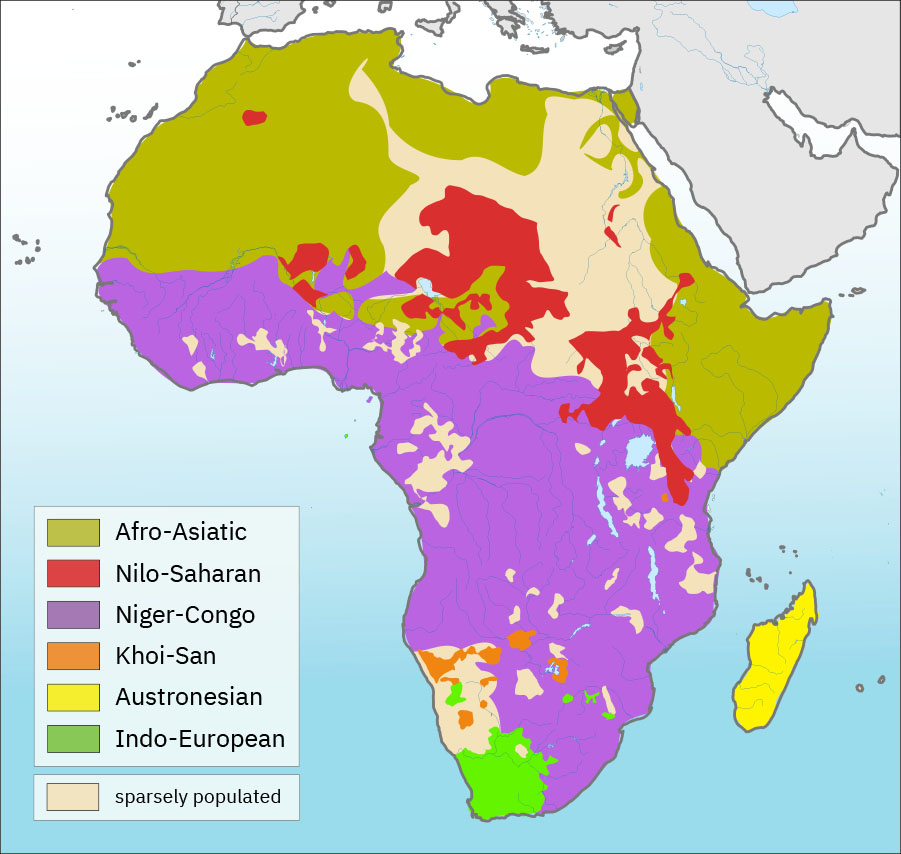
(credit: modification of work “Languages of Africa map” by “Seb az86556”/Wikimedia Commons, CC BY 3.0) · CC BY 3.0
Figure 9.12 This map shows the distribution of language groups in Africa that resulted from ancient migrations. The Bantu subfamily is part of the Niger-Congo family and extends from western Africa to the far south. (credit: modification of work “Languages of Africa map” by “Seb az86556”/Wikimedia Commons, CC BY 3.0)
図9.12 この地図は、古代の人々の移動によって生じた、アフリカの言語集団の分布を示す。バントゥー語派はニジェール・コンゴ語族の一部で、西アフリカからはるか南まで広がる。(出典:「Seb az86556」「Languages of Africa map」を改変、Wikimedia Commons、CC BY 3.0)
Theories about the spread of the Bantu speakers have changed over the last several decades. For example, it was once believed that the spread occurred relatively recently, meaning over the last several centuries. It was also assumed that the process took the form of conquering bands of Bantu speakers who subjugated or even annihilated those they came into contact with. We know now that the process began several thousand years ago and proceeded in a piecemeal fashion as small groups of Bantu speakers spread across the larger area, integrating and intermarrying into the largely hunter-gatherer communities they met.
英語のヒント
バントゥー諸語を話す人々の広がりに関する学説は、この数十年で変わった。たとえば以前は、比較的最近、つまり過去数世紀に広がったと考えられていた。また、バントゥー諸語の話者の集団が征服を進め、出会った人々を服従させ、ときには絶滅させるような過程だったと想定されていた。現在では、その過程が数千年前に始まったと分かっている。小さな集団が広い地域へ少しずつ分かれて広がり、出会った主に狩猟採集を営む共同体へ溶け込み、婚姻関係を結びながら進んだのである。
It is generally accepted today that the original proto-Bantu speakers emerged and lived in the area between modern-day Nigeria and Cameroon in West and Central Africa. A Neolithic people, the proto-Bantu were farmers who subsisted by cultivating pearl millet and yams and extracting oil from the abundant palm and bush candle trees of the region’s luxuriant rainforests. Gradual changes in weather patterns caused the rainforests to recede and, together with increasingly seasonal (rather than constant) rainfall, opened tracts of savanna between forested areas. Over time, these open patches merged to form the Sangha River Interval, a 200-mile-wide grassland running north–south between modern-day southeastern Cameroon, southern Central African Republic, and northern Republic of Congo. This grassland corridor allowed the previously forest-dwelling Bantu to move southward, through what had once been impenetrable tropical rainforest.
英語のヒント
現在では、最初のバントゥー祖語の話者は、西・中央アフリカの、現在のナイジェリアとカメルーンの間の地域に現れ、暮らしていたと広く認められている。新石器時代の人々である彼らは農民で、トウジンビエやヤムイモを育て、豊かな雨林に多く生えるヤシやブッシュ・キャンドルの木から油を採って生計を立てた。天候の緩やかな変化により雨林が後退し、雨も、絶えず降るものから季節的なものへ変わっていった。こうした変化が重なり、森林の間にサヴァンナの区画が開けた。やがて開けた部分がつながり、サンガ川回廊が形成された。これは幅200マイルの草原で、現在のカメルーン南東部、中央アフリカ共和国南部、コンゴ共和国北部の間を、南北に伸びていた。この草原の通路によって、それまで森林に暮らしていたバントゥー系の人々は、かつては入り込めない熱帯雨林だった地域を通り、南へ移動できるようになった。
The expansion of the Bantu speakers beyond that region and across other parts of sub-Saharan African likely began between 3000 and 2000 BCE and is referred to as the Bantu migrations (Figure 9.13). Although scholars debate the precise timing, motivation, and directions of these migrations, linguistic evidence and archaeological traces of pottery and ironmaking technology suggest there were multiple waves. The earliest seems to have consisted of two phases: an initial eastern stream or “early split,” and a somewhat later western “rivers and coasts” stream. In both phases, pioneering groups moved gradually and sporadically, first proceeding eastward across the northern reaches of the Congo Forest and arriving in the Great Lakes region of East Africa around 1500 BCE.
英語のヒント
バントゥー諸語を話す人々が、この地域を越え、サハラ以南の他の地域へ広がったのは、おそらく前3000〜前2000年に始まる。この拡大を「バントゥーの移動」と呼ぶ(図9.13)。正確な時期、動機、方向について研究者は議論を続けているが、言語の証拠や、土器・製鉄技術の考古学的な痕跡は、移動の波が複数あったことを示す。最初の波は、二段階からなっていたようだ。初めの東向きの流れ、すなわち「早期の分岐」と、やや後の西方の「川と海岸」に沿う流れである。どちらの段階でも、先に進む集団は、少しずつ、間を置きながら移動した。まずコンゴの森林の北の周縁を東へ進み、前1500年ごろに東アフリカの大湖沼地域へ到達した。
The Bantu Migrations.バントゥー系の人々の移動。
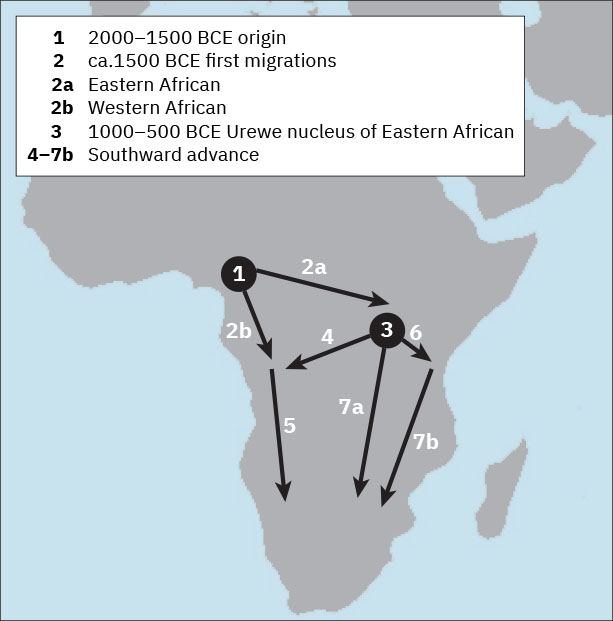
(credit: modification of work “Map showing the Bantu expansion” by Derek Nurse und Gérard Philippson/“Botev”/Wikimedia Commons, Public Domain) · Public Domain
Figure 9.13 Two streams of ancient Bantu migration originated in the Bantu homeland, located in West and Central Africa: (1) an eastward “early split” (2a) and a southward “western” expansion (2b). In later waves of migration, Bantu groups moved on from the Great Lakes region (3) in a generally southward advance (4–7). (credit: modification of work “Map showing the Bantu expansion” by Derek Nurse und Gérard Philippson/“Botev”/Wikimedia Commons, Public Domain)
図9.13 古代バントゥー系の人々の移動は、西・中央アフリカの原郷(1)から二つの流れとして始まった。東向きの「早期の分岐」(2a)と、南へ向かう「西方」の拡大(2b)である。後の移動の波では、大湖沼地域(3)から、全体として南へ前進した(4〜7)。(出典:Derek Nurse und Gérard Philippson/「Botev」「Map showing the Bantu expansion」を改変、Wikimedia Commons、パブリックドメイン)
Dominated by the Urewe culture, the Great Lakes region was one of the oldest centers of iron smelting in Africa. It was likely from the Urewe that the Bantu learned the iron-forging techniques that enabled them to later produce carbon steel. The Urewe also produced the earliest East African Iron Age pottery, called Urewe ware. Confidently dated to between the second and fifth centuries CE, Urewe ware is found in the Great Lakes region and is recognizable by the distinctive indentation on the bases of its bowls and pots, which gives it the name “dimple-based” pottery. Kwale ware, a related style, has been discovered in the region to the east of the Rift Valley, in southern Kenya and northern Tanzania. Kwale ware appears to be an offshoot of the earlier Urewe ware and dates to the Early Iron Age, around the third century. Archaeologists and historians have traced the southward thrust of the eastern stream of Bantu in the third and fourth centuries by uncovering Iron Age slag sites and related styles of pottery in Malawi and Mozambique.
英語のヒント
ウレウェ文化が主流だった大湖沼地域は、アフリカで最も古い製鉄の中心地の一つである。バントゥー系の人々が、後に炭素鋼を作れるようになる鍛鉄技術を学んだ相手は、おそらくウレウェの人々だった。彼らはまた、東アフリカ鉄器時代の最古の土器である、ウレウェ式土器も作った。ウレウェ式土器の年代は2〜5世紀と確実に定められており、大湖沼地域で見つかる。鉢や壺の底に特徴的なくぼみがあり、その形から「くぼみ底」の土器と呼ばれる。関連する型式のクワレ式土器は、大地溝帯の東側、ケニア南部とタンザニア北部で発見されている。これは、より早いウレウェ式土器から分かれたものと考えられ、鉄器時代初期の3世紀ごろにさかのぼる。考古学者や歴史家は、マラウイやモザンビークで鉄器時代の鉱滓の遺跡や、関連する土器の型式を発見し、3〜4世紀のバントゥー東方系統の南進をたどっている。
As small clusters of Bantu advanced into modern Kenya and Tanzania, some turned toward Congo, while other groups pushed southward in the direction of southern East Africa. By the seventh century, Bantu communities stretched from the extreme southern reaches of Somalia in the north to Natal and Eastern Cape in present-day South Africa. Along the way, they created key cultural elements that were the bases for later civilizations, including the Swahili speakers of the East African coast.
英語のヒント
バントゥー系の小集団が、現在のケニアやタンザニアへ進むなかで、一部はコンゴの方向へ転じ、他の集団は東アフリカ南部へ向かって南進した。7世紀までには、バントゥー系の共同体は、北はソマリアの最南部から、南は現在の南アフリカのナタールや東ケープまで広がった。移動の途上で、東アフリカ沿岸のスワヒリ語話者の社会など、後の文明の基盤となる重要な文化的要素が形作られた。
The western stream of Bantu migration progressed considerably more slowly than the eastward stream, advancing south along the West African coast into modern Gabon and the Democratic Republic of Congo, with small groups branching off to follow the Congo River system inland as early as 1500 BCE. Early Iron Age farm settlements dating from around the second century CE have been uncovered in southwestern Congo, near Kinshasa, but some of the most impressive and revealing evidence of Iron Age Bantu settlements comes from the savanna woodlands around Lake Kale in southeastern Congo. Here, archaeologists have uncovered evidence of extensive copper and iron smelting, with copper used for trade and to fashion jewelry, while iron was forged into tools and weapons. The westward stream penetrated deeper into the south-central African interior, where Kalundu and Dambwa pottery, Early Iron Age styles specific to this flow of Bantu, have been identified in the Zambezi valley. This evidence dates to the same period of southward expansion that has been linked to the eastward early split Bantu.
英語のヒント
バントゥー移動の西方の流れは、東向きの流れよりかなりゆっくり進んだ。西アフリカ沿岸を南下し、現在のガボンやコンゴ民主共和国へ入った。そこから小集団が枝分かれし、早くも前1500年には、コンゴ川水系に沿って内陸へ進んだ。コンゴ南西部のキンシャサ付近では、2世紀ごろの鉄器時代初期の農業集落が発掘されている。しかし、鉄器時代のバントゥー系集落について、特に印象的で多くを明らかにする証拠は、コンゴ南東部のカレ湖周辺のサヴァンナ疎林から出ている。そこでは大規模な銅・鉄の製錬の跡が発見された。銅は交易や宝飾品の製作に用いられ、鉄は鍛えて道具や武器にされた。西方の流れは、アフリカ南部内陸へさらに深く進んだ。ザンベジ川流域では、この流れに特有の鉄器時代初期の型式である、カルンドゥ式やダンブワ式の土器が確認されている。その証拠の年代は、東向きの早期分岐のバントゥー系集団に結びつけられる南進と、同じ時期に当たる。
It was not until the early centuries of the Common Era that the western stream penetrated Angola in the far southern extreme of West Africa. Around this time, East Africa witnessed a third phase of Bantu expansion, with groups moving through and settling in parts of modern Mozambique, Botswana, and eastern South Africa. It appears that all three streams of Bantu migration—the western stream, the early split, and its later southward-bound branch—converged on the Zambezi valley (Figure 9.13). By 500 CE, all parts of the vast tropical rainforest had been settled by Bantu farming communities. Populations of Bantu-speaking peoples could now be found throughout southern Africa, from the savanna woodland south of the Congo forest and that of northern Namibia in the west, to the Great Lakes region of East Africa, western Tanzania, and eastern Botswana in the east, to the Transvaal high veld, Natal, and Eastern Cape in the south.
英語のヒント
西方の移動の流れが、西アフリカのはるか南の端にあるアンゴラへ入ったのは、紀元後初めの数世紀になってからだった。このころ東アフリカでは、バントゥー拡大の第3段階が生じた。集団が現在のモザンビーク、ボツワナ、南アフリカ東部の一部を通り、そこへ定住したのである。西方の流れ、早期の分岐、そしてそこから後に南へ向かった支流という三つの流れは、いずれもザンベジ川流域へ合流したと考えられる(図9.13)。500年までには、広大な熱帯雨林のすべての地域に、バントゥー系の農業共同体が定住していた。そのころには、バントゥー諸語を話す人々は南部アフリカ各地に見られた。西ではコンゴの森林の南のサヴァンナ疎林やナミビア北部の疎林、東では東アフリカの大湖沼地域、タンザニア西部、ボツワナ東部、そして南ではトランスヴァールの高原草地、ナタール、東ケープまで及んでいた。
The Bantu were among the earliest groups to benefit from the diffusion of farming, herding and animal keeping, and advanced metalworking technologies, and they dispersed across the continent changing its linguistic and cultural landscape along the way. Pioneers originating in West and Central Africa advanced sporadically as small groups of people moving from one point to another. During the earliest centuries of expansion, groups of Bantu arrived in regions that were only thinly populated by groups of nomadic hunter-gatherers. The land was unsettled, enabling the Bantu to select the best sites for their farms, and because there was no need to clear thick forest or adopt new techniques to suit a difficult environment, their expansion across the subcontinent proceeded relatively rapidly. New generations could simply move to new areas. Initially, then, Bantu farm settlements were typically confined to fertile river valleys and regions with favorable rainfall—which helps explain why they moved toward the southeast, a path that avoided the much drier southwest.
英語のヒント
バントゥー系の人々は、農耕、牧畜や家畜飼育、高度な金属加工技術の普及から、早くに恩恵を受けた集団の一つだった。彼らは大陸各地へ広がり、その途上で言語と文化のあり方を変えた。西・中央アフリカを出発した先行集団は、小さなまとまりで一地点から次の地点へ、断続的に進んだ。拡大の初期の数世紀に彼らが入った地域には、遊動的な狩猟採集民の集団がまばらに暮らしていた。土地に定住者がいなかったため、バントゥー系の人々は農場に最適な場所を選べた。密林を開く必要も、困難な環境に合う新技法を取り入れる必要もなかったため、大陸南部への拡大は比較的速く進んだ。新しい世代は、単に新たな土地へ移ればよかった。したがって当初のバントゥー系農業集落は、通常、肥沃な河川流域や、雨の条件がよい地域に限られていた。このことは、彼らが南東へ進んだ理由を説明する助けになる。その経路は、はるかに乾燥した南西部を避けていた。
The situation changed, however, as the birth of each new generation put pressure on a given area’s limited resources. Growing needs necessitated further expansion, and as the Bantu advanced into the rainforest—their path helpfully cleared with new iron tools—they began to adjust their cultivation techniques to a variety of conditions. Although it may seem so, the tropical rainforest is not—and has never been—a uniform ecosystem: its topography and climate vary greatly from river valleys and swampy regions to dense forest canopies and plateaus, and across highlands and lowlands. Each of these environments requires different cultivation techniques, knowledge the Bantu acquired only after their gradual occupation of all parts of the rainforest and centuries of experimentation and adaptation. Their efforts were so effective that by the sixth century CE, Bantu farming communities had settled in virtually all parts of the tropical rainforest.
英語のヒント
しかし、世代が新しくなるたびに、その地域の限られた資源へ圧力がかかり、状況は変わった。必要なものが増えると、さらなる拡大が不可欠になった。バントゥー系の人々は、新しい鉄の道具を使って進路を開きながら雨林へ入り、さまざまな条件に栽培技法を合わせ始めた。熱帯雨林は、一様な生態系に見えるかもしれないが、そうではなく、かつてもそうではなかった。地形と気候は、河川流域や湿地、密生する森林の林冠や台地、そして高地と低地で、大きく異なる。それぞれの環境には、異なる栽培技法が必要だ。バントゥー系の人々がその知識を得たのは、雨林の各地に徐々に住み込み、何世紀にもわたり試行と適応を重ねてからだった。その努力はきわめて有効で、6世紀までには熱帯雨林のほぼすべての地域に、バントゥー系の農業共同体が定住した。
But the Bantu did not stop at the rainforest. Rather, they continued to drift southward and eventually emerged into the southern savanna, where they found an environment not unlike the grasslands they had encountered north of the rainforest. Like the rainforest, southern Africa was also lightly populated by foragers and hunter-gatherers, leaving vast swaths of land open for the Bantu farmers to inhabit. They expanded into this region seeking new land, a migratory process repeated by generations of their successors. Initially, the diffusion of the Bantu speakers south of the rainforest followed an easterly direction and hugged the southern and eastern edges of the rainforest. When they began to settle around Lake Victoria, the Bantu acquired cattle. From there, a general dispersal into eastern and southern Africa began.
英語のヒント
しかし、バントゥー系の人々は雨林で立ち止まらなかった。さらに南へ少しずつ移動し、ついには南のサヴァンナへ出た。そこには、雨林の北で出会った草原と、よく似た環境があった。雨林と同じように、南部アフリカにも採集民や狩猟採集民がまばらに暮らしていたため、バントゥー系の農民が住める広い土地が残されていた。彼らは新たな土地を求めてこの地域へ広がった。この移動の過程は、後の何世代にもわたって繰り返された。当初、雨林の南への広がりは東寄りの方向へ進み、雨林の南縁と東縁に沿っていた。ヴィクトリア湖周辺へ定住し始めると、バントゥー系の人々はウシを手に入れた。そこから東アフリカと南部アフリカへの全般的な拡散が始まった。
Although the areas into which the Bantu migrated were only sparsely populated, interactions with the peoples who already lived there were unavoidable. It is not entirely clear what these meetings were like, but evidence suggests that interactions were complex and included elements of cultural absorption and assimilation as well as displacement, often at the same time. Early on, the Bantu moved in relatively small numbers, so there were no large-scale displacements of hunter-gatherer societies. It was some time before the Iron Age farmers came to dominate their Neolithic contemporaries.
英語のヒント
バントゥー系の人々の移動先は人口がまばらだったとはいえ、先に住んでいた人々との接触は避けられなかった。その出会いがどのようなものだったかは、完全には明らかでない。しかし証拠は、関係が複雑であり、文化の吸収や同化と、先住者の立ち退きが、しばしば同時に起きたことを示している。初期には、バントゥー系の人々は比較的少人数で移動したため、狩猟採集社会を大規模に移動させることはなかった。鉄器時代の農民が、同時代の新石器段階の人々を支配するまでには、しばらく時間がかかった。
At first, there was enough room for both societies to coexist in relative harmony. Oral tradition and linguistic evidence indicate that the Bantu intermingled with some of these populations, including rainforest-dwelling peoples such as the Twa and the Khoekhoe herders of South Africa. Had it not been for the rainforest dwellers, the Bantu may have had a far more difficult time adjusting to the environment. Indeed, Bantu oral tradition holds that it was rainforest dwellers like the Twa who taught them to adapt. It is also likely that the Bantu acquired their cattle—or at least their cattle-herding techniques—from the Khoisan, a cattle- and goat-herding people who preceded them in southern Africa. In fact, many of the words in the southern Bantu language that relate to cattle and cattle-herding practices are derived from Khoisan. This linguistic heritage is reinforced by the presence today of Khoisan “click” sounds in certain Bantu languages, particularly those of the south.
英語のヒント
当初は、両方の社会が比較的平和に共存できるだけの土地があった。口承と、言語上の証拠は、バントゥー系の人々が、雨林のトゥワや南アフリカのコイコイ牧畜民など、一部の先住集団と混じり合ったことを示している。雨林の住民がいなければ、彼らがその環境に適応するのは、はるかに難しかったかもしれない。実際、バントゥーの口承は、適応の方法を教えてくれたのはトゥワなどの雨林の住民だったと伝える。またバントゥー系の人々は、南部アフリカに先に住んでいた、ウシとヤギを飼うコイサン系の人々から、ウシそのもの、少なくともその飼育技術を得た可能性が高い。実際、南方のバントゥー諸語で、ウシやその飼育を表す多くの語は、コイサン諸語に由来する。現在も、特に南方の一部のバントゥー諸語にコイサン諸語の「クリック音」が存在することが、この言語的な継承を裏づけている。
Yet displacements did occur. The peoples who dwelled in the rainforest had all descended from a common population, but the arrival of the more technologically advanced Bantu farmers caused them to scatter into separate groups. On entering San territory, for example, the Bantu farmers displaced the previously dominant San and Khoekhoe peoples, the first inhabitants of South Africa. Forced from their home territories by the Iron Age farmers, the San and Khoekhoe embarked on their own widespread migrations. The Bantu were not dominant everywhere in southern Africa, however. In the drier, sandier areas of the western Kalahari Desert and Namibia, Khoisan speakers remained the dominant group until more recent times.
英語のヒント
それでも、居住地を追われる人々は実際にいた。雨林の住民はもともと共通の集団の子孫だったが、より進んだ技術を持つバントゥー系農民の到来によって、別々の集団へ分かれていった。たとえばサンの領域へ入ったバントゥー系農民は、南アフリカの先住民で、それまで優勢だったサンやコイコイの人々を押しのけた。鉄器時代の農民に故郷から追われた彼らは、自分たちもまた広域の移動に乗り出した。ただし、南部アフリカの至る所でバントゥー系の人々が優勢だったわけではない。カラハリ砂漠西部やナミビアの、より乾燥して砂の多い地域では、コイサン諸語の話者が、さらに最近まで優勢な集団であり続けた。
Overall, the Bantu migrations had a significant impact on Africa’s economic and cultural practices. As they migrated, the Bantu encountered different groups whose adaptations to their environments had produced innovations in plant and animal husbandry and metalworking. The Bantu borrowed and adapted these over a generations-long expansion across and throughout sub-Saharan Africa, forging a package of common cultural advances that they gradually diffused among the peoples in the areas they settled. In the long term, the Bantu laid a common cultural framework throughout much of sub-Saharan Africa. This enabled them to forge complex settled societies that later became the bases of large African states, such as medieval Great Zimbabwe, that could dominate whole regions.
英語のヒント
全体として、バントゥー系の人々の移動は、アフリカの経済と文化の営みに大きな影響を与えた。移動のなかで彼らは、それぞれの環境への適応によって、植物の栽培、動物の飼育、金属加工に革新を生んできた、さまざまな集団と出会った。バントゥー系の人々は、サハラ以南を何世代にもわたって横断し、各地へ広がる間に、これらの技術を借り、自らの用途に合わせた。その結果、共通する文化的な進歩の組み合わせが形作られ、定住先の人々へ徐々に伝えられた。長期的に見れば、彼らはサハラ以南の大部分に、共通の文化的枠組みを築いた。それによって複雑な定住社会を形成できた。そうした社会は後に、中世のグレート・ジンバブウェのように、地域全体を支配できる大きなアフリカの国家の基盤となった。