第9章古代のアフリカAfrica in Ancient Times
9.3 The Kingdom of Kush9.3 クシュ王国
Learning Objectives学習の目標
By the end of this section, you will be able to:
この節を学び終えると、次のことができるようになる。
Explore the origins and rise of the Kingdom of Kush
クシュ王国の起源と台頭を探る。
Describe the relationship between the Kingdom of Kush and Egyptian culture
クシュ王国とエジプト文化の関係を説明する。
Analyze the transformations in Nubia following the founding of Meroe
メロエ建設後のヌビアの変容を分析する。
The traditional southern boundary of Ancient Egypt was the first cataract of the Nile. A cataract is a place in a river where the otherwise placid flow is upset by a waterfall, a shallow portion, or the presence of boulders that make the river impassable by boats. Downriver of the first cataract, the river is largely unobstructed and serves as a fertile highway skirting through an otherwise desert and connecting the Egyptian settlements and facilitating the dissemination of a uniform Egyptian culture. Since the cataract served as a physical barrier, it largely limited Egyptian influence south of it and thus allowed distinct cultures and kingdoms to emerge along the upper reaches of the Nile.
英語のヒント
古代エジプトの伝統的な南の境界は、ナイル川の第1急流だった。急流部とは、普段は穏やかな川の流れが、滝、浅瀬、大きな岩によって乱され、船では通れなくなる場所をいう。第1急流より下流では、川を遮るものはほとんどない。ナイルは、ほかは砂漠である土地を通る肥沃な交通路として、エジプトの集落を結び、共通するエジプト文化の普及を促した。急流部は物理的な障壁となったため、その南へのエジプトの影響を大きく制限した。その結果、ナイル上流では、独自の文化や王国が生まれる余地があった。
Nubia was the name Egyptians gave to the expansive area south of the first cataract and extending into sub-Saharan Africa. The kingdom that first emerged in Nubia was called Kush. Because of its location along the Nile, throughout its long history the Kingdom of Kush was culturally influenced by Egypt. However, because it was sufficiently distant from Egypt, it also had the liberty to develop its own traditions, culture, language, and impressive history.
英語のヒント
ヌビアは、エジプト人が、第1急流の南からサハラ以南のアフリカへ広がる広大な地域に付けた名である。そこで最初に生まれた王国は、クシュと呼ばれた。ナイル川沿いに位置するため、クシュ王国は長い歴史を通じて、エジプトの文化的影響を受けた。しかし、エジプトから十分に離れていたことから、独自の伝統、文化、言語、そして見事な歴史を築く自由も持っていた。
The Origin and Rise of the Kingdom of Kushクシュ王国の起源と台頭
The history of the Nubian Kingdom of Kush is bound up in the history of Egypt, its northern neighbor. It was heavily influenced by Egypt throughout much of its long history. And at one point during the eighth century BCE, a line of Kushite kings even sat on the throne of Egypt. At that time, the kingdom stretched from the Nile delta south to the confluence of the Blue and White Niles outside Khartoum, the capital of present-day northern Sudan (Figure 9.14). But the origins of the Kingdom of Kush date back almost two thousand years before that impressive period.
英語のヒント
ヌビアのクシュ王国の歴史は、北の隣国エジプトの歴史と深く結びついている。その長い歴史の多くの期間、クシュはエジプトから強い影響を受けた。そして前8世紀のある時期には、クシュの王たちの王統が、エジプトの王座にさえ就いた。そのころ王国は、ナイル・デルタから南へ、現在のスーダン北部の首都ハルツームの郊外で青ナイルと白ナイルが合流する地点まで広がった(図9.14)。しかし、クシュ王国の起源は、この目覚ましい時代よりも約2000年さかのぼる。
The Kingdom of Kush.クシュ王国。
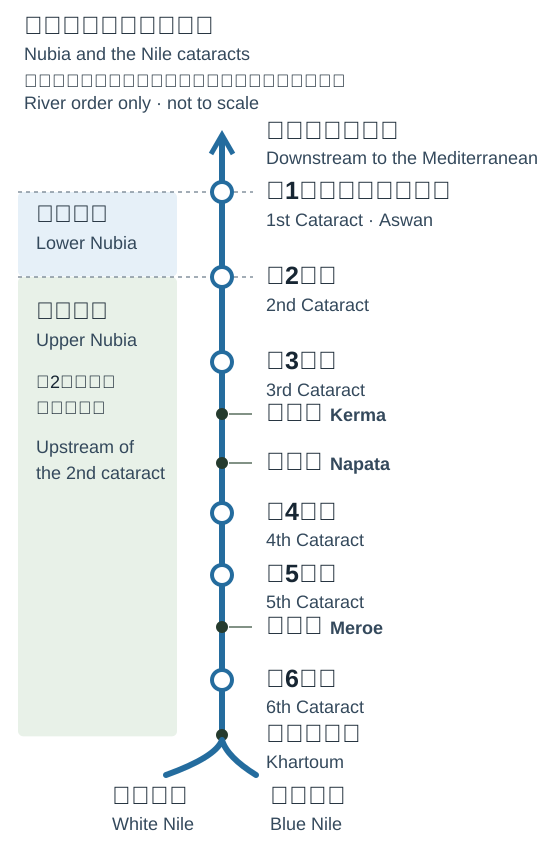
Original river-order diagram created for this translation; geographical references: The Metropolitan Museum of Art, the Swiss archaeological mission at Kerma, and UNESCO. · CC BY 4.0
Figure 9.14 A schematic of sites and regions along the Nile, arranged from downstream to upstream; not to scale. Lower Nubia lies between the First and Second Cataracts. Upper Nubia lies farther upstream, to the south. Kerma, an early capital of Kush, lies just upstream of the Third Cataract in Upper Nubia.
図9.14 ナイル沿いの地域と地点を、下流から上流の順に並べた模式図。縮尺は一定ではない。下ヌビアは第1〜第2急流の間にあり、上ヌビアはそこからさらに上流、すなわち南に位置する。クシュ初期の都ケルマは、第3急流のすぐ上流にある上ヌビアの都市である。
Although the earliest period of Nubian history is shrouded in mystery, we do know that kingdoms from Nubia engaged in trade with the Egyptian Old Kingdom (c. 2686–2181 BCE). Goods of particular interest to the Old Kingdom Egyptians seem to have been ostrich feathers, ivory, ebony, incense, and especially gold, a commodity that played a vital role in pharaonic ritual and ceremony. For example, craftspeople used Nubian gold to fashion the sarcophagus mask of Tutankhamun, arguably Egypt’s most famous pharaoh.
英語のヒント
ヌビア史の最初期は謎に包まれているが、ヌビアの王国がエジプト古王国(前2686〜前2181年ごろ)と交易していたことは分かっている。古王国のエジプト人が特に関心を持ったのは、ダチョウの羽、象牙、黒檀、香料、そして何より金だったと考えられる。金はファラオの儀式や典礼で重要な役割を果たす商品だった。たとえば職人たちは、ヌビアの金を使い、おそらくエジプトで最も有名なファラオ、ツタンカーメンの棺の仮面を作った。
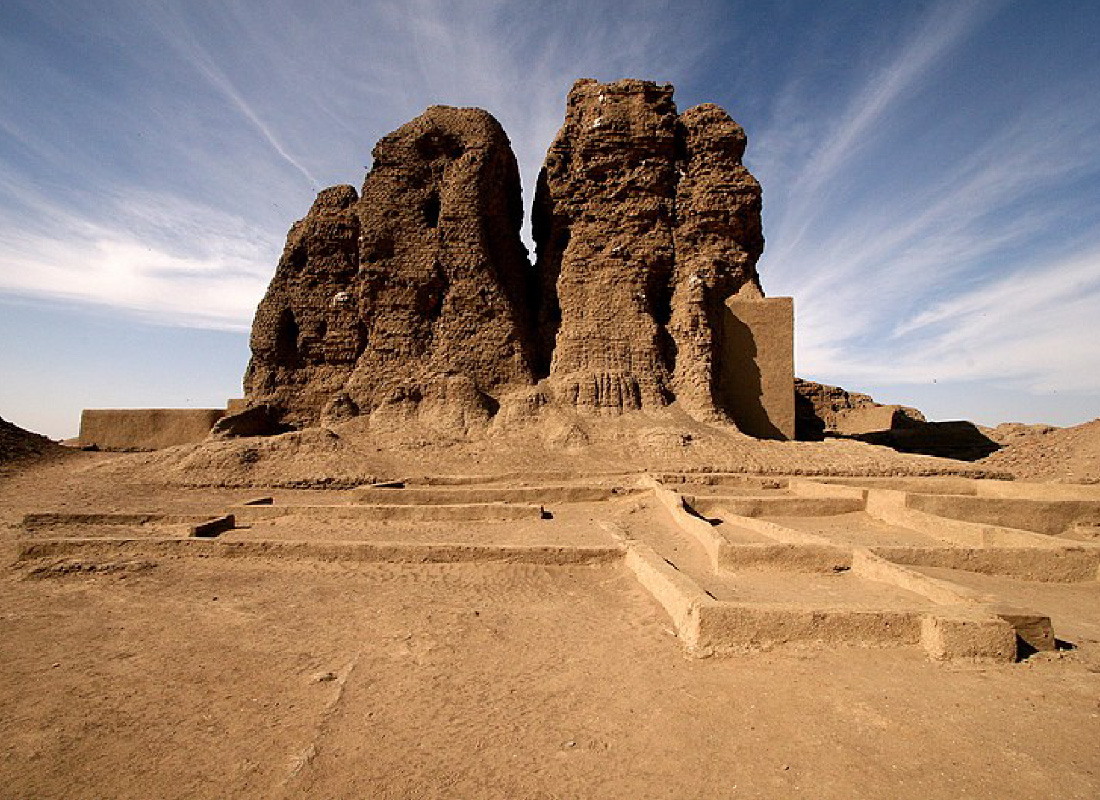
The earliest Nubian state arose sometime around 2400 BCE and was organized around the city of Kerma (in present-day northern Sudan) located just south of the Nile’s third cataract in a lush floodplain ideal for agriculture and the pasturage of animals. The city’s wealth and prosperity were symbolized by its great walls, behind which lay a palace, religious buildings, dwellings, and roads, as well as a funerary complex that included a temple and chapel. At the heart of the urban center lay a large temple known today as the Western Deffufa. A deffufa is a form of mud-brick architecture specific to Nubia. There are three known deffufas in the area today. Of these, the two best known are the large Western Deffufa and less well-preserved Eastern Deffufa some two kilometers away. The Western Deffufa is an impressively large three-story temple reaching nearly sixty feet in height. Religious ceremonies (possibly involving ancestor worship, although we do not know their actual nature) were held in this massive structure (Figure 9.15). At its height, around the eighteenth century BCE, Kerma may have supported a population of about ten thousand people.
英語のヒント
最初のヌビア国家は、前2400年ごろに生まれた。中心は、現在のスーダン北部にあるケルマの都市だった。ケルマはナイルの第3急流のすぐ南にあり、農耕や家畜の放牧に適した豊かな氾濫原に位置する。富と繁栄を象徴したのは巨大な城壁で、その内側には宮殿、宗教建築、住居、道路に加え、神殿や礼拝堂を備えた葬祭複合施設があった。都市の中心には、現在「西デフファ」と呼ばれる大きな神殿が立っていた。デフファとは、ヌビアに特有の日干し煉瓦建築の一形式である。現在、この地域には三つが知られている。特に有名なのは、大きな西デフファと、そこから約2キロメートル離れ、保存状態がそれほどよくない東デフファだ。西デフファは、高さが約60フィートに達する、印象的な規模の3階建て神殿である。この巨大な建物では宗教儀礼が行われた。祖先崇拝を含んでいた可能性もあるが、実際の内容は分かっていない(図9.15)。最盛期の前18世紀ごろには、ケルマの人口は約1万人に達していたかもしれない。
The Western Deffufa.西デフファ。
(credit: “Western Deffufa – Kerma” by Walter Callens/Wikimedia Commons, CC BY 2.0) · CC BY 2.0
Figure 9.15 Kerma’s Western Deffufa is one of three such massive temples known to exist. It is fifty-nine feet tall, and its complex extends over fifteen thousand square feet. (credit: “Western Deffufa – Kerma” by Walter Callens/Wikimedia Commons, CC BY 2.0)
図9.15 ケルマの西デフファは、現存が知られている三つの巨大な神殿の一つである。高さは59フィートで、複合施設の面積は1万5,000平方フィートを超える。(出典:Walter Callens「Western Deffufa – Kerma」、Wikimedia Commons、CC BY 2.0)
It seems to have been the Egyptians who first referred to the Nubian city-state of Kerma as “Kush.” Beginning during the rise of Egypt’s Middle Kingdom (2040–1782 BCE), the Egyptian state initiated a centuries-long but intermittent expansion southward, a process that entailed the establishment of fortresses to consolidate its control over regional trade. Over time, its trade with Kush grew, and the area became increasingly wealthy. Although the Egyptians’ southward advance was periodically stymied, usually by internal political problems occasioned by the death of a pharaoh and the chaos that ensued, their progress seemed inexorable.
英語のヒント
ヌビアの都市国家ケルマを、初めて「クシュ」と呼んだのは、エジプト人だったと考えられる。エジプト中王国(前2040〜前1782年)の台頭期に始まり、エジプト国家は数世紀にわたって、断続的に南へ拡大した。その過程では、地域交易の支配を固めるための要塞が建てられた。時がたつにつれてクシュとの交易は増え、この地域はいっそう豊かになった。エジプトの南進は、時折阻まれた。通常、その原因は、ファラオの死と、それに続く混乱が引き起こす内政上の問題だった。それでも、前進は止めようがないように見えた。
When the Middle Kingdom collapsed and the Second Intermediate Period (1782–1570 BCE) began, trade and Egyptian contact with Kush declined. This left the Egyptian fortresses to fend for themselves. For a short time, the fortress communities attempted to become independent entities. But by at least 1650 BCE, the expanding power of the emerging Kingdom of Kush absorbed them. As this happened, the Kingdom of Kush also adopted elements of Egyptian culture, integrating Egyptian artistic styles and technology into their practices. Additionally, the leaders of Kush during this time cooperated with Hyksos-controlled Lower Egypt to keep the native Egyptian center of power located at Thebes weak.
英語のヒント
中王国が崩壊し、第2中間期(前1782〜前1570年)が始まると、クシュとの交易やエジプトの接触は減った。エジプトの要塞は、自力で生き延びねばならなくなった。要塞の共同体は、一時的に独立した勢力になろうとしたが、遅くとも前1650年までには、台頭するクシュ王国の拡大する力に取り込まれた。その過程でクシュも、エジプト文化の要素を取り入れ、エジプトの美術様式や技術を自分たちの実践へ組み込んだ。さらにこの時期のクシュの指導者は、ヒクソスが支配する下エジプトと協力し、テーベにあったエジプト人自身の権力の中心を弱いままに保とうとした。
Leaders in Kush had good reason to believe that a strong Egypt threatened their survival. And when the native Egyptian rulers began to grow their power and inaugurated the New Kingdom (1570–1069 BCE), they soon expanded into Kush. By the time Pharaoh Thutmose I came to the throne in about 1506 BCE, the Egyptians had extended their control of the Nile valley as far as the Nile’s second cataract. Thutmose was determined to conquer Kerma. His forces sacked and burned the city, desecrating its great temple with the unsettling inscription, “[Quotation omitted for rights reasons.]” Decades later, Thutmose III built a temple to the god Amun at Napata, just below the fourth cataract of the Nile. For the next five hundred years, Egypt controlled Nubia, and the region was further Egyptianized—that is, it was made Egyptian in character. The Kingdom of Kush was crushed as New Kingdom pharaohs asserted their control over Nubia, constructed Egyptian-style architecture, and promoted the use of Egyptian hieroglyphs on temples and Demotic (ancient Egyptian) script by the region’s Egyptian administrators.
英語のヒント
クシュの指導者には、強いエジプトが自分たちの生存を脅かすと考える十分な理由があった。エジプト人の支配者が勢力を回復し、新王国(前1570〜前1069年)を始めると、ほどなくクシュへも拡大した。トトメス1世が前1506年ごろに即位したときには、エジプトはナイル流域の支配を第2急流まで伸ばしていた。ケルマの征服を決意したトトメスの軍勢は、都市を略奪して焼き、その大神殿を冒瀆した。そこには、恐ろしい内容の碑文が残された。〔権利の関係で割愛〕。数十年後、トトメス3世は、ナイル第4急流のすぐ下流にあるナパタに、アムン神の神殿を建てた。以後500年にわたり、エジプトはヌビアを支配し、この地域はいっそうエジプト化した。つまり、エジプト的な性格を帯びるようになった。新王国のファラオがヌビア支配を確立し、エジプト式建築を建て、神殿ではヒエログリフを、この地域のエジプト人行政官にはデモティック(古代エジプト語の文字)の使用を奨励するなかで、クシュ王国は打ち砕かれた。
With the decline of the New Kingdom and the beginning of Egypt’s Third Intermediate Period (1069–525 BCE), local leaders in Nubia were able to reassert their independence. As Egypt withdrew, Nubians built up a new independent Kushite kingdom around the city of Napata, just above the fourth cataract and beyond the Nile floodplain but within the zone of tropical summer rainfall and a region of fertile soil. Despite efforts to assert a specifically Nubian culture, the rulers at Napata were still largely Egyptianized—they built temples to Egyptian gods in Egyptian styles, increased trade with Egypt, and governed their state along Egyptian lines.
英語のヒント
新王国が衰え、エジプトの第3中間期(前1069〜前525年)が始まると、ヌビアの地方指導者は独立を再び主張できるようになった。エジプトの撤退に伴い、ヌビア人はナパタを中心に、新しい独立したクシュ王国を築いた。ナパタは第4急流のすぐ上流にあり、ナイルの氾濫原からは外れるが、夏に熱帯性の雨が降る帯の中にあり、土壌も肥沃だった。独自のヌビア文化を打ち出そうとはしたものの、ナパタの支配者はなお、かなりエジプト化していた。エジプトの神々のためにエジプト式の神殿を建て、エジプトとの交易を増やし、エジプト的な方法で国家を統治した。
By the year 736 BCE, the Kushite kingdom centered on Napata was growing in power and influence, as evidenced by the fact that a Kushite king named Piye managed to install his own sister as high priestess of Amun in Thebes. Such a move was tantamount to an assertion of Kushite authority over Upper Egypt itself and appears to have precipitated a war. During the war, King Piye of Kush marched his army down the river to the Nile delta, effectively conquering all of Egypt. This move inaugurated a period of Nubian rule in Egypt that lasted for several decades. Egyptologists refer to this unique period as the Twenty-Fifth Dynasty or the Ethiopian dynasty.
英語のヒント
前736年までに、ナパタを中心とするクシュ王国は、力と影響を強めていた。その証拠に、ピイというクシュ王は、自分の姉妹をテーベのアムンの高位女性祭司に就けることに成功した。この措置は、上エジプトそのものにクシュの権威を主張するに等しく、戦争を引き起こしたと考えられる。戦争では、クシュのピイ王が軍を率いてナイル川を下り、デルタまで進んで、事実上エジプト全土を征服した。こうして数十年続く、ヌビア人によるエジプト支配の時代が始まった。エジプト学者は、この独特の時代を第25王朝、またはエチオピア王朝と呼ぶ。
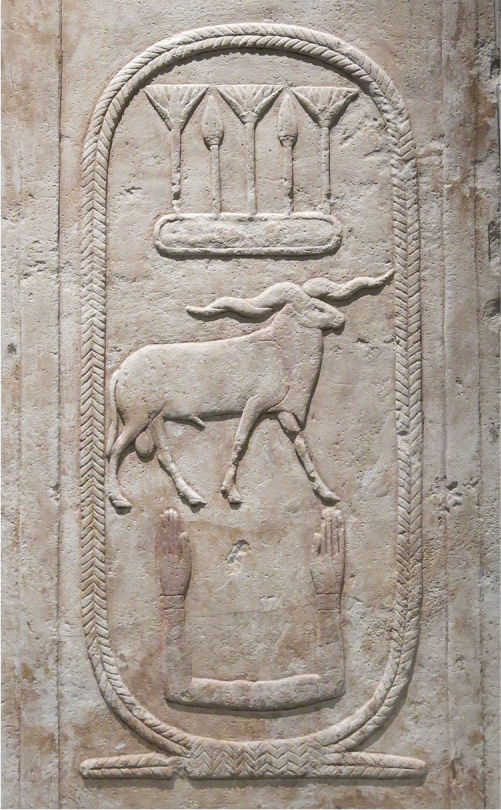
The Nubian leaders who ruled Egypt during this period were thoroughly Egyptianized in culture and religious traditions. As a result, they ruled as Egyptian leaders, carefully preserving Egyptian cultural practices and traditions as a way to strengthen legitimacy. Like other pharaohs, the Kushite pharaohs wore the traditional double crown, promoted the worship of Egyptian deities, and constructed architectural testaments to their rule in the Egyptian style (Figure 9.16).
英語のヒント
この時期にエジプトを治めたヌビアの指導者は、文化と宗教的伝統の面で、徹底してエジプト化していた。そのため彼らはエジプトの支配者として統治し、正統性を強めるため、エジプトの文化的慣行と伝統を丁寧に守った。ほかのファラオと同じように、クシュのファラオも伝統的な二重冠を着け、エジプトの神々への崇拝を奨励し、エジプト式の建築によって自らの支配を記念した(図9.16)。
Pharaoh Chabaka.ファラオ・シャバカ。
(credit: modification of work “Cartouche au nom du pharaon Chabaka (Ägyptisches Museum Berlin AM 31235)” by “Tangopaso”/Wikimedia Commons, Public Domain) · Public Domain
Figure 9.16 Like pharaohs before and after, the Kushite pharaohs of the Twenty-Fifth Dynasty inscribed their names on temples using traditional Egyptian hieroglyphics. This stone remnant displays the name of the Kushite pharaoh Chabaka. (credit: modification of work “Cartouche au nom du pharaon Chabaka (Ägyptisches Museum Berlin AM 31235)” by “Tangopaso”/Wikimedia Commons, Public Domain)
図9.16 前後の時代のファラオと同様に、第25王朝のクシュのファラオも、伝統的なエジプトのヒエログリフで神殿に自らの名を刻んだ。この石片には、クシュのファラオ、シャバカの名が示される。(出典:「Tangopaso」「Cartouche au nom du pharaon Chabaka (Ägyptisches Museum Berlin AM 31235)」を改変、Wikimedia Commons、パブリックドメイン)