第11章イスラームとカリフ国家の台頭The Rise of Islam and the Caliphates
The Abbasid Translation Movementアッバース朝の翻訳運動
The society the early Abbasids created was one of the great marvels of the Middle Ages, and the growth of Baghdad and its courtly culture played a major part in that achievement. But as central as Baghdad was to the advancement and success of the Abbasids, so too were the people who made up their cosmopolitan empire. The early Abbasids strongly supported learning, especially in their capital, and fostered what is now called the Abbasid Translation Movement, or the Greco-Arabic Translation Movement. Few people were literate at this time, but it was an especially important moment in world history thanks to new technology and opportunities that improved access to education and literacy more generally. Especially important was the introduction of Chinese papermaking techniques into the Middle East. These methods allowed for the creation of significantly less expensive books, and the Abbasids’ patronage of scholarly work proved the catalyst for an explosion of medieval learning.
英語のヒント
初期アッバース朝が作り上げた社会は、中世の驚くべき成果の一つだった。バグダードの成長と宮廷文化は、その実現に大きく貢献した。しかし、王朝の発展と成功にバグダードが欠かせなかったのと同じくらい、その多文化的な帝国を構成する人々も重要だった。初期アッバース朝は、とくに首都で学問を強く支援し、現在「アッバース朝の翻訳運動」または「ギリシア語・アラビア語翻訳運動」と呼ばれる活動を育てた。当時、文字を読み書きできる人は少なかった。それでも、新しい技術と機会によって、より広く教育や読み書きに接する道が開かれたため、この時代は世界史の重要な転機となった。とくに重要だったのは、中国の製紙技術が中東へ伝わったことである。書物を大幅に安く作れるようになり、アッバース朝による学問の保護・援助が、中世の学術の急速な発展を促した。
The Abbasids sought to preserve the knowledge of past societies by translating the works of the ancient world into Arabic, especially from Greek and Persian, as the Islamic world transitioned from an oral to a writerly society during the ninth century. Writing and scholarly research were not always well funded in the premodern world, so wealthy patrons, including the caliph himself, provided financial support to scholars capable of completing this work. As a result, the Abbasid elite were able to attract the best and brightest to participate, and a culture of learning grew among the upper echelons of society and especially in Baghdad. Scholars were often native speakers of Greek and Syriac who were generally non-Muslim. The Abbasids’ support of this multicultural and multiethnic community ultimately increased the number of works produced in Arabic during the first centuries of their rule, while at the same time providing exceptional educational opportunities as Islamic schools called madrasas were founded and grew.
英語のヒント
9世紀、イスラーム世界が口承を中心とする社会から書かれたものを重んじる社会へ移るなか、アッバース朝は古代の著作を、とくにギリシア語とペルシア語からアラビア語へ訳し、過去の社会の知識を保存しようとした。近代以前の世界では、著述や学術研究に十分な資金が用意されるとは限らなかった。そのため、カリフ自身を含む裕福な後援者が、翻訳を完成できる学者を経済的に支えた。これにより、アッバース朝のエリートは優れた人材を活動に引き入れることができた。社会の上層、とりわけバグダードに学問を重んじる文化が育った。学者の多くはギリシア語やシリア語を母語とし、一般にムスリムではなかった。アッバース朝がこの多文化・多民族の共同体を支援した結果、その支配の初期数世紀には、アラビア語で作られる著作が増えた。同時に、マドラサと呼ばれるイスラームの学校が設立・発展することで、卓越した教育の機会が生まれた。
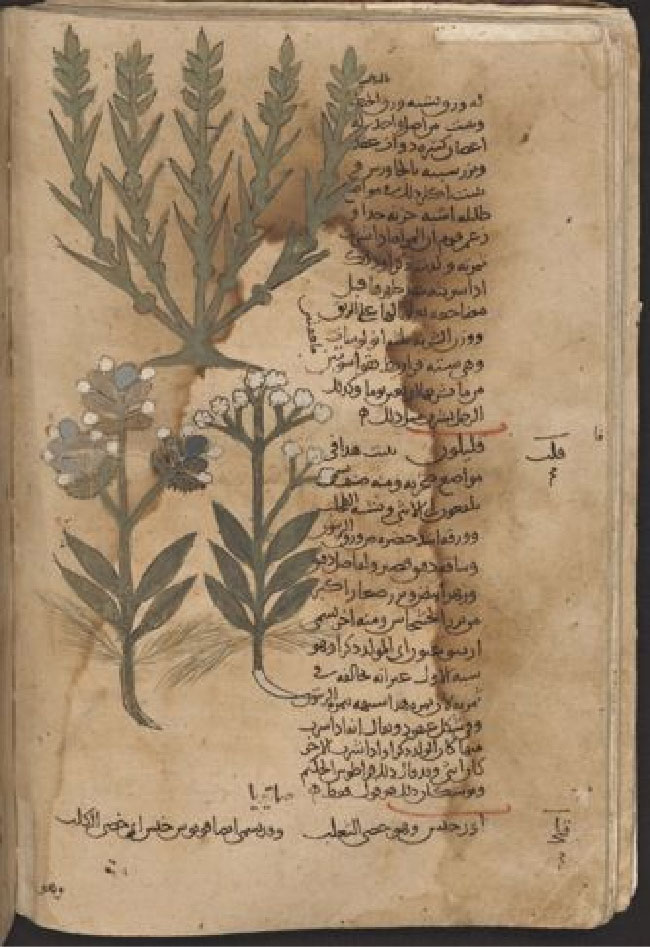
The achievements of the translation movement were considerable, preserving many incredibly important astrological, geographic, mathematical, medical, and other scientific and philosophical texts in Arabic at a time when non-Arabic copies had become increasingly rare. These texts included seminal works by the Greek thinkers Aristotle, Dioscorides, Galen, Hippocrates, and Ptolemy that were given advanced study in the Muslim world when their popularity and even availability were extremely limited in the rest of the Mediterranean (Figure 11.20).
英語のヒント
翻訳運動の業績は大きかった。アラビア語以外の写本がしだいに希少になるなかで、占星術、地理学、数学、医学などの科学や哲学に関する、きわめて重要な多くの文献をアラビア語で保存したのである。そこにはアリストテレス、ディオスコリデス、ガレノス、ヒポクラテス、プトレマイオスといったギリシアの思想家による基礎的な著作が含まれていた。地中海世界のほかの地域では、これらの著作が広く読まれることも、入手することさえも難しくなっていた時代に、イスラーム世界では高度な研究が進められた(図11.20)。
The Abbasid Translation Movement.アッバース朝の翻訳運動。
(credit: “Kitāb al-Ḥašāʾiš fī hāyūlā al-ʿilāg al-ṭibbī Or. 289” by Universitaire Bibliotheken Leiden/Leiden University LibrariesK, CC BY) · CC BY
Figure 11.20 This is a page from an Arabic translation of the first-century Greek physician Dioscorides’s treatise, De materia medica (On Medical Material). It dates from the eleventh century, but many manuscripts like it were first rendered from the original Greek into Arabic during the Abbasid Translation Movement. (credit: “Kitāb al-Ḥašāʾiš fī hāyūlā al-ʿilāg al-ṭibbī Or. 289” by Universitaire Bibliotheken Leiden/Leiden University LibrariesK, CC BY)
図11.20 1世紀のギリシアの医師ディオスコリデスによる『薬物誌』のアラビア語訳の1ページ。これは11世紀の写本だが、こうした多くの著作は、アッバース朝の翻訳運動のなかで初めてギリシア語の原文からアラビア語へ訳された。(クレジット:“Kitāb al-Ḥašāʾiš fī hāyūlā al-ʿilāg al-ṭibbī Or. 289”、Universitaire Bibliotheken Leiden/Leiden University LibrariesK、CC BY)
From the Persian world, the Abbasids focused on the translation of materials related to statecraft, etiquette, the history of kings, and economics. All these were topics considered essential for a professional education, especially for a class of state bureaucrats known as “secretaries” whose job was to administer the empire and its people on behalf of the ruler. Yet the Abbasids were not simply having the great texts of ancient peoples brought into their language and their madrasas during this period. The manuscripts, especially works of science, were in some cases many centuries old. So, a major goal of the translation movement was not just to preserve but also to correct and expand them. Baghdad, then, became the “house of wisdom” through this emphasis on learning and continued scholarly endeavor. Although the scholars who improved these traditional works often go uncredited in the new volumes they produced, their work allowed the Abbasids to apply contemporary knowledge and understanding to the ruminations of previous generations. Early Abbasid society was a time and place of learning and openness to considering old, new, and foreign ideas; to making them a part of the “Islamic sciences”; and to bringing material from the Mediterranean, Central Asian, and Indian Ocean worlds into the empire.
英語のヒント
ペルシア世界からは、国家統治、礼儀作法、王たちの歴史、経済に関する資料が重点的に訳された。いずれも専門的な教育、とくに「書記」と呼ばれた官僚層の教育に欠かせないと考えられた分野だった。書記は君主に代わって、帝国とその住民の行政を担った。しかし、この時代のアッバース朝が行ったのは、古代の人々の偉大な文献を自分たちの言語に移し、マドラサへ取り入れることだけではなかった。写本、とくに科学の著作のなかには、すでに何世紀も前に書かれたものがあった。そのため翻訳運動の大きな目標は、保存することに加えて、内容を修正し発展させることにもあった。学問の重視と、絶えず続けられた研究によって、バグダードは「知恵の館」となったのである。古くから伝わる著作を改良した学者たちは、新たに作った書物で功績を明示されないことも多かった。それでも、その仕事のおかげでアッバース朝の人々は、先人の考察に同時代の知識と理解を適用できた。初期アッバース朝社会は、学問と開放性のある時代・場所だった。古い考え、新しい考え、外国の考えを検討し、それらを「イスラームの学問」の一部にし、地中海世界・中央アジア・インド洋世界の資料を帝国内へ取り込んだ。
Sect Formation in the Middle East中東における宗派の形成
The early Abbasid period brought stability to the Islamic world, but it was not permanent. Although there had been contention within the Islamic ummah from the very beginning, it was during the Abbasid rule that more distinct sects formed, based on doctrinal differences and questions about the leadership of the community that traced back to the first century of Islamic history.
英語のヒント
初期のアッバース朝はイスラーム世界に安定をもたらしたが、それは永続しなかった。イスラーム共同体には当初から対立があったものの、より明確に区別される宗派が形成されたのはアッバース朝の時代だった。その根底には、教義上の相違と、イスラーム史の最初の1世紀にさかのぼる共同体の指導権をめぐる問題があった。
The catalyst for the formation of denominations within Islam was a growing divide between the groups now known as the Sunni and the Shia (sometimes written as Shi‘ite), the two primary “umbrella sects” within Islam. The Sunni take their name from the sunna or customs of the Islamic prophet Muhammad. Adherents follow a canonized, common form of the hadith and interpretation of the Quran, although different schools of law exist that provide variable interpretation and guidance to the religious faithful. Today the largest group of Muslims around the world, the Sunni also came to be identified as those who accepted the decision, following Muhammad’s death, that the first leader of the community would be his father-in-law Abu Bakr rather than his son-in-law Ali. The Shia derive their name from the Arabic phrase Shiat Ali or “the followers of Ali,” who eventually became the fourth caliph. They began as those who believed in the claim by Ali and the Prophet’s family that Ali had been designated the new leader of the Muslim community following Muhammad’s death.
英語のヒント
イスラーム内部で宗派が形成されるきっかけとなったのは、現在スンナ派とシーア派と呼ばれる二つの集団の隔たりが広がったことだった。両者はイスラームの主要な二つの大きな宗派群である。スンナ派の名は、預言者ムハンマドの慣行を意味する「スンナ」に由来する。信徒は、正典として確立された共通のハディースとクルアーンの解釈に従う。ただし、法学には複数の学派があり、信徒に異なる解釈や指針を与える。現在、世界のムスリムのなかで最大の集団をなすスンナ派は、ムハンマドの死後、最初の共同体指導者を、娘婿のアリーではなく義父のアブー・バクルにするという決定を受け入れた人々としても位置付けられるようになった。シーア派の名は、アラビア語の「シーアト・アリー」、すなわち「アリーの支持者」に由来する。アリーはのちに第4代カリフとなった。シーア派の始まりは、ムハンマドの死後の新しい共同体指導者としてアリーが指名されていた、というアリーと預言者の家族の主張を信じる人々だった。
Tensions between the two groups continued to escalate through the first Islamic civil war, fought between the caliph Ali and the Umayyad ruler Mu‘awiya, and escalated with the massacre of a large portion of Muhammad’s family, including his grandson Husayn ibn Ali, at Karbala as the second Islamic civil war was beginning. The commemoration of these events in the early Islamic period remains a major feature of the denominations of Shia Islam. The Shia came to revere the family of the Prophet, seeing in them a role beyond providing a new caliph. They believe members of Muhammad’s family transmit divine knowledge, charisma, and authority, and they afford certain of them the title of imam, signifying the religious leader of the community of Muslims. At the center of this focus on the Prophet’s family in the faith’s earliest century was the lineage of Muhammad through his daughter Fatima, the wife of Ali, and her children, who included Husayn. As time passed, however, and as Islam became increasingly more patriarchal in the Abbasid period, the emphasis shifted to the male members of Muhammad’s family and their lineage through Ali specifically.
英語のヒント
カリフのアリーとウマイヤ家の支配者ムアーウィヤが戦った第1次イスラーム内戦を通じて、両集団の緊張は高まり続けた。第2次内戦が始まるころ、カルバラーで、ムハンマドの孫フサイン・イブン・アリーを含む多数の家族が殺害されると、対立はさらに激しくなった。イスラーム初期のこれらの事件を追悼することは、今もシーア派諸派の重要な特徴である。シーア派は預言者の家族を深く敬うようになり、新しいカリフを輩出する以上の役割を彼らに見いだした。ムハンマドの家族が神的な知識、カリスマ、権威を伝えると信じ、そのうち特定の人物に、ムスリム共同体の宗教的指導者を表す「イマーム」の称号を与える。イスラーム最初の1世紀、この預言者一族への注目の中心にあったのは、ムハンマドの娘でアリーの妻でもあるファーティマと、フサインを含むその子どもたちを通じた血統だった。しかし時がたち、アッバース朝時代にイスラームがますます男性中心になると、重点はムハンマド一族の男性と、とくにアリーを通じた血統へ移っていった。
In the medieval period, the divide between the Sunni and Shia was not complete. The issue of succession following Muhammad’s death was not irreconcilable, and the Sunni respected the family of the Islamic prophet Muhammad even if they did not see an automatic or exclusive right to rule through Ali’s bloodline. The early Shia supported the Abbasids’ claim to leadership because the Abbasids required the caliph to be a member of the Prophet’s family, but Ali’s kin were eventually overlooked in the line of succession. As rivalry grew between these early Shia and the Abbasids, it seems likely that the Shia then articulated that the authority of the imam specifically passed through the family of the Prophet through Ali, and not through anyone less closely related to him—likely to support their own claims to rule.
英語のヒント
中世には、スンナ派とシーア派の隔たりは、まだ完全なものではなかった。ムハンマド死後の継承問題も、和解が不可能というわけではない。スンナ派は、アリーの血統に自動的・独占的な統治権を認めなかったとしても、預言者ムハンマドの家族を尊敬していた。初期のシーア派は、アッバース家がカリフを預言者一族の出身者とするよう求めたため、アッバース家の指導権の主張を支持した。しかし結局、アリーの一族は継承者の選定から外された。初期シーア派とアッバース家の対立が強まるなかで、シーア派は、イマームの権威がアリーを通じた預言者の家系に限って受け継がれる、と明確に述べるようになったらしい。ムハンマドとの血縁がそれより遠い人々を除外することで、おそらく自分たちの統治権の主張を支えようとしたのである。
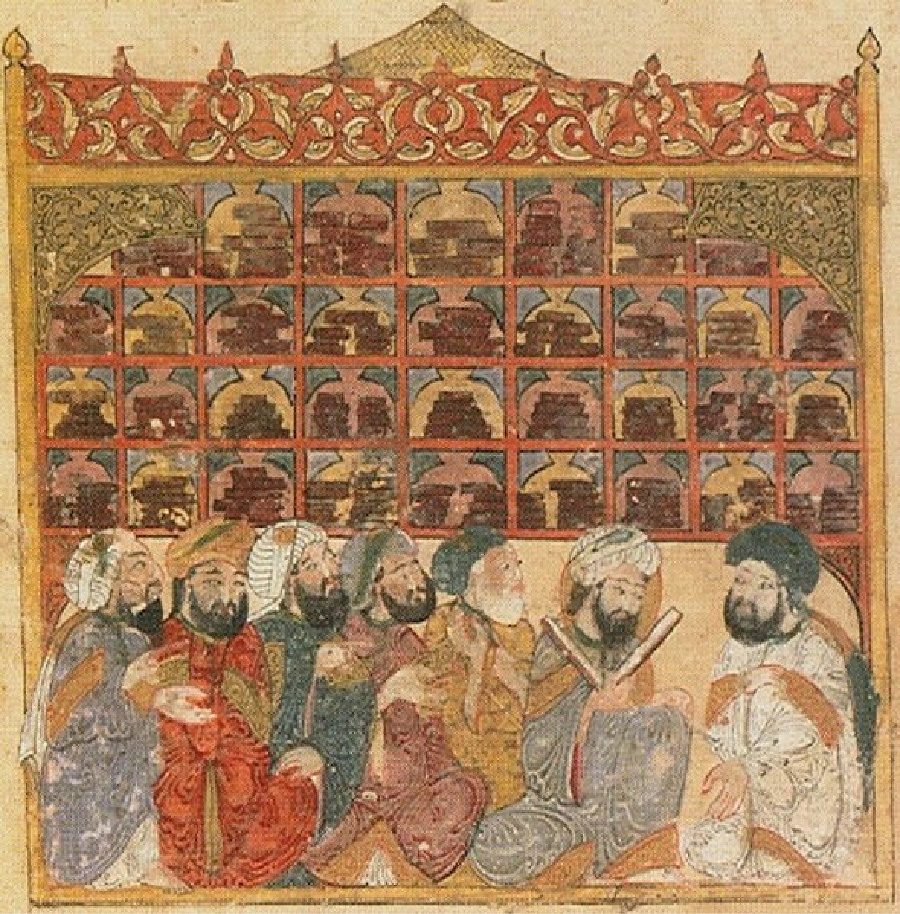
The role of the caliph as a leader in the Islamic world also began to change dramatically in the Middle Ages. This shift was due not just to the Shia conception of the imam. Rather, as the Abbasids came to power, a religious clerical class also arose within Islam. Known as the ulama (literally “the scholars”), they came to hold an increasingly important role as the interpreters of Islamic law within non-Shia, Sunni Islam during the Abbasid period (Figure 11.21).
英語のヒント
イスラーム世界の指導者としてのカリフの役割も、中世には大きく変わり始めた。その理由は、シーア派のイマーム観だけではない。アッバース朝の成立に伴い、イスラーム内部に宗教上の専門家の階層も生まれた。彼らはウラマー、文字どおりには「学者たち」と呼ばれた。アッバース朝時代、シーア派ではないスンナ派のイスラームにおいて、イスラーム法の解釈者として、しだいに重要な役割を担うようになった(図11.21)。
A Member of the Ulama as Teacher.教師としてのウラマー。
(credit: “Les Makamat de Hariri” by Bibliothèque nationale de France/Wikimedia Commons, Public Domain) · Public Domain
Figure 11.21 This thirteenth-century image of a group of students learning from a teacher (far right) in a library depicts religious education in the Abbasid period. (credit: “Les Makamat de Hariri” by Bibliothèque nationale de France/Wikimedia Commons, Public Domain)
図11.21 図書館で、右端の教師から学ぶ学生たちを描いた13世紀の絵。アッバース朝時代の宗教教育を表している。(クレジット:“Les Makamat de Hariri”、Bibliothèque nationale de France/Wikimedia Commons、パブリックドメイン)
Before the Abbasid period, the early caliphs had successfully made a case for being vested with both secular and religious authority, including the ability to interpret the scripture and issue religious proclamations. As the ulama acquired a more prominent role in Abbasid society, however, they claimed more of this power and authority for themselves, diminishing the religious entitlements that earlier caliphs had claimed. As the centuries passed, the religious role of the caliph weakened further, and the decision to compile and write down the hadith, which had been transmitted only orally for the bulk of the first two centuries, gave further authority to the keepers and teachers of this material at the expense of the caliph within early Sunni Islam.
英語のヒント
アッバース朝以前の初期カリフは、世俗的権威と宗教的権威の両方を与えられているという主張を、認めさせることができていた。そこには、聖典を解釈し、宗教上の宣言を出す権能も含まれた。しかし、ウラマーがアッバース朝社会で重要な役割を担うようになると、その権力と権威を自分たちに帰属させるよう求めた。その結果、以前のカリフが主張していた宗教上の権限は縮小した。世紀を重ねるうちに、カリフの宗教的役割はさらに弱まった。ハディースを編纂し書き留める決定によって、その内容を保存・教授する人々に、いっそう大きな権威が与えられた。初期スンナ派では、それがカリフの権威を削ることになった。原著は、ハディースが最初の2世紀の大半にわたって口頭だけで伝えられた、と説明している。