第11章イスラームとカリフ国家の台頭The Rise of Islam and the Caliphates
Conquering Persia and the Byzantine Empireペルシアとビザンツ帝国の征服
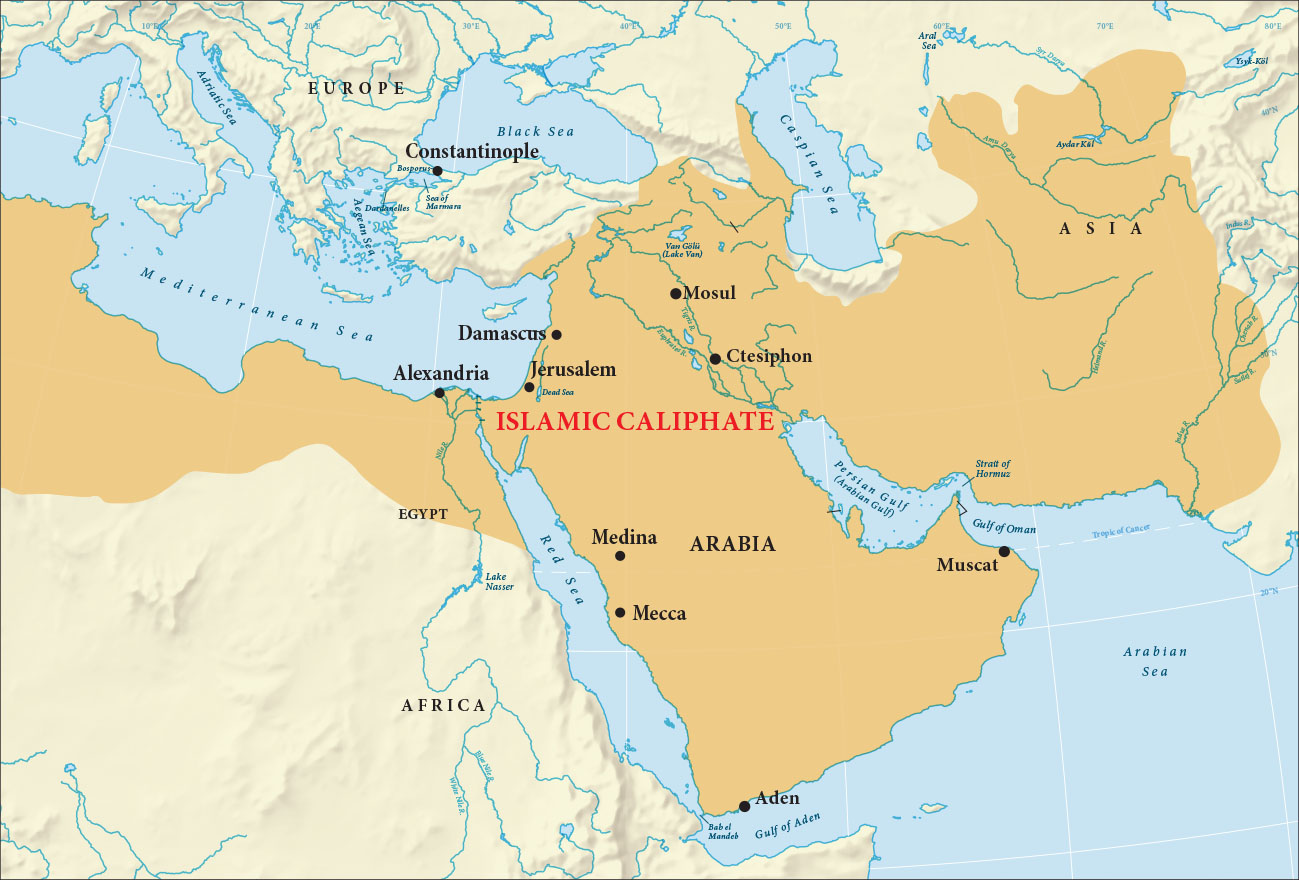
It was not always clear that the Arab-Muslims would be successful against the Byzantines and the Persians, the last empires of antiquity. Nonetheless, starting in 634 and continuing into the early eighth century, they found enormous success conquering much of the territory around the Mediterranean basin and central Asia, going as far west as Spain and Portugal and all the way to the Indus River valley in the east. The new Islamic state, or caliphate (an area under the control of a caliph), was larger than the realm of Alexander the Great, the Romans, or the Han Chinese; it was the largest empire the world had yet seen (Figure 11.13).
英語のヒント
古代最後の帝国であるビザンツとペルシアに対し、アラブ・ムスリムが勝てることは、初めから明らかだったわけではない。それでも、634年から8世紀初頭にかけて、地中海沿岸と中央アジアの広大な領土の征服に成功した。西はスペインとポルトガル、東ははるかインダス川流域にまで達した。新しいイスラーム国家、すなわちカリフ領——カリフの支配する領域——は、アレクサンドロス大王、ローマ、漢の版図よりも大きくなった。それは、世界がそれまでに経験した最大の帝国だった(図11.13)。
The Eighth-Century Islamic Caliphate.8世紀のイスラームのカリフ領
(attribution: Copyright Rice University, OpenStax, under CC BY 4.0 license) · CC BY 4.0
Figure 11.13 This map shows the extent the new Islamic caliphate had achieved by the end of its first dynasty, the Umayyads. During the eighth century CE, the Umayyads ruled the world’s largest empire. (attribution: Copyright Rice University, OpenStax, under CC BY 4.0 license)
図11.13 最初の王朝であるウマイヤ朝の末期までに、新たなイスラームのカリフ領が達した範囲を示す地図。西暦8世紀、ウマイヤ朝は世界最大の帝国を支配した。(出典:Copyright Rice University, OpenStax、CC BY 4.0)
The crucial early years of Islamic expansion were overseen by the first four caliphs, a group of rulers who came to be called the “rightly guided” or Rashidun. These four figures—Abu Bakr, Umar, Uthman, and the originally overlooked son-in-law of Muhammad, Ali—ruled between 632 and 661, a period when much Byzantine and Persian territory was conquered, and the message of Islam spread throughout a predominantly Christian Middle East. While the Byzantines and the Persians had employed the Arabian Ghassanids and Lakhmids to guard their borders and serve in their wars, the arrival of the Arab-Muslim armies was unlike anything either empire had seen before.
英語のヒント
イスラーム拡大の重要な初期段階を指揮したのは、最初の4人のカリフだった。彼らは後に「正しく導かれた者たち」、すなわちラシードゥーンと呼ばれるようになった。アブー・バクル、ウマル、ウスマーン、そして最初の後継者選びでは見送られたムハンマドの娘婿アリーの4人は、632年から661年にかけて統治した。この時期にビザンツとペルシアの領土の多くが征服され、住民の大多数がキリスト教徒だった中東一帯へ、イスラームの教えが広まった。ビザンツとペルシアは、アラビアのガッサーン朝とラフム朝を用いて国境を守らせ、戦争に従軍させていた。しかし、アラブ・ムスリム軍の到来は、どちらの帝国にとっても、かつて経験したことのないものだった。
The Byzantine emperor Heraclius, heralded for bringing victory over the Persians, was not able to enjoy his triumph for very long. Meanwhile, defeated Sasanian Persia was coping with the effects of a destabilizing civil war. The ruler who ultimately emerged in 632, Yazdegerd III, was little more than a puppet king, a child figurehead, and the once-unified Sasanian state devolved into a fractured entity ruled by the noble families.
英語のヒント
ペルシアに勝利をもたらしたと称賛されたビザンツ皇帝ヘラクレイオスは、その勝利を長く享受することはできなかった。他方、敗れたササン朝ペルシアは、国を不安定化させる内戦の影響に対処していた。632年に最終的に王となったヤズデギルド3世は、ほとんど傀儡にすぎない王、すなわち名目上の君主に据えられた子どもだった。かつて統一されていたササン朝国家は、貴族の諸家が支配する、分裂した政治体へと変わっていった。
The Arab-Muslim armies began their invasion with the provinces of Iraq and Syria before moving eastward into the Iranian plateau and westward into Egypt. On all fronts, the first decades of the conflict proved extraordinarily successful for the conquerors. Shortly after winning several skirmishes and capturing the Syrian city of Damascus, the Arab-Muslims bested the Byzantine army at the Battle of Yarmuk in 636. Unable to defend the remaining cities of the region, the Byzantines then abandoned Greater Syria, consisting of what are today Israel, Jordan, Lebanon, Palestine, and Syria. The Arab-Muslim armies continued northward and westward, laying siege to and capturing the Egyptian port city of Alexandria in 641. Many other Byzantine provinces soon followed. In Iraq, the armies of Persia lost to the Arab-Muslims at the Battle of Qadisiyya, bringing an end to any sustained resistance by the Persians.
英語のヒント
アラブ・ムスリム軍はイラクとシリアの諸州への侵入から始め、その後、東のイラン高原と西のエジプトへ進んだ。どの戦線でも、戦争の最初の数十年間は、征服者にとってきわめて成功に満ちていた。いくつかの小規模な戦闘に勝ち、シリアの都市ダマスクスを占領してまもなく、アラブ・ムスリムは636年のヤルムークの戦いでビザンツ軍を破った。その地域に残る都市を守れなくなったビザンツは、現在のイスラエル、ヨルダン、レバノン、パレスチナ、シリアからなる大シリアから撤退した。アラブ・ムスリム軍はさらに北と西へ進み、641年にはエジプトの港湾都市アレクサンドリアを包囲し、占領した。ビザンツの他の多くの州も、まもなくその後を追った。イラクでは、ペルシア軍がカーディシーヤの戦いでアラブ・ムスリムに敗れ、ペルシアによる持続的な抵抗は終わった。
Still, the conquest of Persia proved to be a longer-term process. Sasanian-controlled territory was vast and geographically diverse, and the independence the Sasanian nobility had wrested from the central government following the war with the Byzantines meant the Arab-Muslims needed to negotiate with many local governors and landed elites for the surrender of their territory. At the same time, dynamics between the Sasanian nobility and the lower classes had already begun changing. The nobility existed in a well-established court culture and practiced the traditional Persian religion of Zoroastrianism. Outside this elite circle, however, Zoroastrianism had long been declining in popularity, while other religious traditions, including Nestorian Christianity and Manichaeism, grew. The collapse of the Sasanian ruling family in Persia also provides a unique glimpse into something that had not happened among the elite before: the brief rise of a female ruler, Boran. The daughter of Khosrow II, Boran came to power briefly during the civil war after the Byzantine victory over her father. While such opportunities for female power in the region were few and far between, her rule underscores that seventh-century Persia was already a state and a people in transition, and the arrival of the Arab-Muslims with the cultural practices of Arabia and the religion of Islam only expedited change.
英語のヒント
それでも、ペルシアの征服は、さらに長期にわたる過程となった。ササン朝の支配領域は広大で、地理的にも多様だった。ビザンツとの戦争の後、ササン朝の貴族たちは中央政府から自立性を勝ち取っていた。そのため、アラブ・ムスリムは領土を明け渡させるにあたり、多くの地方総督や土地を所有する有力者たちと交渉する必要があった。同時に、ササン朝の貴族と下層階級の関係は、すでに変わり始めていた。貴族たちは、確立された宮廷文化のなかで暮らし、ペルシアの伝統的な宗教であるゾロアスター教を信仰していた。しかし、その上層の集団の外では、ゾロアスター教の人気は長い間低下しており、ネストリウス派キリスト教やマニ教など、他の宗教的伝統が広がっていた。ペルシアでササン朝の王家が崩壊したことは、それまで上層階級では起こらなかった出来事を垣間見せてもくれる。女性の統治者ボーラーンが、一時的に台頭したのである。ホスロー2世の娘ボーラーンは、父がビザンツに敗れた後の内戦期に、短期間、権力を握った。この地域で女性が権力を握る機会はごくまれだったが、彼女の統治は、7世紀のペルシアがすでに国家としても住民のあり方としても変化の途上にあったことを浮き彫りにする。アラビアの文化的慣行とイスラームという宗教を携えたアラブ・ムスリムの到来は、その変化をいっそう速めた。
Although the Byzantines and Persians had put up resistance, by the 650s much of their territory had been taken by the new Islamic state of the Rashidun. Heraclius died in 641, with the territories he and the Byzantines had fought to retake from the Persians largely lost. The Byzantine Empire survived the Arab-Muslim conquests, but it never again controlled much of the territory of the old Roman east. The Sasanian ruler Yazdegerd III fled east to escape capture by the Arab-Muslims or their supporters, spending much of his short life on the run before being killed by his own people in 651. By that time, the entirety of the Persian Empire had effectively been brought into the control of the new Islamic state.
英語のヒント
ビザンツもペルシアも抵抗したが、650年代までに領土の多くが正統カリフたちの新しいイスラーム国家に奪われた。ヘラクレイオスは641年に死去した。その時には、彼とビザンツがペルシアから奪回するために戦った領土の大部分が、失われていた。ビザンツ帝国はアラブ・ムスリムの征服を生き延びたものの、かつてのローマ東部領土の多くを再び支配することはなかった。ササン朝の王ヤズデギルド3世は、アラブ・ムスリムやその支持者に捕らえられるのを避け、東へ逃れた。短い生涯の多くを逃亡に費やした末、651年に同胞に殺された。その頃までに、ペルシア帝国の全域は、事実上、新しいイスラーム国家の支配下に入っていた。
The Conquerors and the Conquered征服者と征服された人々
From the perspective of the Arab-Muslims, the conquest movement had been enormously successful, a demonstration of the power of God and his favoring of their ummah. From the perspective of Christians who were not aligned with the Muslims during this period, the arrival of the Arab-Muslims was also seen as an act of God, a God who was angry at the sinfulness of the Christians and who had sent the Arab-Muslims as a punishment they needed to bear.
英語のヒント
アラブ・ムスリムの視点では、征服運動は大成功であり、神の力と、神が自分たちのウンマをひいきにしていることの証しだった。この時期にムスリムと提携していなかったキリスト教徒の視点からも、アラブ・ムスリムの到来は神の業と受け止められた。ただし、神はキリスト教徒の罪深さに怒り、彼らが耐えなければならない罰として、アラブ・ムスリムを遣わしたと考えられたのである。
Calling these events the “Arab-Muslim conquests” is somewhat misleading, however. While the first years of expansion did see several major battles, including Yarmuk and Qadisiyya, most of the territory came under Islamic control through peace agreements. Cities and regions agreed to terms of surrender that protected their residents, many of their belongings, and their right to practice their religion. Peaceful agreements made sense for non-Muslim populations. Especially during the seventh century, the Muslims maintained a policy of noninterference toward the religious practices of subject populations. As long as they paid taxes to their new Muslim government, the conquered could live in the Islamic state and still practice their religion somewhat freely.
英語のヒント
しかし、これらの出来事を「アラブ・ムスリムの征服」と呼ぶのは、やや誤解を招く。拡大の初期には、ヤルムークやカーディシーヤを含む大きな戦いが実際に何度かあったものの、領土の大部分は和平協定によってイスラームの支配下に入った。都市や地域は、住民とその財産の多く、そして宗教を実践する権利を保護する、降伏条件に同意した。非ムスリムの住民にとって、平和的な合意には道理があった。特に7世紀のムスリムは、被支配住民の宗教的実践に干渉しない政策を維持した。征服された人々は、新しいムスリム政府に税を納めさえすれば、イスラーム国家に暮らしながら、ある程度自由に自分たちの宗教を実践できた。
The Muslims developed a legal classification for the Jewish people, Christians, and Zoroastrians who lived under their rule. They referred to them as ahl al-kitab, or People of the Book, which recognized them as monotheists who had received a revealed scripture from God in the past, and who were worthy of protection by the Islamic state so long as they paid taxes and submitted to Muslim rule. For many, this situation was an improvement on their earlier lives. Under Byzantine rule, for instance, those who did not follow the official Christian religion of the empire were often discriminated against. They could be barred from holding certain jobs, charged extra taxes, and otherwise be badly treated as heretics. For Jewish populations, the situation had often been even harsher. Many had been unable to openly practice their faith or gather outside the synagogue. While they were not officially monotheists and were not seen as having a revealed scripture, Zoroastrians under the Muslims were still treated as People of the Book, likely for pragmatic reasons owing to their noble status in Persian society.
英語のヒント
ムスリムは、その支配下に暮らすユダヤ人、キリスト教徒、ゾロアスター教徒のための法的な区分を発展させた。彼らをアフル・アル=キターブ、すなわち「啓典の民」と呼んだ。これは、彼らを、過去に神から啓示された聖典を受け取った一神教徒として認め、税を納めてムスリムの支配に従うかぎり、イスラーム国家に保護される資格のある人々とするものだった。多くの人にとって、これは以前の暮らしからの改善だった。たとえばビザンツの支配下では、帝国の公式のキリスト教に従わない人々は、しばしば差別を受けた。特定の職に就くことを禁じられ、余分な税を課されるなど、異端者としてひどく扱われることがあった。ユダヤ人にとって状況はさらに厳しいことが多く、多くの人々は、公然と信仰を実践することも、シナゴーグの外で集まることもできなかった。ゾロアスター教徒は、正式には一神教徒とはされず、啓示された聖典を持つともみなされなかった。それでも、ムスリムの下では啓典の民として扱われた。これはおそらく、ペルシア社会で彼らが貴族の地位を占めていたため、実際上の理由から採られた措置だった。
The term “Arab-Muslim conquest” has another drawback in that some participants were non-Arabs, including people from East Africa, North Africa, and Persians who chose to join the Muslim armies. Among them were some Amazigh (Berber) tribes from North Africa and the elite Persian cavalry, the asawira. Other fighters were Arabs but had not necessarily formally converted to Islam. These included Arab members of devout Christian tribes such as the Banu Taghlib. There are likely many reasons for non-Arabs and non-Muslims to have contributed to the Muslim effort. Joining in the conquests would at least have entitled the participant to a portion of the spoils of war and standing in the new society, both of which were immensely beneficial.
英語のヒント
「アラブ・ムスリムの征服」という言い方には、もう一つ難点がある。参加者の一部はアラブ人ではなく、ムスリムの軍隊に加わることを選んだ、東アフリカや北アフリカの人々、そしてペルシア人などだったからである。北アフリカのアマジグ(ベルベル)諸部族の一部や、アサーウィラと呼ばれたペルシアの精鋭騎兵も参加した。また、アラブ人であっても、必ずしも正式にイスラームへ改宗していない戦士たちがいた。敬虔なキリスト教徒の部族であるバヌー・タグリブなどの成員が、その例である。非アラブ人や非ムスリムがムスリムの軍事活動に加わった理由は、おそらく数多くあった。少なくとも征服に参加すれば、戦利品の一部を受け取る権利と、新社会での地位が得られただろう。そのどちらも、きわめて大きな利益だった。
In the end, the most important differentiator of status in this earliest society was not Arab versus non-Arab or Muslim versus non-Muslim, but rather conqueror versus conquered. Thus, in the first centuries of Islamic history, society was organized into those who paid tax for the protection and benefit of the state, and those who received that payment and provided that protection and those benefits. Those who were ethnically Arab had opportunities to enjoy special preferences within government and society in the earliest decades, but by the end of the eighth century, this distinction eroded as more non-Arabs became involved in the affairs of state.
英語のヒント
結局のところ、この最初期の社会で地位を分ける最も重要な区別は、アラブ人か非アラブ人か、ムスリムか非ムスリムかではなく、征服した側か、征服された側かということだった。そのため、イスラーム史の初期数世紀において、社会は、国家による保護と恩恵を受けるために税を払う人々と、その支払いを受け取り、保護と恩恵を提供する人々とに分かれて組織されていた。最初の数十年間には、民族的にアラブ人である者が、政府や社会のなかで特別な優遇を受ける機会があった。しかし8世紀末までには、より多くの非アラブ人が国政にかかわるようになり、この区別は薄れていった。