第11章イスラームとカリフ国家の台頭The Rise of Islam and the Caliphates
11.1 The Rise and Message of Islam11.1 イスラームの誕生と教え
Learning Objectives学習の目標
By the end of this section, you will be able to:
この節を学ぶと、次のことができるようになる。
Describe the political, geographic, and economic circumstances within the Middle East during the rise of Islam
イスラームが台頭した時期の中東の政治的・地理的・経済的状況を説明する。
Discuss the origins of Islam and the career of the prophet Muhammad
イスラームの起源と預言者ムハンマドの生涯を論じる。
Explain the uniqueness of the community Muhammad built
ムハンマドが築いた共同体の独自性を説明する。
The story of Abraham, called Ibrahim, within Islam is an important one. Not only was he a monotheist at a time when his people had embraced polytheism and begun to worship various idols, but according to Islamic tradition, he was the first person to settle in what later became the city of Mecca. Abraham arrived there with his servant and concubine Hagar and their son Ishmael. There he constructed the Kaaba, considered by Muslims to be the house of God and the most sacred site in Islam.
英語のヒント
イスラームでイブラーヒームと呼ばれるアブラハムの物語は、重要な意味をもつ。彼は、周囲の人々が多神教を受け入れ、さまざまな偶像を崇拝し始めていた時代に一神教を信じていただけではない。イスラームの伝統によれば、後にメッカの町となる場所に最初に住み着いた人物でもある。アブラハムは、召使いであり側室でもあったハガルと、彼女との間に生まれた息子イシュマエルを連れてそこへ来た。そこでカアバを築いた。ムスリムはカアバを神の家、そしてイスラームで最も神聖な場所とみなしている。
Muslims believe that as generations passed, however, the descendants of Ishmael, the Arabs, forgot their monotheism and began to worship idols, entering a period of ignorance known as the jahiliyyah. There they remained until God sent a new prophet, Muhammad, to correct their religious practices and deliver them from ignorance and disbelief. This lapse and deliverance, according to the faithful, is the story of Islam.
英語のヒント
しかしムスリムの信仰によれば、世代が移るにつれ、イシュマエルの子孫であるアラブ人は一神教を忘れ、偶像を崇拝し始めた。そしてジャーヒリーヤと呼ばれる無明の時代に入った。神が新しい預言者ムハンマドを送り、宗教実践を正し、無知と不信仰から救い出すまで、人々はその状態にあった。信仰する人々にとって、この信仰からの逸脱と救済こそがイスラームの物語である。
Arabia on the Eve of Islamイスラーム誕生前夜のアラビア
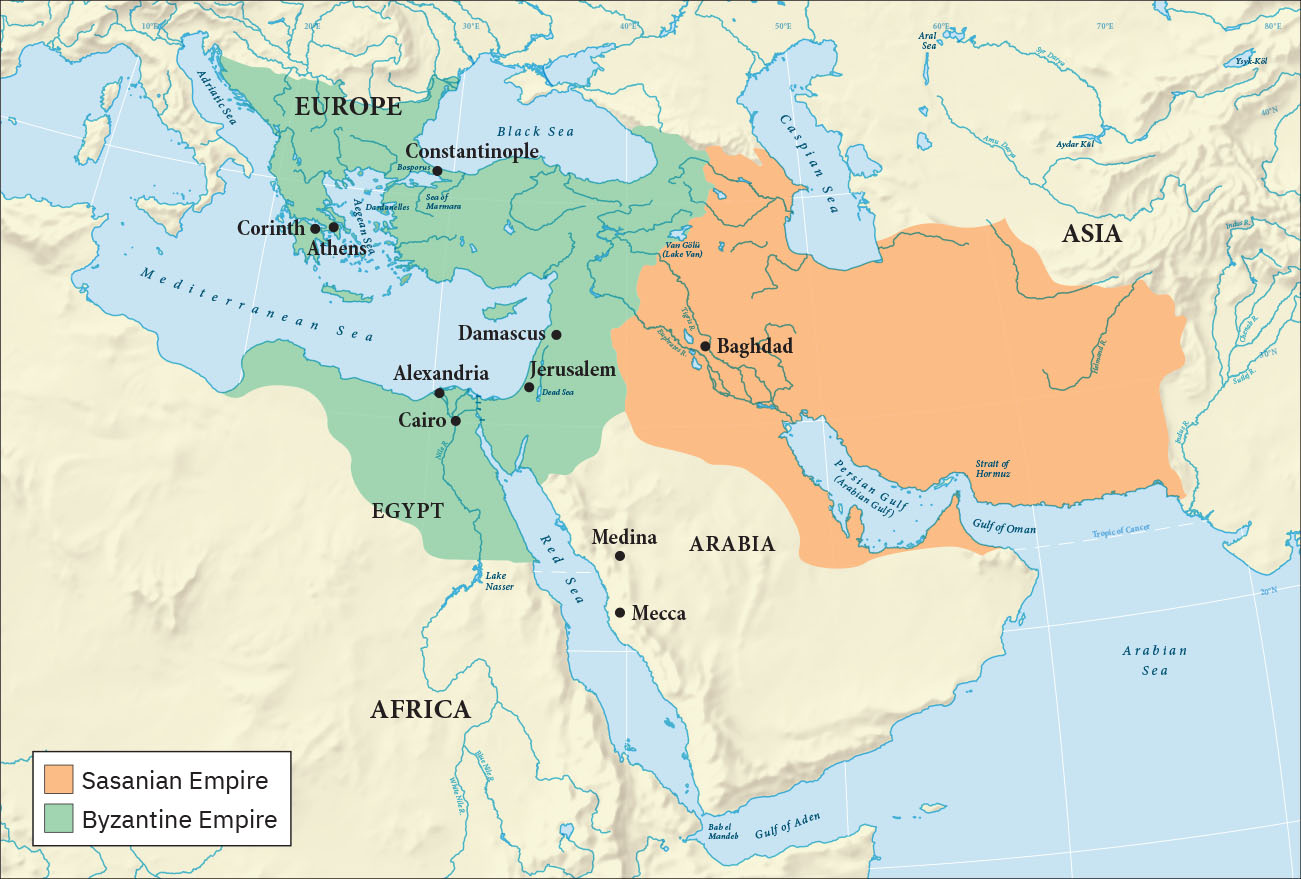
Seen from the outside, the Arabian Peninsula of the fifth and sixth centuries CE was a seemingly marginal space, on the southern fringes of the last great realms of antiquity, the Byzantine (Roman) and Sasanian (Persian) Empires. The geography of much of Arabia was harsh; the peninsula was filled with many dry and inhospitable places where rainfall, access to water, and cultivatable land were in short supply. Even today, a large portion of the center of modern Saudi Arabia is taken up by the “Empty Quarter,” the Rubʽ al-Khali, a 250,000-square-mile sand desert that barely sustains the few local Arab tribes that continue to live in the region. To many, the Arabian Peninsula might not seem like an obvious setting for the rise of a ruling empire and one of the world’s largest religious traditions (Figure 11.4).
英語のヒント
外から見ると、紀元5〜6世紀のアラビア半島は、周縁的な地域に見えた。古代最後の大国であるビザンツ(ローマ)帝国とサーサーン朝(ペルシア)帝国の南の縁に位置していた。アラビアの多くは厳しい地理的条件にあり、半島には雨も利用できる水も耕せる土地も乏しい、乾燥した住みにくい場所が広がっていた。今日でも、サウジアラビア中央部の広い範囲を「空白の地」、ルブアルハリ砂漠が占める。面積25万平方マイルの砂砂漠で、この地域で暮らし続ける少数のアラブ部族を、かろうじて養っている。多くの人には、支配的な帝国や世界有数の大宗教が生まれる場所として、アラビア半島はすぐには思い浮かばないだろう(図11.4)。
The Byzantine and Sasanian Empires.ビザンツ帝国とサーサーン朝
(attribution: Copyright Rice University, OpenStax, under CC BY 4.0 license) · CC BY 4.0
Figure 11.4 This map shows the Byzantine (Roman) and Sasanian (Persian) Empires at the beginning of the seventh century CE. Note the long border the two empires shared, and the southern borders with Arabia that remained out of their direct control. (attribution: Copyright Rice University, OpenStax, under CC BY 4.0 license)
図11.4 この地図は、紀元7世紀初めのビザンツ(ローマ)帝国とサーサーン朝(ペルシア)帝国を示す。両帝国が接していた長い国境と、両国の直接支配の外にとどまったアラビアとの南の境界に注目しよう。(帰属:© Rice University、OpenStax、CC BY 4.0)
The reality, however, is that the Arabian Peninsula is—and was—more diverse than it might immediately seem. In the fifth, sixth, and early seventh centuries, it was the home of disparate tribes often united by the bonds of kinship typical of nomadic and seminomadic peoples around the world, and divided for the same reason. As they do with the Celts, Iroquois, Mongols, and Persians (to name but a few), historians often group peoples together because of their use of a common language, their habitation of a specific geographic area, and aspects of culture they share such as food, dress, and religious practices. But beyond these shared features, little unified the peoples of the Arabian Peninsula prior to the seventh century. Many communities in the region were divided along tribal lines while vying with one another for power, prestige, influence, and available resources.
英語のヒント
しかし実際のアラビア半島は、すぐに受ける印象よりも多様であり、それは当時も同じだった。5世紀、6世紀、そして7世紀初めには、多様な部族が暮らしていた。世界各地の遊牧・半遊牧の人々に典型的な血縁の絆によって結び付くことも多かったが、同じ理由で分かれてもいた。ケルト人、イロコイ、モンゴル人、ペルシア人など、数例だけ挙げてもそうであるように、歴史家はしばしば人々を一つの集団にまとめる。共通の言語を使うこと、特定の地域に住むこと、食事・服装・宗教実践などの文化を共有することが、その基準となる。しかし、こうした共通点を別にすれば、7世紀以前のアラビア半島の人々を一つにするものはほとんどなかった。地域の多くの共同体は部族ごとに分かれ、権力、威信、影響力、利用できる資源をめぐって互いに競っていた。
The great Byzantine and Persian Empires to the immediate north had a history of expansion and conflict. Despite their strength, however, neither desired to dominate Arabia. To those classical states, much of Arabia appeared as a backwater occupied by migratory and aggressive Arab tribes and offered no reason for them to turn their imperial ambitions southward. Few resources were produced in the region that suggested conquest would be worthwhile, even if western Arabia did play a role in the caravans of trade goods that traveled between east and west.
英語のヒント
すぐ北にあるビザンツとペルシアの大帝国は、拡大と対立の歴史をもっていた。しかし、力があっても、どちらもアラビアを支配しようとはしなかった。これら古代国家の目には、アラビアの大半は、移動する好戦的なアラブ部族が住む辺境と映り、帝国の野心を南へ向ける理由がなかった。征服に見合う価値があると思わせる資源は、地域にほとんど産出しなかった。アラビア西部が、東西を往来する交易品の隊商に一定の役割を果たしていたことを考えても、そうだった。
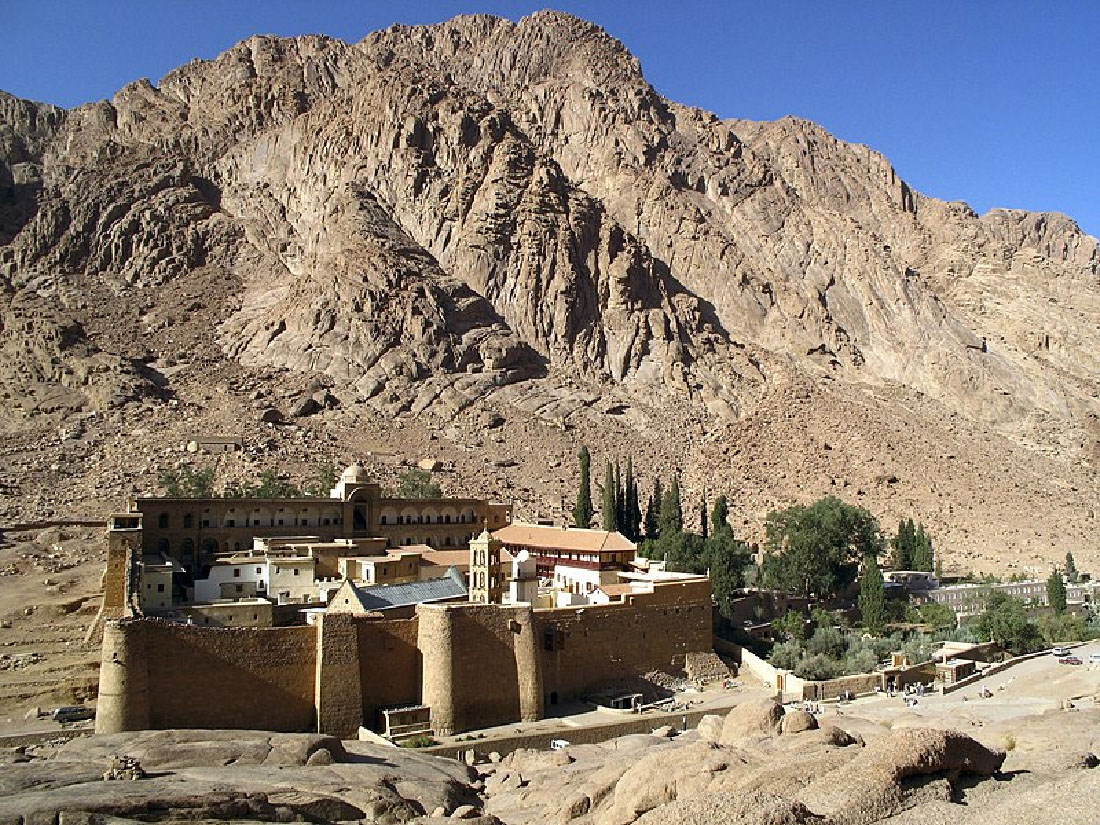
However, the region was a tapestry of unique cultures and history. The Bedouin were migratory Arab tribes that largely subsisted on animal herding and, in some instances, on the raiding of trade caravans and settled communities. Many Bedouin and other seminomadic Arabs practiced polytheism, the worship of many gods and goddesses who were often considered patrons of certain tribes or residents of certain locales. Polytheistic religions were not all that was found in the Arabian Peninsula: the monotheistic faiths of Judaism and Christianity were both present in the region before the arrival of Islam, and they influenced its formation. Given the harshness of the environment, in fact, during the ancient and late antique periods, important monasteries were founded for Christian worship, allowing the monks there to fully dedicate themselves to an ascetic life detached from the earthly world (Figure 11.5).
英語のヒント
とはいえ、この地域には独自の文化と歴史が織り交ぜられていた。ベドウィンは移動するアラブ部族で、主に家畜の飼育によって、時には交易の隊商や定住共同体への襲撃によって生計を立てていた。ベドウィンやほかの半遊牧のアラブ人の多くは多神教を信じ、多くの男女の神を崇拝した。神々は、特定の部族の守護者や、特定の土地に住む存在と考えられることが多かった。アラビア半島に見られたのは、多神教だけではない。イスラームの登場以前から、一神教であるユダヤ教とキリスト教の両方が存在し、イスラームの形成にも影響した。実際、環境が厳しかったからこそ、古代から古代末期にかけてキリスト教の重要な修道院が設けられた。そこでは修道士が、俗世から離れた禁欲生活に完全に身をささげることができた(図11.5)。
St. Catherine’s Monastery.聖カタリナ修道院
(credit: “Saint Catherine's Monastery on the Sinai Peninsula in Egypt” by Joonas Plaan/Wikimedia Commons, CC BY 2.0) · CC BY 2.0
Figure 11.5 Perhaps the most famous Christian monastery of the Arabian Peninsula is St. Catherine’s, constructed in the sixth century CE and adjacent to Mount Sinai (in the background of the photo), where the prophet Moses is said to have received from God the religious laws known as the “Ten Commandments.” (credit: “Saint Catherine's Monastery on the Sinai Peninsula in Egypt” by Joonas Plaan/Wikimedia Commons, CC BY 2.0)
図11.5 アラビア半島のキリスト教修道院で最も有名なのは、おそらく聖カタリナ修道院である。紀元6世紀に建設され、シナイ山(写真の背景)に隣接する。シナイ山では、預言者モーセが神から「十戒」と呼ばれる宗教上の法を授かったと伝えられる。(出典:Joonas Plaan/Wikimedia Commons「Saint Catherine’s Monastery on the Sinai Peninsula in Egypt」、CC BY 2.0。)
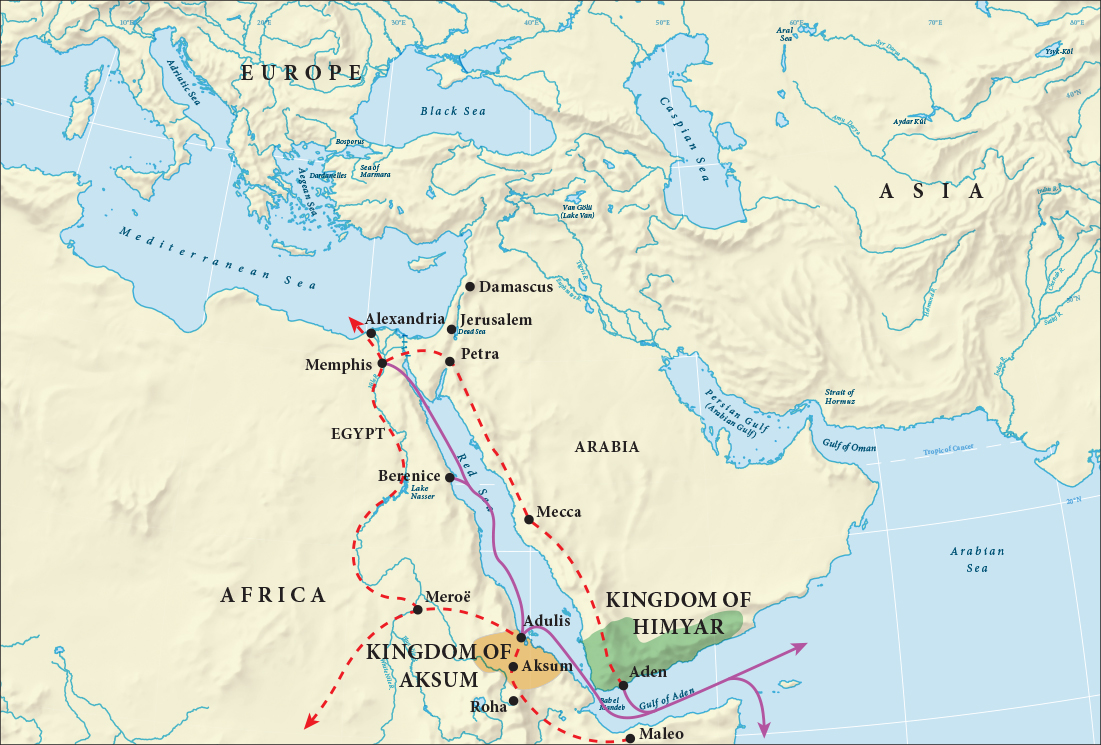
In the very south of the Arabian Peninsula, in what is Yemen today, was a kingdom known as Himyar. Its rulers controlled some of the most fertile lands in the region. They built their state on agricultural produce, on luxury goods such as frankincense and myrrh, and on their role as intermediaries in both East African and Indian Ocean trade. The Himyarites and their predecessors the Sabaeans played significant roles in long-distance trade, using camel caravans along the western coast of Arabia to bring goods from Africa and Asia to the markets in places such as Alexandria, Damascus, Jerusalem, and beyond (Figure 11.6). Their cultural influence was important, too, with a number of the southern Arab tribes connecting their history and lineage directly with these prestigious states. The decision by the Himyarite rulers to convert to Judaism in the late fourth century CE made monotheism more prominent in the region.
英語のヒント
アラビア半島の最南部、現在のイエメンに当たる場所には、ヒムヤルという王国があった。支配者たちは地域でも特に肥沃な土地を押さえていた。農産物、乳香や没薬などのぜいたく品、東アフリカとインド洋の両方の交易を仲介する役割を基盤として、国家を築いた。ヒムヤル人とその先行者であるサバ人は、長距離交易に大きな役割を果たした。アラビア西岸に沿うラクダの隊商を利用し、アフリカとアジアの品物を、アレクサンドリア、ダマスクス、エルサレム、さらに遠方の市場へ運んだ(図11.6)。文化的な影響も重要で、南アラビアの多くの部族が、自らの歴史と系譜を、これらの威信ある国家に直接結び付けていた。紀元4世紀末にヒムヤルの支配者たちがユダヤ教への改宗を決めたことで、地域では一神教の存在感が増した。
Himyar and Aksum.ヒムヤルとアクスム
(attribution: Copyright Rice University, OpenStax, under CC BY 4.0 license) · CC BY 4.0
Figure 11.6 The Arabian Kingdom of Himyar (shaded green) and the African Kingdom of Aksum (orange) both played important roles in the overland and oversea Silk Roads trade, bringing goods northward to markets in Egypt, Palestine, and beyond. (attribution: Copyright Rice University, OpenStax, under CC BY 4.0 license)
図11.6 アラビアのヒムヤル王国(緑)とアフリカのアクスム王国(オレンジ)は、いずれも陸路・海路のシルクロード交易で重要な役割を果たした。品物を北へ運び、エジプトやパレスチナ、さらに遠方の市場へ届けていた。(帰属:© Rice University、OpenStax、CC BY 4.0)
In the very north of Arabia, along the southern borders of the Byzantine and Sasanian Empires, were the Arabs who had the most sustained interactions with those two imperial powers. While tribes in the region had long acted as trade intermediaries between the Mediterranean world and the Indian Ocean states, those of northern Arabia were most regularly engaged in harassing the trade caravans that brought goods to and from the urban imperial centers. To combat this aggression on their southern borders, both the Byzantines and the Persians opted to employ certain Arab confederations to create a buffer between the settled peoples and the raiders from the south. Best known were the Ghassanids and the Lakhmids, who were brought into the service of the Byzantines and Persians, respectively, by the sixth century CE and became increasingly acculturated to them.
英語のヒント
アラビアの最北部、ビザンツ帝国とサーサーン朝の南の国境に沿う地域には、この二つの帝国と特に継続的に交流していたアラブ人がいた。地域の部族は長く地中海世界とインド洋の諸国家の交易を仲介していたが、北アラビアの部族は、帝国の都市中心部へ品物を運び、そこから持ち帰る隊商を、特に頻繁に襲っていた。南の国境でのこうした攻撃に対処するため、ビザンツとペルシアは、ともに特定のアラブ部族連合を雇い、定住民と南から来る襲撃者の間に緩衝地帯を作ることを選んだ。最もよく知られるのがガッサーン朝とラフム朝である。紀元6世紀までに、それぞれビザンツとペルシアに仕えるようになり、しだいに各帝国の文化を取り入れた。
The Ghassanids adopted many elements of Byzantine culture, including Christianity. In fact, it was among Christian Arabs specifically that historians have found some of the earliest surviving uses of the Arabic script, from the seventh century. The Byzantine emperors also formally recognized and rewarded the Ghassanids, at least for a time. The Ghassanid ruler was documented as a phylarch (local ruler or chieftain) and given titles of honor by the Byzantine emperor Justinian during the sixth century.
英語のヒント
ガッサーン朝は、キリスト教を含むビザンツ文化の多くの要素を取り入れた。実際、歴史家が見いだした現存するアラビア文字の初期の使用例の一部は、特にキリスト教徒のアラブ人の間で使われたもので、7世紀にさかのぼる。ビザンツ皇帝は、少なくとも一時期、ガッサーン朝を公式に認め、報酬を与えてもいた。ガッサーン朝の支配者は、6世紀のビザンツ皇帝ユスティニアヌスのもとで、フュラルコス(地方の支配者・首長)として記録され、栄誉ある称号を授けられた。
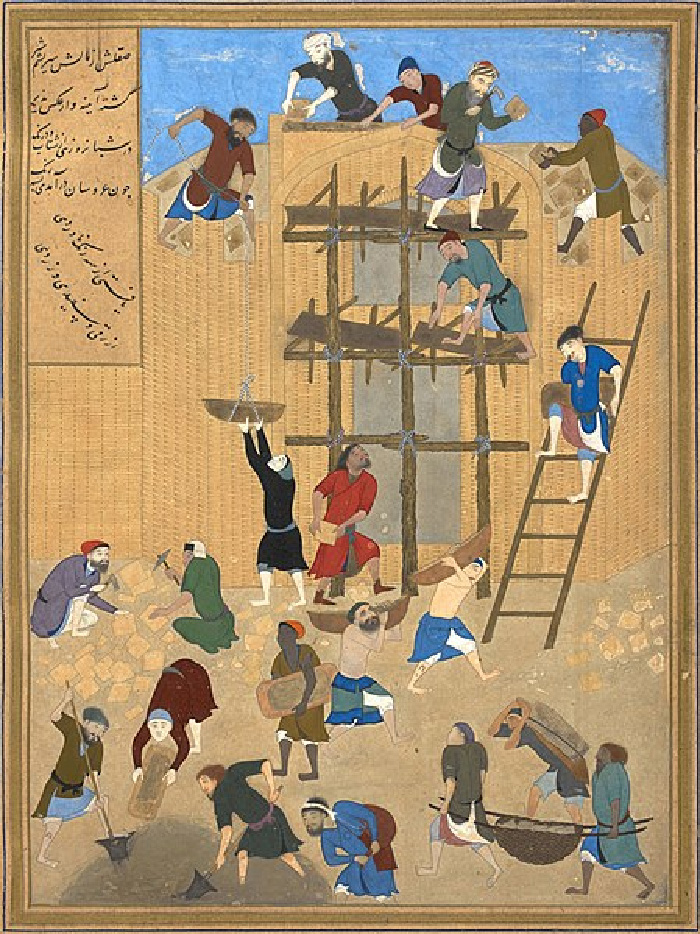
The Lakhmids established themselves in the central Iraqi city of Al-Hirah and were recognized as allies of the Sasanian Persians from the late fourth century onward (Figure 11.7). Some of the Lakhmids embraced a form of Christianity known as Nestorianism and, like the Ghassanids, were able to thrive on the patronage of the great empire while protecting its southern borders from other Arabs. Both tribes were more than just servants of their larger patrons, however. They were allies with a certain degree of autonomy that allowed their societies to flourish. The money and support they received allowed them to become powerful confederations in comparison to other Arab tribes, and their conversion to Christianity allowed the further spread of monotheism in the region.
英語のヒント
ラフム朝はイラク中部の都市ヒーラを拠点とし、4世紀末以降、サーサーン朝ペルシアの同盟者として認められた(図11.7)。ラフム朝の一部はネストリウス派として知られるキリスト教を受け入れた。ガッサーン朝と同様、ほかのアラブ人から大帝国の南の国境を守りながら、その帝国の庇護のもとで繁栄することができた。しかし両部族は、大きな庇護者に仕えるだけの存在ではなかった。ある程度の自治をもつ同盟者であり、その自治が社会の繁栄を可能にした。受け取った資金と支援によって、ほかのアラブ部族に比べて強力な連合となることができた。また、キリスト教への改宗は、この地域での一神教のさらなる普及を促した。
The Lakhmid Fort at Kharnaq.ハワルナクのラフム朝の城
(credit: “The construction of the palace of Khavarnaq” by British Museum/Wikimedia Commons, Public Domain) · Public Domain
Figure 11.7 This late fifteenth-century manuscript page by the renowned Persian miniaturist Kamal al-din Bihzad shows the construction of the fort at Kharnaq, a castle near the Lakhmid capital of Al-Hirah. (credit: “The construction of the palace of Khavarnaq” by British Museum/Wikimedia Commons, Public Domain)
図11.7 著名なペルシアの細密画家カマール・アッディーン・ビフザードによる15世紀末の写本の1ページ。ラフム朝の都ヒーラに近い城、ハワルナクの建設を描く。(出典:大英博物館/Wikimedia Commons「The construction of the palace of Khavarnaq」、パブリックドメイン。)
The relationship between the Byzantines and the Sasanian Persians was very often tense, however. Both empires had ambitions to expand their influence, and they regularly skirmished with one another and attempted to meddle in each other’s politics, including by supporting rival claimants to the throne. Their combative relationship was not unique in late antiquity. When Rome was still a united empire and Persia was ruled by the Parthian dynasty, conflict between those two sides occurred regularly. By the sixth century, however, such conflicts between the two great powers of the region were increasingly costly and risky. Both states had a good deal to lose from open warfare, and much of their conflict played out through proxies, often the Arab Ghassanids and the Lakhmids. This arrangement was beneficial for the Arab tribes so long as payment and recognition of their role was forthcoming. By the beginning of the seventh century, however, much had changed.
英語のヒント
しかし、ビザンツとサーサーン朝ペルシアの関係は、緊張することが非常に多かった。両帝国は影響力の拡大を望み、たびたび小競り合いを起こした。また、対立する王位請求者を支援するなど、相手の政治に干渉しようとした。こうした好戦的な関係は、古代末期だけのものではなかった。ローマがまだ統一された帝国で、ペルシアをパルティア王朝が治めていた時代にも、両者は繰り返し争っていた。しかし6世紀になると、この地域の二大国の戦争は、費用も危険もますます大きくなった。両国とも、公然たる戦争によって失うものが多かった。そのため対立の多くは代理者を通じて行われ、その役をしばしば担ったのが、アラブのガッサーン朝とラフム朝だった。支払いがあり、その役割が認められる限り、この仕組みはアラブ部族に利益をもたらした。しかし7世紀初めまでには、多くのことが変わっていた。
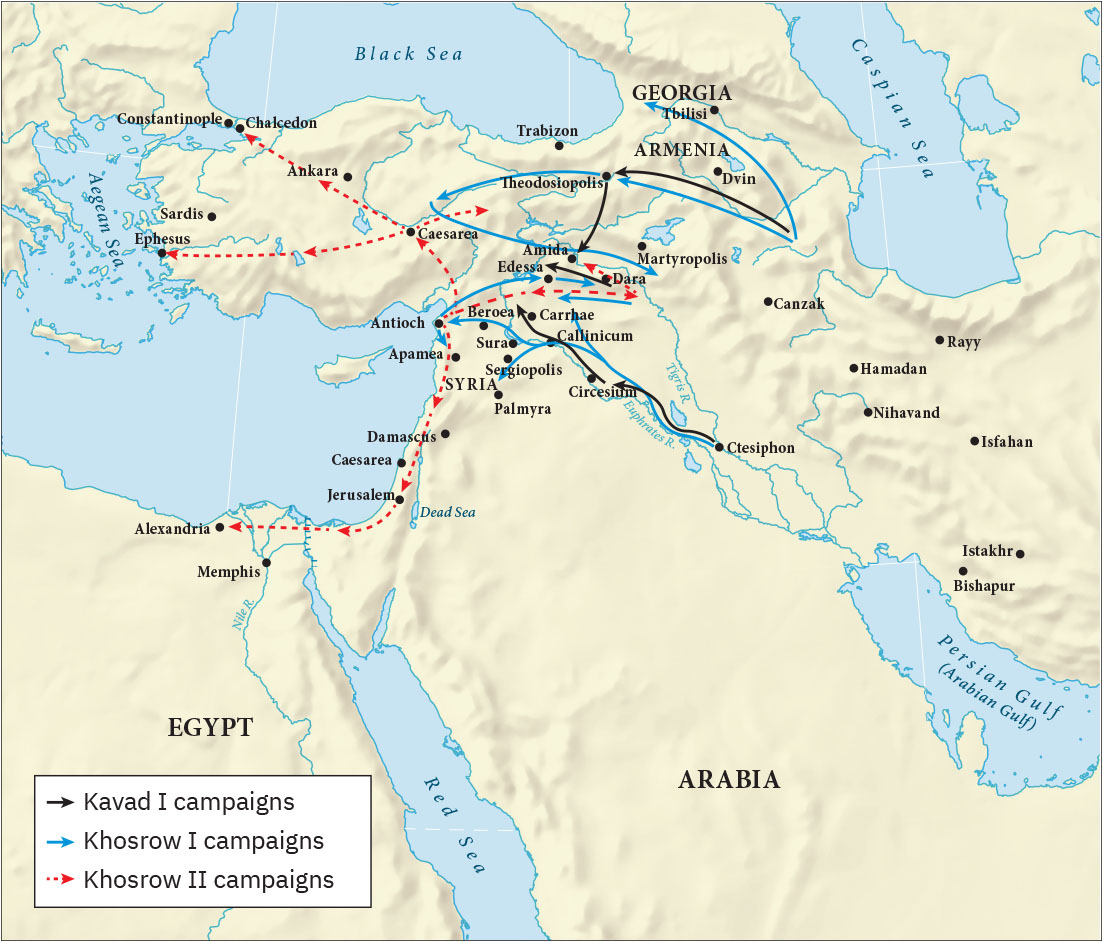
The borderlands between the Byzantine Empire and Sasanian Persia were often where conflicts broke out, and this happened several times during the sixth century, especially in places like Iraq and Armenia (now called the Caucasus). In the year 602, however, the conflict exploded. The Byzantine emperor Maurice, who had helped the Sasanian ruler Khosrow II regain the throne of Persia and brought peace between the two sides, was murdered by his own troops. They installed a new emperor, Phocas, and Khosrow vowed revenge, using the coup as a reason to begin what historians call “the last great war of antiquity” (Figure 11.8).
英語のヒント
ビザンツ帝国とサーサーン朝ペルシアの国境地帯は、しばしば争いが起こる場所だった。6世紀にも、特にイラクやアルメニア(現在のコーカサス)のような地域で、何度も争いが起きた。しかし602年、対立は一気に大規模なものとなった。ビザンツ皇帝マウリキウスは、サーサーン朝のホスロー2世がペルシアの王位を取り戻すのを助け、両国の間に和平をもたらした人物だったが、自国の兵士に殺害された。兵士たちはフォカスを新皇帝に据えた。ホスローは復讐を誓い、この政変を理由に、歴史家が「古代最後の大戦争」と呼ぶ戦争を始めた(図11.8)。
Byzantines versus Sasanians.ビザンツとサーサーン朝の戦争
(attribution: Copyright Rice University, OpenStax, under CC BY 4.0 license) · CC BY 4.0
Figure 11.8 This map shows most of the major conflict zones between the Byzantines and Sasanians during their wars of the sixth and seventh centuries. Think about how much time was spent in regular conflict and what life must have been like for noncombatants in places like Theodosiopolis, Dara, and Sergiopolis. (attribution: Copyright Rice University, OpenStax, under CC BY 4.0 license)
図11.8 6〜7世紀の戦争における、ビザンツとサーサーン朝の主要な交戦地域の大部分を示す地図。繰り返す戦争にどれほどの年月が費やされたか、テオドシオポリス、ダラ、セルギオポリスなどの非戦闘員はどのような暮らしを送っていたか、考えてみよう。(帰属:© Rice University、OpenStax、CC BY 4.0)
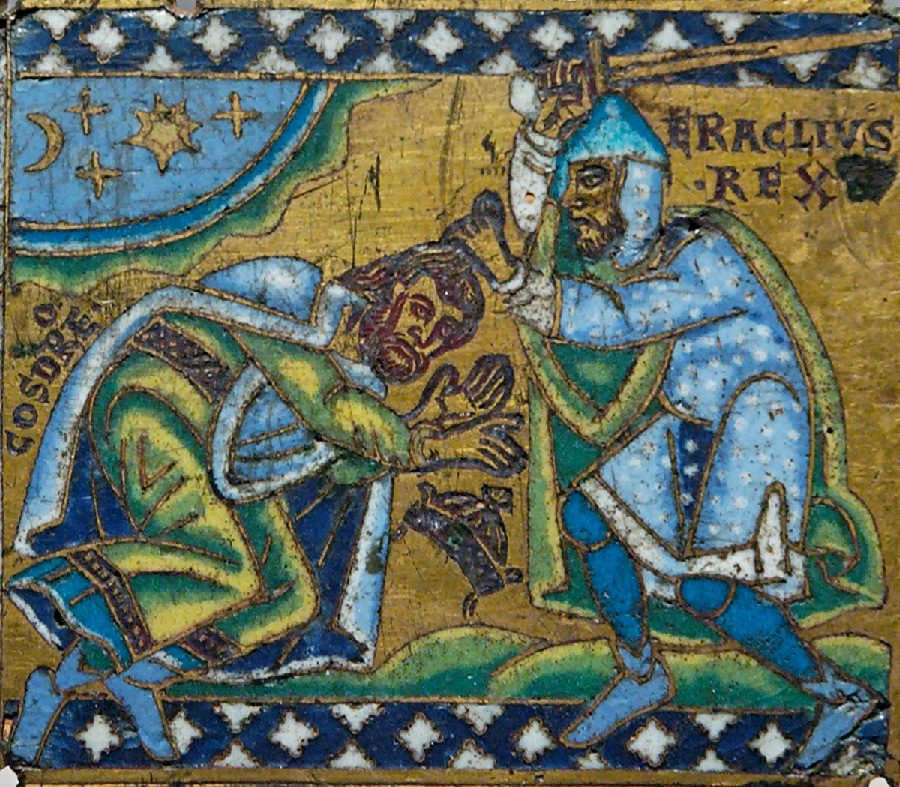
Between 602 and 628, the Byzantines and Persians waged a devastating conflict that had long-lasting repercussions for the entire region. In the first phase, Khosrow and the Persians overwhelmed the Byzantines and claimed much of their eastern Mediterranean territory, including Iraq, Syria, Jordan, Palestine, and crucially, the vital agricultural province of Egypt. Phocas, facing upheaval within his empire aside from the war with the Persians, was deposed and then executed in 610 by the newly declared emperor Heraclius. Desperate to claim back lost territory, return stability to the state, and rebuild the army to face the Persians, Heraclius was able to lead the Byzantines to victory and end the conflict in 628 (Figure 11.9).
英語のヒント
602〜628年、ビザンツとペルシアは壊滅的な戦争を繰り広げ、その影響は地域全体に長く及んだ。初期には、ホスローとペルシア軍がビザンツを圧倒し、東地中海にある領土の多くを奪った。そこにはイラク、シリア、ヨルダン、パレスチナ、そして特に重要な農業地帯であるエジプトが含まれた。フォカスは、ペルシアとの戦争のほかにも帝国内の混乱に直面していた。610年、新たに皇帝を名乗ったヘラクレイオスによって廃位され、その後処刑された。失った領土を取り戻し、国家の安定を回復し、ペルシアに対抗する軍隊を再建しようと必死だったヘラクレイオスは、ビザンツを勝利へ導き、628年に戦争を終わらせることができた(図11.9)。
The Victorious Emperor Heraclius.勝利した皇帝ヘラクレイオス
(credit: "Sassanid King Khosrau II submitting to the Byzantine Emperor Heraclius" by "Jastrow"/Louvre Museum/Wikimedia Commons, Public Domain) · Public Domain
Figure 11.9 This inlaid copper plaque is a twelfth-century depiction of the Byzantine emperor Heraclius (right) overcoming the Persian Sasanian Shahenshah Khosrow II (left) during the war between the two sides. Note the symbolism of the heroic warrior-ruler Heraclius knocking the crown from the head of his rival. Despite the short-lived victory of the Byzantines in the war, depictions of their success remained popular images throughout the Middle Ages. (credit: "Sassanid King Khosrau II submitting to the Byzantine Emperor Heraclius" by "Jastrow"/Louvre Museum/Wikimedia Commons, Public Domain)
図11.9 12世紀の象嵌を施した銅製の飾り板で、ビザンツ皇帝ヘラクレイオス(右)が、両国間の戦争でサーサーン朝ペルシアのシャーハンシャー、ホスロー2世(左)を打ち破る姿を描く。英雄的な戦士・支配者としてのヘラクレイオスが、敵の頭から冠を打ち落とす象徴表現に注目しよう。戦争でのビザンツの勝利は長く続かなかったが、その成功を描く図像は中世を通じて人気を保った。(出典:「Jastrow」/ルーヴル美術館/Wikimedia Commons「Sassanid King Khosrau II submitting to the Byzantine Emperor Heraclius」、パブリックドメイン。)
Heraclius and the Byzantines did not go on to destroy the Sasanian dynasty, however. While Khosrow II was overthrown in a civil war at the end of the conflict, neither side was truly capable of continuing a long and costly fight against the other. The Byzantines were ultimately victorious, but the war was devastating for both sides politically, militarily, and economically. Despite his accomplishments, Heraclius had placed all his focus and state expenditures on the war itself rather than on truly governing the empire. Both sides had lost an enormous number of soldiers over more than fifteen years of conflict, and those who survived were war-weary and ready for retirement. Neither side had the money to rebuild the army or their defenses when they had put so much of the state’s resources toward victory—and survival.
英語のヒント
しかし、ヘラクレイオスとビザンツが、さらにサーサーン朝を滅ぼしたわけではない。戦争の終わりにホスロー2世は内戦で倒されたが、どちらの側も、長く費用のかかる戦いをなお続けられる状態ではなかった。最終的な勝者はビザンツだったものの、戦争は両国に政治・軍事・経済のすべてで甚大な被害を与えた。ヘラクレイオスは成果を挙げたが、帝国を実際に統治することより、戦争自体に注意と国家の支出を集中させていた。両国は15年以上にわたる戦争で膨大な数の兵士を失い、生き残った者も戦いに疲れ、退役を望んでいた。勝利と生き残りのために国家の資源をこれほど投入した後では、どちらにも軍隊や防衛体制を再建する資金はなかった。
With so much upheaval occurring despite the Byzantine victory, the war affected many aspects of society, including the state and nobility’s ability to patronize scholarship, historical writing, and the arts, leading this period to be known as the “Byzantine Dark Age” because of the severe lack of historical writing that survived in the seventh and eight centuries. Finally, the borders were constantly changing, and many civilians just attempting to live their lives were likely tossed between sides as the tides of war changed. More war would have taken an exhausting toll even on the people living in seemingly safe places like Jerusalem, Antioch, and Damascus.
英語のヒント
ビザンツが勝ったにもかかわらず、これほどの混乱が生じ、戦争は社会の多くの側面に影響した。国家や貴族が、学問、歴史の記述、芸術を支援する力にも影響が及んだ。7〜8世紀の歴史記述がほとんど残っていないことから、この時代は「ビザンツの暗黒時代」と呼ばれるようになった。さらに、国境は絶えず変わっていた。ただ日々を暮らそうとしていた多くの民間人が、戦局の変化に伴って、両陣営の間で翻弄されたと考えられる。いっそうの戦争は、一見安全なエルサレム、アンティオキア、ダマスクスのような場所に住む人々にさえ、疲弊をもたらしただろう。