第9章1標本による仮説検定
9.4 Rare Events, the Sample, Decision and Conclusion9.4 まれな事象、標本、判断と結論
Establishing the type of distribution, sample size, and known or unknown standard deviation can help you figure out how to go about a hypothesis test. However, there are several other factors you should consider when working out a hypothesis test.
英語のヒント
分布の種類、標本の大きさ、標準偏差が既知か未知かを確かめると、仮説検定の進め方が分かりやすくなる。ただし、検定に取り組む際には、ほかにも考慮すべき要因がある。
Rare Eventsまれな事象
Suppose you make an assumption about a property of the population (this assumption is the null hypothesis). Then you gather sample data randomly. If the sample has properties that would be very unlikely to occur if the assumption is true, then you would conclude that your assumption about the population is probably incorrect. (Remember that your assumption is just an assumption—it is not a fact and it may or may not be true. But your sample data are real and the data are showing you a fact that seems to contradict your assumption.)
英語のヒント
母集団のある性質について仮定を置くとする(これが帰無仮説である)。次に、標本データを無作為に集める。仮定が真なら非常に起きにくい性質が標本に見られた場合、母集団についての仮定はおそらく誤っていると結論づける。仮定はあくまで仮定であり、事実ではない。真かもしれないし、真でないかもしれない。それに対して標本データは現実のものであり、仮定と矛盾するように見える事実を示している。
For example, Didi and Ali are at a birthday party of a very wealthy friend. They hurry to be first in line to grab a prize from a tall basket that they cannot see inside because they will be blindfolded. There are 200 plastic bubbles in the basket and Didi and Ali have been told that there is only one with a $100 bill. Didi is the first person to reach into the basket and pull out a bubble. Her bubble contains a $100 bill. The probability of this happening is = 0.005. Because this is so unlikely, Ali is hoping that what the two of them were told is wrong and there are more $100 bills in the basket. A "rare event" has occurred (Didi getting the $100 bill) so Ali doubts the assumption about only one $100 bill being in the basket.
英語のヒント
たとえば、ディディとアリが裕福な友人の誕生日会に参加している。背の高いかごから景品を取る列の先頭に並ぼうと急ぐ。目隠しをするので、かごの中は見えない。かごにはプラスチックのカプセルが200個あり、100ドル札入りは1個だけだと2人は聞いている。ディディが最初に手を入れてカプセルを取り出すと、中に100ドル札が入っていた。この出来事の確率は = 0.005である。これは非常に起きにくいため、アリは、聞かされた内容が間違っていて、かごには100ドル札がもっとあるのではないかと期待する。ディディが100ドル札を引くという「まれな事象」が起きたため、100ドル札は1枚だけという仮定を疑っているのである。
Using the Sample to Test the Null Hypothesis標本を使って帰無仮説を検定する
Use the sample data to calculate the actual probability of getting the test result, called the p-value. The p-value is the probability that, if the null hypothesis is true, the results from another randomly selected sample will be as extreme or more extreme as the results obtained from the given sample.
英語のヒント
標本データを使い、検定結果を得る実際の確率を計算する。これをp値と呼ぶ。p値とは、帰無仮説が真なら、別の無作為標本の結果が、与えられた標本の結果と同じかそれ以上に極端になる確率である。
A large p-value calculated from the data indicates that we should not reject the null hypothesis. The smaller the p-value, the more unlikely the outcome, and the stronger the evidence is against the null hypothesis. We would reject the null hypothesis if the evidence is strongly against it.
データから計算したp値が大きければ、帰無仮説を棄却すべきでないことを示す。p値が小さいほど、その結果は起きにくく、帰無仮説に反する証拠は強くなる。証拠が強く反する場合、帰無仮説を棄却する。
Draw a graph that shows the p-value. The hypothesis test is easier to perform if you use a graph because you see the problem more clearly.
p値を示すグラフを描こう。グラフを使うと問題がはっきり見えるため、仮説検定を進めやすくなる。
Example 9.9例題 9.9
Suppose a baker claims that his bread height is more than 15 cm, on average. Several of his customers do not believe him. To persuade his customers that he is right, the baker decides to do a hypothesis test. He bakes 10 loaves of bread. The mean height of the sample loaves is 17 cm. The baker knows from baking hundreds of loaves of bread that the standard deviation for the height is 0.5 cm. and the distribution of heights is normal.
英語のヒント
パン職人が、自分のパンの高さは平均15 cmを超えると主張しているとする。何人かの客は信じない。自分が正しいと納得してもらうため、職人は仮説検定を行うことにした。パンを10個焼くと、標本の平均高さは17 cmだった。何百個も焼いた経験から、高さの標準偏差は0.5 cm、分布は正規分布と分かっている。
The null hypothesis could be H0: μ ≤ 15 The alternate hypothesis is Ha: μ > 15
帰無仮説はH0:μ ≤ 15、対立仮説はHa:μ > 15とできる。
The words "is more than" translates as a ">" so "μ > 15" goes into the alternate hypothesis. The null hypothesis must contradict the alternate hypothesis.
「超える」は「>」を意味するので、「μ > 15」は対立仮説に入る。帰無仮説は対立仮説と矛盾しなければならない。
By the Central Limit Theorem, the distribution of sample means, for samples of 10 loaves, will be normal with mean μ = 15 and standard deviation .
中心極限定理により、パン10個の標本平均の分布は、平均μ = 15、標準偏差の正規分布となる。
Suppose the null hypothesis is true (the mean height of the loaves is no more than 15 cm). Then is the mean height (17 cm) calculated from the sample unexpectedly large? The hypothesis test works by asking the question how unlikely the sample mean would be if the null hypothesis were true. The graph shows how far out the sample mean is on the normal curve. The p-value is the probability that, if we were to take other samples, any other sample mean would fall at least as far out as 17 cm.
帰無仮説が真、つまり平均高さが15 cm以下だとする。このとき、標本から計算した平均高さ17 cmは、予想外に大きいだろうか。仮説検定は、帰無仮説が真なら、この標本平均はどれほど起きにくいかを問うことで進める。グラフは、標本平均が正規曲線上でどれほど端にあるかを示す。p値は、別の標本を取ったときに、その標本平均が17 cmと同じか、それ以上に端の値になる確率である。
The p-value, then, is the probability that a sample mean is the same or greater than 17 cm. when the population mean is, in fact, 15 cm. We can calculate this probability using the normal distribution for means.
したがってp値は、実際の母平均が15 cmのときに、標本平均が17 cm以上となる確率である。平均の正規分布を使って計算できる。
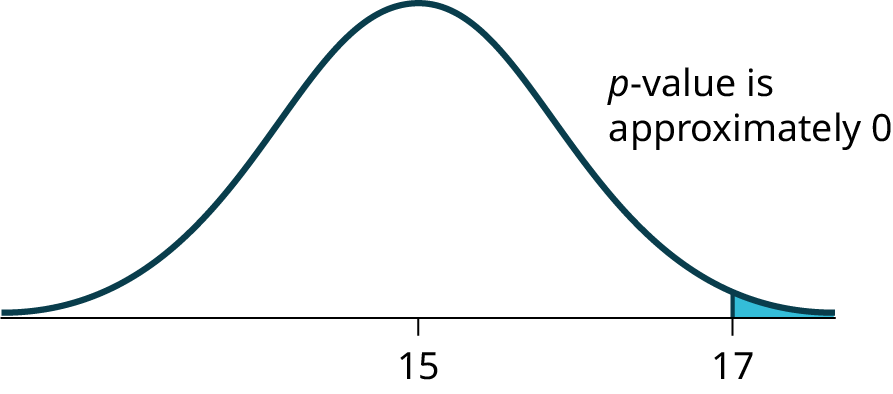

Figure 9.2図 9.2
p-value= P( > 17) which is approximately zero.
p値 = P( > 17)であり、ほぼ0である。
A p-value of approximately zero tells us that it is highly unlikely that a loaf of bread rises no more than 15 cm, on average. That is, almost 0% of all loaves of bread would be at least as high as 17 cm. purely by CHANCE had the population mean height really been 15 cm. Because the outcome of 17 cm. is so unlikely (meaning it is happening NOT by chance alone), we conclude that the evidence is strongly against the null hypothesis (the mean height is at most 15 cm.). There is sufficient evidence that the true mean height for the population of the baker's loaves of bread is greater than 15 cm.
英語のヒント
p値がほぼ0であることから、パンの平均の膨らみが15 cm以下であることは非常に考えにくいと分かる。つまり、母平均高さが本当に15 cmなら、単なる偶然だけで高さが17 cm以上になるパンは、全体のほぼ0%である。17 cmという結果は非常に起きにくい(偶然だけでは起きていないことを意味する)ため、この証拠は帰無仮説「平均高さは15 cm以下」に強く反していると結論づける。この職人のパンの母集団の真の平均高さが15 cmを超えるという十分な証拠がある。