第2章代数の言葉
2.5 Prime Factorization and the Least Common Multiple2.5 素因数分解と最小公倍数
Learning Objectives学習目標
Learning Objectives学習目標
By the end of this section, you will be able to:
この節を終えると、次のことができるようになる。
- Find the prime factorization of a composite number合成数を素因数分解する
- Find the least common multiple (LCM) of two numbers2つの数の最小公倍数(LCM)を求める
Before You Begin (3)準備問題(3題)
Find the Prime Factorization of a Composite Number合成数を素因数分解する
In the previous section, we found the factors of a number. Prime numbers have only two factors, the number and the prime number itself. Composite numbers have more than two factors, and every composite number can be written as a unique product of primes. This is called the prime factorization of a number. When we write the prime factorization of a number, we are rewriting the number as a product of primes. Finding the prime factorization of a composite number will help you later in this course.
英語のヒント
前の節では、数の約数を求めた。素数の約数は、とその素数自身の2つだけである。合成数の約数は3つ以上あり、どの合成数も素数の積として一意に書ける。これを数の素因数分解という。ある数の素因数分解を書くときは、その数を素数の積に書き直している。合成数の素因数分解を求めることは、このコースの後の学習に役立つ。
Additional Resources追加教材
You may want to refer to the following list of prime numbers less than as you work through this section.
この節を進めるときには、以下の未満の素数の一覧を参照するとよい。
Prime Factorization Using the Factor Tree Method因数分解の木を使う素因数分解
One way to find the prime factorization of a number is to make a factor tree. We start by writing the number, and then writing it as the product of two factors. We write the factors below the number and connect them to the number with a small line segment—a “branch” of the factor tree.
英語のヒント
素因数分解を求める方法の1つは、因数分解の木を作ることである。まず数を書き、次にそれを2つの因数の積として書く。因数を元の数の下に書き、短い線分、つまり木の「枝」で元の数と結ぶ。
If a factor is prime, we circle it (like a bud on a tree), and do not factor that “branch” any further. If a factor is not prime, we repeat this process, writing it as the product of two factors and adding new branches to the tree.
英語のヒント
因数が素数なら、木の芽のように丸で囲み、その「枝」はそれ以上分解しない。素数でなければ、2つの因数の積として書き、木に新しい枝を加える手順を繰り返す。
We continue until all the branches end with a prime. When the factor tree is complete, the circled primes give us the prime factorization.
すべての枝の先が素数になるまで続ける。因数分解の木が完成すると、丸で囲んだ素数から素因数分解が得られる。
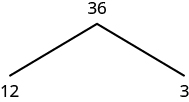
For example, let’s find the prime factorization of We can start with any factor pair such as and We write and below with branches connecting them.
例えば、の素因数分解を求めよう。となど、どの因数の対から始めてもよい。の下にとを書き、枝で結ぶ。
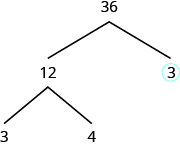
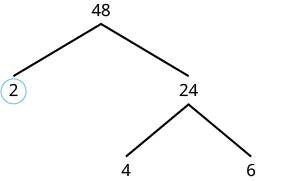
The factor is prime, so we circle it. The factor is composite, so we need to find its factors. Let’s use and We write these factors on the tree under the
因数は素数なので丸で囲む。因数は合成数なので、その因数を求める必要がある。とを使おう。木のの下に、この2つの因数を書く。
The factor is prime, so we circle it. The factor is composite, and it factors into We write these factors under the Since is prime, we circle both
因数は素数なので丸で囲む。因数は合成数で、に分解できる。の下にこれらの因数を書く。は素数なので、両方のを丸で囲む。
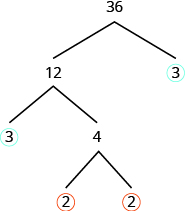
The prime factorization is the product of the circled primes. We generally write the prime factorization in order from least to greatest.
素因数分解は、丸で囲んだ素数の積である。一般に、素因数は小さい順に並べて書く。
In cases like this, where some of the prime factors are repeated, we can write prime factorization in exponential form.
このように同じ素因数が繰り返される場合は、指数表記で素因数分解を書ける。
Note that we could have started our factor tree with any factor pair of We chose and but the same result would have been the same if we had started with and and
のどの因数の対から木を作り始めてもよかったことに注意しよう。ここではとを選んだが、ととから始めても結果は同じになる。
Example 2.48例題 2.48
Find the prime factorization of using the factor tree method.
因数分解の木を使ってを素因数分解せよ。
Solution解答
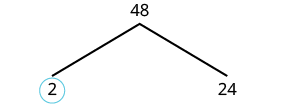
We can start our tree using any factor pair of 48. Let's use 2 and 24. 48のどの因数の対から木を作り始めてもよい。2と24を使おう。 We circle the 2 because it is prime and so that branch is complete. 2は素数なので丸で囲む。これでその枝は完成である。 |
 |
Now we will factor 24. Let's use 4 and 6. 次に24を因数に分解する。4と6を使おう。 |
 |
Neither factor is prime, so we do not circle either. We factor the 4, using 2 and 2. We factor 6, using 2 and 3. どちらの因数も素数ではないので、どちらも丸で囲まない。4を2と2に分解する。6を2と3に分解する。 We circle the 2s and the 3 since they are prime. Now all of the branches end in a prime. 2と3は素数なので、それぞれ丸で囲む。これですべての枝の先が素数になった。 |
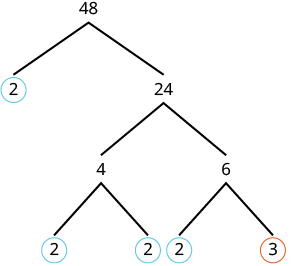 |
Write the product of the circled numbers. 丸で囲んだ数の積を書く。 |
|
Write in exponential form. 指数表記で書く。 |
Check this on your own by multiplying all the factors together. The result should be
すべての因数を掛け合わせ、自分で確かめよう。結果はになるはずである。
Try It (2)確認問題(2題)
Example 2.49例題 2.49
Find the prime factorization of 84 using the factor tree method.
因数分解の木を使って84を素因数分解せよ。
Solution解答
Solution解答
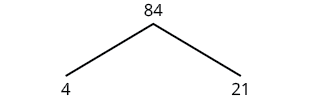
We start with the factor pair 4 and 21. 因数の対4と21から始める。 Neither factor is prime so we factor them further. どちらの因数も素数ではないので、さらに分解する。 |
 |
Now the factors are all prime, so we circle them. 因数がすべて素数になったので、丸で囲む。 |
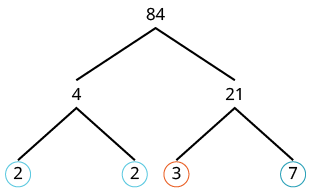 |
Then we write 84 as the product of all circled primes. 次に、84を丸で囲んだすべての素数の積として書く。 |
Draw a factor tree of
の因数分解の木を描け。