第2章代数の言葉
Prime Factorization Using the Ladder Methodはしご法による素因数分解
The ladder method is another way to find the prime factors of a composite number. It leads to the same result as the factor tree method. Some people prefer the ladder method to the factor tree method, and vice versa.
英語のヒント
はしご法は、合成数の素因数を求めるもう1つの方法である。因数分解の木を使う方法と同じ結果が得られる。木を使う方法よりはしご法を好む人もいれば、その逆の人もいる。
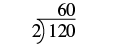
To begin building the “ladder,” divide the given number by its smallest prime factor. For example, to start the ladder for we divide by the smallest prime factor of
「はしご」を作り始めるには、与えられた数をその最小の素因数で割る。例えば、のはしごを始めるには、を、の最小の素因数であるで割る。

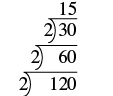
To add a “step” to the ladder, we continue dividing by the same prime until it no longer divides evenly.
はしごに「段」を加えるには、同じ素数で割り切れなくなるまで割り続ける。

Then we divide by the next prime; so we divide by
次に、次の素数で割る。したがって、をで割る。

We continue dividing up the ladder in this way until the quotient is prime. Since the quotient, is prime, we stop here.
このようにはしごを上がりながら、商が素数になるまで割り続ける。商は素数なので、ここで終了する。
Do you see why the ladder method is sometimes called stacked division?
はしご法が「積み重ねた割り算」と呼ばれることがある理由が分かるだろうか。
The prime factorization is the product of all the primes on the sides and top of the ladder.
素因数分解は、はしごの横と一番上にあるすべての素数の積である。
Notice that the result is the same as we obtained with the factor tree method.
因数分解の木を使う方法で得た結果と同じであることに注意しよう。
Example 2.50例題 2.50
Find the prime factorization of using the ladder method.
はしご法を使ってを素因数分解せよ。
Solution解答
Divide the number by the smallest prime, which is 2. 最小の素数である2で割る。 |
 |
Continue dividing by 2 until it no longer divides evenly. 2で割り切れなくなるまで割り続ける。 |
 |
Divide by the next prime, 3. 次の素数である3で割る。 |
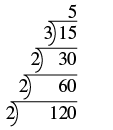 |
The quotient, 5, is prime, so the ladder is complete. Write the prime factorization of 120. 商5は素数なので、はしごは完成である。120の素因数分解を書く。 |
Check this yourself by multiplying the factors. The result should be
因数を掛け合わせ、自分で確かめよう。結果はになるはずである。
Try It (2)確認問題(2題)
Example 2.51例題 2.51
Find the prime factorization of using the ladder method.
はしご法を使ってを素因数分解せよ。
Solution解答
Solution解答
Divide the number by the smallest prime, 2. 最小の素数である2で割る。 |
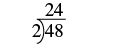 |
Continue dividing by 2 until it no longer divides evenly. 2で割り切れなくなるまで割り続ける。 |
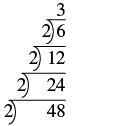 |
The quotient, 3, is prime, so the ladder is complete. Write the prime factorization of 48. 商3は素数なので、はしごは完成である。48の素因数分解を書く。 |
Try It (2)確認問題(2題)
Find the Least Common Multiple (LCM) of Two Numbers2つの数の最小公倍数(LCM)を求める
One of the reasons we look at multiples and primes is to use these techniques to find the least common multiple of two numbers. This will be useful when we add and subtract fractions with different denominators.
倍数と素数を調べる理由の1つは、その方法で2つの数の最小公倍数を求めるためである。これは、分母の異なる分数を足したり引いたりするときに役立つ。
Listing Multiples Method倍数を列挙する方法
A common multiple of two numbers is a number that is a multiple of both numbers. Suppose we want to find common multiples of and We can list the first several multiples of each number. Then we look for multiples that are common to both lists—these are the common multiples.
英語のヒント
2つの数の公倍数とは、両方の数の倍数である数のことをいう。との公倍数を求めたいとする。それぞれの数の最初のいくつかの倍数を列挙できる。次に、両方の一覧に共通する倍数を探す。それが公倍数である。
We see that and appear in both lists. They are common multiples of and We would find more common multiples if we continued the list of multiples for each.
両方の一覧にとがある。これらはとの公倍数である。それぞれの倍数の一覧を続ければ、さらに公倍数が見つかる。
The smallest number that is a multiple of two numbers is called the least common multiple (LCM). So the least LCM of and is
2つの数の倍数である数のうち、最も小さいものを最小公倍数(LCM)という。したがって、との最小公倍数はである。
Example 2.52例題 2.52
Find the LCM of and by listing multiples.
倍数を列挙して、との最小公倍数を求めよ。
Solution解答
List the first several multiples of and of Identify the first common multiple.
との最初のいくつかの倍数を列挙する。最初の公倍数を特定する。
The smallest number to appear on both lists is so is the least common multiple of and
両方の一覧にある最も小さい数はなので、との最小公倍数はである。
Notice that is on both lists, too. It is a common multiple, but it is not the least common multiple.
も両方の一覧にあることに注意しよう。公倍数ではあるが、最小公倍数ではない。