第2章代数の言葉
Identify Prime and Composite Numbers素数と合成数を見分ける
Some numbers, like have many factors. Other numbers, such as have only two factors: and the number. A number with only two factors is called a prime number. A number with more than two factors is called a composite number. The number is neither prime nor composite. It has only one factor, itself.
英語のヒント
のように、約数がたくさんある数もある。のように、とその数自身の2つしか約数がない数もある。約数が2つだけの数を素数という。約数が3つ以上ある数を合成数という。は素数でも合成数でもない。約数がその数自身の1つしかないからである。
Figure 2.10 lists the counting numbers from through along with their factors. The highlighted numbers are prime, since each has only two factors.
図2.10には、からまでの数える数と、その約数を示す。色の付いた数は、それぞれ約数が2つしかないため素数である。
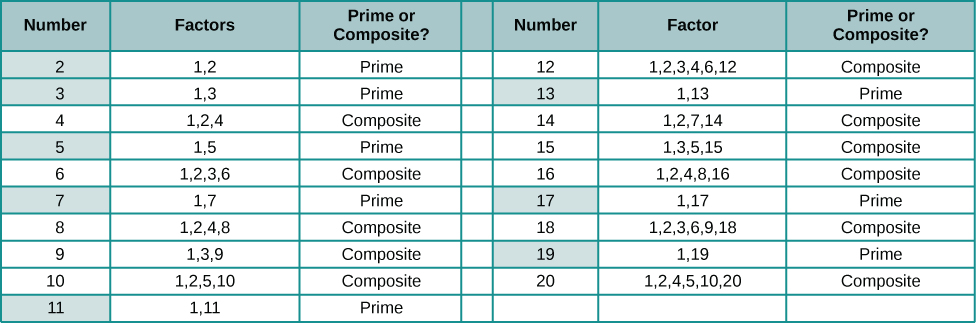
Figure 2.10図 2.10
Factors of the counting numbers from through with prime numbers highlighted
からまでの数える数の約数。素数に色を付けている。
The prime numbers less than are There are many larger prime numbers too. In order to determine whether a number is prime or composite, we need to see if the number has any factors other than and itself. To do this, we can test each of the smaller prime numbers in order to see if it is a factor of the number. If none of the prime numbers are factors, then that number is also prime.
未満の素数はである。もっと大きな素数もたくさんある。ある数が素数か合成数かを判定するには、とその数自身以外に約数があるかを調べる必要がある。そのために、より小さい素数を順に試し、その数の約数かどうかを調べられる。どの素数も約数でなければ、その数も素数である。
Example 2.47例題 2.47
Identify each number as prime or composite:
各数が素数か合成数かを判定せよ。
- ⓐ
- ⓑ
Solution解答
ⓐ Test each prime, in order, to see if it is a factor of , starting with as shown. We will stop when the quotient is smaller than the divisor.
ⓐ 図のようにから始め、素数を順に試しての約数かどうかを調べる。商が除数より小さくなったら終了する。
Prime 素数 |
Test 判定 |
Factor of の約数か。 |
|---|---|---|
Last digit of is not の末尾の数字はのいずれでもない。 |
No. いいえ。 |
|
and is not divisible by で、はで割り切れない。 |
No. いいえ。 |
|
The last digit of is not or の末尾の数字はでもでもない。 |
No. いいえ。 |
|
No. いいえ。 |
||
No. いいえ。 |
We can stop when we get to because the quotient is less than the divisor.
まで来たら、商が除数より小さいため終了できる。
We did not find any prime numbers that are factors of so we know is prime.
の約数となる素数は見つからなかったので、は素数であると分かる。
ⓑ Test each prime, in order, to see if it is a factor of
ⓑ 素数を順に試して、の約数かどうかを調べる。
Prime 素数 |
Test 判定 |
Factor of の約数か。 |
|---|---|---|
Last digit is not 末尾の数字はのいずれでもない。 |
No. いいえ。 |
|
and is not divisible by で、はで割り切れない。 |
No. いいえ。 |
|
the last digit is not or 末尾の数字はでもでもない。 |
No. いいえ。 |
|
Yes. はい。 |
Since is divisible by we know it is not a prime number. It is composite.
はで割り切れるので、素数ではないと分かる。合成数である。
Try It (2)確認問題(2題)
Additional Resources追加教材
Key Concepts重要な概念
Divisibility Tests 整除判定法 |
|
|---|---|
A number is divisible by ある数は次の数で割り切れる。 |
|
2 |
if the last digit is 0, 2, 4, 6, or 8 末尾の数字が0、2、4、6、8のいずれかなら |
3 |
if the sum of the digits is divisible by 3 各桁の数字の和が3で割り切れるなら |
4 |
if the last two digits are a number divisible by 4 下2桁が表す数が4で割り切れるなら |
5 |
if the last digit is 5 or 0 末尾の数字が5または0なら |
6 |
if divisible by both 2 and 3 2と3の両方で割り切れるなら |
10 |
if the last digit is 0 末尾の数字が0なら |
- Factors If , then and are factors of , and is the product of and .因数・約数 なら、とはの約数であり、はとの積である。
- Find all the factors of a counting number.数える数の約数をすべて求める。
- Divide the number by each of the counting numbers, in order, until the quotient is smaller than the divisor.商が除数より小さくなるまで、各数える数で順に割る。
- If the quotient is a counting number, the divisor and quotient are a pair of factors.商が数える数なら、除数と商は約数の対である。
- If the quotient is not a counting number, the divisor is not a factor.商が数える数でなければ、除数は約数ではない。
- List all the factor pairs.約数の対をすべて列挙する。
- Write all the factors in order from smallest to largest.約数をすべて、小さい順に書く。
- Determine if a number is prime.ある数が素数かどうかを判定する。
- Test each of the primes, in order, to see if it is a factor of the number.素数を順に試して、その数の約数かどうかを調べる。
- Start with 2 and stop when the quotient is smaller than the divisor or when a prime factor is found.2から始め、商が除数より小さくなるか、素因数が見つかったら終了する。
- If the number has a prime factor, then it is a composite number. If it has no prime factors, then the number is prime.素因数があれば、その数は合成数である。素因数がなければ、その数は素数である。