第2章代数の言葉
Solve Equations Using the Subtraction Property of Equality等式の減法の性質を使って方程式を解く
Our puzzle has given us an idea of what we need to do to solve an equation. The goal is to isolate the variable by itself on one side of the equations. In the previous examples, we used the Subtraction Property of Equality, which states that when we subtract the same quantity from both sides of an equation, we still have equality.
英語のヒント
パズルを通して、方程式を解くために何が必要かが分かってきた。目標は、方程式の一方の辺に変数だけを残すことである。これまでの例では、等式の減法の性質を使った。この性質は、方程式の両辺から同じ量を引いても、等しさが保たれるというものである。
Think about twin brothers Andy and Bobby. They are years old. How old was Andy years ago? He was years less than so his age was or What about Bobby’s age years ago? Of course, he was also. Their ages are equal now, and subtracting the same quantity from both of them resulted in equal ages years ago.
双子の兄弟アンディとボビーを考えよう。2人は歳である。年前、アンディは何歳だったか。歳より歳下なので、年齢は、つまり歳だった。年前のボビーはどうか。もちろん、同じく歳だった。2人の年齢は今等しく、両方から同じ量を引いた年前の年齢も等しかった。
Example 2.31例題 2.31
Solve:
次の方程式を解く:
Solution解答
We will use the Subtraction Property of Equality to isolate
等式の減法の性質を使い、だけを残す。
 |
|
Subtract 8 from both sides. 両辺から8を引く。 |
 |
Simplify. 簡単にする。 |
 |
 |
|
 |
|
 |
Since makes a true statement, we know is the solution to the equation.
によってが正しい文になるため、がこの方程式の解であると分かる。
Try It (2)確認問題(2題)
Example 2.32例題 2.32
Solve:
次の方程式を解く:
Solution解答
Solution解答
To solve an equation, we must always isolate the variable—it doesn’t matter which side it is on. To isolate we will subtract from both sides.
方程式を解くときは、変数がどちらの辺にあっても、必ず変数だけを残す。だけを残すために、両辺からを引く。
 |
|
Subtract 74 from both sides. 両辺から74を引く。 |
 |
Simplify. 簡単にする。 |
 |
Substitute for to check. にを代入して検算する。 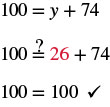 |
Since makes a true statement, we have found the solution to this equation.
によってが正しい文になるため、この方程式の解が求まった。
Try It (2)確認問題(2題)
Solve Equations Using the Addition Property of Equality等式の加法の性質を使って方程式を解く
In all the equations we have solved so far, a number was added to the variable on one side of the equation. We used subtraction to “undo” the addition in order to isolate the variable.
ここまでに解いた方程式ではすべて、一方の辺で変数に数が足されていた。変数だけを残すために、引き算で足し算を元に戻した。
But suppose we have an equation with a number subtracted from the variable, such as We want to isolate the variable, so to “undo” the subtraction we will add the number to both sides.
しかし、のように、変数から数が引かれている方程式があるとしよう。変数だけを残したいので、引き算を元に戻すために両辺にその数を足す。
We use the Addition Property of Equality, which says we can add the same number to both sides of the equation without changing the equality. Notice how it mirrors the Subtraction Property of Equality.
等式の加法の性質を使う。この性質によると、方程式の両辺に同じ数を足しても、等しさは変わらない。等式の減法の性質と対応していることに注意しよう。
Remember the twins, Andy and Bobby? In ten years, Andy’s age will still equal Bobby’s age. They will both be
の双子、アンディとボビーを覚えているだろうか。10年後も、アンディとボビーの年齢は等しい。2人とも歳になる。
We can add the same number to both sides and still keep the equality.
両辺に同じ数を足しても、等しさを保てる。
Example 2.33例題 2.33
Solve:
次の方程式を解く:
Solution解答
We will use the Addition Property of Equality to isolate the variable.
等式の加法の性質を使い、変数だけを残す。
 |
|
Add 5 to both sides. 両辺に5を足す。 |
 |
Simplify. 簡単にする。 |
 |
 |
|
 |
|
 |
|
 |
Try It (2)確認問題(2題)
Example 2.34例題 2.34
Solve:
次の方程式を解く:
Solution解答
Solution解答
We will add to each side to isolate the variable.
変数だけを残すため、両辺にを足す。
 |
|
Add 16 to each side. 両辺に16を足す。 |
 |
Simplify. 簡単にする。 |
 |
 |
 |
 |
|
 |
The solution to is
の解はである。
Try It (2)確認問題(2題)
Translate Word Phrases to Algebraic Equations言葉の表現を代数の方程式に直す
Remember, an equation has an equal sign between two algebraic expressions. So if we have a sentence that tells us that two phrases are equal, we can translate it into an equation. We look for clue words that mean equals. Some words that translate to the equal sign are:
方程式では、2つの代数式の間に等号があることを思い出そう。したがって、2つの表現が等しいことを述べる文は、方程式に直せる。等しいという意味の手がかりとなる言葉を探す。等号に対応する言葉には、次のようなものがある。
- is equal tois equal to(〜に等しい)
- is the same asis the same as(〜と同じである)
- isis(〜である)
- givesgives(結果として〜になる)
- waswas(〜だった)
- will bewill be(〜になる)
It may be helpful to put a box around the equals word(s) in the sentence to help you focus separately on each phrase. Then translate each phrase into an expression, and write them on each side of the equal sign.
文の中の「等しい」を表す語を四角で囲むと、両側の表現に分けて注目しやすくなる。その後、各表現を式に直し、等号の両側に書く。
We will practice translating word sentences into algebraic equations. Some of the sentences will be basic number facts with no variables to solve for. Some sentences will translate into equations with variables. The focus right now is just to translate the words into algebra.
言葉で書かれた文を、代数の方程式に直す練習をする。変数の値を求める必要のない、基本的な計算の事実を表す文もある。変数を含む方程式になる文もある。今は、言葉を代数に直すことだけに注目する。
Example 2.35例題 2.35
Translate the sentence into an algebraic equation: The sum of and is
次の文を代数の方程式に直せ:との和はである。
Solution解答
The word is tells us the equal sign goes between 9 and 15.
isという語は、9と15の間に等号を置くことを示している。
Locate the “equals” word(s). 「等しい」を表す語を見つける。 |
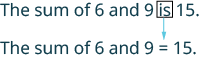 |
Write the = sign. =記号を書く。 |
|
Translate the words to the left of the equals word into an algebraic expression. 「等しい」を表す語の左側の言葉を、代数式に直す。 |
 |
Translate the words to the right of the equals word into an algebraic expression. 「等しい」を表す語の右側の言葉を、代数式に直す。 |
 |
Try It (2)確認問題(2題)
Example 2.36例題 2.36
Translate the sentence into an algebraic equation: The product of and is
次の文を代数の方程式に直せ:との積はである。
Solution解答
Solution解答
The location of the word is tells us that the equal sign goes between 7 and 56.
isという語の位置から、7と56の間に等号を置くことが分かる。
Locate the “equals” word(s). 「等しい」を表す語を見つける。 |
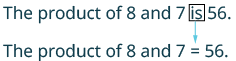 |
Write the = sign. =記号を書く。 |
|
Translate the words to the left of the equals word into an algebraic expression. 「等しい」を表す語の左側の言葉を、代数式に直す。 |
 |
Translate the words to the right of the equals word into an algebraic expression. 「等しい」を表す語の右側の言葉を、代数式に直す。 |
 |
Try It (2)確認問題(2題)
Example 2.37例題 2.37
Translate the sentence into an algebraic equation: Twice the difference of and gives
次の文を代数の方程式に直せ:との差の2倍はになる。
Solution解答
Solution解答
Locate the “equals” word(s). 「等しい」を表す語を見つける。 |
 |
Recognize the key words: twice; difference of …. and …. キーワードを見つける:twice(2倍)、difference of … and …(…と…の差)。 |
Twice means two times. twiceは2倍を意味する。 |
Translate. 数式に直す。 |
 |