第2章代数の言葉
Use Common Divisibility Testsよく使う整除判定法を使う
Another way to say that is a multiple of is to say that is divisible by In fact, is so is Notice in Example 2.43 that is not a multiple When we divided by we did not get a counting number, so is not divisible by
英語のヒント
がの倍数であることは、がで割り切れるともいえる。実際、はなので、はである。例2.43では、はの倍数ではないことに注意しよう。をで割っても数える数にならなかったので、はで割り切れない。
Since multiplication and division are inverse operations, the patterns of multiples that we found can be used as divisibility tests. Table 2.11 summarizes divisibility tests for some of the counting numbers between one and ten.
掛け算と割り算は逆演算なので、見つけた倍数の規則性は、割り切れるかどうかの判定に使える。表2.11に、1から10までのいくつかの数える数について、整除判定法をまとめる。
Divisibility Tests 整除判定法 |
|
|---|---|
A number is divisible by ある数は次の数で割り切れる。 |
|
if the last digit is 末尾の数字がのいずれかなら |
|
if the sum of the digits is divisible by 各桁の数字の和がで割り切れるなら |
|
if the last digit is or 末尾の数字がまたはなら |
|
if divisible by both and との両方で割り切れるなら |
|
if the last digit is 末尾の数字がのいずれかなら |
|
Example 2.44例題 2.44
Determine whether is divisible by
がで割り切れるかどうかを判定せよ。
Solution解答
Table 2.12 applies the divisibility tests to In the far right column, we check the results of the divisibility tests by seeing if the quotient is a whole number.
表2.12では、に整除判定法を適用する。右端の列では、商が非負整数かどうかを調べ、判定結果を確かめる。
Divisible by…? 次の数で割り切れるか。 |
Test 判定 |
Divisible? 割り切れるか。 |
Check 確認 |
|---|---|---|---|
Is last digit Yes. 末尾の数字はのいずれかか。はい。 |
yes はい |
||
Yes. はい。 |
yes はい |
||
Is last digit or Yes. 末尾の数字はまたはか。はい。 |
yes はい |
||
Is last digit Yes. 末尾の数字はのいずれかか。はい。 |
yes はい |
Thus, is divisible by
したがって、はで割り切れる。
Try It (2)確認問題(2題)
Example 2.45例題 2.45
Determine whether is divisible by
がで割り切れるかどうかを判定せよ。
Solution解答
Solution解答
Table 2.13 applies the divisibility tests to and tests the results by finding the quotients.
表2.13では、に整除判定法を適用し、商を求めて結果を確かめる。
Divisible by…? 次の数で割り切れるか。 |
Test 判定 |
Divisible? 割り切れるか。 |
Check 確認 |
|---|---|---|---|
Is last digit No. 末尾の数字はのいずれかか。いいえ。 |
no いいえ |
||
Yes. はい。 |
yes はい |
||
Is last digit is or Yes. 末尾の数字はまたはか。はい。 |
yes はい |
||
Is last digit No. 末尾の数字はのいずれかか。いいえ。 |
no いいえ |
Thus, is divisible by and but not or
したがって、はとで割り切れるが、とでは割り切れない。
Try It (2)確認問題(2題)
Find All the Factors of a Number数の約数をすべて求める
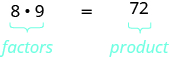
There are often several ways to talk about the same idea. So far, we’ve seen that if is a multiple of we can say that is divisible by We know that is the product of and so we can say is a multiple of and is a multiple of We can also say is divisible by and by Another way to talk about this is to say that and are factors of When we write we can say that we have factored
同じ考え方を述べる方法はいくつもある。ここまで、がの倍数なら、はで割り切れるといえることを見てきた。はとの積なので、はの倍数であり、はの倍数であるといえる。また、はとで割り切れるともいえる。別の言い方では、とはの約数である。と書けば、を因数に分解したといえる。
In algebra, it can be useful to determine all of the factors of a number. This is called factoring a number, and it can help us solve many kinds of problems.
代数では、ある数の約数をすべて求めることが役立つ場合がある。これは数の因数分解と呼ばれ、さまざまな問題を解く助けになる。
Additional Resources追加教材
For example, suppose a choreographer is planning a dance for a ballet recital. There are dancers, and for a certain scene, the choreographer wants to arrange the dancers in groups of equal sizes on stage.
英語のヒント
例えば、振付師がバレエの発表会の踊りを計画しているとする。踊り手は人おり、ある場面で、同じ人数のグループに分けて舞台に配置したい。
In how many ways can the dancers be put into groups of equal size? Answering this question is the same as identifying the factors of Table 2.14 summarizes the different ways that the choreographer can arrange the dancers.
同じ人数のグループに分ける方法は何通りあるか。この問いに答えることは、の約数を特定することと同じである。表2.14に、振付師が踊り手を配置できる方法をまとめる。
Number of Groups グループ数 |
Dancers per Group 1グループ当たりの踊り手の人数 |
Total Dancers 踊り手の総人数 |
|---|---|---|
What patterns do you see in Table 2.14? Did you notice that the number of groups times the number of dancers per group is always This makes sense, since there are always dancers.
表2.14にはどのような規則性が見えるか。グループ数に1グループ当たりの踊り手の人数を掛けると、常にになることに気づいただろうか。踊り手は常に人なので、これは当然である。
You may notice another pattern if you look carefully at the first two columns. These two columns contain the exact same set of numbers—but in reverse order. They are mirrors of one another, and in fact, both columns list all of the factors of which are:
最初の2列をよく見ると、別の規則性にも気づくかもしれない。2列にある数の組はまったく同じだが、順序が逆である。互いを映したような関係になっており、実際、どちらの列にもの約数がすべて並んでいる。それは次の数である。
We can find all the factors of any counting number by systematically dividing the number by each counting number, starting with If the quotient is also a counting number, then the divisor and the quotient are factors of the number. We can stop when the quotient becomes smaller than the divisor.
英語のヒント
どの数える数の約数も、から順に各数える数で割ることで、すべて求められる。商も数える数なら、除数と商がその数の約数である。商が除数より小さくなったら終了できる。
Example 2.46例題 2.46
Find all the factors of
の約数をすべて求めよ。
Solution解答
Divide by each of the counting numbers starting with If the quotient is a whole number, the divisor and quotient are a pair of factors.
から始め、各数える数でを割る。商が非負整数なら、除数と商は約数の対である。
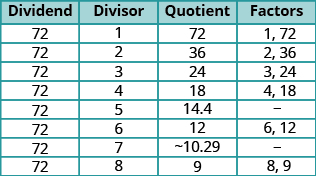
The next line would have a divisor of and a quotient of The quotient would be smaller than the divisor, so we stop. If we continued, we would end up only listing the same factors again in reverse order. Listing all the factors from smallest to greatest, we have
次の行では、除数が、商がになる。商が除数より小さくなるので終了する。続けても、同じ約数を逆の順序でもう一度並べるだけになる。すべての約数を小さい順に並べると、次のようになる。