Authentication confirms the identity and authorization of people and devices that use a system. It is a vital two-step process to help ensure that only authorized users have access to a system. Authentication first requires identification followed by verification to establish and confirm a user’s unique credentials and ensure the user is authorized.
A password is a secret string of characters used to gain entry into a system. It is a critical part of authentication. To function as a cybersecurity tool, passwords must be secure, which can be challenging. Attackers can steal passwords by guessing, installing a hardware or software keylogger, finding written passwords, obtaining them via social engineering/phishing, intercepting the password over the network, or stealing them from a service or third party.
• Create long passwords with at least 16 characters.
• 16文字以上の長いパスワードを作る。
• Make passwords random by following NIST’s recommended password rules.
• NISTが推奨するパスワード規則に従い、ランダムにする。
• Ensure that passwords are unique by using a different password for every access point in a system.
• システムの各アクセスポイントで異なるパスワードを使い、固有のものにする。
Access Controlアクセス制御
A vital part of cybersecurity is access control, which regulates the people and devices that can use a computer system’s resources. The three most common access control designs include the following:
• Mandatory access control (MAC) is a strict system where security decisions are fully controlled by a central policy administrator, making it impossible for users to set permissions irrespective of ownership.
• Discretionary access control (DAC) is a system where users can set permissions for their files, including granting access rights to other users on the same system. DAC is the most common access control design approach in commercial operating systems. While generally less secure than mandatory control, DAC is easier to implement and more flexible.
• Role-based access control (RBAC) is a system in which access depends on an individual or group’s role in an organization and the access they need to meet job requirements. Typically, roles with more responsibility and authority have greater access to the system.
The typical attacks launched against cryptography generally involve the following:
暗号に対する典型的な攻撃には、一般に次のものがある。
• brute force (e.g., try all possible private keys)
• 総当たり。例えば、ありうる秘密鍵をすべて試す。
• mathematical attacks (e.g., factoring)
• 数学的攻撃。例えば、因数分解を使う。
• timing attacks (e.g., based on knowledge of the time it takes to decrypt)
• タイミング攻撃。例えば、復号にかかる時間の知識に基づく。
• hardware-based fault attack (e.g., take advantage of faulty hardware to generate digital signatures)
• ハードウェアに基づく故障攻撃。例えば、欠陥のあるハードウェアを利用してデジタル署名を生成する。
• chosen ciphertext attack (e.g., gather information by obtaining the decryptions of chosen ciphertexts and attempt to recover from this information the secret key used for decryption)
• architectural changes (e.g., use knowledge of vulnerabilities)
• アーキテクチャーの変更。例えば、脆弱性の知識を使う。
Anonymity and Privacy匿名性とプライバシー
Protecting anonymity and privacy is an important aspect of cybersecurity. Being able to interact on the Internet, even publicly, while concealing your identity, is considered anonymity. Anonymity is not the same as secrecy/confidentiality. As discussed previously, confidentiality is about message contents (i.e., what was said). Anonymity is about identities (i.e., who said it and to whom) and must be preserved to ensure certain civil liberties such as autonomy, free association, free speech, and freedom from censorship and surveillance.
By remaining anonymous, users make it difficult for hackers to steal their personal data (e.g., passwords, credit card information). It also allows users to preserve their civil liberties (e.g., free speech and association) on social media. Anonymity can also be important for people concerned about their safety and do not want to create safety risks because of their online activities.
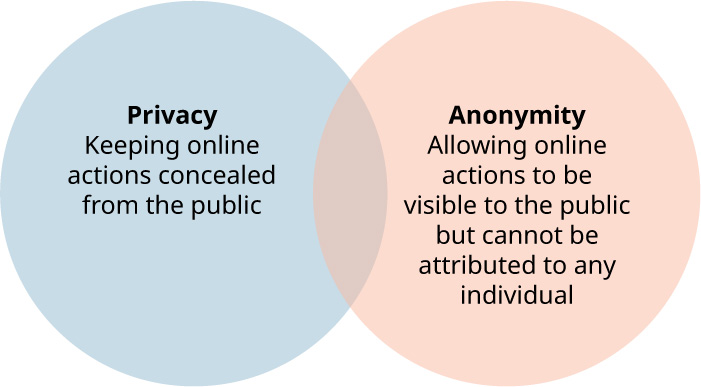
Keeping your actions online, such as messages intended only for certain individuals, concealed from the public is called privacy. Privacy is regarded as a basic human right. While not explicit in the U.S. Constitution, privacy rights are implied by the personal protections offered in the First, Third, Fourth, Fifth, and Ninth Amendments in the Bill of Rights. As Figure 14.9 shows, privacy is related to anonymity but is a separate concept. Both anonymity and privacy are important to promote cybersecurity.
attribution: Copyright Rice University, OpenStax, under CC BY 4.0 license · CC BY 4.0 · Source出典
Figure 14.9 Privacy and anonymity are related concepts that are important to promote cybersecurity. (attribution: Copyright Rice University, OpenStax, under CC BY 4.0 license)
図14.9 プライバシーと匿名性は、サイバーセキュリティーを促進するために重要な、関連した概念である。(帰属表示:著作権 Rice University、OpenStax、CC BY 4.0)
Internet anonymity is difficult, if not impossible, to achieve for average users, but it seems easy for unethical people. Anonymity is a state-of-the-art technique that relies on proxy intermediaries that relay Internet traffic through trusted third parties. Generally, the process requires setting up an encrypted virtual private network (VPN) to the third party’s site, and all your traffic goes through it.
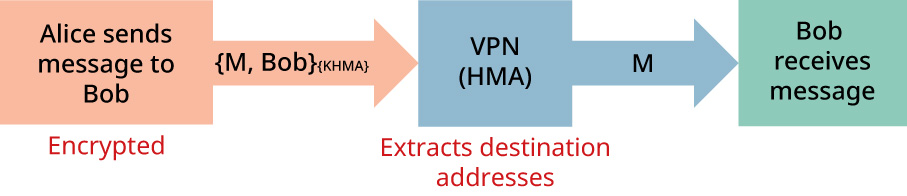
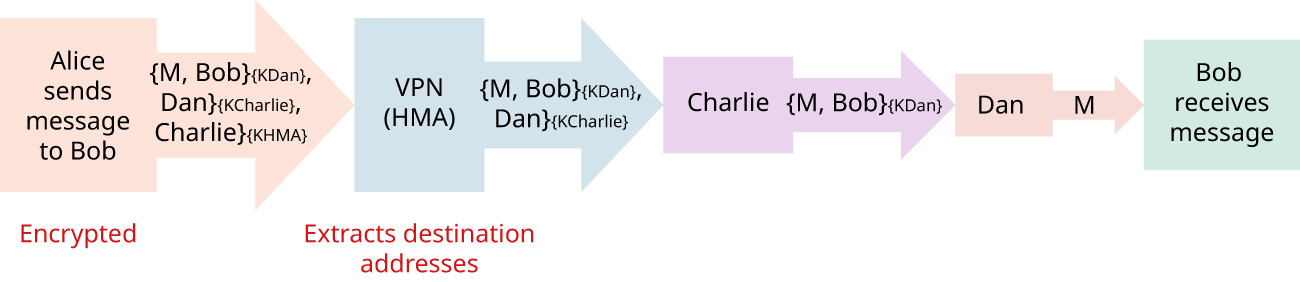
To understand how unethical people use proxies, assume a scenario depicted in Figure 14.10 where Alice wants to message M to Bob. Bob does not know that the message M is from Alice, and Eve (“Eve” is short for eavesdropper) cannot determine that Alice is communicating with Bob. HMA accepts messages encrypted for it, then extracts the corresponding destination addresses and forwards the message accordingly.
attribution: Copyright Rice University, OpenStax, under CC BY 4.0 license · CC BY 4.0 · Source出典
Figure 14.10 When Alice sends a message to Bob, HMA accepts encrypted messages, then extracts the corresponding destination addresses and forwards the messages accordingly. (attribution: Copyright Rice University, OpenStax, under CC BY 4.0 license)
図14.10 AliceがBobへメッセージを送るとき、HMAは暗号化されたメッセージを受け取り、対応する宛先アドレスを取り出し、それに従って転送する。(帰属表示:著作権 Rice University、OpenStax、CC BY 4.0)
Anonymity is meant to counter the type of surveillance that is mandated as part of the Patriot Act (section 215, and national security letters or NSLs) and the FISA Amendment Act.
An older Google transparency report (Table 14.4) shows the number of NSLs that FBI agents issued without a judge’s approval to obtain personal information.
Table 14.4Google Transparency Report Data from Google.
表14.4 Googleの透明性レポート。データ提供:Google。
Reporting Period
報告対象期間
National Security Letters
国家安全保障書簡
Users/Accounts
利用者/アカウント
January to June 2013
2013年1〜6月
0–499
500–999
July to December 2012
2012年7〜12月
0–499
500–999
January to June 2012
2012年1〜6月
500–999
1,000–1,499
July to December 2011
2011年7〜12月
0–499
500–999
January to June 2011
2011年1〜6月
0–499
500–999
July to December 2010
2010年7〜12月
0–499
1,000–1,499
January to June 2010
2010年1〜6月
500–999
1,500–1,999
July to December 2009
2009年7〜12月
0–499
500–999
January to June 2009
2009年1〜6月
0–499
500–999
Table 14.4Google Transparency Report Data from Google.
表14.4 Googleの透明性レポート。データ提供:Google。
NSLs cover everything except the contents of your communications (i.e., if, when, how much, who). These data are included in the exception because such metadata often provides privileged information that is essentially, according to the FTC, a “proxy for content.” In fact, the U.S. National Security Agency (NSA) collection of bulk call data was ruled illegal in 2015.
Encryption tools such as Pretty Good Privacy (PGP), which was introduced earlier, can be used. GnuPG is a free software recreation of PGP created by Phil Zimmerman (1991). These tools allow users to encrypt emails to hide their content by creating a hash of the email’s content and using digital signatures to sign the hash. Both the message text and the digital signature attached to the message are protected using hybrid encryption. Digital signatures require public-key cryptography (which has separate public and private keys). Before sending a message, the message is signed with the signature key, and both the message and its signature are encrypted with the recipient’s public encryption key. Once the message is received, it is decrypted with the private key to extract it and its signature. The sender’s public verification key is then used to check the signature’s authenticity.
英語のヒント
先に紹介したPretty Good Privacy(PGP)のような暗号化ツールを利用できる。GnuPGは、Phil Zimmermanが1991年に作ったPGPを、自由ソフトウェアとして再実装したものである。これらのツールでは、メールの内容のハッシュを作り、デジタル署名でそのハッシュに署名することによって、メールを暗号化して内容を隠せる。メッセージ本文と添付されたデジタル署名は、どちらもハイブリッド暗号で保護される。デジタル署名には、公開鍵と秘密鍵が別々に存在する公開鍵暗号が必要である。送信前に、署名鍵でメッセージへ署名し、メッセージと署名をどちらも受信者の公開暗号鍵で暗号化する。受信すると、秘密鍵で復号してメッセージと署名を取り出す。その後、送信者の公開検証鍵で署名の真正性を確認する。
Fingerprints must be used to secure this process further. Because Bob’s public key can be obtained from his website, it needs to be verified via out-of-band communication of fingerprints. A fingerprint is a cryptographic hash of a key. To support this approach, you need key servers that store public keys to look up keys by name/ email address and verify them with fingerprints. If you do not know Bob personally, you can rely on the Web of Trust (WoT) or “friend of a friend” mechanism (i.e., Bob introduces Alice to Caro by signing Alice’s key).
英語のヒント
この過程の安全性をさらに高めるには、フィンガープリントを使わなければならない。Bobの公開鍵は彼のウェブサイトから入手できるため、別経路でフィンガープリントをやり取りし、検証する必要がある。フィンガープリントとは、鍵の暗号学的ハッシュである。この方法を支えるには、公開鍵を保存する鍵サーバーが必要になる。名前やメールアドレスで鍵を検索し、フィンガープリントで検証するためである。Bobを個人的に知らなければ、「信頼の輪」(Web of Trust、WoT)、つまり「友人の友人」の仕組みに頼れる。たとえばBobがAliceの鍵に署名し、CaroへAliceを紹介する。
There are drawbacks to (just) using encryption because Bob’s private key may be compromised. In that case, the specifics of the keys may become known, and past messages may be decrypted and read. Because the sender’s signature is available as part of the messages sent, it also becomes possible to prove the sender’s identity, which defeats the security scheme. This attack exposes many incriminating records, including the key material that decrypts data sent over the public Internet and signatures with proofs of who said what.
There is nothing better than “off-the-record” conversations where Alice and Bob talk in a room, and no one else can hear them. In that case, no one else knows what they say unless Alice or Bob tells them. Furthermore, no one can prove what was said, not Alice or Bob. Based on this, desirable communication properties are as follows:
• Deniability makes it plausible to deny having sent a message.
英語のヒント
• 否認可能性:メッセージを送ったことを、もっともらしく否定できる。
• Forward secrecy allows past messages to be safe even if key material if compromised.
• 前方秘匿性:鍵の情報が漏れても、過去のメッセージの安全性を保てる。
• Mimic off-the-record conversations to facilitate deniable authentication. Make it possible to be confident of who you are talking to but unable to prove to a third party what was said.
One technique is to use off-the-record (OTR) messaging.
一つの方法は、Off-the-Record(OTR)メッセージングを使うことである。
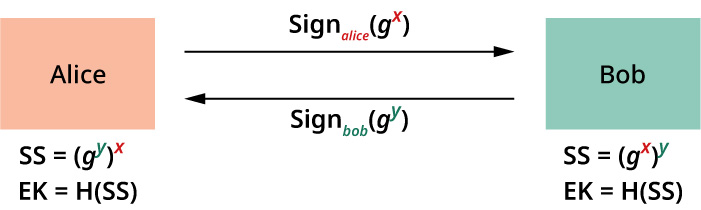
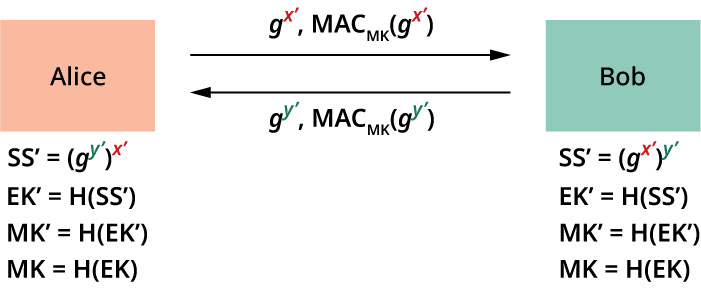
1. Use authenticated Diffie-Hellman (DH) protocol to establish a (short-lived) session key: Diffie-Hellman is a security algorithm with only one (symmetric) private key that is shared by both participants (e.g., Alice and Bob). Alice and Bob agree on values for prime number p and a generator number g (or base), where 1< g < p and g is any number agreed upon by both parties that is a generator of p. The number g is a generator of p because, when raised to positive whole-number powers less than p, it never produces the same result for any two such whole numbers. For ease of computation, g is usually chosen small, and the order of g should be prime and approximately p/2. Alice and Bob pick private values x and y respectively and they generate a key and exchange it publicly. So Alice selects x and generates public key a = gx modulo p and Bob selects y and generates public key b = gy modulo p. For example, if p = 23 and g = 9, the private keys for Alice and Bob are respectively 4 and 3, and the secret keys for Alice and Bob are both 9. During the DH key (signed) exchange, the only pieces of information that are exposed to the public (and susceptible to interception by malicious actors) are x, y, p, and g. None of which are sufficient to recover Alice and Bob’s private keys. It is also not enough information to recover the shared (symmetric) secret (SS) cryptographic key. SS can then be used by Alice and Bob to send encrypted messages to each other safely, which is done using a secret-key encryption algorithm, using a hash of SS as the encryption key EK, to transmit ciphertext. The strength of the scheme comes from the fact that (gy)x modulo p = (gx)y modulo p is a one-way function that takes an extremely long time to compute/invert using any known algorithm (just from the knowledge of p, g, gx modulo p, and gy modulo p.
attribution: Copyright Rice University, OpenStax, under CC BY 4.0 license · CC BY 4.0 · Source出典
(attribution: Copyright Rice University, OpenStax, under CC BY 4.0 license)
(帰属表示:著作権 Rice University、OpenStax。CC BY 4.0ライセンス。)
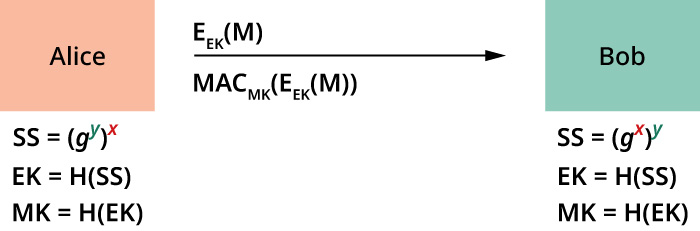
2. Then Alice uses secret-key encryption on message M and sends it across as EEK(M) ... and authenticates the message using a message authentication code MACMK(EEK(M), where MK is computed as a hash of the EK, H(EK):
attribution: Copyright Rice University, OpenStax, under CC BY 4.0 license · CC BY 4.0 · Source出典
(attribution: Copyright Rice University, OpenStax, under CC BY 4.0 license)
(帰属表示:著作権 Rice University、OpenStax。CC BY 4.0ライセンス。)
3. Re-keying is performed using the DH protocol to exchange new private values x′ and y′:
3. DHプロトコルで新しい秘密の値x′とy′を交換し、鍵を更新する。
attribution: Copyright Rice University, OpenStax, under CC BY 4.0 license · CC BY 4.0 · Source出典
(attribution: Copyright Rice University, OpenStax, under CC BY 4.0 license)
(帰属表示:著作権 Rice University、OpenStax。CC BY 4.0ライセンス。)
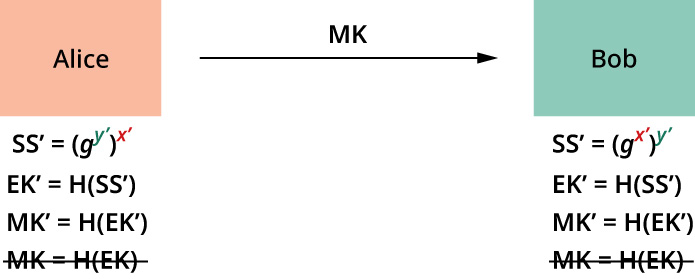
4. Publishing the old MK:
4. 古いMKを公開する。
attribution: Copyright Rice University, OpenStax, under CC BY 4.0 license · CC BY 4.0 · Source出典
(attribution: Copyright Rice University, OpenStax, under CC BY 4.0 license)
(帰属表示:著作権 Rice University、OpenStax。CC BY 4.0ライセンス。)
Note that OTR is more applicable to interactive communication than email. It provides message authentication, confidentiality, deniability, and forward secrecy. However, there are no practical examples of “deniability.” OTR is built into Adium and Pidgin; in that case, some defaults apply. In particular, logging is enabled by default, and etiquette dictates you should disable this, as do past instances where people’s activities were discovered using those logs (e.g., Chelsea Manning, who leaked classified information, was discovered after the Army reviewed access logs). It is very different from Google Hangout’s OTR feature, which does not allow the conversation to be logged.
An interesting anonymity solution is the protocol behind the Signal app (iPhone, Android), which uses the double ratchet algorithm set forth by Trevor Perrin and Moxie Marlinspike. It provides forward secrecy (i.e., today’s messages are secret, even if the key is compromised tomorrow), future secrecy (i.e., tomorrow’s messages are secret, even if the key is compromised today), deniability (no permanent/transferable evidence of what was said), and usability (i.e., tolerates out-of-order message delivery).
Another interesting idea for anonymity is achieved via plausibly deniable storage. In this case, the goal is to encrypt data stored on your hard drive. Someone can be compelled to decrypt it. The idea is to have a “decoy” volume with benign information (e.g., VeraCrypt).
Note that it may be worthwhile to differentiate sender from receiver anonymity. An interesting example of a protocol that achieves sender anonymity is described by David Chaum as the “dining cryptographers problem.”16In this case, three cryptographers dining together are told that payment will be made anonymously by either one of them or the agency that employs them. As they respect each other’s right to make an anonymous payment but wonder if their agency will be paying, they carry out the protocol described to achieve sender anonymity.
A naive solution to achieve anonymity for browsing is to use VPNs. Organizations providing these may receive court orders asking for information relating to an account, and they will cooperate with law enforcement if they receive a court order. A better approach is to use Tor by downloading the Tor browser bundle (https://openstax.org/r/76TorProj) or becoming a volunteer in the Tor network. Tor is built on a modified version of Firefox and is a low-latency anonymous communication system that hides metadata (i.e., who is communicating). As noted earlier, you may get in trouble when an encrypted message you are sending is intercepted, and the included metadata are exposed. To avoid this, Tor completely hides the existence of communication (e.g., web connections). Tor operates at the transport layer and makes it possible to establish Transmission Control Protocol (TCP) connections without revealing your IP address. The Tor network relies on many nodes (i.e., onion routers) operated by volunteers and located worldwide. The Tor approach becomes useful if Alice wants to connect to a web server without revealing her IP address. Simply speaking, onion routing (Figure 14.11) generalizes to an arbitrary number of intermediaries (“mixes” or “mix-nets”). Alice ultimately wants to talk to Bob, with the help of HMA, Dan, and Charlie, and as long as any of the mixes is honest, no one can link Alice with Bob.
英語のヒント
ブラウジングの匿名性を得る単純な方法は、VPNを使うことである。提供組織には、アカウントに関する情報を求める裁判所命令が届く場合があり、命令を受ければ法執行機関に協力する。よりよい方法は、Torブラウザーバンドル(https://openstax.org/r/76TorProj)をダウンロードしてTorを使うか、Torネットワークのボランティアになることである。Torは改変版Firefoxを基にした、低遅延の匿名通信システムで、誰が通信しているかというメタデータを隠す。先に述べたように、送信中の暗号化メッセージが傍受され、その中のメタデータが露わになると、困った事態になりうる。これを避けるため、Torは、ウェブ接続などの通信の存在を完全に隠す。Torはトランスポート層で動作し、IPアドレスを明かさずにTransmission Control Protocol(TCP)接続を確立できる。Torネットワークは、世界各地でボランティアが運用する多数のノード、つまりオニオンルーターに依存している。Aliceが自分のIPアドレスを明かさずウェブサーバーにつなぎたい場合に、Torの方式は役立つ。簡単にいうと、オニオンルーティング(図14.11)は、任意の数の仲介者(「ミックス」または「ミックスネット」)へ一般化できる。Aliceが最終的に話したい相手はBobであり、HMA、Dan、Charlieの助けを借りる。ミックスのいずれか一つでも正直であれば、誰もAliceとBobを結び付けられない。
16 Chaum, David. “The Dining Cryptographers Problem: Unconditional Sender and Recipient Untraceability. Journal of Cryptology, vol. 1, 65–75, 1998. https://chaum.com/wp-content/uploads/2022/01/chaum-dc.pdf
16 Chaum, David.「The Dining Cryptographers Problem: Unconditional Sender and Recipient Untraceability(食事する暗号学者の問題:送信者と受信者の無条件の追跡不能性)」、Journal of Cryptology、第1巻、65–75頁、1998年。https://chaum.com/wp-content/uploads/2022/01/chaum-dc.pdf
attribution: Copyright Rice University, OpenStax, under CC BY 4.0 license · CC BY 4.0 · Source出典
Figure 14.11 Users can achieve anonymity by using Tor. This is what the industrial-strength Tor anonymity service uses. It also provides bidirectional communication. The key concept here is that no one really knows both you and the destination. (attribution: Copyright Rice University, OpenStax, under CC BY 4.0 license)
図14.11 Torを使うと匿名性を得られる。これは本格運用向けのTor匿名化サービスが使う仕組みであり、双方向通信も提供する。鍵となる考え方は、あなたと宛先の両方を実際に知る者がいないことである。(帰属表示:著作権 Rice University、OpenStax。CC BY 4.0ライセンス。)
Tor end-to-end paths are called Circuits, and Tor almost always uses 3-hop circuits (i.e., k = 3). Tor balances anonymity (i.e., k not too small so as to be traceable) and latency (i.e., k not too large). The last node in a Tor circuit is called an "exit” node. To the outside world, the Tor exit node is initiating connections to destinations. Every peer in the Tor network gets to decide whether to be an exit node or to just relay between other Tor nodes. Tor exit nodes also determine what IP addresses/websites to exit. Tor clients learn about other Tor peers by downloading a list of them.17The list provides information for each one of the Tor routers, such as IP address and hostname, the country where it resides, the uptime, the average throughput, websites it is willing to be an exit node for, and the node’s public key.
Tor’s attack model is more “relaxed” than the models used by typical mix-nets. In particular, Tor does not assume a global, passive attacker. It does assume that a limited subset of the Tor nodes are malicious and that there may be some level of eavesdropping on small portions of the links but not a global view of all traffic. This relaxed attack model, which assumes a less powerful adversary, makes it possible for Tor to achieve better performance. That said, there are a few aspects that Tor does not cover as compared to typical mix-nets: Tor does not batch or delay packets. If only one client were to communicate over Tor, there would be no anonymity. The philosophy behind the Tor relaxed attack model is to assume that if the performance is reasonable enough, users will be more likely to adopt it. The more users adopt it, the more "cover traffic" there will be, making it harder for an attacker to map packets to any one sender. Figure 14.12 summarizes how Tor works at a high level.
Image omitted because its reuse rights could not be verified.権利の確認ができないため画像を割愛。
Figure 14.12 Tor is a multistep process that enables users to achieve anonymity online. (attribution: Copyright Rice University, OpenStax, under CC BY 4.0 license; credit key icon: modification of "Accessible" by Phạm Thanh Lộc/Wikimedia Commons, CC BY 4.0; credit: reproduced with permission from Dave Levin)
図14.12 Torは複数の段階からなる過程で、オンラインでの匿名性を実現する。(帰属表示:著作権 Rice University、OpenStax。CC BY 4.0ライセンス。鍵のアイコン:Phạm Thanh Lộc/Wikimedia Commonsの「Accessible」を改変、CC BY 4.0。出典:Dave Levinの許可を得て転載。)
Tor implements the following trust protocol:
Torは次の信頼プロトコルを実装する。
• Entry node knows that Alice is using Tor, and also knows the identity of the middle node but does not know the identity of the destination.
• Exit node knows that some Tor user is connecting to the destination but does not know which user.
• 出口ノードは、Tor利用者の誰かが宛先へ接続していると知るが、どの利用者かは知らない。
• Destination knows a Tor user is connecting to it via the exit node.
• 宛先は、Tor利用者が出口ノード経由で接続していると知る。
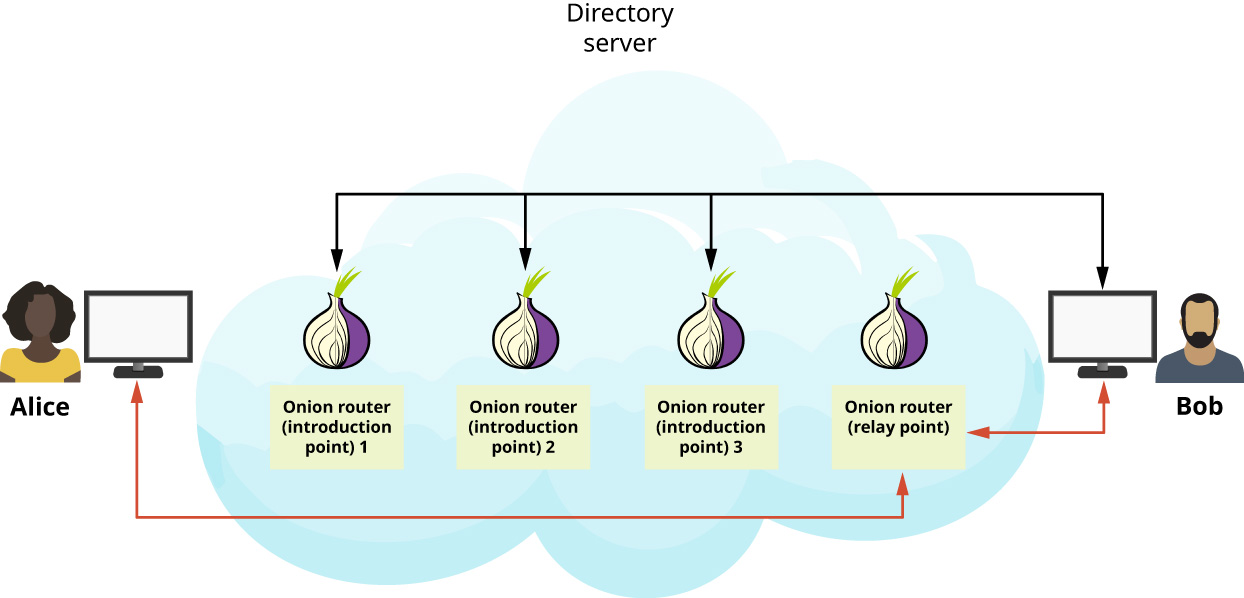
It should be noted that Tor does not provide encryption (e.g., use HTTPS) between the exit node and the destination). We discussed earlier how senders can hide their identities. Similar to that, Tor is also a means of allowing destinations to hide their identities. An example was The Silk Road, an eBay-like online store where users could purchase illicit and illegal goods and pay for them using Bitcoins. Running such a website requires a certain degree of anonymity. Therefore it was run as what is known as a "Tor hidden service." Hidden services have since been renamed to onion services.18Interestingly, onion services can achieve receiver anonymity using techniques that achieve sender anonymity (Figure 14.13).19
18 To read more about how onion services work, visit https://community.torproject.org/onion-services/overview/, and to read more about how to set them up, visit https://community.torproject.org/onion-services/setup/. 19 For more information on Tor, how it is used, and where it is being censored, check out the Tor metrics site at https://metrics.torproject.org/.
attribution: Copyright Rice University, OpenStax, under CC BY 4.0 license · CC BY 4.0 · Source出典
Figure 14.13 Tor hidden services, also known as onion services, achieve receiver-anonymity using techniques that achieve sender-anonymity. (attribution: Copyright Rice University, OpenStax, under CC BY 4.0 license)
図14.13 Tor隠しサービスはオニオンサービスとも呼ばれ、送信者の匿名性を実現する技術により、受信者の匿名性を実現する。(帰属表示:著作権 Rice University、OpenStax。CC BY 4.0ライセンス。)
Note that there are various known onion routing attacks and other issues as follows:
オニオンルーティングには、次のような既知の攻撃や問題がある。
• Attacks:
• 攻撃:
◦ Rubber-hose cryptanalysis of mix operators; as a defense, use mix servers in different countries
英語のヒント
◦ ミックス運用者への暴力・強制による暗号解読。防御には、異なる国のミックスサーバーを使う。
◦ Adversary operates all of the mixes; as a defense, has lots of mix servers.
◦ 敵対者がすべてのミックスを運用する。防御には、多数のミックスサーバーを用意する。
◦ Adversary observes when Alice sends and when Bob receives and links the two together.
◦ 敵対者がAliceの送信時刻とBobの受信時刻を観測し、両者を結び付ける。
◦ Side channel attack exploits timing information; as a defense, pad messages or introduce significant delays. (Tor does the former, but note that it is not enough for defense.)
Concerning the traffic leakage problem, Tor’s solution is to inspect the logs of their DNS server to see who looked up sensitive.com just before your connection to their web server arrived. The hard, general problem is that anonymity is often at risk when an adversary can correlate separate sources of information.
To summarize, Tor hides metadata (i.e., the “what,” or message content) via TLS/PGP/OTR/Signal, and also hides the “who” via the onion routing protocol. It also provides a messaging system called Pond (Figure 14.14), which hides the “when” and “how much” parts as illustrated. Note that Pond is not an email; rather, it is a forward, secure, asynchronous messaging system. Pond seeks to protect the possibility of leaking traffic info against all but a global passive adversary (i.e., forward secure, no spam allowed, and messages expire automatically after a week).
Image omitted because its reuse rights could not be verified.権利の確認ができないため画像を割愛。
Figure 14.14 Pond is a forward, secure, asynchronous messaging system that seeks to protect against leaking traffic information. (attribution: Copyright Rice University, OpenStax, under CC BY 4.0 license; credit: reproduced with permission from Dave Levin)
図14.14 Pondは前方秘匿性を持つ非同期メッセージングシステムで、トラフィック情報の漏えい防止を目指す。(帰属表示:著作権 Rice University、OpenStax。CC BY 4.0ライセンス。出典:Dave Levinの許可を得て転載。)