第14章サイバー資源の品質とサイバーコンピューティングのガバナンス
Measuring Cyber Resources Qualitiesサイバー資源の品質を測定する
TOGAF recommends combining quantitative and qualitative methodologies to measure a system and provides several quality assessment techniques. The systems architect should create assessment plans to ensure all functional and non-functional requirements are met and tested, aligning with the framework. This methodology checks to see if the requirements are met and evaluates how well the requirements meet their objective. Other models, like the CIS Critical Controls,2 can be used to test compliance with policies and requirements.
英語のヒント
TOGAFは、システムの測定に定量的方法と定性的方法を組み合わせることを推奨し、複数の品質評価手法を提供する。システムアーキテクトは、フレームワークに合わせ、すべての機能要件と非機能要件が満たされ、テストされるように評価計画を作るべきである。この方法では、要件が満たされているかを確認し、その要件がどの程度目的を達成しているかも評価する。CIS Critical Controls2などの別のモデルを使い、方針や要件への準拠をテストすることもできる。
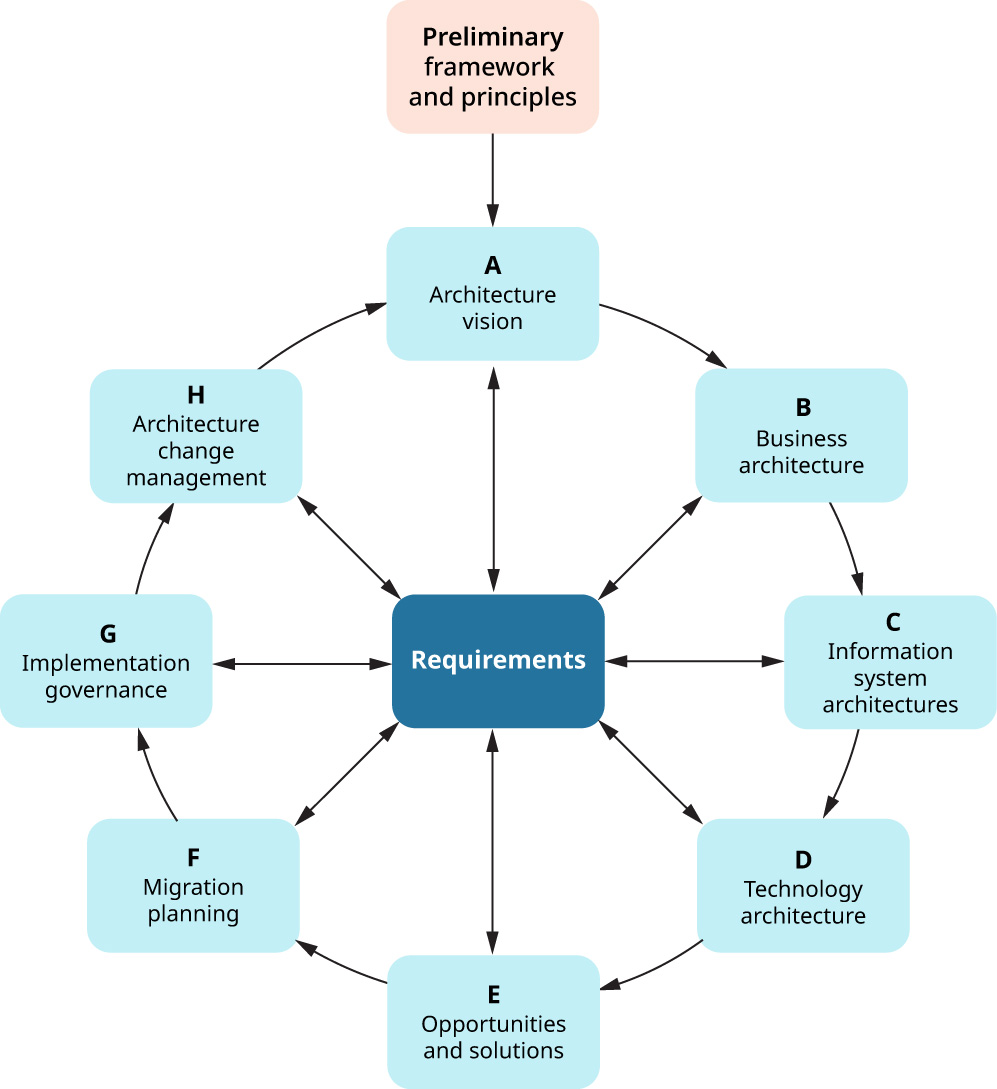
An important approach to testing resource qualities is to log tests performed and continually analyze system changes. This aids in assessing maintainability, survivability, and performance. The TOGAF Architecture Development Model (ADM)3 , centers the requirements around the development process.
英語のヒント
資源の品質をテストする重要な方法は、実施したテストを記録し、システムの変化を継続的に分析することである。これは保守性、生存性、性能の評価を助ける。TOGAFアーキテクチャー開発モデル(ADM)3は、開発プロセスを中心に要件を据える。
credit: modification of “TOGAF ADM” by Stephen Marley/NASA/SCI, Public Domain · Public Domain · Source出典
Figure 14.5 The TOGAF ADM is a standard to assist enterprises in identifying the steps of different activities and the inputs required to develop an architecture. (credit: modification of “TOGAF ADM” by Stephen Marley/NASA/SCI, Public Domain)
図14.5 TOGAF ADMは、アーキテクチャーの開発に必要な、各活動の手順と入力を企業が特定するのを助ける標準である。(クレジット:Stephen Marley/NASA/SCIによる「TOGAF ADM」を改変。パブリックドメイン)
To assess the quality of a platform/solution architecture, TOGAF recommends using a combination of quantitative and qualitative methods. Quantitative methods measure performance against quality attribute scenarios, while qualitative methods review the architecture against best practices, principles, standards, and guidelines. TOGAF provides several tools and techniques for quality assessment, including the following:
プラットフォームやソリューションのアーキテクチャーの品質を評価するため、TOGAFは定量的方法と定性的方法の組み合わせを推奨する。定量的方法は、品質属性のシナリオに照らして性能を測定する。定性的方法は、最善の慣行、原則、標準、指針に照らしてアーキテクチャーを検討する。TOGAFは、以下を含む複数の品質評価ツールと技法を提供する。
2 Center for Internet Security, “CIS critical security controls,” v8.1, 2024. https://www.cisecurity.org/controls 3 Refer to the TOGAF ADM in the TOGAF Standard at https://openstax.org/r/TOGAF
2 Center for Internet Security。「CIS critical security controls」、v8.1、2024年。https://www.cisecurity.org/controls3 TOGAF標準内のTOGAF ADMを参照。https://openstax.org/r/TOGAF
• architecture compliance review to check alignment with enterprise architecture standards and policies
• アーキテクチャー準拠レビュー:企業のアーキテクチャー標準や方針との整合性を確認する。
• architecture maturity assessment to measure maturity level based on a predefined model or framework
• アーキテクチャー成熟度評価:事前に定めたモデルやフレームワークに基づき、成熟度を測定する。
• architecture capability assessment to measure an organization’s capability to deliver and manage an architecture based on a predefined model or framework
• アーキテクチャー能力評価:事前に定めたモデルやフレームワークに基づき、アーキテクチャーを提供・管理する組織の能力を測定する。
• architecture trade-off analysis to compare and balance trade-offs between different quality attributes and design alternatives
• アーキテクチャーのトレードオフ分析:異なる品質属性や設計案の間にあるトレードオフを比較し、バランスを取る。
To improve the quality of a platform/solution architecture, TOGAF recommends a continuous improvement cycle: plan, do, check, and act. In the plan step, define and agree on quality objectives, criteria, and metrics. In the do step, execute and document the quality activities, tasks, and responsibilities. The quality outcomes, results, and feedback are collected and analyzed in the check step. The quality issues, gaps, and opportunities are addressed and resolved in the act step.
英語のヒント
アーキテクチャーの品質を改善するため、TOGAFは計画、実行、確認、改善という継続的な改善サイクルを推奨する。計画段階では、品質の目標、基準、測定指標を定義して合意する。実行段階では、品質に関する活動、タスク、責任を遂行し、記録する。確認段階では、品質の成果、結果、フィードバックを集めて分析する。改善段階では、品質の問題、不足、改善の機会に対処し、解決する。
To ensure the acceptance and adoption of a platform/solution architecture, TOGAF emphasizes quality communication. TOGAF provides various tools and techniques, such as architecture views, viewpoints, models, and documentation. Architecture views represent a subset of architecture, which focuses on a specific quality attribute or concern. Architecture viewpoints specify the conventions and rules for creating and using an architecture view, while architecture models are formal or informal descriptions of an aspect of the architecture. Lastly, architecture documentation collects artifacts that capture and convey information about architecture and decisions.
英語のヒント
プラットフォームやソリューションのアーキテクチャーが受け入れられ、採用されるようにするため、TOGAFは品質に関する情報伝達を重視する。アーキテクチャーのビュー、視点、モデル、文書など、各種のツールと技法を提供する。ビューはアーキテクチャーの一部分を表し、特定の品質属性や関心事に焦点を当てる。視点は、ビューを作成・利用するための慣例と規則を指定する。モデルは、アーキテクチャーのある側面を形式的または非形式的に記述する。最後に、文書化では、アーキテクチャーと意思決定の情報を捉え、伝える成果物を集める。
Cyber resource measurement is a layered process. Remember that according to IBM’s responsible development methodologies, quality assurance should be done during all development steps, not just at the end. Following these steps results in an incremental system with proper checks and controls for security purposes.
英語のヒント
サイバー資源の測定は、層を重ねるプロセスである。IBMの責任ある開発の方法では、品質保証は最後だけでなく、開発のすべての段階で行うべきだということを思い出そう。これらの手順に従うと、安全のための適切な確認と管理を備えた、段階的に構築されるシステムになる。
Web and Mobile Solutions EraWeb・モバイルソリューションの時代
Web, mobile, and IoT solutions are used at a global scale today. We have built development models, created a TRM, and educated computer scientists to prioritize cyber resource qualities. We have set the stage for web and mobile platforms by emphasizing these qualities in development. The TRM’s focus on usability, ease of operation, assurance, security, and adaptability has built a framework for responsible content development. Utilizing web-centric server-side coding, we have created more secure platforms that efficiently communicate through APIs.
英語のヒント
現在、Web、モバイル、IoTのソリューションは世界規模で使われる。私たちは開発モデルとTRMを作り、サイバー資源の品質を優先するようコンピューター科学者を教育してきた。開発でこうした品質を重視することにより、Webとモバイルのプラットフォームの土台を整えた。TRMがユーザビリティー、操作の容易さ、保証、セキュリティー、適応性に重点を置くことで、責任あるコンテンツ開発の枠組みができた。Webを中心とするサーバー側のコードを使い、API経由で効率よく通信する、より安全なプラットフォームを作ってきた。
Scalability, extensibility, and flexibility of web platforms pose significant challenges for cyber quality. In the past, quality focused on ensuring that cyber solutions functioned as intended, but now it is also focused on security. Securing a web platform involves more than just the web front end; it also requires securing the server architecture, the physical locations of the servers, the cloud solutions, and interfaces. Many web platforms use third-party software plug-ins that rely on the proprietary software’s security and quality. Poorly written code is easily exploitable, especially with the widely accessible tools to do so freely accessible on the World Wide Web (WWW), the Internet information system that connects public websites and users.
英語のヒント
Webプラットフォームのスケーラビリティー、拡張可能性、柔軟性は、サイバー品質にとって大きな課題となる。以前は、意図したとおりにソリューションが機能することを品質の中心としたが、現在はセキュリティーも重視する。Webプラットフォームの保護は、フロントエンドだけでは済まない。サーバーのアーキテクチャー、サーバーの物理的な場所、クラウドソリューション、インターフェースも保護する必要がある。多くのWebプラットフォームは第三者のソフトウェアプラグインを使い、そのプロプライエタリーなソフトウェアの安全性と品質に依存する。質の低いコードは容易に悪用される。公開Webサイトと利用者を結び付けるインターネットの情報システムであるWorld Wide Web(WWW)では、悪用のためのツールを無料で広く入手できるため、なおさらである。
Web platforms have continuously changed in direction and architecture design. The architectural principles of the Internet stated in the Request for Comments (RFC) 1958 set forth by the Internet Engineering Task Force (IETF) in June 1996.4 Knowing that the Internet had to be able to change was a design principle. Anticipating that IP addresses would need to adapt or be replaced at some point because the number of devices would exceed the allotted number was a guiding principle that forced the Internet to be scalable and extensible. Quality of service and assurance/security concerns drive the commercial Internet. Initially, the Internet’s architecture was unregulated, and there was no mandate for IP address allocation or domain name services (DNS) from the Internet Architecture Board (IAB). Public Internet is now ubiquitous in most economic areas of the world. The increase in mobile platforms and the continuous need to be connected pushes the boundaries of cyber quality beyond the original architectural goals of the Internet. Performance and usability demands drive technology and the Internet to adapt and create new mediums easily adapted into scalable infrastructure.
英語のヒント
Webプラットフォームの方向性とアーキテクチャー設計は、変わり続けてきた。インターネットのアーキテクチャー原則は、Internet Engineering Task Force(IETF)が1996年6月に提示したRequest for Comments(RFC)1958に述べられている。4インターネットは変化できなければならないという認識が、設計原則だった。装置数が割り当て可能な数を超えるため、いずれIPアドレスを適応させるか置き換える必要があるという予測が、スケーラビリティーと拡張可能性をインターネットに求める指導原則となった。商用インターネットを動かすのは、サービス品質と保証・セキュリティーへの関心である。当初、そのアーキテクチャーは規制されておらず、Internet Architecture Board(IAB)によるIPアドレス割り当てやドメインネームサービス(DNS)の義務付けもなかった。現在、公開インターネットは世界のほとんどの経済圏に行き渡っている。モバイルプラットフォームの増加と、常に接続していたいという必要が、サイバー品質の範囲を当初のアーキテクチャーの目標より先へ押し広げる。性能と使いやすさへの要求が、技術とインターネットを適応させ、規模を拡大できる基盤に容易に組み込める新しい媒体を生み出す。