第5章アルゴリズムのハードウェアによる実現:コンピューターシステム設計
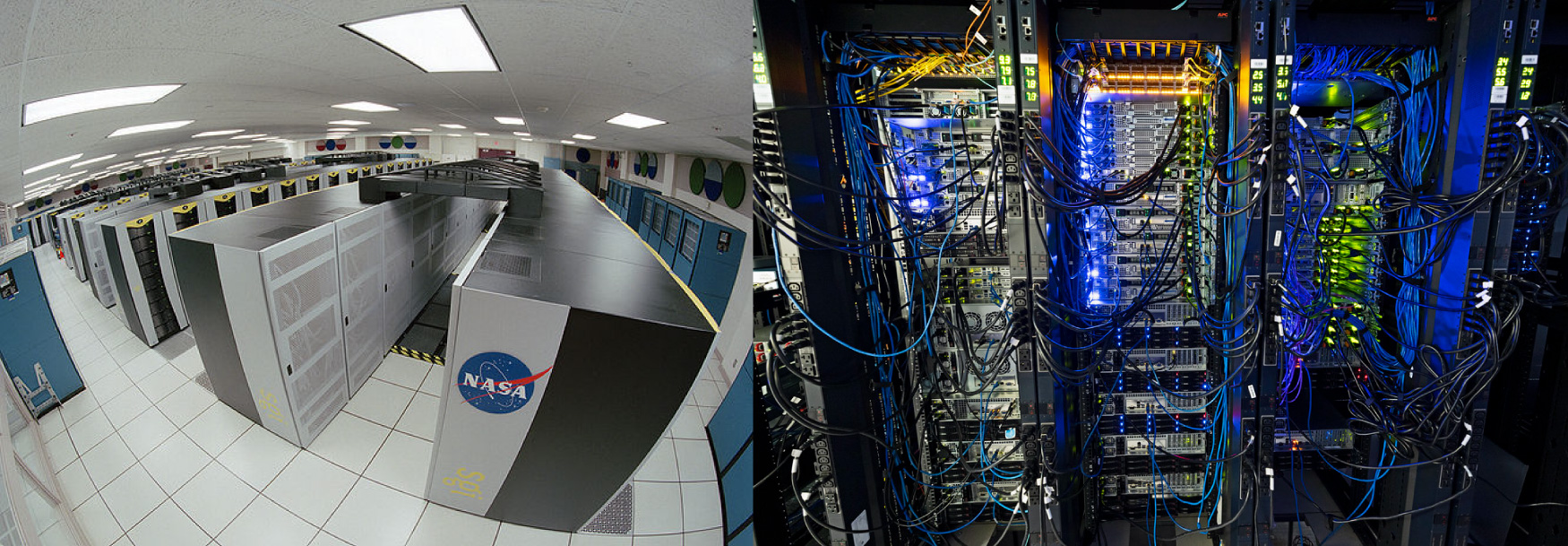
credit left: modification of “Columbia Supercomputer—NASA Advanced Super computing Facility” by Trower, NASA/ Goddard Space Flight Center, Public Domain; credit right: modification of "2020 Data Center" by Jefferson Lab/Flickr, Public Domain) · Public Domain · Source出典
Figure 5.1 What does the word computer really mean? For example, supercomputers (left) and data centers (right) are types of computers. "(credit left: modification of “Columbia Supercomputer—NASA Advanced Supercomputing Facility” by Trower, NASA/ Goddard Space Flight Center, Public Domain; credit right: modification of "2020 Data Center" by Jefferson Lab/Flickr, Public Domain)"
図5.1 コンピューターという言葉は、本当は何を意味するのだろうか。例えば、スーパーコンピューター(左)やデータセンター(右)もコンピューターの一種である。(左のクレジット:Trower、NASA/Goddard Space Flight Centerによる「Columbia Supercomputer—NASA Advanced Supercomputing Facility」を改変、パブリックドメイン。右のクレジット:Jefferson Lab/Flickrによる「2020 Data Center」を改変、パブリックドメイン)
Introductionはじめに
We use the word computer a lot, but we may not know a precise definition of it. More often than not, we use it to mean our desktops and laptops. But computers exist in many different forms, like your laptop, smartphone, or tablet. Embedded processors are used to power smart home security systems. When you access your social media accounts on Facebook, Twitter, Instagram, or any website, you are using very big computers hosted by these companies. These huge and powerful computers are clusters of computers hosted in data centers and supercomputers for some applications.
英語のヒント
私たちはコンピューターという言葉をよく使うが、その正確な定義を知っているとは限らない。多くの場合、デスクトップやノートパソコンを指してこの言葉を使う。しかし、コンピューターには、ノートパソコン、スマートフォン、タブレットなど、さまざまな形態がある。スマートホームの防犯システムも組み込みプロセッサで動いている。Facebook、Twitter、Instagramのアカウントや何らかのWebサイトにアクセスするときには、その企業が設置する非常に大きなコンピューターを利用している。こうした巨大で強力なコンピューターは、データセンターに設置されたコンピューター群や、用途によってはスーパーコンピューターである。
These computers have many things in common, but they also differ in many aspects. In general, computers all have processors, memory, storage, and input/output devices such as keyboards, screens, and speakers. What are these components? And how do they interact with each other to form what we know as a computer? This is what we will explore in this chapter. The difference between the computer inside your watch and the one running the big sites is the number and strength of processors (computer brain), the size of memory and disks (main means of storage), and how these many pieces are connected to each other. But the main concepts are the same.
英語のヒント
これらのコンピューターには多くの共通点がある一方、さまざまな違いもある。一般に、コンピューターはすべて、プロセッサ、メモリ、ストレージ、そしてキーボード・画面・スピーカーなどの入出力装置を備えている。これらはどのような部品なのだろうか。また、どう相互に働き、私たちがコンピューターと呼ぶものを構成しているのだろうか。本章ではそれを探っていく。腕時計の中のコンピューターと、大規模なサイトを動かすコンピューターの違いは、プロセッサ(コンピューターの頭脳)の数と能力、メモリとディスク(主な記憶手段)の容量、そしてそれらの部品同士の接続方法にある。しかし、基本となる考え方は同じである。
A computer’s main job, as you may have guessed, is to do computations—a lot of computations. The faster a computer, the more computations it can do per second. All computer programs you use are based on computations, whether a modern immersive graphics intensive game that leverages artificial intelligence (AI), a text editor, or a web browser. In this chapter, you will learn how computers can do computations in a fast and correct manner using processors, memory, disks, and other related hardware.
英語のヒント
すでに想像したかもしれないが、コンピューターの主な仕事は計算、それも大量の計算をすることだ。コンピューターが速いほど、1秒間に多くの計算ができる。AIを活用し、高度なグラフィックスを大量に使う現代の没入型ゲームでも、テキストエディターでも、Webブラウザーでも、私たちが使うコンピュータープログラムはすべて計算を基礎としている。本章では、プロセッサ、メモリ、ディスク、その他の関連するハードウェアを使って、コンピューターがどう高速かつ正確に計算するのかを学ぶ。
A company called TechWorks is taking advantage of leverages such as the latest nanotechnology, processor models known as neuromorphic processors, to enable the creation of the next generation of super society intelligent autonomous solutions (e.g., advanced robotics, autonomous cars and drones, or other autonomous systems). The use of Intel’s Kapoho Point 8-chip Loihi 2 board technology allows TechWorks’ developers to solve larger problems by stacking large-scale workloads and enabling AI models with up to one billion parameters and solving optimization problems with up to eight million variables.
英語のヒント
TechWorksという企業は、最新のナノテクノロジーやニューロモーフィック・プロセッサと呼ばれるプロセッサモデルなどを活用し、次世代の超社会に向けた知的自律型ソリューションの開発を可能にしようとしている。例えば、高度なロボティクス、自律走行車やドローン、その他の自律システムなどだ。IntelのLoihi 2チップを8個搭載したKapoho Pointボード技術を使うことで、TechWorksの開発者は大規模なワークロードを積み重ね、最大10億個のパラメーターをもつAIモデルを動かし、最大800万個の変数をもつ最適化問題を解くことができ、より大きな問題に取り組める。