第14章サイバー資源の品質とサイバーコンピューティングのガバナンス
GLOBAL ISSUES IN TECHNOLOGY技術をめぐる世界的な課題
Technology Skills Gap技術の技能格差
A big challenge in technology is the growing issue of the skills gap. There is a mismatch between what is needed in the industry and what students learn in colleges and universities and industry certificates. Many companies are advertising for software engineers with three to five years’ experience and not entry-level positions. The demand on companies forces them to look for workers who can hit the ground running with little supervision. The need for entry-level jobs is increasing, but the pay scale is not what people can afford to take after graduating from college. The amount of debt students are accruing to earn their degrees is increasing, and students are forced to take jobs they know they won’t like, only to get the experience to jump to a better-paying job. The skill gap is increasing in the areas of cybersecurity and data analytics.
英語のヒント
技術の大きな課題は、技能の隔たりが広がっていることである。業界が必要とすることと、大学や業界資格で学生が学ぶことが一致しない。多くの企業は、未経験者向けの職ではなく、3〜5年の経験を持つソフトウェア技術者を募集する。企業にかかる要求によって、ほとんど指導せずに、すぐ活躍できる人を探すことになる。未経験者向けの仕事の必要は増しているが、賃金は、大学を出た人が生活できる水準ではない。学位を得るまでに学生が積み上げる借金は増えている。そのため、より給料のよい仕事へ移る経験を得るためだけに、好きになれないと分かっている仕事に就かざるをえない。サイバーセキュリティーとデータ分析では、技能の隔たりが広がっている。
The cybersecurity skills gap is framed from the perspective of individuals in the industry repurposing themselves. People who have been in the computer industry are retooling themselves to be part of the cybersecurity demands. If you are an IT professional with years of experience and have a certificate or degree in cybersecurity, it is hard to start over at the lower end of the job pool. These individuals want management or higher-end jobs, but they have only entry-level skills. This creates a divide because these individuals have the experience to be successful in the industry and don’t need as much assistance as a pure entry-level employee.
英語のヒント
サイバーセキュリティーの技能格差は、業界内の人々が自分の役割を変えるという観点でも捉えられる。コンピューター業界で働いてきた人が、新しい技能を身に付け、その需要に応えようとしている。何年もの経験とサイバーセキュリティーの資格・学位を持つIT専門家にとって、仕事の下位の段階からやり直すのは難しい。管理職や上位の職を望むが、その分野の技能は初級者の水準でしかない。業界で成功するための経験を持ち、全くの初級者ほど助けを必要としないため、ここに隔たりが生まれる。
Key Cybersecurity Technologies and Best Practices主要なサイバーセキュリティー技術と最善の慣行
Key cybersecurity technology and associated best practices typically fall under three categories: identity and access management, a data security platform, and security information and event management.
主要なサイバーセキュリティー技術と関連する最善の慣行は、通常、ID・アクセス管理、データセキュリティープラットフォーム、セキュリティー情報・イベント管理の三つに分かれる。
The technology used to manage users’ roles and access privileges is identity and access management (IAM). Approaches used to allow access to systems include single sign-on (SSO), multifactor authentication, privileged user accounts, and user life cycle management. SSO keeps users from entering their credentials multiple times within the same session. Multifactor authentication leverages multiple access credentials provided via different devices. Privileged user accounts are only accessible to specific users. User life cycle management handles user credentials from initial registration to retirement. Cybersecurity professionals use IAM tools to investigate and respond to security issues remotely and contain breach damages.
英語のヒント
利用者の役割とアクセス権限を管理する技術を、ID・アクセス管理(IAM)という。アクセスを認める方法には、シングルサインオン(SSO)、多要素認証、特権利用者アカウント、利用者のライフサイクル管理がある。SSOは、同じセッション内で何度も認証情報を入力する必要をなくす。多要素認証は、異なる装置を通じて提供される複数の認証情報を利用する。特権利用者アカウントは特定の利用者だけが使える。ライフサイクル管理は、登録から廃止までの認証情報を扱う。専門家はIAMツールで、安全上の問題を遠隔から調査・対応し、侵害の被害を封じ込める。
A data security platform is meant to automate the proactive protection of information via monitoring and detecting data vulnerabilities and risks across multiple environments, including hybrid and multicloud platforms. The protection provided by a data security platform simplifies compliance with data privacy regulations and supports backups and encryption to keep data safe.
データセキュリティープラットフォームは、ハイブリッドやマルチクラウドを含む複数の環境で、データの脆弱性と危険を監視・検出し、先を見越した情報保護を自動化するためのものである。提供される保護は、データプライバシー規則への準拠を簡単にし、安全を保つバックアップと暗号化を支える。
The practice of security information and event management (SIEM) focuses proactively on the automated detection and remediation of suspicious user activities based on the analysis of security events. SIEM solutions typically analyze user behavior and use artificial intelligence (AI) techniques to detect and remediate suspicious activities according to the organization’s risk management guidelines. SIEM tools may be integrated with security orchestration, automation, and response (SOAR) platforms designed to fully automate the management of cybersecurity incidents without human intervention.
英語のヒント
セキュリティー情報・イベント管理(SIEM)は、安全に関わる出来事の分析に基づき、疑わしい利用者活動を先回りして自動検出し、是正することに重点を置く。通常、利用者の行動を分析し、AI技術を使って、組織のリスク管理指針に沿って不審な活動を検出・是正する。SIEMツールは、セキュリティーのオーケストレーション・自動化・対応(SOAR)プラットフォームに統合できる場合がある。人が介入せず、事故の管理を完全に自動化するために設計された基盤である。
Some organizations also choose to use a zero-trust strategy, which assumes the system is compromised and sets up controls to continuously validate every user, device, and connection in the system for authenticity and purpose.
英語のヒント
ゼロトラスト戦略を使う組織もある。システムは侵害されていると仮定し、すべての利用者、装置、接続の真正性と目的を継続して確かめる管理策を設ける。
LINK TO LEARNING学習リンク
Cybersecurity is big business, and many companies in the technology industry have developed cybersecurity solutions and services that they sell to other organizations. In particular, IBM provides a variety of such solutions and services (https://openstax.org/r/76ibm) to cover all aspects of cybersecurity, including AI and cloud security.
サイバーセキュリティーは大きな事業であり、多くの技術企業が、他の組織へ販売するソリューションやサービスを開発している。特にIBMは、AIとクラウドの安全を含む全領域に対応する、さまざまな製品・サービス(https://openstax.org/r/76ibm)を提供する。
Securing Information and Communication情報と通信を保護する
Cryptography is an essential tool for securing information systems, which use codes to protect data and other information. With cryptography, information is encrypted and accessible only by those authorized to decrypt and use the information.
英語のヒント
暗号技術は、データなどの情報を符号で守る情報システムの保護に欠かせない道具である。情報を暗号化し、復号して利用する権限を持つ人だけがアクセスできるようにする。
Cryptography can help ensure properties such as confidentiality (i.e., secrecy, privacy), integrity (i.e., tamper resilience), authenticity, availability, and nonrepudiability (or deniability).
英語のヒント
暗号技術は、機密性、すなわち秘密・プライバシー、完全性、すなわち改ざんへの耐性、真正性、可用性、否認不可能性、あるいは否認可能性といった性質の確保を助ける。
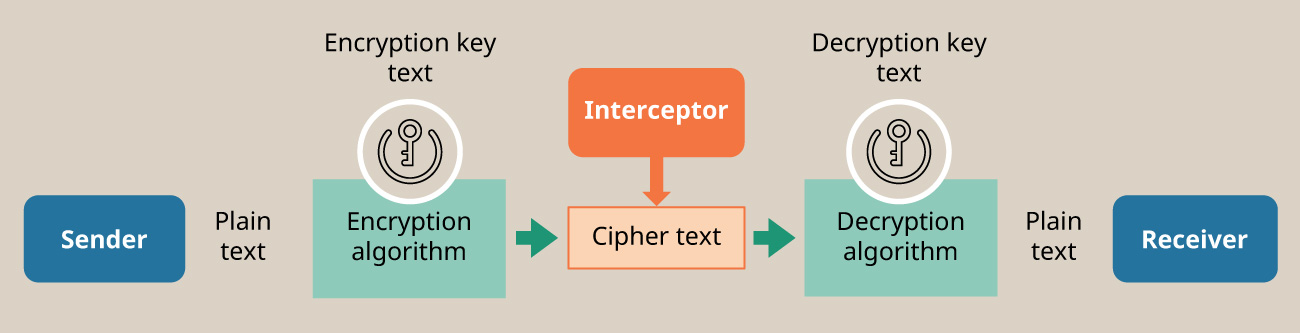
As shown in Figure 14.8, the components of cryptography include the following:
図14.8に示すように、暗号技術には次の構成要素がある。
• plaintext: refers to the data that need protection
• 平文:保護が必要なデータを指す。
• encryption: handled by an algorithm, and creates ciphertext and an encryption key for plaintext
• 暗号化:アルゴリズムが扱い、平文に対する暗号文と暗号化鍵を作る。
• ciphertext: uses an encryption key to scramble plaintext
• 暗号文:暗号化鍵を使い、平文をかき混ぜる。
• decryption: also handled by an algorithm, and uses a decryption key to transform the ciphertext back into plaintext
• 復号:これもアルゴリズムが扱い、復号鍵を使って暗号文を平文へ戻す。
• encryption key: value known to the sender of the data; by inputting the encryption key into the encryption algorithm, the sender converts the plaintext into ciphertext
• 暗号化鍵:データの送信者が知る値。この鍵を暗号化アルゴリズムへ入力し、平文を暗号文へ変換する。
• decryption key: value known to the receiver of the data; by inputting the decryption key into the decryption algorithm, the receiver converts the ciphertext back into plaintext
• 復号鍵:データの受信者が知る値。この鍵を復号アルゴリズムへ入力し、暗号文を平文へ戻す。
attribution: Copyright Rice University, OpenStax, under CC BY 4.0 license; credit key icon: modification of "Accessible" by Phạm Thanh Lộc/Wikimedia Commons, CC BY 4.0 · CC BY 4.0 · Source出典
Figure 14.8 Cryptography is a process that enables senders and receivers to secure digital data by using encryption and decryption algorithms. (attribution: Copyright Rice University, OpenStax, under CC BY 4.0 license; credit key icon: modification of "Accessible" by Phạm Thanh Lộc/Wikimedia Commons, CC BY 4.0)
図14.8 暗号技術は、暗号化と復号のアルゴリズムを使い、送信者と受信者がデジタルデータを保護できるようにする過程である。(帰属表示:著作権 Rice University、OpenStax、CC BY 4.0。鍵のアイコン:Phạm Thanh Lộc/Wikimedia Commonsによる「Accessible」を改変、CC BY 4.0)
Cryptography can be used to create different types of ciphers, including the following:
暗号技術を使い、次のような異なる種類の暗号を作れる。
• Substitution: Ciphertext is created by substituting plaintext characters, bits, or character blocks with alternate characters, bits, or character blocks. The substitution can be monoalphabetic, meaning that if the letter D is enciphered as P in one part of the ciphertext, D will be used for P throughout the message. The substitution can also be polyalphabetic, meaning that while D may be enciphered as P in one part of the message, in another part, D may be encoded as a different letter.
英語のヒント
• 換字:平文の文字、ビット、文字のブロックを別の文字、ビット、ブロックに置き換え、暗号文を作る。単一換字の場合、暗号文のある部分でDをPに暗号化すると、メッセージ全体でPの代わりにDを使う。多表式の換字もあり、ある部分でDをPに暗号化しても、別の部分では異なる文字で符号化することがある。
• Transposition: Instead of substituting the letters and characters, they are rearranged using a specific algorithm, such as writing a message vertically to produce a ciphertext that is read horizontally. Transposition ciphers are also known as permutation ciphers.
英語のヒント
• 転置:文字や記号を置き換える代わりに、特定のアルゴリズムで並べ替える。例えば、メッセージを縦に書き、横に読む暗号文を作る。転置暗号は、置換暗号とも呼ばれる。
• Polygraphic: Substitution is performed on two or more blocks of letters simultaneously.
• 多字式:二つ以上の文字のブロックに、同時に換字を行う。
Cryptography can also be performed using asymmetric encryption (also known as public-key cryptography), which uses private and public keys. With public-key cryptography, the sender and receiver have a preshared secret key to handle encryption and decryption. In public-key cryptography, the sender uses the receiver’s public key to encrypt the message and then send that ciphertext to the receiver. Only the receiver has the private key that is needed to decrypt the message.
英語のヒント
秘密鍵と公開鍵を使う非対称暗号、すなわち公開鍵暗号を使うこともできる。公開鍵暗号では、送信者と受信者は、暗号化と復号を行うため、事前に共有した秘密鍵を持つ。送信者は受信者の公開鍵でメッセージを暗号化し、暗号文を送る。復号に必要な秘密鍵は、受信者だけが持つ。