第14章サイバー資源の品質とサイバーコンピューティングのガバナンス
Open Web Platform Quality ChallengesオープンWebプラットフォームの品質上の課題
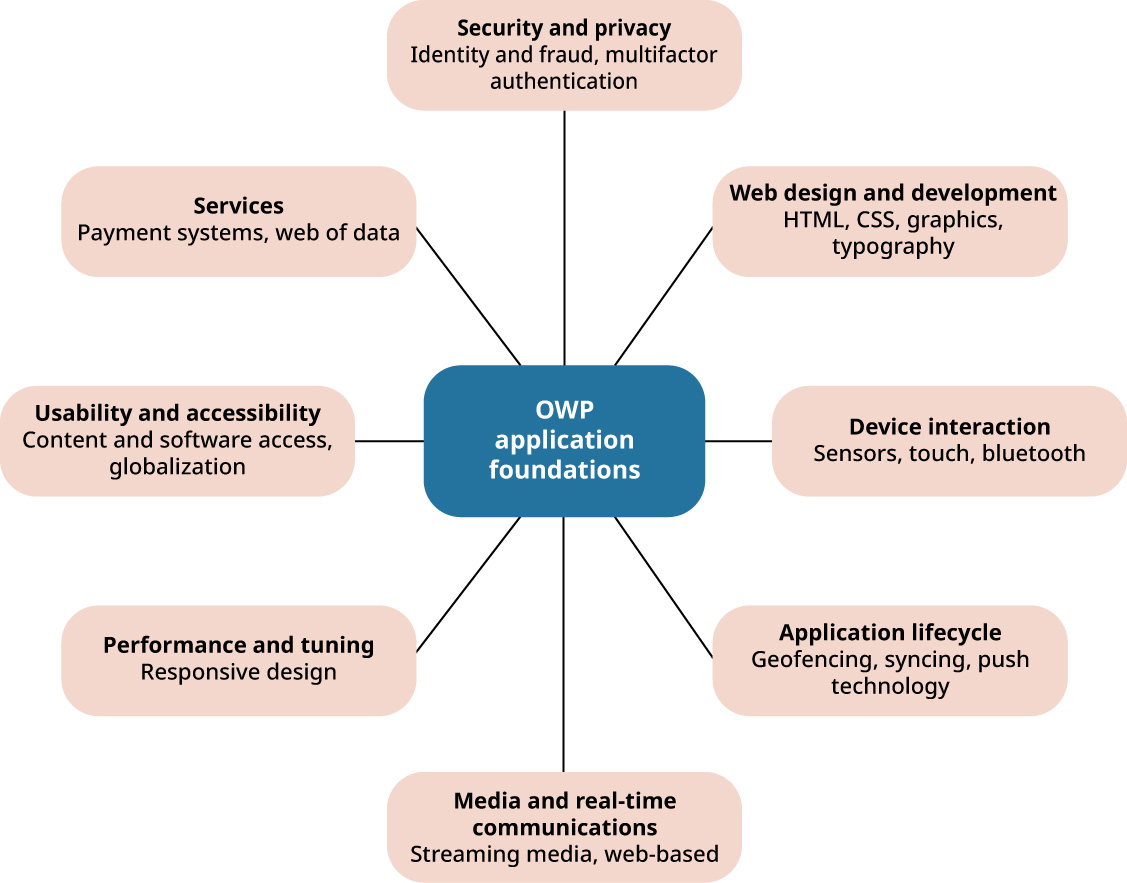
The Open Web Platform (OWP) initiative was designed to offer royalty-free (open) technologies for web platforms.5 Its goal was to provide a foundation of services and capabilities for developing web/mobile applications, as illustrated in Figure 14.6. Using the OWP, everyone can implement a web or mobile solution without requiring approvals or license fees and maximizing usability and accessibility.
英語のヒント
attribution: Copyright Rice University, OpenStax, under CC BY 4.0 license · CC BY 4.0 · Source出典
Figure 14.6 The foundational characteristics of OWP solutions allow anyone to implement a web or mobile solution without licensing. (attribution: Copyright Rice University, OpenStax, under CC BY 4.0 license)
図14.6 OWPソリューションの基盤となる特徴によって、誰でもライセンスの取得なしにWebやモバイルのソリューションを実装できる。(帰属表示:著作権 Rice University、OpenStax、CC BY 4.0)
The cyber qualities of these technologies are continuously evaluated. People want free web applications that are easy to use, have good performance, are secure (always an afterthought), are compatible with their current technology, and, most of all, remain free and open to the public. Security plays a significant role in the adoption, and ease of use is often a struggle. The most straightforward security measure, restricting access to the system, is not feasible if companies want to interact with the world. Several companies, like Meta, use a limited functional interface called a walled garden approach, which limits openness and prevents users from accessing a platform. This approach goes against the spirit of OWP. Open web platforms like WordPress and Drupal provide user-friendly web design through drag-and-drop web page creation frameworks. However, updates to these technologies can break other areas or disrupt compatibility with other open web software packages. To mitigate this, people and companies are adopting the walled garden approach to web applications, limiting controls and plug-ins, and the developer can incorporate their own HTML security measures.
英語のヒント
こうした技術のサイバー品質は、継続的に評価される。人々は、使いやすく、性能がよく、安全であり――安全はいつも後から考慮されるが――、今使っている技術と互換性があり、何よりも無料で一般に開かれ続けるWebアプリケーションを望む。セキュリティーは採用の判断で大きな役割を果たし、使いやすさの確保には苦労することが多い。最も単純な安全対策である、システムへのアクセス制限は、企業が世界とやり取りしたいなら実行できない。Metaなどの企業は、ウォールドガーデン方式と呼ばれる、機能を制限したインターフェースを使う。これは開放性を制限し、利用者のプラットフォームへのアクセスを妨げる。OWPの精神に反する方式である。WordPressやDrupalのようなオープンWebプラットフォームは、ドラッグ&ドロップによるページ作成フレームワークを通じ、使いやすいWeb設計を提供する。しかし、こうした技術を更新すると、他の部分が壊れたり、別のオープンWebソフトウェアパッケージとの互換性が損なわれたりすることがある。これを緩和するため、個人や企業は、操作やプラグインを制限するウォールドガーデン方式をWebアプリケーションに採用している。開発者は独自のHTMLのセキュリティー対策を組み込める。
4 See Network Working Group, “Architectural principles of the Internet,” June 1996. https://datatracker.ietf.org/doc/html/rfc1958 5 See W3C, “Open web platform,” August 27, 2020. https://www.w3.org/wiki/Open_Web_Platform.
4 Network Working Group。「Architectural principles of the Internet」、1996年6月。https://datatracker.ietf.org/doc/html/rfc1958 を参照。5 W3C。「Open web platform」、2020年8月27日。https://www.w3.org/wiki/Open_Web_Platform を参照。
The wall garden approach goes against the principles of the OWP. The concept of “openness” wants technology to be free and interoperable. Giving individuals a subset of technologies and forcing them only to use those technologies diminishes the power and expansibility of the Internet.
英語のヒント
ウォールドガーデン方式は、OWPの原則に反する。「開放性」という考えは、技術が自由に使え、相互運用できることを求める。限られた技術だけを個人に与え、それだけを使うよう強いると、インターネットの力と拡張性が損なわれる。
Modern Web/Mobile Solutions Quality Challenges現代のWeb・モバイルソリューションの品質上の課題
The World Wide Web (WWW) demands 24/7 access as users expect constant availability. Companies like Amazon have set the bar for quality of service and how fast a product purchased on the Web can be delivered to a residency. Smartphones and the IoT have provided new access models to services and goods. What challenges does this pose?
英語のヒント
World Wide Web(WWW)は、利用者が常時利用できることを期待するため、24時間365日のアクセスを求める。Amazonのような企業は、サービス品質と、Webで買った製品をどれだけ速く住居へ届けられるかについて、基準を引き上げた。スマートフォンとIoTは、サービスと商品にアクセスする新しい方法を提供した。これはどのような課題をもたらすだろうか。
• Account management: Users have numerous online accounts, requiring unique, strong passwords for each. Research by Colorlib in May 2023 found that the average person has 100 accounts needing passwords, up from 70–80 in 2022.6 This growth highlights the challenge of managing diverse and increasing technology.
英語のヒント
• アカウント管理:利用者はオンラインのアカウントを多数持ち、それぞれに固有で強力なパスワードが必要となる。Colorlibが2023年5月に行った調査では、1人当たりのパスワードを必要とするアカウント数は平均100で、2022年の70〜80から増加した。6 この増加は、多様化し、増え続ける技術の管理が難しいことを示している。
• Workforce shortage: There is a shortage of qualified professionals. Higher education and companies like Microsoft, CompTIA, and CISCO provide certifications to prepare workers, but students without industry experience struggle to find suitable jobs, and entry-level positions are limited.
英語のヒント
• 人材不足:資格・能力を持つ専門家が不足している。高等教育機関や、Microsoft、CompTIA、CISCOなどの企業は、働く人の準備を整える資格を提供する。しかし、業界経験のない学生は適切な仕事を見つけるのに苦労し、未経験者向けの職は限られている。
• Threat landscape: The rapid growth of web platforms and technology increases security challenges. The use of cloud technology and IoT devices introduces new vulnerabilities. Companies like Microsoft invest heavily in training programs and certifications, particularly for securing Azure web platforms.
英語のヒント
• 脅威の状況:Webプラットフォームと技術の急成長により、セキュリティーの課題が増える。クラウド技術とIoT装置の利用は、新たな脆弱性を持ち込む。Microsoftなどの企業は、特にAzureのWebプラットフォームを保護するための研修や資格に、多額の投資を行っている。
Modern Walled Garden Platforms Quality Challenges現代のウォールドガーデンプラットフォームの品質上の課題
The main challenge for Walled Garden Platforms is interoperability. For instance, WordPress offers more than 59,000 plug-ins. While these plug-ins allow for customization, only cosmetic changes are typically possible. This allows security to be maintained in a walled garden approach. Plug-ins are tested for security issues before being added to a library. However, using plug-ins in ways they were not intended can create vulnerabilities. Using plug-ins in untested ways goes against IBM’s responsible coding practices. Then questions must be asked, such as who is responsible for the misuse? Who is responsible for updating the plug-ins for newfound security issues? And lastly, who is responsible for removing outdated plug-ins, whose functionality no longer works with the current technology?
英語のヒント
ウォールドガーデンプラットフォームの主な課題は相互運用性である。例えばWordPressは59,000を超えるプラグインを提供する。カスタマイズはできるが、通常、見た目の変更しかできない。このことが、ウォールドガーデン方式でセキュリティーを保つのを可能にする。プラグインはライブラリーへ加える前に、安全上の問題がないかテストされる。しかし、意図されていない使い方は脆弱性を生むことがある。未検証の方法でプラグインを使うのは、IBMの責任あるコーディングの慣行に反する。そこで、誰が誤用の責任を負うのか、新たに見つかったセキュリティー問題に対する更新は誰の責任か、そして現在の技術では機能しなくなった古いプラグインを取り除くのは誰の責任か、といった問いが必要になる。
Using frameworks to assess the proper development of websites and content should be a requirement for web programmers. Insecure content puts users at risk. Security frameworks, plans, and walled garden approaches can enhance web platform security. However, this requires skilled developers and available resources.
英語のヒント
Webプログラマーには、Webサイトとコンテンツが適切に開発されているかを、フレームワークで評価することを要求すべきである。安全でないコンテンツは利用者を危険にさらす。セキュリティーの枠組み、計画、ウォールドガーデン方式は、Webプラットフォームの安全性を高められる。しかし、そのためには熟練した開発者と、利用できる資源が必要である。