第14章サイバー資源の品質とサイバーコンピューティングのガバナンス
14.1 Cyber Resources Management Frameworks14.1 サイバー資源管理のフレームワーク
Learning Objectives学習目標
By the end of this section, you will be able to:
この節を終えると、次のことができるようになる。
• Describe cyber resources quality requirements
• サイバー資源の品質要件を説明する。
• Analyze various frameworks developed over time to manage cyber resources
• サイバー資源を管理するため、時代とともに開発されてきた各種フレームワークを分析する。
• Identify specific cyber resources qualities such as cybersecurity
• サイバーセキュリティーなど、サイバー資源の具体的な品質特性を特定する。
• Explain the growing challenges that are faced by innovative web solutions
• 革新的なWebソリューションが直面する、増大する課題を説明する。
• Analyze cloud cyber resource implementation strategies
• クラウドのサイバー資源の実装戦略を分析する。
• Describe the metaverse ecosystem and its cyber resource challenges
• メタバースのエコシステムと、そこにあるサイバー資源の課題を説明する。
The “cyber” qualifier typically applies to anything related to computers or information technology. Cyber resources include cyber platforms, solutions, processes, policies, and procedures or guidelines required. Cyber resources store, process, and manage data and other assets electronically and make them available via networks. Cyber resources must be evaluated in a world heavily inundated with computers to ensure they conform to best practices and meet certain quality requirements. The qualities expected from cyber resources include security, safety, performance, usability, reliability, and autonomy. These qualities apply to the various architectural components of cyber resources, including business, application, data (and the pyramid of knowledge layers above data, including information, and knowledge), and infrastructure components. Cyber resources’ qualities are typically paired with one another and enhanced to optimize user experience. For example, technology solutions that leverage front-end interaction must be usable and ensure safety in various forms (e.g., data protection and user safety).
英語のヒント
「サイバー」という修飾語は、通常、コンピューターや情報技術に関するあらゆるものに付く。サイバー資源には、サイバープラットフォーム、ソリューション、プロセス、方針、必要な手順や指針が含まれる。これらは、データなどの資産を電子的に保存・処理・管理し、ネットワークを通じて利用できるようにする。コンピューターがあふれる世界では、サイバー資源が最善の慣行に従い、一定の品質要件を満たすように評価しなければならない。期待される品質特性には、セキュリティー、安全性、性能、ユーザビリティー、信頼性、自律性がある。これらは、サイバー資源のアーキテクチャーのさまざまな構成要素に適用される。事業、アプリケーション、データと、その上位にある情報・知識などの知識ピラミッドの層、そしてインフラストラクチャーである。利用体験を最適化するため、品質特性は通常、互いに組み合わせて高められる。例えば、フロントエンドのやり取りを利用する技術的ソリューションは、使いやすく、データ保護や利用者の安全など、各種の安全を確保しなければならない。
While cybersecurity is meant to ensure the quality of an organization’s cyber resources, it also calls for a specific cyber resource that encompasses the policies, procedures, technology, and other tools, including people, that organizations rely on to protect their computer systems and technological environments from digital threats. Regarding cybersecurity, organizations typically implement an information security policy (ISP) that outlines security practices for employees and systems. Since organizations’ assets are not always information-centric, the ISP policy applies to all organizational architectural components, including its business, applications, data (and associated pyramid of knowledge layers), and infrastructure. For example, the ISP policy details how the various infrastructure components are evaluated and outlines how the organization’s information is secured. An ISP policy typically includes safety procedures and best performance practices, but it does not handhold workers through their jobs by telling employees how to maintain safety and perform within their role.
英語のヒント
サイバーセキュリティーは組織のサイバー資源の品質を確保するためのものだが、そのために特定のサイバー資源も必要とする。それは、コンピューターシステムや技術環境をデジタルの脅威から守るために組織が頼る、方針、手順、技術、人を含む各種の手段を包括するものである。組織は通常、従業員とシステムのセキュリティー慣行を定める情報セキュリティーポリシー(ISP)を実施する。資産は必ずしも情報を中心としたものばかりではないため、ISPは、事業、アプリケーション、データと関連する知識ピラミッドの層、インフラストラクチャーを含む、組織のアーキテクチャーの全構成要素に適用される。例えばISPは、インフラストラクチャーの各構成要素をどのように評価するかを詳しく定め、情報をどのように保護するかを示す。通常、安全の手順と、最善の性能を得るための慣行を含む。しかし、各従業員にその役割の中で安全を保ち、仕事を進める方法を逐一指示して、手取り足取り導くものではない。
To help manage the development of cyber resources architectures that abide by specific requirements, organizations typically choose a specific framework, or a Technical Reference Model (TRM), that details the technologies and standards that should be used to develop systems and deliver services. Analyzing frameworks, which can be complete or incomplete, helps determine which TRM applies to an organization’s needs. However, most TRMs and related frameworks briefly outline procedures or system structures/ capabilities. It then becomes the responsibility of the workers to determine how to best adapt the framework to their company’s needs. In adopting these TRMs and frameworks, computer scientists need to take a proactive approach to enhance the overall quality of cyber resources, including cybersecurity.
英語のヒント
特定の要件を守るサイバー資源のアーキテクチャーの開発を管理しやすくするため、組織は通常、特定のフレームワーク、すなわち技術参照モデル(TRM)を選ぶ。システムの開発とサービスの提供に使うべき技術と標準を詳しく示すものである。完全なものも不完全なものもあるフレームワークを分析すると、組織の必要に合うTRMを判断できる。しかし、ほとんどのTRMと関連フレームワークは、手順やシステムの構造・能力を簡潔に概説するだけである。したがって、自社の必要に最もよく適応させる方法を決めるのは、働く人々の責任となる。こうしたTRMやフレームワークを採用する際、コンピューター科学者は、サイバーセキュリティーを含むサイバー資源全体の品質を高めるため、先を見越して行動する必要がある。
In 2012, a reference model and associated framework referred to as The Open Group Architechture Framework (TOGAF) TRM was created to help users develop architectures based on their specific requirements. It champions a layered and componentized architecture that can be leveraged to develop specialized domain and industry architectures for infrastructure and business applications. It also provides a set of qualities that these specialized architectures and the applications that use them must fulfill.
英語のヒント
2012年、利用者がそれぞれの要件に基づくアーキテクチャーを開発できるよう、The Open Group Architechture Framework(TOGAF)TRMと呼ばれる参照モデルと関連フレームワークが作られた。階層化され、構成要素に分かれたアーキテクチャーを推進し、インフラストラクチャーと業務アプリケーション向けに、特定の領域や業界のアーキテクチャーを開発する際に利用できる。また、それらの専門的なアーキテクチャーと、それを使うアプリケーションが満たすべき品質特性も提示する。
LINK TO LEARNING学習リンク
Read this TOGAF Series Guide (https://openstax.org/r/76togaf) on the TOGAF Reference Model from The Open Group for more information about TOGAF, including a diagram that shows the Technical Reference Model in detail. The TOGAF Reference Model shows the service categories that may apply to an information system. Not all architectures will include all of these services. TOGAF users should select services based on their specific requirements to build an architecture.
英語のヒント
TOGAFについて、技術参照モデルの詳細を示す図などをさらに知るには、The Open GroupのTOGAF参照モデルに関するTOGAFシリーズガイド(https://openstax.org/r/76togaf)を読もう。TOGAF参照モデルは、情報システムに適用されうるサービスの分類を示す。すべてのアーキテクチャーが全サービスを含むわけではない。利用者は、独自の要件に基づいてサービスを選び、アーキテクチャーを構築するべきである。
This framework was created and designed to be customized for each organization, resulting in a more secure design framework. The TRM analyzes business information systems, including application software, platforms, and communication infrastructures. The TRM assumes that all software and applications are running on the Internet. The original intention of the model was to create a taxonomy of vocabulary and standards that could be used to evaluate business and infrastructure applications. The different qualities within the TRM were meant to break an organization’s infrastructure into manageable segments. These segments could then be evaluated for cyber resource quality and implementation needs. This model tried to establish easy interoperability, allowing two or more computers or processes to work together for infrastructure applications while providing the versatility to analyze business applications. This TRM is vastly applicable to modern systems, but newer TRMs have been created to handle cloud and other infrastructure areas.
英語のヒント
このフレームワークは組織ごとにカスタマイズできるように作られ、より安全な設計の枠組みをもたらす。TRMは、アプリケーションソフトウェア、プラットフォーム、通信基盤を含む業務情報システムを分析する。すべてのソフトウェアとアプリケーションがインターネット上で動作することを前提とする。モデルの当初の目的は、業務アプリケーションとインフラストラクチャーのアプリケーションを評価するために使える、用語と標準の分類体系を作ることだった。TRM内の各種品質特性は、組織のインフラストラクチャーを管理可能な部分に分けるためのものであり、各部分のサイバー資源の品質と実装上の必要を評価できる。このモデルは、インフラストラクチャーのアプリケーションで二つ以上のコンピューターやプロセスが協力できるよう、容易な相互運用性を実現しようとした。同時に、業務アプリケーションを分析する柔軟性も提供する。このTRMは現代のシステムにも広く適用できるが、クラウドなどの基盤領域を扱うため、より新しいTRMも作られている。
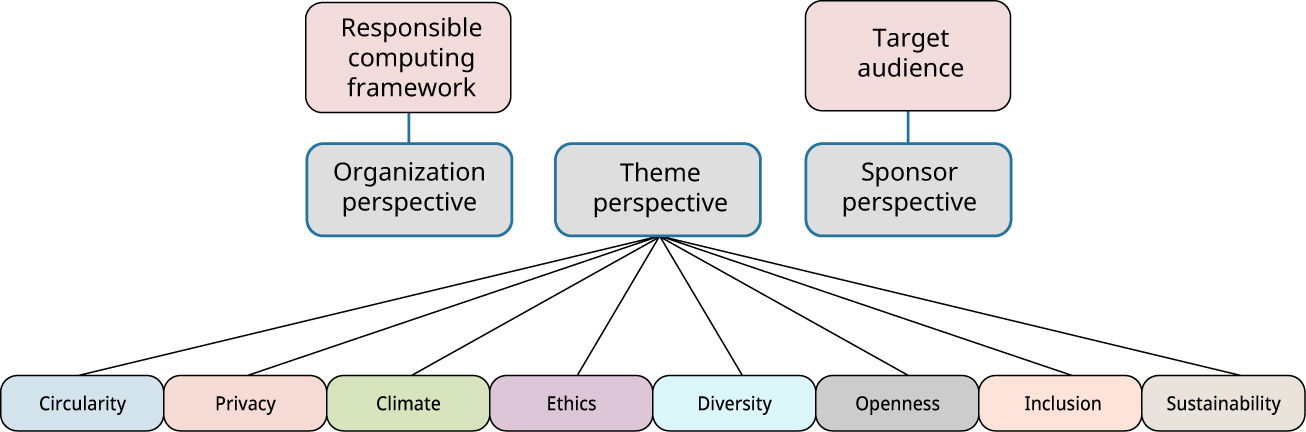
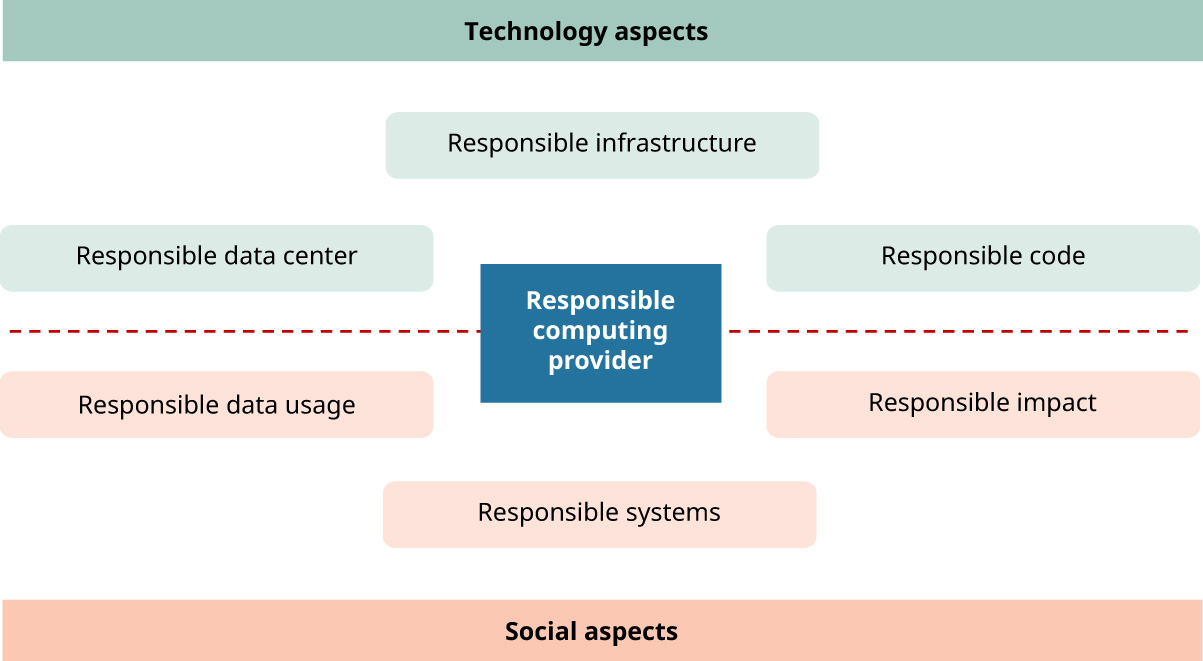
While optimizing the quality of cloud-based solutions, smart ecosystems, and supersociety solutions is proving to be quite difficult, these solutions are also opening the door to current and future challenges in computing including sustainability, ethics, and professionalism. This has led to the creation of the Responsible.Computing() movement as an IBM Academy of Technology (AoT) initiative in early 2020. Subsequently, in May 2022, the Object Management Group (OMG) created the Responsible.Computing() consortium with IBM and Dell as founding members. This led to the creation of the Responsible Computing Framework (Figure 14.2 and Figure 14.3).
英語のヒント
クラウドベースのソリューション、スマートエコシステム、超社会のソリューションの品質最適化は、かなり難しいと分かってきた。同時に、これらは持続可能性、倫理、専門職としての姿勢など、現在と将来のコンピューティングの課題への扉も開いている。これを受け、2020年初め、IBM Academy of Technology(AoT)の取り組みとしてResponsible.Computing()運動が生まれた。続いて2022年5月、Object Management Group(OMG)がIBMとDellを創設メンバーとしてResponsible.Computing()コンソーシアムを設立した。これが責任あるコンピューティングのフレームワークの作成につながった(図14.2、図14.3)。
attribution: Copyright Rice University, OpenStax, under CC BY 4.0 license · CC BY 4.0 · Source出典
Figure 14.2 The various perspectives of the responsible computing approach include organization, theme, and sponsor. (attribution: Copyright Rice University, OpenStax, under CC BY 4.0 license)
図14.2 責任あるコンピューティングの考え方には、組織、主題、支援者など、さまざまな観点がある。(帰属表示:著作権 Rice University、OpenStax、CC BY 4.0)
attribution: Copyright Rice University, OpenStax, under CC BY 4.0 license · CC BY 4.0 · Source出典
Figure 14.3 The Responsible Computing Framework helps organizations regulate the use of cyber resources to protect our current and future generations and the planet. (attribution: Copyright Rice University, OpenStax, under CC BY 4.0 license)
図14.3 責任あるコンピューティングのフレームワークは、現在と将来の世代、そして地球を守るため、サイバー資源の利用を組織が統制するのを助ける。(帰属表示:著作権 Rice University、OpenStax、CC BY 4.0)
Responsible computing is a comprehensive approach tackling present and future computing challenges. It emphasizes both systematic design and soft skills crucial in the industry. Developers are urged to anticipate potential harm from their work, emphasizing secure coding and adversarial systems development.
英語のヒント
責任あるコンピューティングは、現在と将来のコンピューティングの課題に取り組む包括的な方法である。体系的な設計と、業界で欠かせない対人能力などのソフトスキルの両方を重視する。開発者には、安全なコードの記述と敵対的な状況を考慮したシステム開発を重視し、自分の仕事が生みうる害を予測することが求められる。
These frameworks and styles target various enterprise business platforms. Traditional architectural styles like OMA and SOA are generic models that can be applied to the TOGAF. The OMA focuses on creating and assembling components that can be used for information systems, including interfaces. At the same time, the SOA relates to the assembly of services that can be applied to the TOGAF TRM. Understanding the difference between OMA and SOA is crucial, especially for cyber-quality resources. Newer platforms require updated models and the adoption of older models with modifications to fit system needs. This realization becomes more critical as cyber ecosystems continuously change.
英語のヒント
これらのフレームワークと様式は、各種の企業向け業務プラットフォームを対象とする。OMAやSOAのような従来のアーキテクチャー様式は、TOGAFに適用できる汎用モデルである。OMAは、インターフェースを含む、情報システムで使える構成要素を作り、組み立てることに重点を置く。それに対し、SOAはTOGAF TRMに適用できるサービスの組み立てに関わる。特にサイバー資源の品質を考える際、OMAとSOAの違いの理解は欠かせない。新しいプラットフォームには、更新されたモデルや、システムの必要に合うよう修正した古いモデルの採用が必要となる。サイバーエコシステムが変化し続けるにつれ、この認識は一層重要になる。
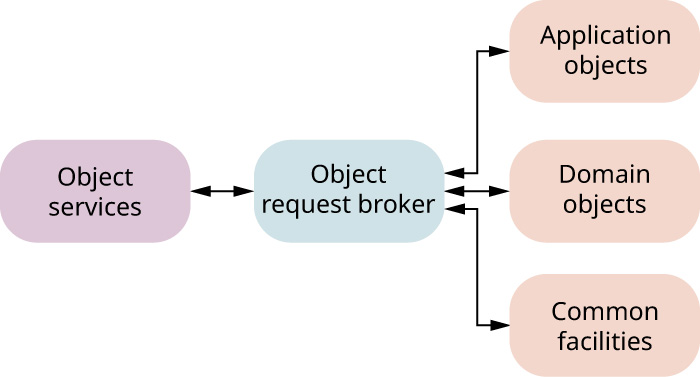
These architectural styles offer vision but are not core concepts of cyber resources. The OMA reference model (OMA-RM) (Figure 14.4) was developed in the 1990s to detail communications with object request brokers and different services. It visualized interfaces and services before the need to control and protect web interfaces.
これらのアーキテクチャー様式は将来像を示すが、サイバー資源の中核概念ではない。OMA参照モデル(OMA-RM)(図14.4)は、オブジェクトリクエストブローカーや各種サービスとの通信を詳しく示すため、1990年代に開発された。Webインターフェースを制御・保護する必要が生じる前に、インターフェースとサービスを可視化した。
attribution: Copyright Rice University, OpenStax, under CC BY 4.0 license · CC BY 4.0 · Source出典
Figure 14.4 This figure shows the OMA reference model developed in the 1990s to explain communications and interactions with object request brokers and different services. (attribution: Copyright Rice University, OpenStax, under CC BY 4.0 license)
図14.4 1990年代に開発され、オブジェクトリクエストブローカーや各種サービスとの通信・相互作用を説明する、OMA参照モデルを示す。(帰属表示:著作権 Rice University、OpenStax、CC BY 4.0)
Different architectural styles cater to various project managerial styles, such as the waterfall model and the Agile development style (refer to Chapter 9 Software Engineering). Each framework has its strengths and weaknesses, influencing the implementation and evaluation of cyber resource qualities, which significantly affects the information security policy. IT specialists must consider all cyber qualities, not just security. Best practices for quality and performance determine data storage methods, which can be automated to enhance cyber quality resources.
英語のヒント
異なるアーキテクチャー様式は、ウォーターフォールモデルやアジャイル開発など、さまざまなプロジェクト管理の様式に対応する(第9章「ソフトウェア工学」を参照)。各フレームワークには長所と短所があり、サイバー資源の品質特性の実装と評価に影響する。これは情報セキュリティーポリシーを大きく左右する。ITの専門家は、セキュリティーだけでなく、すべてのサイバー品質特性を考慮しなければならない。品質と性能の最善の慣行によってデータの保存方法が決まり、それを自動化してサイバー資源の品質を高めることもできる。