第3章近世アフリカと広域世界Early Modern Africa and the Wider World
3.4 The Trans-Saharan Slave Trade3.4 サハラ横断の奴隷交易
Learning Objectives学習の目標
By the end of this section, you will be able to:
この節を学ぶと、次のことができるようになる。
Describe the emergence of Kanem-Bornu as a major slave-trading society
カネム・ボルヌが主要な奴隷交易社会として台頭した過程を説明する。
Explain the effect of the arrival of Europeans on the trans-Saharan slave trade
ヨーロッパ人の到来がサハラ横断の奴隷交易に与えた影響を説明する。
Analyze how the slave trade affected the trans-Saharan trade network in West Africa
奴隷交易が西アフリカのサハラ交易網にどのような影響を与えたかを分析する。
The sale of enslaved people had been a constant feature of African trade since its earliest days, and over time it became a key component in the continent-spanning network. For some kingdoms, economic well-being depended on the traffic in human cargo. But this trade also required a near-constant state of warfare and conflict, which had the effect of destabilizing certain regions, particularly around the Central Sudan. Then the advent of Europe’s age of discovery and exploration in the fifteenth century transformed the nature of the slave trade in Africa. The wealth of Portugal, Spain, England, France, and the Netherlands—along with their firearms and manufactured goods—appealed to many West African polities, particularly those that emerged along the Gulf of Guinea and the Atlantic coast following the decline of Songhai. These new states, such as Whydah and Dahomey, enriched themselves by providing the Europeans with captives, the vast majority of whom went to the Americas, in exchange for goods like guns. These developments altered the nature of society in Africa, militarizing states and reorienting African trade.
英語のヒント
奴隷化された人々の売買は、アフリカ交易の最初期から一貫した特徴であり、やがて大陸全体をつなぐ交易網の重要な構成要素となった。一部の王国では、経済的な豊かさが、人間を積荷として取引することに依存した。しかしこの交易は、ほぼ絶え間のない戦争や紛争も必要とし、特に中央スーダン周辺など、いくつかの地域を不安定にした。15世紀、ヨーロッパに発見と探検の時代が到来すると、アフリカの奴隷交易の性質は変わった。ポルトガル、スペイン、イングランド、フランス、ネーデルラントの富、さらに火器や製品は、西アフリカの多くの国家、とりわけソンガイの衰退後にギニア湾岸と大西洋岸で成立した国家にとって魅力的だった。ウィダーやダホメなどの新興国は、捕虜をヨーロッパ人に供給し、銃などの品と引き換えることで富を築いた。捕虜の圧倒的多数はアメリカ大陸へ送られた。これらの変化は、国家の軍事化を進め、アフリカ交易の向きを変えることで、アフリカ社会のあり方を変えた。
The Role of Kanem-Bornuカネム・ボルヌの役割
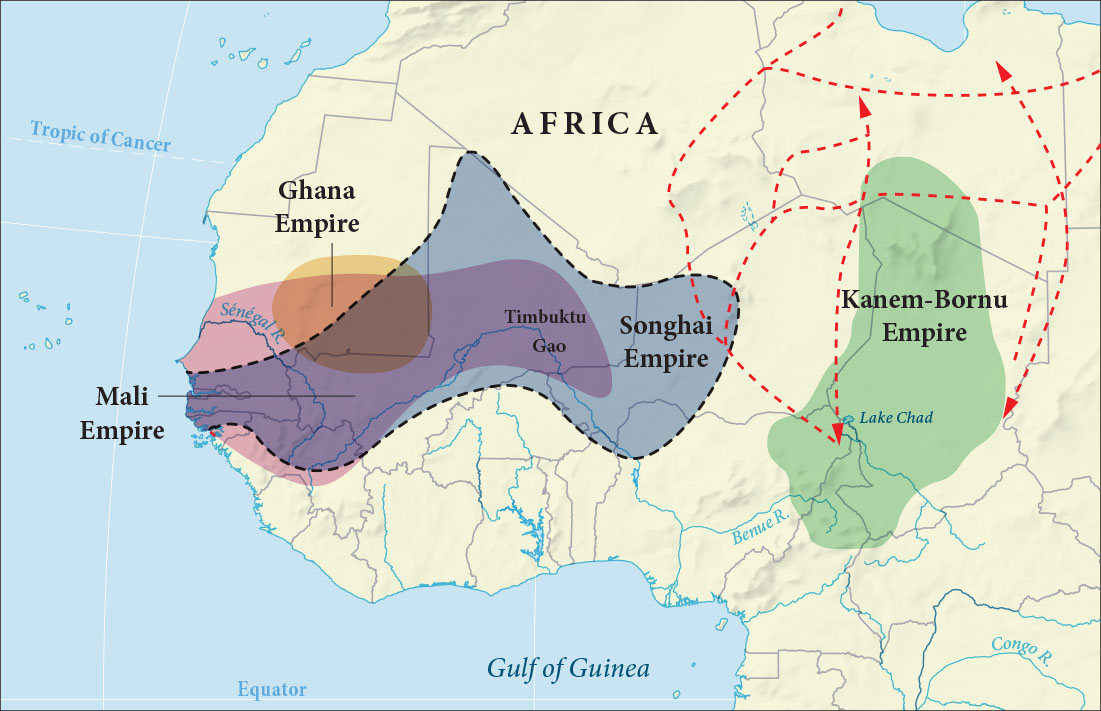
In about 900 CE, an empire called Kanem arose in the Central Sudan, located to the east of Ghana, Mali, and Songhai, and confined initially to the northeast of Lake Chad. The accession of Humai I to the throne of Kanem in 1087 marked the beginning of the Muslim Sefuwa dynasty. Around the same time, a fixed capital was established at Njimi, east of Lake Chad. Over the course of the next century and a half, the mais (kings) of Kanem established their control over the region. As in Ghana, the key to establishing and exercising this power was control over the desert caravan routes (Figure 3.20).
英語のヒント
西暦900年頃、ガーナ、マリ、ソンガイより東の中央スーダンに、カネムと呼ばれる帝国が興った。当初はチャド湖の北東部に限られていた。1087年のフマイ1世の即位は、ムスリムのセフワ朝の始まりとなった。同じ頃、チャド湖の東のンジミに定まった首都が置かれた。その後1世紀半をかけ、カネムのマイ、すなわち王たちは、この地域への支配を確立した。ガーナと同じく、その権力を築き行使する鍵は、砂漠の隊商路の支配だった(図3.20)。
Trans-Saharan Trade.サハラ縦断交易
(attribution: Copyright Rice University, OpenStax, under CC BY 4.0 license) · CC BY 4.0
Figure 3.20 Trans-Saharan trade routes (red dotted lines) were a key factor in the development of the Kanem-Bornu Empire, which resulted from the expansion of the Kanem Empire south into Bornu along the western shore of Lake Chad. (attribution: Copyright Rice University, OpenStax, under CC BY 4.0 license)
図3.20 サハラ交易路(赤い点線)は、カネム・ボルヌ帝国の発展にとって重要だった。この帝国は、カネム帝国が南へ拡大し、チャド湖西岸のボルヌに進出したことで成立した。(出典:Rice University、OpenStax。著作権者の許諾条件はCC BY 4.0)
It was under Dunama Dibbalemi in the thirteenth century that Kanem reached the height of its power and influence. Commanding a cavalry force of some forty thousand, Mai Dunama II gained control of the Lake Chad basin and extended the state’s control over the trans-Saharan trade northward as far as the Fezzan (southern Libya). Before the end of his reign, he established diplomatic relations with the kings of North Africa, especially in Tunis, thus ensuring the safety of caravans journeying to the distant south from the Mediterranean coast. This achievement guaranteed an increase in cross-Saharan traffic.
英語のヒント
カネムが権力と影響力の頂点に達したのは、13世紀のドゥナマ・ディバレミのもとだった。ドゥナマ2世は約4万人の騎兵を率い、チャド湖流域を支配し、国家によるサハラ交易の統制を、北のフェザーン、現在のリビア南部まで広げた。治世の終わりまでに、北アフリカ、特にチュニスの王たちと外交関係を結び、地中海岸からはるか南へ旅する隊商の安全を確保した。この成果は、サハラを越える往来の増加を確実にした。
Although the Kanuri, the people of Kanem, mainly exported ivory and ostrich feathers, they also specialized in the selling of captives to the Muslims of North Africa and later to Europeans, notably the Portuguese who paid in guns and horses. The raids that produced these captives were justified in the name of jihad or holy war against unbelievers, a practice that led to conflict between Kanem and its neighbors.
英語のヒント
カネムの人々、すなわちカヌリ人は、おもに象牙とダチョウの羽を輸出したが、北アフリカのムスリム、そして後にはヨーロッパ人への捕虜の売買にも特化していた。特にポルトガル人は、銃や馬で代価を支払った。捕虜を得るための襲撃は、非信徒に対するジハード、すなわち聖戦の名で正当化され、カネムと近隣勢力の争いを招いた。
By the mid-thirteenth century, Kanem dominated the Central Sudan. The empire extended as far west as the Niger River, as far east as the Wadai Sultanate (in eastern Chad), and north to the Sahara Desert. Crowning the Kanuris’ achievement during this period was the establishment of a tributary state in Bornu, southwest of Lake Chad. Over the course of the next century, however, Kanem became overstretched and weakened by wars and quarrels over succession, notably between the ruling Muslim Sefuwa dynasty, its sons, and the non-Muslim Bulala pastoralists east of Lake Chad.
英語のヒント
13世紀半ばまでに、カネムは中央スーダンを支配していた。帝国は、西はニジェール川、東はチャド東部のワダイ・スルタン国、北はサハラ砂漠まで広がった。この時代のカヌリ人の業績を締めくくったのは、チャド湖の南西、ボルヌに朝貢国を築いたことだった。しかし次の世紀、カネムは拡大しすぎ、戦争と継承争いによって弱まった。特に、支配するムスリムのセフワ朝、その王子たち、チャド湖の東に住む非ムスリムの牧畜民ブララ人との争いが大きかった。
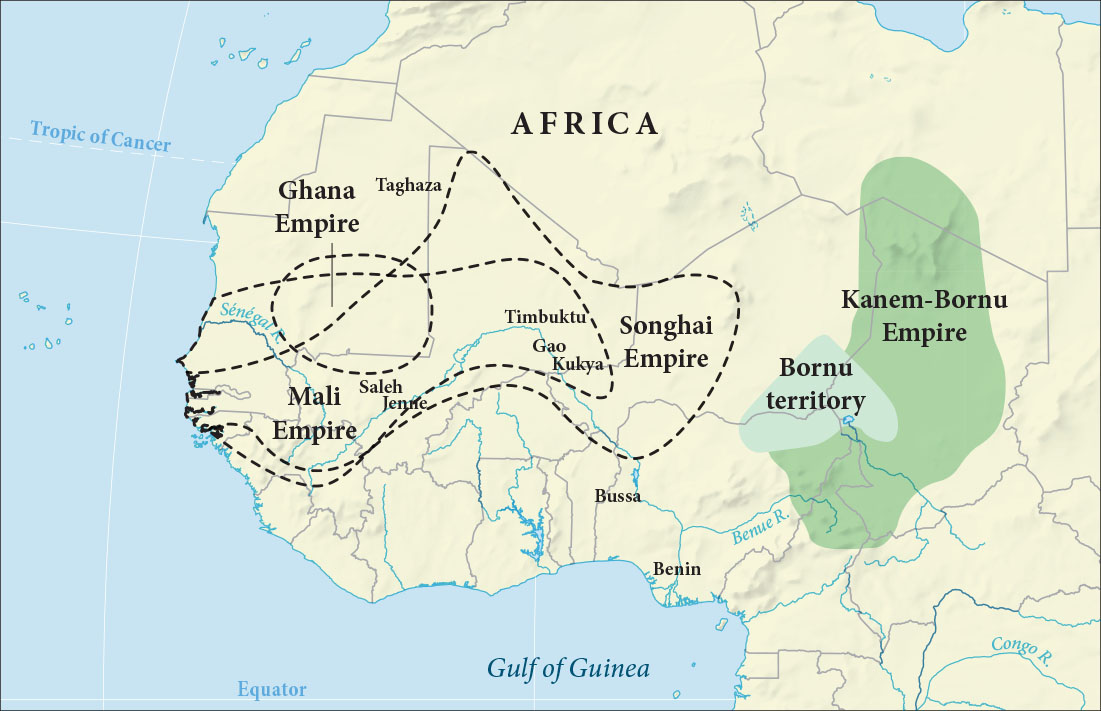
Between 1376 and 1400, the rebellious Bulala, who opposed the imposition of strict Islamic rule under the Sefuwa, managed to assassinate five of the six Sefuwa kings. The result of this strife was a destabilized empire, which forced Mai Umar ibn Idris to abandon the capital at Njimi altogether. He led many of the empire’s Kanuri to Bornu, in the savanna region on the western shore of Lake Chad, where they permanently settled (Figure 3.21). Bornu was better situated to give the kings of the Sefuwa dynasty access to a wider trading network, and it already had established vital trading links with the Hausa kingdoms to the west.
英語のヒント
1376~1400年、セフワ朝による厳格なイスラーム統治の強制に反対するブララ人は、反乱を起こし、6人のセフワ朝君主のうち5人を暗殺した。この争乱は帝国を不安定にし、マイ・ウマル・イブン・イドリースは、首都ンジミを完全に放棄せざるをえなくなった。彼は帝国の多くのカヌリ人を率い、チャド湖西岸のサバンナ地域ボルヌへ移り、そこに定住した(図3.21)。ボルヌは、セフワ朝の王たちがより広い交易網に接するうえで有利な位置にあり、すでに西のハウサ諸王国との重要な交易関係も確立していた。
Kanem-Bornu.カネム・ボルヌ
(attribution: Copyright Rice University, OpenStax, under CC BY 4.0 license) · CC BY 4.0
Figure 3.21 The kingdom of Kanem-Bornu was less a kingdom than the conjoining of two city-states, Kanem and Bornu. The longest-lived of all the African kingdoms, Kanem-Bornu depended primarily on trade in the enslaved, whom it acquired by raiding neighboring states. (attribution: Copyright Rice University, OpenStax, under CC BY 4.0 license)
図3.21 カネム・ボルヌは、一つの王国というよりも、カネムとボルヌという二つの都市国家の結合であった。アフリカ諸王国の中で最も長く存続し、その経済はおもに、近隣諸国を襲って得た人々を奴隷として取引することに依存した。(出典:Rice University、OpenStax。著作権者の許諾条件はCC BY 4.0)
The early decades of the sixteenth century witnessed a revitalization of the Sefuwa dynasty. Under Mai Idris Katakarmabe, who ruled from 1507 to 1529, the Sefuwa were able to defeat the Bulala. The Sefuwa also strengthened their grip on the people of Bornu as they entrenched their rule, prompting a series of internal revolts by the non-Muslim peasant population that they ruthlessly suppressed. The dynasty established firm control over the peasants of Bornu who, once they submitted to Islam, were no longer subjected to raids.
英語のヒント
16世紀初めの数十年間に、セフワ朝は再び活力を得た。1507~1529年に統治したマイ・イドリース・カタカルマベのもと、セフワ朝はブララ人を破ることができた。また、支配を確固たるものにするにつれ、ボルヌの人々への統制も強化した。そのため非ムスリム農民の間で内乱が相次いだが、王朝は容赦なく鎮圧した。こうしてボルヌの農民への確実な支配を築いた。農民はイスラームに従うようになると、それ以上は襲撃の対象とされなくなった。
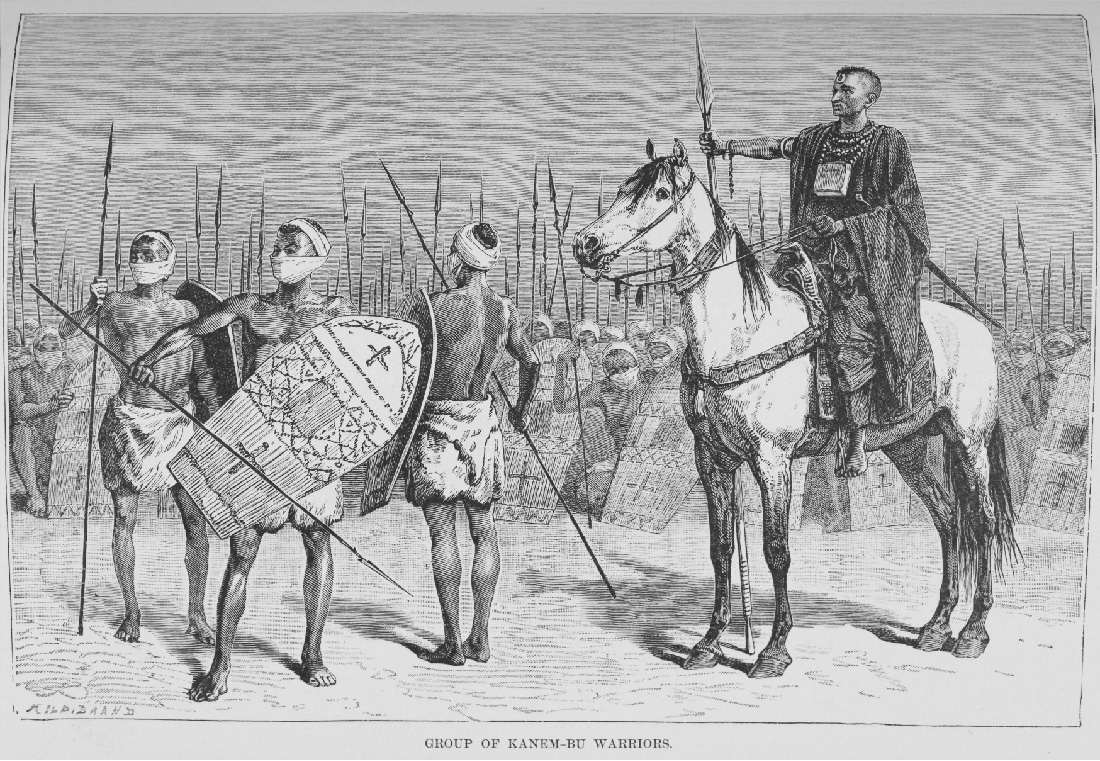
The prosperity of Kanem-Bornu was tied to the trans-Saharan trade in enslaved people destined for the markets of North Africa and the Atlantic coast. By the end of the fifteenth century, Kanem-Bornu was trading about five thousand captives annually. During the second half of the sixteenth century, Mai Idris Aloma strengthened his army by importing firearms from North Africa. While the Songhai army failed to modernize, the rulers of Kanem-Bornu established strong relations with the Ottoman Empire in North Africa and gained access to Turkish mercenaries and advisers, who were brought in to train their new army (Figure 3.22). These changes, combined with the empire’s position on the frontier of Islam in Central Sudan, enabled it to make deeper slave-raiding incursions against its non-Muslim neighbors.
英語のヒント
カネム・ボルヌの繁栄は、北アフリカと大西洋岸の市場へ送られる人々の、サハラ横断の奴隷交易に結びついていた。15世紀末までに、年間約5,000人の捕虜を取引していた。16世紀後半、マイ・イドリース・アロマは北アフリカから火器を輸入し、軍を強化した。ソンガイ軍が近代化に失敗したのに対し、カネム・ボルヌの支配者は北アフリカのオスマン帝国と強い関係を結んだ。そこからトルコ人の傭兵や顧問を招き、新たな軍の訓練に当たらせた(図3.22)。これらの変化と、中央スーダンのイスラーム圏の境界に位置することが合わさり、カネム・ボルヌは、非ムスリムの近隣社会のさらに奥へ奴隷狩りの侵入を行えるようになった。
The Military Might of Kanem-Bornu.カネム・ボルヌの軍事力
(credit: “Group of Kanem-Bu warriors” by New York Public Library Digital Gallery/Wikimedia Commons, Public Domain) · Public Domain
Figure 3.22 Kanem warriors in the sixteenth century routinely raided nearby communities in Central Sudan to capture prisoners they sold to European slave traders. This image comes from The Earth and Its Inhabitants, published in Europe in the 1890s. (credit: “Group of Kanem-Bu warriors” by New York Public Library Digital Gallery/Wikimedia Commons, Public Domain)
図3.22 16世紀のカネムの戦士は中央スーダンの近隣共同体を日常的に襲い、ヨーロッパの奴隷商人に売る捕虜を捕らえた。この図は、1890年代にヨーロッパで刊行された『地球とその住民』から採られた。(出典:New York Public Library Digital Gallery/Wikimedia Commons「Group of Kanem-Bu warriors」、パブリックドメイン)
Kanem-Bornu peaked under Aloma, whose administrative and military reforms survived to sustain the empire for more than one hundred years. By the end of the sixteenth century, however, the empire’s power had begun to fade. A century later, the state’s capacity to maintain its territorial integrity had diminished so severely that the king’s rule extended effectively only westward, into Hausaland (present-day northern Nigeria). In the space of a hundred years, Fulani from West Africa had made significant inroads against Bornu, and in 1808, they seized the capital of Ngazargamu. The last Sefuwa king was killed in 1846, but Africa’s longest-lived empire managed to continue under new rulers until nearly the end of the nineteenth century.
英語のヒント
カネム・ボルヌはアロマのもとで最盛期を迎えた。彼の行政・軍事改革はその後も続き、100年以上にわたって帝国を支えた。しかし16世紀末までに、帝国の力は衰え始めていた。1世紀後には、領土を一体として維持する能力が大きく低下し、王の支配が実効的に及ぶのは西のハウサ地方、現在のナイジェリア北部だけとなった。100年の間に、西アフリカのフラニ人はボルヌに対して大きく進出し、1808年には首都ンガザルガムを占領した。最後のセフワ朝の王は1846年に殺された。しかしアフリカで最も長く続いた帝国は、新しい支配者のもとで、19世紀の終わり近くまで存続した。