第3章近世アフリカと広域世界Early Modern Africa and the Wider World
The Later Trans-Saharan Slave Tradeその後のサハラ横断奴隷交易
Africa was transformed during the eighteenth century. This period witnessed the emergence of expansionist new states in West Africa, such as Dahomey and Segou, whose wars of conquest generated captives for European slavers. It also saw a sharp rise in conflict between African states and related growth in the trade in enslaved captives. Such growth came at the expense of the historical trans-Saharan trade network, which was disrupted and reoriented to prioritize the traffic in captive human cargo destined for coastal slave markets. While the overall numbers varied by location, the general trend was an increase in the number of captives being moved along the trans-Saharan corridors during the eighteenth century. This trade did more than benefit merchants; in many instances, it provided a boon to businesses and firms related to the slave trade that were located at trans-Saharan trading centers. The societies as a whole did not benefit, however, nor did the people who were enslaved. As a result of this altered state of affairs, the scope of the trans-Saharan trade in enslaved people doubled between the seventeenth and eighteenth centuries to an estimated 900,000 enslaved people.
英語のヒント
18世紀のアフリカは大きく変貌した。西アフリカにはダホメやセグーなど、領土拡張を進める新しい国家が台頭し、その征服戦争がヨーロッパの奴隷商人へ供給する捕虜を生み出した。アフリカ諸国間の争いは急増し、それに伴って、奴隷化された捕虜の売買も拡大した。この拡大は従来のサハラ交易網を犠牲にした。交易網は混乱し、沿岸の奴隷市場に送る捕虜という人間の積荷の輸送を優先する方向へ組み替えられた。規模は場所によって違ったが、18世紀にはサハラの交通路を移動する捕虜の数が増えるのが一般的な傾向だった。利益を得たのは商人だけではない。多くの場合、サハラの交易拠点にある、奴隷売買に関連する事業や企業も恩恵を受けた。しかし、社会全体も、奴隷にされた人々も、利益を得たわけではなかった。こうした状況の変化によって、サハラを横断する奴隷取引の人数は17世紀から18世紀にかけて倍増し、推計90万人に達した。
The development of the trading state of Whydah provides a unique window into these dynamics. Situated in the Bight of Benin on the Gulf of Guinea, along what came to be called the Slave Coast, Whydah was transformed with the arrival of the Europeans in West Africa in the fifteenth century (Figure 3.23). By the seventeenth century, the French West India Company had moved its main trading site to Whydah, making it one of the region’s most important slave ports, second only to Luanda in Angola. By the end of the century, the Dutch West India Company, the English Royal African Company, and the Portuguese all had moved their slave markets to Whydah. Several of these European powers went on to establish coastal trading forts there. Between 1650 and 1690, the number of captives brought to Whydah in caravans increased dramatically, from about one thousand people per year to about ten thousand. It is estimated that in the quarter-century between 1700 and 1725, fully a third of all captives coming from Africa—approximately 378,000 of them—were taken out of Whydah.
英語のヒント
交易国家ウィダーの発展は、こうした動きをよく示す事例である。ギニア湾のベニン湾、のちに「奴隷海岸」と呼ばれた地域に位置するウィダーは、15世紀のヨーロッパ人の到来で大きく変わった(図3.23)。17世紀までにフランス西インド会社が主要な交易拠点を移し、ウィダーはアンゴラのルアンダに次ぐ、この地域でも特に重要な奴隷貿易港となった。世紀末までに、オランダ西インド会社、イングランドの王立アフリカ会社、ポルトガルも、それぞれの奴隷市場をウィダーへ移した。いくつかのヨーロッパ勢力は、さらに沿岸交易要塞を築いた。1650~1690年に、隊商でウィダーへ連れてこられる捕虜は、年およそ1,000人から1万人へと激増した。1700~1725年の四半世紀には、アフリカから運び出された捕虜全体の実に3分の1、約37万8,000人がウィダーから出航したと推計される。
Crowning a King on the Slave Coast.奴隷海岸の王の戴冠
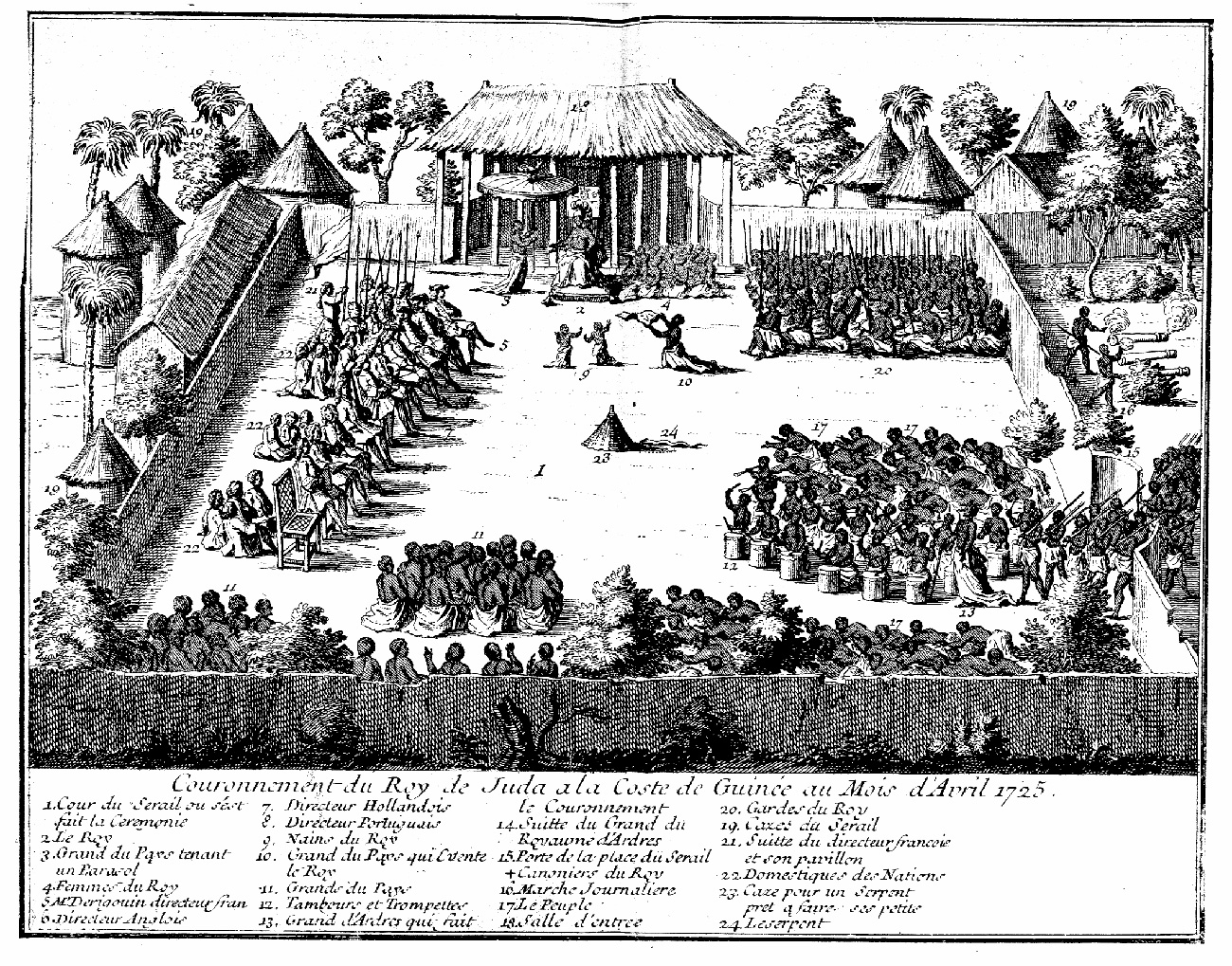
(credit: “Coronation ceremony for the King of Whydah” by Gallica/Wikimedia Commons, Public Domain) · Public Domain
Figure 3.23 The kings of Whydah had a very close relationship with the European slavers who established trading centers along the Gulf of Guinea. In this French etching from about 1725, a new king is crowned before an audience that includes Europeans. (credit: “Coronation ceremony for the King of Whydah” by Gallica/Wikimedia Commons, Public Domain)
図3.23 ウィダーの王たちは、ギニア湾岸に交易拠点を設けたヨーロッパの奴隷商人と、非常に密接な関係にあった。1725年頃のフランスのこのエッチングでは、ヨーロッパ人を含む人々の前で、新しい王が戴冠している。(出典:Gallica/Wikimedia Commons「Coronation ceremony for the King of Whydah」、パブリックドメイン)
Whydah’s flourishing trade in enslaved people did not result from wars waged by its own rulers, but from its location at the end point of trade routes between battling factions. One route originated from the former Mali Empire. Some captives from there wore Muslim clothing and had been in transit for three months before arriving in Whydah. Another route originated in the Yoruba kingdom of Oyo, which was engaged in a series of wars against the neighboring kingdoms of Nupe and Borgu. The value of enslaved captives passing through Whydah was enormous, and the slave trade benefited both the African slave merchants and the state, which was entitled to customs duties and taxes. From providing porterage services to supplying food and other necessities that made the trade possible, local businesses also profited from the sale of enslaved people. As elsewhere, the transport and sale of captives into slavery produced a profitable economy for virtually everyone involved, except for the enslaved people.
英語のヒント
ウィダーの奴隷売買が栄えたのは、自国の支配者が行う戦争によるのではなく、争う勢力の間を結ぶ交易路の終点に位置していたためである。ある経路は旧マリ帝国を起点とし、そこから来た捕虜の中には、ムスリムの衣服を着て、ウィダー到着まで3か月も移動していた人がいた。別の経路は、隣国ヌペとボルグとの一連の戦争を進める、ヨルバ人のオヨ王国から延びていた。ウィダーを通過する奴隷化された捕虜の価値は莫大で、奴隷交易はアフリカの奴隷商人と、関税や税を徴収する権利を持つ国家の双方を潤した。荷物運びから食料や必需品の供給まで、交易を可能にする地元の事業者も、人々の売買から利益を得た。ほかの場所と同じく、捕虜を運んで奴隷として売ることは、奴隷化された人々を除き、関わったほぼすべての者に利益をもたらす経済を生み出した。
In 1727, King Agaja of Dahomey conquered the kingdom of Whydah and incorporated it into his own (Figure 3.24). The fall of Whydah was part of a larger campaign by Agaja to restore traditional social and political controls over the region, which was then home to several smaller Aja kingdoms including Dahomey. By 1737, Agaja had conquered the entire Slave Coast and brought it under Dahomey’s control. However, initially Dahomey was reluctant to continue the practice of selling Africans to Europeans. This was not to the liking of the kingdom of Oyo, whose foreign trade depended on it. By the middle of the century, near-constant warfare against Oyo, which disrupted interior trade routes and hurt both kingdoms economically, convinced the rulers of Dahomey to abandon their reluctance. They opted instead to exercise strict royal control over the Slave Coast trade. Dahomey went on to become one of the major exporters of enslaved captives, which the state traded in exchange for firearms. By the end of the century, Dahomey had become one of the most heavily armed and militarized states in West Africa.
英語のヒント
1727年、ダホメのアガジャ王はウィダー王国を征服し、自国に組み入れた(図3.24)。ウィダーの陥落は、伝統的な社会的・政治的統制をこの地域に取り戻そうとする、アガジャのより大きな軍事行動の一部だった。当時この地域には、ダホメを含む、いくつかの小さなアジャ人の王国があった。1737年までにアガジャは奴隷海岸全体を征服し、ダホメの支配下に置いた。しかしダホメは当初、アフリカ人をヨーロッパ人へ売る慣行を続けることに消極的だった。これは、その売買に対外交易を依存していたオヨ王国の意向に沿わなかった。世紀半ばまでには、オヨとのほぼ絶え間ない戦争が内陸交易路を混乱させ、両国の経済を損なったため、ダホメの支配者はためらいを捨てるに至った。その代わり、奴隷海岸の交易に王権の厳格な統制を及ぼす道を選んだ。ダホメはやがて、捕虜を火器と交換して輸出する主要国の一つになった。世紀末には、西アフリカで最も重武装し、軍事化した国家の一つとなっていた。
The Slave Coast.奴隷海岸
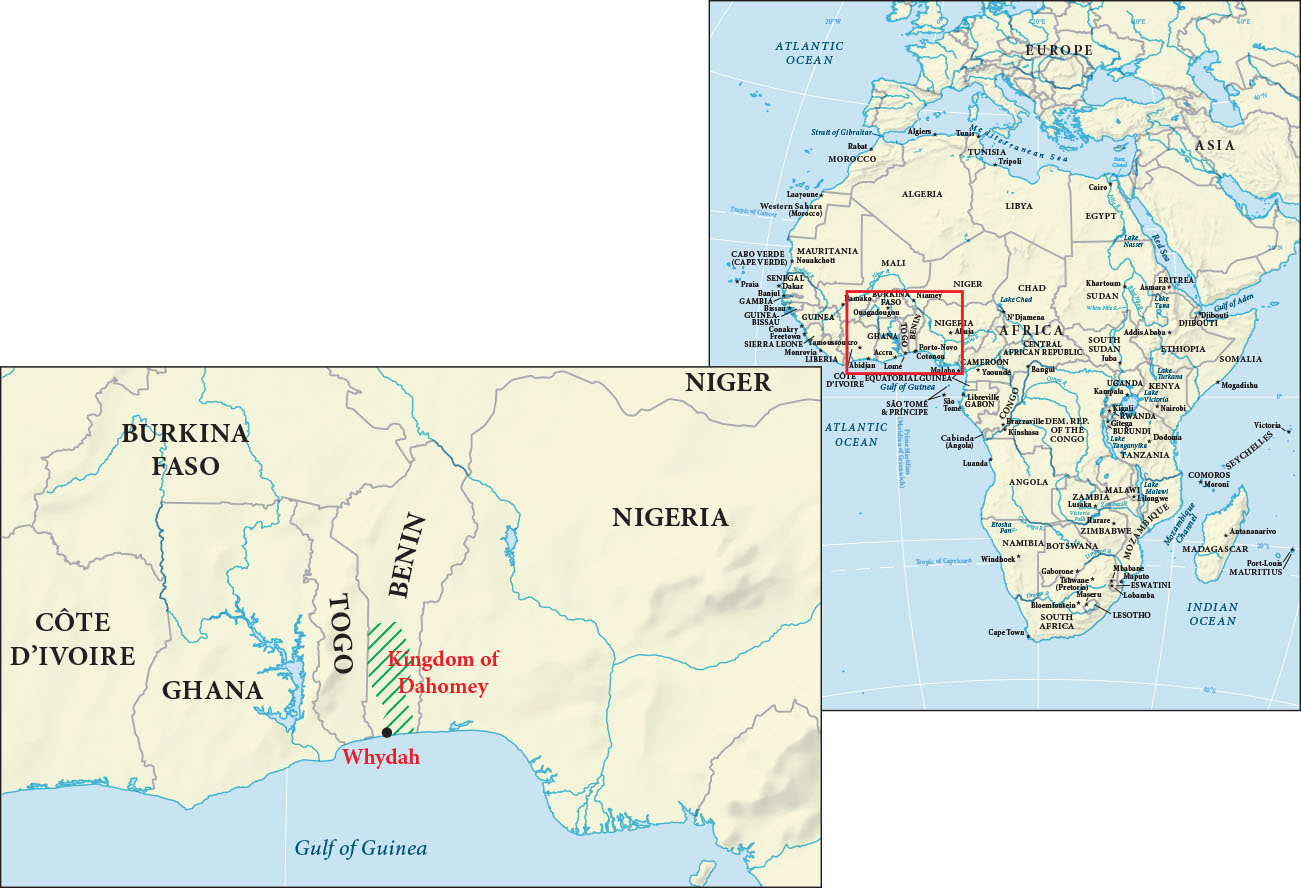
(attribution: Copyright Rice University, OpenStax, under CC BY 4.0 license) · CC BY 4.0
Figure 3.24 New states like Whydah and Dahomey emerged along the Gulf of Guinea coast in the eighteenth century. These states were formed primarily as a result of the European slave trade, which is why this coastal region was known as the Slave Coast. (attribution: Copyright Rice University, OpenStax, under CC BY 4.0 license)
図3.24 18世紀、ギニア湾岸にはウィダーやダホメのような新しい国家が台頭した。おもにヨーロッパの奴隷交易の結果として形成されたため、この沿岸地域は「奴隷海岸」と呼ばれた。(出典:Rice University、OpenStax。著作権者の許諾条件はCC BY 4.0)
As Agaja and his successors extended their control over the Gulf of Guinea, the frontier of the slave trade on the West African coast was pushed deeper into the African interior, beyond the kingdoms that ranged along the Senegambia. It is estimated that well over half the captives taken and sold during the eighteenth century came from the far interior, many from the Kingdom of Segou, located southwest of Djenné on the Middle Niger in Mali.
英語のヒント
アガジャと後継者たちがギニア湾への支配を広げるにつれ、西アフリカ沿岸の奴隷交易が捕虜を得る範囲は、セネガンビア沿いの王国を越え、アフリカ内陸のさらに奥へ押し広げられた。18世紀に捕らえられ売られた人々の半数を大きく超える人数が、遠方の内陸から来たと推計される。その多くは、現在のマリ、ニジェール川中流域のジェンネの南西に位置したセグー王国から来た。
Founded by Mamari Kulubali in 1712, Segou made warfare a way of life. The Segou kingdom’s economy was trade based, and its essential trade good was enslaved people the state acquired through raiding and warfare waged against its neighbors. These incursions reached as far as north as the Niger Bend and Timbuktu, which the Segou briefly occupied. Once captured, those seized by the Segou military faced two possible fates: they could be sold to desert nomads as part of the trans-Saharan slave trade, or they could be sold to caravan merchants who dealt with European slave traders on the Slave Coast.
英語のヒント
1712年にママリ・クリバリが創建したセグーは、戦争を常態とする国となった。経済の基礎は交易であり、欠かせない商品は、近隣への襲撃と戦争を通じて国家が得る奴隷化された人々だった。こうした侵入は北のニジェール川の大湾曲部やトンブクトゥにまで及び、セグーはトンブクトゥを一時占領した。捕らえられた人々には、二つの運命がありえた。サハラ横断の奴隷交易の一部として砂漠の遊牧民に売られるか、奴隷海岸でヨーロッパの奴隷商人と取引する隊商商人に売られるかである。
Although perhaps most pronounced in West Africa, the altered dynamics of trans-Saharan trade in enslaved people in the eighteenth century were also apparent in North Africa. Scholars have estimated that the Maghreb, encompassing Morocco, Algeria, Tunisia, and Libya, received an average of six thousand enslaved Africans every year between 1700 and 1799. About fourteen hundred enslaved people a year passed through Ghadames and the oases center of the Fezzan in Libya, both historically vital to the trans-Saharan trade between Central Sudan and Tripoli. But by midcentury, these centers—also the destination points for some caravans from West African trade centers such as Timbuktu—were sending larger caravans of captives to the markets at Tripoli. By the end of the eighteenth century, the numbers of the enslaved bound for market along the Mediterranean coast had increased by as much as a quarter, making the trade in enslaved Africans through Tripoli a key component of the region’s economy.
英語のヒント
18世紀のサハラ横断奴隷交易の変化は、西アフリカでおそらく最も顕著だったが、北アフリカでも明らかだった。研究者の推計では、モロッコ、アルジェリア、チュニジア、リビアからなるマグリブには、1700~1799年に年平均6,000人の奴隷化されたアフリカ人が入った。ガダメスとリビアのフェザーンのオアシス中心地を、年間およそ1,400人が通過した。両方とも、中央スーダンとトリポリを結ぶサハラ交易で、歴史的に重要な場所だった。しかし世紀半ばまでに、トンブクトゥなど西アフリカの交易拠点からの隊商も到着するこれらの中心地は、より大きな捕虜の隊商をトリポリの市場へ送るようになった。18世紀末までに、地中海岸の市場へ向かう奴隷の人数は最大で4分の1ほど増え、トリポリ経由のアフリカ人奴隷交易は、地域経済の主要な構成要素となった。