第3章近世アフリカと広域世界Early Modern Africa and the Wider World
The Spread of Islamイスラームの拡大
The Arab conquests of North Africa and the gradual advance of Islam into West Africa from the eighth century did much to unify what had been largely regional trade into a truly cross-desert system of commerce. The spread and adoption of Islam by nomads, such as the Tuareg and Sanhaja of the Niger region, helped expand the networks of exchange. Shared values and rules established by Islamic tradition and law engendered a sense of mutual trust and respect among devout Muslim traders and caravanners. African traders and merchants recognized other benefits of conversion beyond the spiritual, which included guarantees afforded by contract law that was based on Islamic law and made possible by widespread Arabic literacy. They also enjoyed the extension of credit and promissory notes between multiple parties, who were all investors in a caravan, and an increasingly extensive information network in which oasis towns acted as centers of communication and exchange.
英語のヒント
アラブ人による北アフリカ征服と、8世紀以降のイスラームの西アフリカへの漸進的な進出は、それまでおおむね地域ごとに分かれていた交易を、本格的な砂漠横断の商業体系へ統合するうえで大きな役割を果たした。ニジェール地方のトゥアレグ人やサンハジャ人などの遊牧民にイスラームが広がり、受け入れられたことで、交換の網は拡大した。イスラームの伝統と法に基づく共通の価値観や規則は、敬虔なムスリム商人や隊商の人々の間に、相互の信頼と尊敬を生んだ。アフリカの交易者や商人は、信仰上の意味を超えた改宗の利点にも気づいた。その一つは、イスラーム法に基づく契約法による保障であり、それを可能にしたのはアラビア語の読み書きの普及だった。また、隊商へ共同出資する複数の人々の間で、信用供与や約束手形を利用できることも利点となった。さらに、オアシス都市を連絡と交換の中心とする、ますます広い情報網も利用できた。
Africans may also have been led to convert to Islam by other factors. A significant motivation was likely the harsh terms the conquering Muslims imposed on non-Muslims, which included exorbitant taxation as well as demands for hundreds (according to some sources, thousands) of enslaved people. These people, the majority of whom were probably Amazigh, were then shipped to markets in Damascus or Baghdad to be sold or transported onward to other market towns in the east. Since Islamic law forbade the enslavement of fellow Muslims, countless Amazigh people decided to convert to avoid being taken captive.
英語のヒント
アフリカの人々をイスラームへの改宗に向かわせた要因は、ほかにもあったかもしれない。重要な動機だったと考えられるのは、征服したムスリムが非ムスリムに課した苛酷な条件である。そこには法外な課税に加え、数百人、史料によっては数千人もの奴隷化された人々を差し出す要求も含まれていた。こうして連行された人の大部分は、おそらくアマジグ人だった。彼らはダマスクスやバグダードの市場へ送られて売られるか、さらに東の市場都市へと運ばれた。イスラーム法は同じムスリムを奴隷にすることを禁じたため、無数のアマジグ人が、捕らえられるのを避けるために改宗を決めた。
Once Islam reached the savanna south of the Sahara, ruling African elites adopted it, and in some cases they blended it with their traditional beliefs, a process called syncretism. Muslims, who could read and write Arabic script, were sought after as administrators by rulers whose languages did not have their own alphabets. The tendency of non-Muslim kingdoms to employ Muslim merchant-scholars as advisers and scribes (as, for example, in the kingdom of Ghana) in turn helped raise the profile of Islam among Africans and further encouraged conversion.
英語のヒント
イスラームがサハラ以南のサバンナに達すると、アフリカの支配層はそれを受け入れ、ときには伝統的な信仰と混ぜ合わせた。このような過程は宗教混交と呼ばれる。アラビア文字を読み書きできるムスリムは、自分たちの言語に独自の文字を持たない支配者から、行政官として求められた。たとえばガーナ王国のような非ムスリムの王国が、ムスリムの商人兼学者を顧問や書記として雇う傾向は、今度はアフリカの人々の間でイスラームの存在感を高め、改宗をさらに促した。
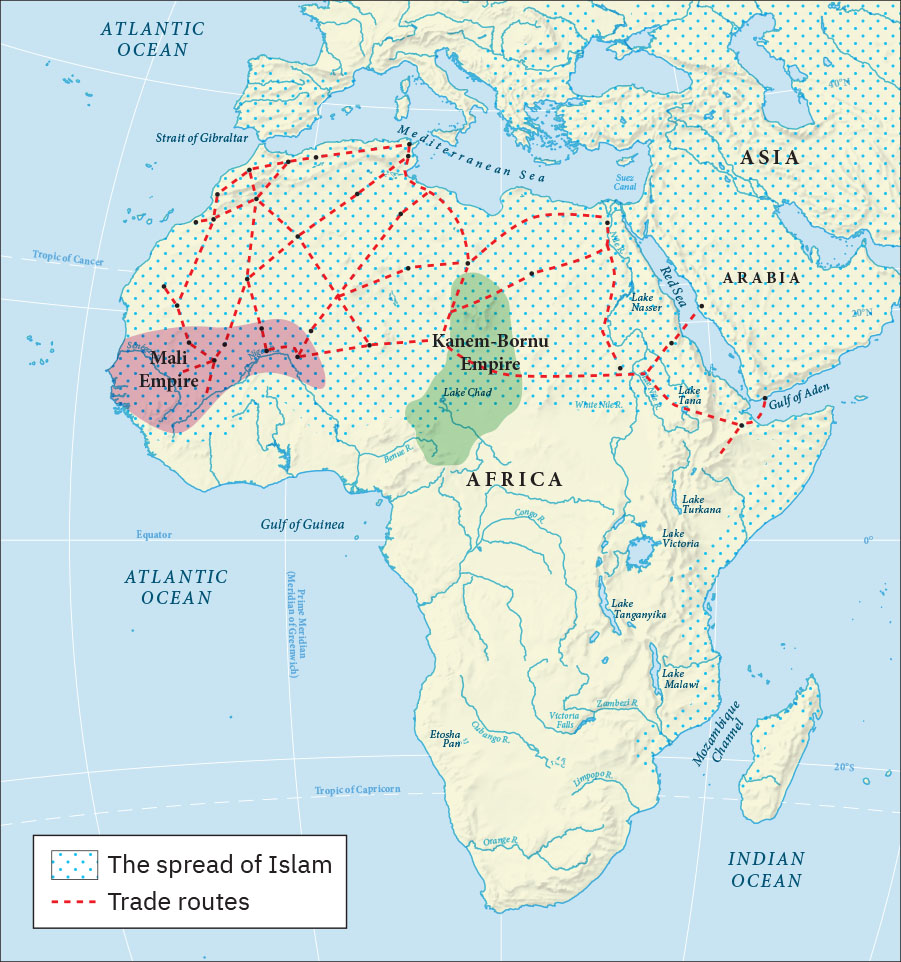
As commerce expanded, Islam gradually spread along the trans-Saharan trade routes and created a network of believers who trusted each other, thanks to a common language—Arabic—and shared values, traditions, and customs such as regular daily prayer. These shared social bonds and trust allowed trade to increase among peoples at some considerable distance who were otherwise unknown to one another. Another social interaction crucial to the widespread diffusion of Islam was intermarriage between Muslim traders and local women, who raised their children as Muslims. By the thirteenth century, Islam had spread into the region of Lake Chad and the Kingdom of Kanem by way of trans-Saharan trade (Figure 3.7).
英語のヒント
商業が拡大すると、イスラームはサハラ交易路に沿って徐々に広がり、信徒同士が信頼し合う網を作り出した。その基礎となったのは共通言語のアラビア語と、日々の定められた礼拝など、共有する価値観、伝統、慣習であった。このような社会的な結びつきと信頼によって、かなり遠く離れ、ほかに接点のない人々の間でも交易が増えた。イスラームの広い伝播に決定的に重要だったもう一つの社会的交流は、ムスリム商人と地元の女性との結婚である。女性たちは子どもをムスリムとして育てた。13世紀までに、イスラームはサハラ交易を通じてチャド湖周辺とカネム王国へ広がっていた(図3.7)。
The Spread of Islam.イスラームの広がり
(attribution: Copyright Rice University, OpenStax, under CC BY 4.0 license) · CC BY 4.0
Figure 3.7 By the fourteenth century, Islam had spread throughout North and West Africa, including Kanem-Bornu (green area), and had become the state religion in the kingdom of Mali (pink area) and, in time, in Songhai, Mali’s successor. (attribution: Copyright Rice University, OpenStax, under CC BY 4.0 license)
図3.7 14世紀までに、イスラームはカネム・ボルヌ(緑の部分)を含む北アフリカと西アフリカ全域へ広がった。マリ王国(ピンクの部分)では国教となり、やがてマリの後継国ソンガイでも国教となった。(出典:Rice University、OpenStax。著作権者の許諾条件はCC BY 4.0)
The Mali Empireマリ帝国
Larger political entities emerged in Sudanic West Africa, beginning with the Mali Empire in the early thirteenth century. Around 1235, Sundiata Keita, the founder of Mali, set about consolidating his control over the heartland of the Mande people, a region centered on the well-watered grasslands of the upper reaches of the Senegal and Niger Rivers. Sundiata convinced the other Malinke (also known as Mandinke) kings to surrender their title, mansa (which means “ruler” in the Malinke language), to him. He thus became the sole mansa, the religious and secular leader of all the Malinke people.
英語のヒント
西アフリカのスーダン地域では、13世紀初頭のマリ帝国を皮切りに、より大きな政治的まとまりが出現した。1235年頃、マリの創始者スンジャタ・ケイタは、セネガル川とニジェール川の上流にある、水に恵まれた草原を中心とするマンデ人の核心地域への支配を固め始めた。スンジャタは、ほかのマリンケ人(マンディンカ人とも呼ばれる)の王たちを説得し、マリンケ語で「支配者」を意味する称号マンサを自分に譲らせた。こうして彼は、すべてのマリンケ人の宗教的・世俗的な指導者である、唯一のマンサとなった。
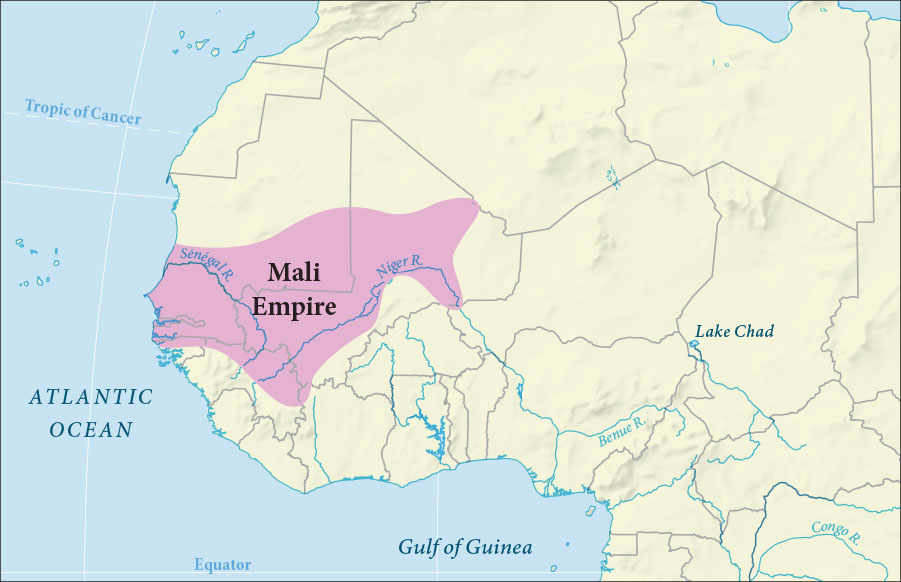
Sundiata then moved to expand the Mali kingdom by taking control of all the Soninke peoples (Figure 3.8). This territory took in much of the former kingdom of Ghana and its nominally independent peripheral vassal states, including Mema and Wagadu. These newly conquered territories were often administered indirectly, leaving in place friendly puppet regimes to do the bidding of the Malian monarch, a political strategy that bred resentment among certain of the Malian vassal states, including Takrur and Songhai. In a few short years, the empire extended from the forested margins of the southwest through the grassland savanna country of the Malinke and the southern Soninke to the Sahel of former Ghana. The kings of Mali were less interested in conquering the various small kingdoms and chiefdoms of the grasslands than in taking the trading towns of the Sahel that linked the regional economy to the vast trans-Saharan trade. These towns were key prizes to the Malian monarchs and included Djenné, Timbuktu, and Gao. Throughout history, economic considerations have often driven political decisions, like conquering neighboring people, made by rulers on all continents.
英語のヒント
続いてスンジャタは、ソニンケ人全体を支配下に入れ、マリ王国を拡張しようとした(図3.8)。この領域には、かつてのガーナ王国の大部分と、メマ、ワガドゥなど、周辺の名目上は独立した従属国が含まれた。新たに征服した領域は間接統治されることが多く、マリ王の命令に従う友好的な傀儡政権をそのまま残した。この政治的な手法は、タクルールやソンガイなど一部の従属国の反感を育てた。わずか数年で帝国は、南西部の森林の縁から、マリンケ人と南部ソニンケ人の住む草原サバンナを経て、旧ガーナのサヘルにまで広がった。マリの王たちがより関心を寄せたのは、草原のさまざまな小王国や首長領を征服することよりも、地域経済を巨大なサハラ交易へ結ぶサヘルの交易都市を獲得することであった。ジェンネ、トンブクトゥ、ガオなどは、マリの君主にとって重要な獲得目標だった。歴史を通して、どの大陸でも、支配者が近隣の人々を征服するなどの政治的な判断を下す背景には、しばしば経済的な考慮があった。
The Mali Empire.マリ帝国
(attribution: Copyright Rice University, OpenStax, under CC BY 4.0 license) · CC BY 4.0
Figure 3.8 The Mali Empire reached its maximum geographic extent in the fourteenth century, stretching from the mouth of the Senegal River in the west to the borders of present-day Algeria and Niger in the east, encompassing some 478,000 square miles and about four hundred cities. (attribution: Copyright Rice University, OpenStax, under CC BY 4.0 license)
図3.8 マリ帝国は14世紀に最大の領域に達した。西はセネガル川河口から、東は現在のアルジェリアとニジェールの境界付近まで広がり、約47万8,000平方マイルと、およそ400の都市を擁した。(出典:Rice University、OpenStax。著作権者の許諾条件はCC BY 4.0)
When Sundiata’s successors converted to Islam, Mali became the largest Islamic kingdom in West Africa. Although its heartland was the Niger floodplain, Mali’s capital Niani was located at the Bure goldfields, enabling its rulers to exert direct control over the most valuable of all the raw materials transported along the trans-Saharan trade routes. Mali’s fabulous wealth made it famous, and its rulers used that wealth to attract scholars and jurists from all over the Islamic world. For example, Mali’s most famous ruler, the fourteenth-century Mansa Musa, transformed the trading center of Timbuktu by establishing mosques and schools there that became repositories of Islamic scholarship and learning.
英語のヒント
スンジャタの後継者たちがイスラームへ改宗すると、マリは西アフリカ最大のイスラーム王国となった。その核心地域はニジェール川の氾濫原であったが、首都ニアニはブーレの金産地に位置し、支配者はサハラ交易路を通って運ばれる原料のうち、最も価値の高いものを直接支配できた。マリは莫大な富で名を知られ、支配者たちはその富を用いて、イスラーム世界の各地から学者や法学者を招いた。たとえば最も有名なマリの君主、14世紀のマンサ・ムーサは、交易拠点トンブクトゥにモスクや学校を設け、都市を変貌させた。それらはイスラームの学問と知識の集積地となった。
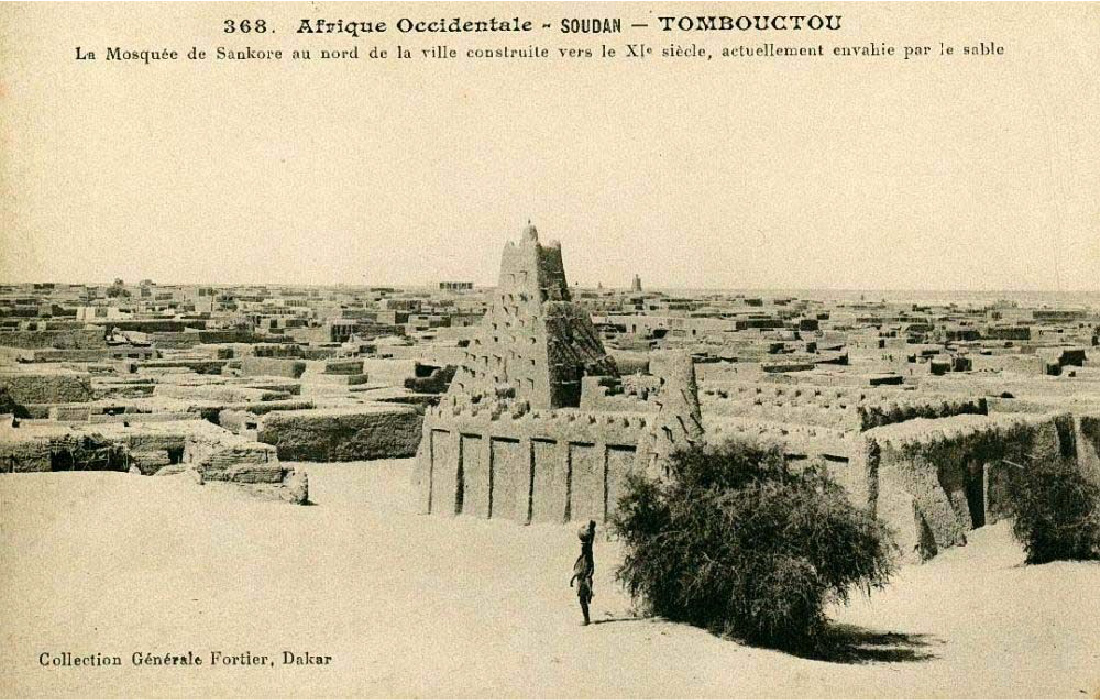
Trans-Saharan commerce also promoted the development of public works in Mali, including the building of social and religious structures. Travelers to West Africa were impressed by the palaces, walled cities, and mosques they saw there and often remarked on them. In the sixteenth century, Leo Africanus, a formerly enslaved Amazigh diplomat and writer (born al-Hasan ibn Muhammad al-Wazzan), visited Songhai and praised the fine architecture of the city of Timbuktu, particularly the walled palace of the king and the temple of “stone and mortar” that dominated the center of the city. While these buildings awed many visitors, none were quite as striking as Timbuktu’s mosques. With its sunbaked brick walls and spiky pyramidal shape, for example, the Sankore mosque presented onlookers with a unique example of West African architecture at this time (Figure 3.9).
英語のヒント
サハラ交易は、マリでの公共事業の発展も促した。そこには社会生活や宗教のための建物の建設も含まれる。西アフリカを訪れた旅人は、目にした宮殿、城壁都市、モスクに感銘を受け、しばしばそのことを書き留めた。16世紀、かつて奴隷にされた経験を持つアマジグ人の外交官・著述家レオ・アフリカヌス(生名アル=ハサン・イブン・ムハンマド・アル=ワッザーン)はソンガイを訪れ、トンブクトゥの優れた建築を称えた。とりわけ城壁で囲まれた王宮と、都市の中心にそびえる「石とモルタル」の寺院を称賛した。これらの建物は多くの来訪者を圧倒したが、トンブクトゥのモスクほど印象的なものはなかった。たとえばサンコレ・モスクは、日干しれんがの壁と、とがったピラミッドの形によって、この時代の西アフリカ建築に固有の姿を見せていた(図3.9)。
The Sankore Mosque.サンコレ・モスク
(credit: “Fortier 368 Timbuktu Sankore Mosque” by Dogon/Wikimedia Commons, Public Domain) · Public Domain
Figure 3.9 The fourteenth-century Sankore mosque, shown in this postcard from about 1905, was one of the leading centers of Islamic learning and scholarship in Timbuktu. It is also an example of Sudanese West Africa’s unique architectural style and has long dominated the city’s skyline. (credit: “Fortier 368 Timbuktu Sankore Mosque” by Dogon/Wikimedia Commons, Public Domain)
図3.9 1905年頃のこの絵はがきに写る14世紀のサンコレ・モスクは、トンブクトゥを代表するイスラームの学問と教育の拠点の一つだった。また、西アフリカのスーダン地域に独特な建築様式の例であり、長く街の景観にそびえてきた。(出典:Dogon/Wikimedia Commons「Fortier 368 Timbuktu Sankore Mosque」、パブリックドメイン)
The fortunes of the Mali Empire were transformed in the fifteenth century, when a host of internal and external challenges combined to fatally undermine the Sudanic kingdom, including rebellions, dynastic disputes, the rise of powerful new neighbors, and the arrival of the Portuguese. These factors, which are explained next, had the effect of weakening Mali economically and politically, setting it up for instability and collapse.
英語のヒント
15世紀、マリ帝国の命運は一変した。反乱、王位をめぐる争い、強力な新しい近隣勢力の台頭、ポルトガル人の到来など、内外の多くの難題が重なり、このスーダンの王国を致命的に弱体化させたからである。以下で説明するこれらの要因は、マリを経済的にも政治的にも弱め、不安定化と崩壊へ向かわせた。
The successors of Mansa Musa, who died circa 1337, tended to be weaker and less influential than their famous predecessor. During the brief reign of his son, Mansa Maghan, Timbuktu was raided and burned by the Mossi, a people who lived to the south of the Niger bend. Although the Malians returned to the city and ruled it for another hundred years, the Mossi raid demonstrated to others that the empire had been diminished. Later, Tuareg nomads raided and caused havoc. They occupied and governed Timbuktu for the next forty years.
英語のヒント
1337年頃に没したマンサ・ムーサの後継者たちは、有名な先代よりも弱く、影響力も乏しい傾向にあった。息子マンサ・マガンの短い治世中、ニジェール川の大湾曲部の南に住むモシ人がトンブクトゥを襲撃し、焼き払った。マリの人々は町に戻り、その後さらに100年間支配したが、モシ人の襲撃は、帝国が弱まったことを周囲に示した。のちにはトゥアレグ遊牧民が襲って甚大な被害を与えた。彼らはトンブクトゥを占領し、その後40年間統治した。
The attacks by the Mossi and Tuareg squeezed the enfeebled Malian Empire from the north and east. These raids were followed by rebellions in towns, signaling a more dramatic shift in the region’s geopolitics whereby many of the empire’s most important cities sought to break free of Malian rule. Between 1374 and 1387, uprisings occurred in the salt-producing center of Takedda and in the major trading center of Gao. While Mansa Musa II managed to subdue the Tuareg rebellion at Takedda, he was unable to control the Songhai of Gao, who asserted their independence from Mali. By the 1430s, Mali had lost control not only of Timbuktu but also of vassal kingdoms such as Mema to the north, and critical trading towns such as Djenné had also regained their independence.
英語のヒント
モシ人とトゥアレグ人の攻撃は、弱体化したマリ帝国を北と東から圧迫した。これらの襲撃に続いて都市で反乱が起こり、地域の地政学には、さらに大きな変化が現れた。帝国の特に重要な都市の多くが、マリの支配からの離脱を目指したのである。1374~1387年には、塩の生産拠点タケッダと、大きな交易拠点ガオで蜂起が起きた。マンサ・ムーサ2世はタケッダでのトゥアレグ人の反乱を鎮圧できたが、ガオのソンガイ人を抑えることはできず、彼らはマリからの独立を宣言した。1430年代までに、マリはトンブクトゥだけでなく、北のメマのような従属王国への支配も失った。ジェンネのような重要な交易都市も、独立を取り戻した。
As a result of weak rulers, rebellions, and attacks by the Mossi and Tuareg, the trading towns and routes on which the mansas depended for their wealth and power were gradually being stripped away from the Malian Empire when the arrival of the Portuguese in the fifteenth century complicated matters. The first Portuguese slave raids in West Africa took place on the Senegambian coast, the Atlantic coastline of Senegal and the Gambia in West Africa, in 1444. Initially, the raids caught Malian vassal territories off guard, but they soon recovered and effectively resisted further European encroachment. In 1462, the Portuguese were forced to negotiate a peace treaty, which limited them to trading along the Senegambian coast. This new, direct trade between a European power and Mande merchants along the coast was the first of several steps that ultimately rerouted much commerce away from the trans-Saharan trade routes of the West African interior.
英語のヒント
弱い支配者、反乱、モシ人とトゥアレグ人の攻撃によって、マンサたちが富と権力を頼っていた交易都市と交易路は、徐々にマリ帝国から奪われていた。そのさなか、15世紀のポルトガル人の到来が事態をさらに複雑にした。西アフリカで最初のポルトガル人による奴隷狩りは1444年、セネガルとガンビアの大西洋岸、セネガンビア海岸で起きた。当初、襲撃はマリの従属領の不意を突いたが、現地側はまもなく立ち直り、ヨーロッパ人によるそれ以上の侵入を効果的に防いだ。1462年、ポルトガル人は和平条約の交渉を余儀なくされ、活動をセネガンビア沿岸の交易に限定された。ヨーロッパの一国と沿岸のマンデ商人との間に生まれたこの新たな直接交易は、最終的に大量の商業活動を、西アフリカ内陸のサハラ交易路から別の経路へ移す、いくつかの段階の最初のものとなった。
As the European threat gradually faded, pressure mounted on the Mali Empire’s eastern and northern frontiers. There, the emergent Songhai Empire under the leadership of Sunni Ali was expanding, and in a series of conquests, it managed to annex the former Malian territory of Mema (1465), capture Timbuktu (1468), and seize Djenné (1473). By the end of the century, nearly all the lands the Mali Empire once ruled had been lost. What remained was little more than the Mande-speaking heartland and surrounding grassland. Mali continued in this diminished state until the late seventeenth century, by which time most non-Malinke people had asserted their independence and reverted to rule by individual mansas.
英語のヒント
ヨーロッパ人の脅威が次第に薄れる一方で、マリ帝国の東と北の国境では圧力が強まった。そこではスンニ・アリに率いられた新興ソンガイ帝国が拡大し、一連の征服で、旧マリ領メマの併合(1465年)、トンブクトゥの占領(1468年)、ジェンネの奪取(1473年)を果たした。世紀末までに、マリ帝国がかつて治めた土地は、ほぼすべて失われていた。残ったのは、マンデ語を話す人々の核心地域と周辺の草原にほとんど限られた。マリはこの縮小した状態で17世紀末まで存続したが、その時点までに、マリンケ人以外の集団の大部分が独立を宣言し、それぞれのマンサによる統治へ戻っていた。